@IONIC_RE subsidiary @IONICTECH_UK has welcomed a visit from UK Industry Minister @ChrisMcDonaldMP to the company's magnet recycling plant in Belfast amid an increasing UK focus on securing sovereign rare earths supply. Read more: https://t.co/sPiltd6nlX
IXR Recycling Has Global Appeal
♻️ IONIC RARE EARTHS $IXR — "Recycling Has Global Appeal" 🌍
MST Access reiterates a A$2.55/share valuation (vs ~A$0.36 now) on the back of THREE hard catalysts for the Belfast magnet-recycling plant. This is the ex-China magnet supply chain going from PowerPoint to proven. 👇
🚗 1. FORD DURABILITY TEST — PASSED ✅
The Western hemisphere's first end-to-end recycled-REE EV motor magnet supply chain, start to finish:
🔹 Ionic Technologies → high-purity recycled Nd/Dy/Tb oxides (>99.5%)
🔹 Less Common Metals → metal + strip alloy
🔹 GKN Powder Metallurgy → sintered NdFeB to Ford spec
🔹 Ford → rotor built + durability-tested at Dunton, UK
Result: the recycled-magnet rotor performed EQUIVALENT to one built from primary mined material. Customer-side validation from a brutally demanding qualifier. 🏁
⚡ 2. NTH CYCLE MOU — CHINA DEPENDENCY OUT OF THE FLOWSHEET
IXR + US-based Nth Cycle signed a Joint Development & Licensing Agreement to slot Nth Cycle's electro-extraction ("the Oyster") into Belfast from 4QCY26.
🔹 Replaces the oxalic-acid precipitation step — a China-sourced reagent that's ~50% of IXR's product carbon footprint
🔹 Uses electricity instead of chemical reagent; regenerates hydrochloric acid for re-use
🔹 Lower opex, lower carbon (already ~60% below primary supply), fewer China inputs 🇨🇳❌
🛡️ 3. FIRST DEFENCE-LINKED BINDING SALE — AML
IXR signed a binding sale of separated NdPr oxide + Dy oxide to US-based Advanced Magnet Lab (AML), feeding AML's US$2m US Defense Logistics Agency (DLA) contract qualifying US-made sintered NdFeB magnets for defence hardware (drone motors, missile guidance).
A non-binding MOU adds a closed-loop swarf-return arrangement. First time IXR's product is qualified into a defence end-use at the magnet level. 🎯
💰 BELFAST ECONOMICS (FS, Nov 2024)
🔹 400tpa plant (2×200tpa lines) — 350tpa NdPr, 37tpa Dy, 13tpa Tb oxide
🔹 £85m capex · post-tax NPV US$502m · IRR ~44% · 2.4yr payback
🔹 £12m UK Gov Offer-in-Principle grant (~14% of capex)
🔹 FID targeted 2HCY26 → production CY2028
📊 CONFIRMED vs INFERENCE
✅ Confirmed (per report): Ford test result, Nth Cycle JD&L Agreement, binding AML sale + DLA contract, all Belfast FS figures, £12m grant.
⚠️ Analyst estimate / not confirmed fact: the A$2.55 target is MST Access's DCF (100% risk-weight Belfast, 33% Makuutu, US$120/kg long-run NdPr).
⚠️ It's a broker valuation — NOT a guaranteed price. Funding for the £85m plant is not yet secured (key risk flagged in the report).
📚 Source: MST Access, "Recycling Has Global Appeal" (Ionic Rare Earths, https://t.co/7NJsD19jr8, 02 Jul 2026) — full report: 👇
https://t.co/UYexwLatTD
👀 Watching to see whether IXR converts the Ford validation + defence offtake into secured non-dilutive funding and a 2HCY26 FID — the catalyst that de-risks the whole valuation.
@IONIC_RE@IONICTECH_UK@CMA_Minerals@ChrisMcDonaldMP@biztradegovuk
#RareEarths #REE #MagnetRecycling #IXR #IonicRareEarths #CriticalMinerals #NdFeB #Ford #NthCycle #DefenceTech #ExChina #CircularEconomy #ASX
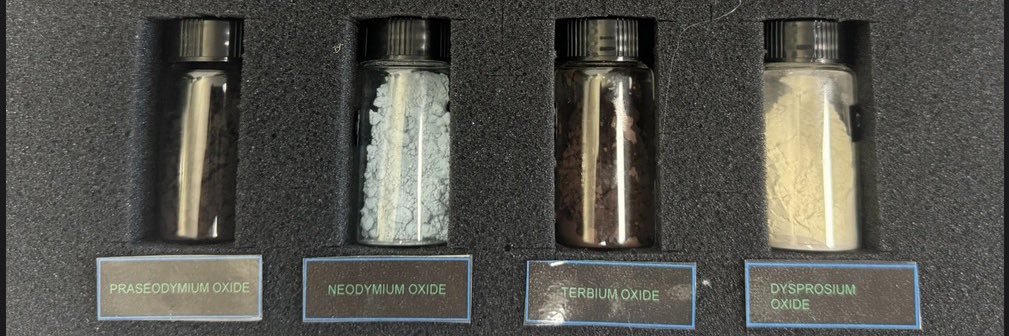
🇺🇸🧲 This is what a real ex-China magnet supply chain starting to form looks like. In the image: AML’s “NdPr and Dy starter kit” from Ionic Rare Earths / Ionic Technologies — the building blocks for high-performance NdFeB magnets.
AML is developing 100% U.S.-made high-grade sintered NdFeB magnets under a $2M Defense Logistics Agency contract, and IXR is now supplying the separated NdPr and Dy oxides to help make that happen.
📝 The IXR-AML deal, in detail:
On May 25, 2026, IonicRE signed binding sales agreements to supply NdPr oxide and Dy2O3 to AML, feeding directly into the DLA qualification program.
Alongside the sales deal, the two companies signed a non-binding MOU to go deeper — collaborating on long-term REO supply and on recycling magnet swarf and pre-consumer manufacturing scrap back into separated oxides.
That’s a closed-loop model: AML’s own production waste gets recycled by IonicRE and fed straight back into magnet-grade oxide supply. 🔄
---
⚙️ Why AML specifically:
AML manufactures magnets using its proprietary PM-Wire platform, designed for scalable, traceable, high-performance U.S. magnet production — precisely the kind of qualified, defense-grade supply chain the Pentagon has been chasing since China’s 2025 export restriction.
Their MD Wade Senti called it “just the tip of the iceberg,” pointing to almost five more major supply chain partnerships in the works to rebuild rare earth magnet capability across the Western hemisphere.
---
🌍 The bigger pattern:
This isn’t IXR’s only downstream tie-up. The same Belfast-processed oxides have already gone to:
🇧🇷 Brazil — via the Viridion JV, delivering Nd/Pr/Dy/Tb oxides to CIT SENAI, Latin America’s only magnet factory
🇺🇸 Florida — AML, under DLA contract, for U.S. defense-qualified magnets
🇬🇧 UK — HyProMag and Less Common Metals, building the domestic magnet chain
One Belfast recycler. Three continents. One shared problem: breaking China’s grip on separated heavy rare earth oxides. 🎯
---
@IONIC_RE@IONICTECH_UK@wsenti
#RareEarths #IonicRareEarths #IXR #AML #AdvancedMagnetLab #NdFeB #Dysprosium #NeodymiumPraseodymium #CriticalMinerals #DefenseSupplyChain #DLA #MagnetRecycling #SupplyChainSecurity #USDefense #RareEarthMagnets #MadeInUSA #SovereignSupply #Deysprosium #HeavyRareEarths #MagnetToMetal #CircularEconomy #ASXIXR $IXR
Ionic Rare Earths Nears Belfast Investment Decision as Ford Validation Marks Major Milestone
@CruxInvestor interview with @IONIC_RE MD @timhorizonmet highlights IXR's latest advances towards a commercial rare earth magnet recycling plant in Belfast: https://t.co/3N6rnVSNU6
@IONIC_RE was among the ASX's top 50 resource gainers for May, posting a 24% gain according to @StockheadAU amid an increasing focus on securing ex-China rare earth supply chains:
https://t.co/MArvtho2ZC
🚨 Massive breakthrough for Western critical mineral supply chain resilience! 🌍
Ionic Rare Earths $IXR Ionic Technologies, has successfully proven its long-loop recycling technology, producing high-purity, individually separated magnet rare earth oxides from pre-consumer scrap and spent NdFeB magnets.
⚗️The demonstration program, utilizing Rare Earths Separation technology, Multifunctional Amide Ionic Liquids IP developed at Queen’s University Belfast, successfully partnered with Less Common Metals, GKN, and Ford UK.
The result? Finished NdFeB magnets that perform exactly like those manufactured from mined material. ♻️🧲
As highlighted in the latest edition of Australia's Paydirt June 2026, Page 60 & Page 61—produced by Paydirt Media, a premier voice and longstanding institution in the Australian mining sector—this is a pivotal moment.
The successful production of solid, separated magnet REOs proves that we can build robust, independent Western supply chains capable of meeting the most demanding technical applications. 🛡️⚡
Next up: Securing the remaining equity for the £85 million, 400 mtpa commercial plant in Belfast, alongside the continued development of the Mukuutu project in Uganda.
📖 Read the full feature in the latest Paydirt magazine: https://t.co/EXWrjBeKqA
📰 Learn more about Paydirt Media's coverage of Australian Mining: https://t.co/V6rLVVL3rw
@IONIC_RE@IONICTECH_UK@LCM_Metals@forduk@Ford@Paydirt_Media #GKN
#IXR #RareEarths #CriticalMinerals #SupplyChainResilience #MagnetRecycling #AustralianMining #NdFeB #CleanEnergy #PaydirtMedia
🏭 IONIC RARE EARTHS' BELFAST MAGNET RECYCLING PLANT — FULLY EXPLAINED
One of the few operating facilities outside China producing individually separated rare earth oxides from recycled magnets.
Here's everything — the tech, the economics, the feedstock, the US opportunity. 🧵👇
Source: Discovery Alert — Muflih Hidayat, 22 June 2026👇
https://t.co/RLmoUUgb8e
1. Why This Moment Is Structural
🌏 THIS ISN'T A TEMPORARY DISRUPTION. IT'S A PERMANENT SPLIT.
China's export controls on heavy rare earths triggered a repricing event that exposed just how fragile Western supply security had become:
📈 Dysprosium + Terbium — 6–7x pre-restriction prices in non-Chinese markets
📈 Yttrium — reportedly >100x in select markets
These aren't temporary dislocations.
They reflect a structural bifurcation of global rare earth supply chains into Chinese and non-Chinese streams — now being cemented by geopolitical momentum on both sides.
The window for first-mover advantage in Western rare earth recycling is finite. ⏳
2. Why Separation Is So Hard
🔬 THE SEPARATION CHALLENGE — WHY SO FEW CAN DO THIS
Rare earth elements are chemically similar to each other. Separating them into individual high-purity oxides isn't just extraction — it's isolating each element to 99.9%+ purity from a mixed input stream with multiple elements in varying concentrations.
This is precisely why so few Western operators have achieved it.
Rare earth separation has historically been concentrated in China where:
🔒 Decades of accumulated process knowledge
🔒 Deeply integrated vertical infrastructure
🔒 Barriers that capital alone cannot easily replicate
What Belfast has done is crack that problem — outside China. For the first time.
3. The Process Flow
⚗️ FROM MAGNET WASTE → 99.9%+ PURE INDIVIDUAL OXIDES
The Ionic Technologies process:
Step 1 — Feed collection
Manufacturing swarf + end-of-life permanent magnets from motors, drives and applications
Step 2 — Upstream alloy preparation
Proprietary processing converts alloy feed into a form ready for chemical separation
*(This step alone is a distinct layer of IP)*
Step 3 — Hydrometallurgical separation
Chemical isolation of individual rare earth elements from each other
Reagent consumption validated against stoichiometric modelling at Belfast demo plant
Step 4 — Separated oxide outputs
✅ Dysprosium oxide (Dy₂O₃)
✅ Terbium oxide (Tb₄O₇)
✅ NdPr oxide
✅ Holmium, Gadolinium, Yttrium
All at 99.9%+ purity — individually separated, not blended
⚠️ A blended output does not meet magnet manufacturer or defence requirements. Individual separation is non-negotiable.
4. The Swarf Insight
♻️ SWARF — THE MOST OVERLOOKED FEEDSTOCK IN RARE EARTHS
Everyone talks about recycling end-of-life EV magnets. That's the future.
But the near-term base load feedstock? Manufacturing swarf.
🪚 When block magnets are machined into final shapes — round, arc-shaped, non-rectangular — cutting waste is generated constantly.
The material loss equation:
For every 100 units of REO entering magnet production:
Only 60–75 units exit as finished magnets
→ 25–40% becomes recoverable swarf per production cycle
Swarf advantages:
✅ Continuous — generated in direct proportion to current magnet output
✅ Predictable — not dependent on product retirement timelines
✅ Co-location friendly — process near the magnet manufacturer, cut logistics costs
✅ Creates integrated supplier-customer loop — manufacturer provides feed AND receives recovered oxides
As US magnet manufacturing capacity comes online, swarf volumes scale immediately. 📈
5. The Demo Plant
🏗️ BELFAST DEMONSTRATION PLANT — CURRENT STATUS
Current output is acknowledged as insufficient to meet inbound demand — reflecting the severity of the heavy REE supply shortage in non-Chinese markets.
What has been proven over ~4 years of operation:
✅ Reagent consumption confirmed stoichiometrically — high confidence in cost modelling
✅ Feed composition flexibility across variable alloy specs from different manufacturers
✅ Commercial sales of separated oxides actively occurring
✅ Ford motor supply chain validation — first recycler globally to achieve this
✅ US defence supply chain entry via Advanced Magnet Laboratories
6. The IP Moat
🔒 THE COMPETITIVE MOAT — TWO LAYERS OF IP
Layer 1 — Core heavy REE separation chemistry
Developed in partnership with Queen's University Belfast
Patent protected
Layer 2 — Upstream alloy feed processing
Proprietary preparation of alloy feed before it enters separation
Developed independently — separate IP layer
Layer 3 (operational) — AI-driven process control logic
Integrated into the operational template
Enables consistent process management
Supports modular replication across jurisdictions
Together these create a technical barrier that capital alone cannot replicate.
That's the moat. Chemistry + process + AI + patents. 🧱
7. The OEM Dynamic
🤝 WHY FORD VALIDATION IS WORTH MORE THAN IT LOOKS
The OEM supply chain qualification cycle takes ~2 years from initial engagement to full integration.
Ford validation took exactly that — 2 years from first engagement to production confirmation.
What this creates:
🔒 OEMs that have begun validating Ionic's separated oxides cannot easily substitute a different supplier mid-cycle
🔒 First-mover advantage compounds with every additional OEM validation underway
🔒 Additional OEM validations reportedly in progress — formal announcements pending
And the boardroom dynamic is shifting:
At procurement level — price resistance remains
At board level — supply security now overrides price
For OEMs with less than 2 years of material runway at current consumption rates, the calculus is already settled. Access to molecules trumps cost per kg. 🎯
8. The US Opportunity
🇺🇸 THE US CALCULATION — 17 BELFAST PLANTS NEEDED
The US mine-to-magnet strategy:
▸ >$14B committed investment
▸ ~$4B in catalytic government capital
▸ ~$7B toward 8 new magnet manufacturing facilities
▸ Target: ~50,000 tpa finished magnet output
Apply the 25–40% swarf generation ratio:
→ Minimum ~20,000 tpa of swarf requiring processing
📍 Belfast commercial plant input capacity: ~1,200 tpa magnet material
📍 That implies at least 17 Belfast-equivalent facilities needed in the US alone.
📍 And that calculation covers only swarf from new US capacity currently under construction.
It excludes:
❌ End-of-life magnet volumes
❌ European demand
❌ Asian market requirements
Ionic already has:
✅ MOU with US Strategic Metals (Nov 2024)
✅ Supply deal with Advanced Magnet Laboratories (US defence)
9. The Timeline
⏰ KEY DATES TO WATCH:
🎯 September 2026 — Final Investment Decision
🏗️ Late 2026 — Construction completion + ramp-up
⚡ Early 2027 — First commercial output
📋 Pre-FID — Feedstock agreements target
Risk factors still in play:
⚠️ Feedstock security pre-FID — negotiations ongoing, no binding agreements disclosed
⚠️ Remaining £73M capital stack — subject to due diligence outcomes
⚠️ Commercial scale-up execution — TRL 8 validated but scale-up risk remains
⚠️ OEM procurement-level price resistance — structural challenge
The window is finite. The first-mover advantage is real.
Companies that secure feedstock, complete OEM validations and establish integrated supply chain relationships before October 2026 will be structurally embedded in Western supply chains that are being built as permanent alternatives to China.
🔔 Follow for updates as FID approaches. @roblun1
Source: Discovery Alert — Muflih Hidayat, 22 June 2026
@IONIC_RE@IONICTECH_UK #MAIL #DyTb @ussmetals@LCM_Metals #JSLink @EMRGroupLimited #VAC @forduk@Viridis_VMM #VIRIDION @CMA_Minerals
#IXR #IonicRareEarths #IonicTechnologies #Belfast #NdFeB #MagnetRecycling #RareEarths #CriticalMinerals #Dysprosium #Terbium #Neodymium #HREE #Swarf #Ford #AdvancedMagnetLab #WesternSupplyChain #DFARS #China #ExportControls #ASX #EnergyTransition #CircularEconomy #EV #Defence #UK #FID #September2026 #QueensUniversityBelfast $IXR
🇺🇸 THE RACE FOR CHINA-FREE MAGNETS: THE U.S. IS BUILDING A SOVEREIGN SUPPLY CHAIN 🇺🇸
As geopolitical tensions rise and Beijing tightens its grip on critical minerals, a monumental shift is happening under the radar. The United States is rapidly transforming into a full-scale, domestic mine-to-magnet powerhouse.
The Pentagon’s upcoming 2027 DFARS mandate draws a hard line: the entire rare earth supply chain for U.S. defense systems must be entirely China-free—from mining and separation to metallization and the final magnet. Failure to comply means a total loss of defense contracts.
The good news? The West is answering the call.
🇺🇸 THE US MINE-TO-MAGNET MARKET IS HEATING UP 🔥
Energy Fuels Inc.'s recent definitive agreement to acquire German magnet manufacturer VACUUMSCHMELZE (VAC) for ~$1.9 billion in cash and stock is a game-changer.
This transaction marks a critical shift in the critical minerals landscape, locking in a massive piece of the domestic supply chain puzzle by bridging the gap between upstream rare earth assets and downstream permanent magnet manufacturing expertise.
🔥 The Headline Reality: 5 Complete Chains in Development
As illustrated in the Benchmark chart👇there are five complete mine-to-magnet supply chains in development in the US. These five critical pathways are leading the domestic decoupling effort:
1. MP Materials: Controlling the entire vertical stack internally—handling mining, refining, metal production, and final magnet fabrication all under one corporate umbrella.🧲
2. Energy Fuels + ASM + Noveon Magnetics: A powerful cross-company alliance connecting domestic extraction and refining with advanced metal reduction and high-performance magnet making.🧲
3. Energy Fuels + ASM + Vulcan Elements: Another strategic pipeline channeling secured Western oxides into independent domestic magnet fabrication.🧲
4. Energy Fuels + ASM + Vacuumschmelze (VAC): Securing commercial scale by tying reliable upstream material directly into world-class, established magnet-manufacturing expertise.🧲
5. USA Rare Earth + LCM: Building out a resilient, fully integrated domestic loop utilizing Less Common Metals for critical alloying before final magnet production.🧲
⚠️ The Clock is Ticking: The 2027 Mandate
The technical flowcharts provided in Mine to Magnet.jpg and US RE Supply Chain Mine to Magnet.jpg highlight exactly why these 5 pipelines are so critical:
📍 The Squeeze: China currently controls roughly 60% of global mining and up to 90% of rare earth element (REE) processing.
📍 The Crunch: Current NdFeB metallization capacity outside of Asia is effectively sitting near zero, creating a massive structural bottleneck for wind energy, EVs, and national defense.
📍 The Demand: The US Military alone requires 3,000 tons of permanent magnets annually, demanding absolute traceability back to the mine.
By mapping miners directly to refiners, metal processors, and magnet makers, these 5 emerging supply chains are systematically eliminating single points of failure. The US isn't just digging holes anymore—it's forging the future of industrial autonomy.
⚠️ THE REALITY CHECK:
We aren't out of the woods yet.
While the capital is flowing, the Western supply chain remains incredibly fragmented. Before we can declare full supply chain independence, the industry must overcome severe structural bottlenecks:
📍 Metallisation: Domestic capacity desperately needs building out to convert oxides to metal alloys.
📍 Heavy Rare Earths (HREE): Commercial-scale separation circuits for HREEs remain a massive missing link in the West.
📍 Upstream Delays: Securing the permits and capital is one thing; many US-based mines still need to actually start operating and producing at scale.
📍The Ultimate Hurdle: China still firmly controls the "chemistry cupboard" and the deep, foundational technical know-how required to refine and process these critical materials efficiently.
The VAC acquisition is a monumental step toward a vertically integrated, non-Chinese pipeline, but the race to build a truly sovereign rare earth ecosystem is a marathon, not a sprint.
📈 Read the full Benchmark Minerals analysis on why the US is becoming the ultimate mine-to-magnet destination: https://t.co/IT93SdjylH
#RareEarths #CriticalMinerals #SupplyChain #NationalSecurity #EnergyFuels #Manufacturing #EVs #Geopolitics #CleanEnergy #IndustrialPolicy
@IONIC_RE just cleared a major tech milestone: separated rare earth oxides validated inside a Ford motor. For a recycler, that’s a serious signal the process is moving beyond lab theory into real-world OEM relevance. ⚙️
Watch here 🧾
https://t.co/tqrYORcS4a
📺 New @CruxInvestor interview with Tim Harrison, MD of Ionic Rare Earths $IXR (rec. 16 June 2026) — and the timing couldn't be sharper given China's fresh export controls. 🇨🇳🧲
Key takeaways for the Belfast story 👇
✅ Industry-first validation: Ionic's recycled separated oxides have been validated in a Ford motor — a first for a recycler — plus a commercial supply agreement with US-based Advanced Magnet Lab (defence-related applications). 🚗🛡️
✅ Heavy rare earths are the prize: the Belfast demo plant has shown it can recover the high-value heavies — dysprosium, terbium, yttrium. Prices for these have surged "multiple times over" since China's restrictions, materially strengthening project economics. 📈
✅ Scale-up case is compelling: the 2024 feasibility study for the larger £85M / 400 tpa Belfast facility projected post-tax NPV >US$500M and IRR >40% — and management notes current market conditions could push that higher (updated figures not yet released). 💷
✅ FID in sight: targeting a Final Investment Decision by September 2026, backed by a £12M UK Government grant — contingent on completing funding + securing supply & offtake. 🎯
✅ Global ambition: plans to replicate the modular recycling model internationally, prioritising the US, via JVs to retain control of tech & material flows. 🌍
⚠️ Risks acknowledged: scaling production, full financing, and finalising commercial agreements. Demo plant is still ~10 tpa today.
The thesis in one line: feedstock-agnostic separation + heavy-REE recovery + Western supply security = right tech, right moment. ⏳
📎 Crux Investor, 22 Jun 2026
@IONIC_RE@IONICTECH_UK@timhorizonmet
#RareEarths #CriticalMinerals #IonicRareEarths #IXR #Dysprosium #Terbium #Magnets #NdFeB #Belfast #SupplyChain #ASX
China just announced today (June 22, 2026) that it is adding 10 American companies to a special “blocked list”.
The companies include:
•Several US drone and robotics makers (like Red Cat, Teal Drones, and others)
•Big defence and military suppliers (Oshkosh Defence, L3Harris Maritime, Ball Aerospace, etc.)
•And importantly , the two main American companies trying to mine and process “rare earth” minerals in the USA (MP Materials and USA Rare Earth) this in reality means that the onshore companies that plan to offset REE Chinas monopoly won’t be able to get the equipment to do so . It’s a blatant block on the wests re industrialisation .
What does it actually mean?
These companies (and anyone supplying them) are now banned from getting materials, parts, or chemicals that come from China , especially things that can be used for both normal business and military purposes (like special magnets, electronics, and processing chemicals).
They have to stop any current shipments immediately unless they get special permission from the Chinese government. Chinas is saying to the west we won’t let you build any equipment to defend yourself . Again it’s a blatant attempt to disarm the west while they continue their accelerated military build up .
It says it’s for “national security”. In plain terms, it’s payback in the big US-China rivalry. America has been blacklisting Chinese companies, supporting Taiwan, and spending billions to build its own supply of these critical minerals so it doesn’t have to rely on China. China is hitting back by making life harder exactly where America is trying to become independent.
Extra costs, delays, and headaches finding new suppliers. For the rare earth companies especially, it slows down America’s plan to stop depending on China for the special metals used in phones, electric cars, wind turbines, and missiles.
This is another round in the ongoing “tech and minerals cold war” between the US and China. It shows the competition is still very real and is directly affecting supply chains, prices, and defence projects.
Germany did this toward the west before both WW and the west did this to Japan before Pearl Harbour .
🇬🇧⚡ The UK just dropped £50M new critical minerals funding (22 June). Will IXR's Ionic Technologies, HyProMag & Co get a slice? 🧲
Here's the honest read: it's competitive, NOT yet allocated — but Ionic, HyProMag, Seloxium and DEScycles are already on the Government's UK Critical Minerals Investment Prospectus🧵👇
The structure 📊
Industry Minister Chris McDonald launched it at Teesside's Wilton Centre. 3 pillars:
🔹 Magnet Hub — £20M (test/scale rare earth magnet manufacturing)
🔹 Critical Minerals Accelerator — £25M (collaborative extraction + processing + recycling)
🔹 Demand Aggregation Platform — up to £5M (pool UK demand → underpin offtakes)
Sits on TOP of £200M+ already deployed via National Wealth Fund, DRIVE35 & Shared Prosperity Fund. 💷
The shortlist 🎯
No named recipients yet. No Innovate UK process published. It's a competitive grant programme — details land "later in 2026."
But here's the kicker: Ionic Technologies, HyProMag (Mkango/CoTec) & Less Common Metals, EMR, Seloxium and DEScycles are ALL profiled in the @CMA_Minerals UK Critical Minerals Investment Prospectus — published WITH DBT & Innovate UK, foreword by McDonald himself. ✍️
That prospectus is effectively the "investment-ready" shortlist this £50M is built to back. 🇬🇧
Where Ionic fits + the edge 🧪
⚗️Best fit = the £25M Accelerator. Ionic's Belfast long-loop hydromet separation → >99.5% individually separated Nd/Pr/Dy/Tb oxides = textbook "processing + recycling." 🔬
The edge? Track record:
✅ £12M DRIVE35/ATF OIP (Belfast £85M plant)
✅ £11M CirculaREEconomy consortium (Ford, Bentley, LCM, EMR)
✅ Largest CLIMATES Phase 1 recipient
✅ Grant Delivery Officer already embedded
⚗️Ionic + 🧲HyProMag aren't rivals — long-loop oxides vs short-loop HPMS powder = complementary halves of a sovereign UK magnet chain. 🧲
HyProMag / Mkango fits the Magnet Hub 🧲🇬🇧
Best fit = the £20M Magnet Hub. HyProMag (Mkango 79.4% / CoTec 20.6%) runs the patented HPMS short-loop — hydrogen liberates NdFeB from end-of-life scrap as demagnetised powder → remanufactured straight back into sintered magnets. ♻️
The edge? It's already real:
✅ Opened Britain's FIRST commercial rare earth magnet plant in 25 years (Birmingham/Tyseley) — cited by McDonald as "recent progress"
✅ Funded by ~£4.5M Innovate UK DER-IC + EPSRC, APC, EU Horizon
✅ Scaling 100 tpa (2026) → 700+ tpa by 2028
✅ Built on University of Birmingham MMG / ~$100M R&D base, UK + Germany + USA footprint
✅ REACTUK Project
A Magnet Hub that "develops, tests & scales rare earth magnet manufacturing" is HyProMag's home turf — and it brings the skills/training pipeline the Hub explicitly wants. 🏭
Note: this pot is SEPARATE from DRIVE35 — a potential additional, non-overlapping stream.
Watching the calls. 👀
🔹 Seloxium — Oxford spin-out at the Wilton Centre, Teesside. Its Selectal™ selective-recovery tech pulls PGMs, gold & rare earths straight from dilute industrial waste streams at low capex. £6M seed + £2M Innovate UK CLIMATES Investor Partnership + £900k grant — scaling a containerised modular pilot. Got the launch-day tour, not a £50M cheque. 🧪
🔹 DEScycle — deep eutectic solvent (DES) tech (low-temp <80°C, low-toxicity, no harsh acids) hitting >99% recovery of gold, silver, palladium & copper from e-waste. Establishing at Wilton Centre, Teesside. Also showcased on launch day — a tech demo of what the £50M wants to back, not a confirmed recipient. ♻️
This is my research-based read, not insider info. Ionic, HyProMag & LCM look like strong candidates given their fit + track record — but the @CMA_Minerals prospectus is explicitly "non-exhaustive," and others on it (EMR, Recyclus, ReOre, Watercycle + more) could just as easily compete. No calls open yet = field is wide open. DYOR. 🔍 #CriticalMinerals #DYOR
#RareEarths #HyProMag #Mkango #NdFeB #MagnetHub #CriticalMinerals #Seloxium #DEScycle #CriticalMinerals #Recycling #Teesside #NdFeB #SupplyChain #IonicTechnologies #ExChina #MagnetRecycling
From this Post
https://t.co/H8Fy8tjJS3
🧲⚠️https://t.co/ipzPQPe9OA reports that, according to Chinese customs data, no Dy or Tb left China at all in May, after months of steep declines under Beijing’s 2025 export controls.
I was asked in the comment section, "Are you able to let me know which western companies have been refining or recycling HREO in the past 2.5 years and their quantities and purities?"
@IXR2THAMOON — this is the question the whole rare earth industry has been skirting. I've been tracking it for months. Full infographic below 👇 — but here's the breakdown:
🟢 TIER 1 — ACTUALLY PRODUCING SEPARATED Dy/Tb OXIDE RIGHT NOW:
🇲🇾 @LynasRareEarths — Kuantan, Malaysia
→ ~32 tpa Dy+Tb annually (hard data from quarterly reports)
→ The ONLY commercial-scale western producer. Full stop.
→ $180M HREE expansion underway — Dy, Tb, Sm capacity scaling
🇪🇺 Neo Performance Materials (NEO) — Silmet, Estonia @neo_materials
→ Commissioned April 2026. Small-scale, nameplate capacity.
→ First tonne-class HREE separation in Europe.
🇺🇸 @Energy_Fuels — White Mesa Mill, Utah
→ 29 kg Dy (99.9%) + ~1 kg Tb — March 2026 pilot
→ First US primary Tb oxide in decades. Phase 1 commercial: late 2027/early 2028
→ 🚨 $725M conditional OSC loan announced June 18
🇬🇧 @IONIC_RE — Belfast
→ ~1.2 tpa demo-scale, running 24/7 sine Jan 2024
→ Commercial plant (~50 tpa) targeting 2027/28
⚠️Note: Cyclic Materials currently produces Mixed Rare Earth Oxides from recycled feedstock, which still require further separation by partners such as Solvay before individual heavy REOs like Dy₂O₃ and Tb₄O₇ are available.”
📌 Prices: Tb ex-China now ~$4,500–4,700/kg. Dy moving hard above domestic China benchmarks
Infographic updated June 2026 — corrections welcome.
📣 Direct Ask @LynasRareEarths@IONIC_RE@IONICTECH_UK@Energy_Fuels@MPMaterials@USARareEarth@SolvayGroup@IlukaResources@neo_materials@PhoenixTailings@ucore@ReElementTech@realloys #Caremag #Carester
Happy to update this infographic if any companies tagged here want to publicly clarify or DM their Dy₂O₃ / Tb₄O₇ capacity, purity or timelines — especially given how fast things are moving in H1 2026.
Goal is simple: a more accurate, ex-China heavy REO map for policymakers, OEMs and investors. 🧲📊
All figures currently based on public announcements only.
#Carester #Caremag #RareEarths #Dysprosium #Terbium #HREO #Dy2O3 #Tb4O7 #NdFeB #PermanentMagnets #CriticalMinerals #ExChina #SupplyChain #Lynas #MPMaterials #IonicRareEarths #EnergyFuels #Iluka #Caremag #MagnetRecycling #WesternSupply #CriticalMineralsStrategy 🧲🌍
@IONIC_RE welcomes moves by the G7 to develop new ex-China rare earth supply chains, as reported by @Reuters. Our @IONICTECH_UK rare earth permanent magnet facility in Belfast, UK can support this drive for sovereign and secure supply. Reuters report: https://t.co/gYQqX8wdDw
🧲 Queen's University Belfast just mapped 20 years of the global rare-earth permanent magnet supply chain. Every firm. Every link. Every geopolitical shock.
And
📣 The Interactive Dashboard (updated with video)
🎬 Here it is — a live walkthrough of the interactive European NdFeB Permanent Magnet Supply Chain dashboard, built by Dr Haoyang Qin and the RiSC+ team at Queen's University Belfast.— this is what 20 years of supply chain data actually looks like when it moves.👇
🧲First the Findings, Dr Haoyang Qin and the RiSC+ team at Queen's University Belfast.
271 companies. 449 supply chain ties. 21 annual snapshots. 2004 → 2024.
Here's what a decade of data reveals about Europe's NdFeB magnet supply chain 🧵
📈 111 → 271 firms. 153 → 449 supply chain links. The network more than doubled in 20 years.
♻️ Recycling firms surged after 2018. Secondary rare-earth sources are no longer a niche — they are becoming structural to the European supply chain.
🌐 Less centralised. The chain is less dependent on dominant Chinese intermediaries than it was in 2004. Slow but measurable diversification is happening.
🔀 More fragmented. Firms connect through longer, less direct paths. Resilience and efficiency are trading off against each other.
💪 More robust. Supplier redundancy has improved. The network can absorb shocks better than at any point in the past 20 years.
🏛️ What drove each structural shift? Not one event — but different combinations of:
► GEOPOLITICS
Geopolitical events shape supply chain evolution
The study identifies four types of geopolitical events that influence the REPM supply chain:
🏛️ World Trade Organization (WTO) dispute resolution — Trade disputes and institutional responses that affected China's rare-earth export quota regime.
🌱 Green transition policy — Climate and energy policies that increased demand for electric vehicles, wind power, and other magnet-intensive technologies.
🇨🇳 China export controls — Export quotas, restrictions, and technology controls that affected rare-earth supply availability.
🛡️ Strategic security policy — Critical mineral strategies and supply security policies aimed at reducing dependence on concentrated sources.
Main insight
No single geopolitical event explains the evolution in the supply chain. Instead, different combinations of events shape network growth, connectedness, centralisation, and robustness.
► OBSERVATIONS
1. The REPM supply chain has expanded rapidly since 2004, with strong growth in recycling and circular recovery firms after 2018.
2. The network is larger and more decentralised, but also more fragmented. Firms remain connected to the wider supply chain but through longer and less direct paths.
3. The supply chain has become more robust through increased supplier redundancy and improved upstream-to-downstream substitutability.
4. Geopolitical events do not act alone. Different combinations of WTO dispute resolution, green transition policy, China export controls, and strategic security policy produce different structural changes.
5. Recycling and circular recovery become especially important when green transition demand rises and geopolitical pressures increase.
💡 The central finding: "Recycling and circular recovery become especially important when green transition demand rises and geopolitical pressures increase."
That moment is now.
20 years of supply chain data actually looks like when it moves.
🔗 Explore it yourself: https://t.co/G6qOYAhPk8
Watch the arc flows shift. Watch the network restructure. Watch recycling nodes multiply after 2018. Watch China's grip on upstream processes in real time.
The tool tracks six complete supply chain processes:
⛏️ Process 1 — Raw Material Extraction (mines in China, Africa, Australia)
⚗️ Process 2 — Alloy & Powder Production (predominantly China)
🏭 Process 3 — Magnet Manufacturing (China dominant, EU emerging)
🔧 Process 4 — Magnetic Assembly & System Integration (Europe, Japan)
⚡ Process 5 — End-Use Applications (EVs, wind turbines, defence, robotics)
♻️ Process 6 — Recycling & Circular Recovery (the fastest-growing tier post-2018)
📊 The Network Indicators panel charts firm count, link density, centralisation, fragmentation and robustness — year by year across all 21 annual snapshots.
🏛️ The Geopolitical Scenarios filter isolates the structural impact of each policy shock:
— WTO dispute resolution
— Green transition policy
— China export controls
— Strategic security policy
Toggle between years. The network restructures before your eyes.
🔑 Why this matters right now: China's 2025 rare-earth export control escalation is live. The US, Australia, Japan and the UK are all actively restructuring their supply chains. This tool shows you the 20-year structural baseline — and exactly where the vulnerabilities remain concentrated.
This is supply chain intelligence, not just supply chain data. And it's free and open to anyone.
🔑 Dysprosium jumped from $335/kg to $780/kg — and is tracking toward $900/kg. The entire ex-China supply chain is racing to respond. The firms in this dashboard are the ones building the answer.
The supply chain in action — who's doing what: Too Many Companies to list
⛏️ Mining & Upstream
— 🇦🇺 Lynas — world's largest ex-China rare earth producer, separation at Kalgoorlie & Malaysia
— 🇺🇸 MP Materials — Mountain Pass, California; 721mt NdPr oxide in Q3 2025; targeting 10,000tpa
NdFeB magnets + heavy REE production by mid-2026
— 🇺🇸 Energy Fuels — MREC producer, White Mesa Mill, Utah
⚗️ Separation & Refining
— 🇫🇷 Solvay — La Rochelle plant inaugurated new magnet-grade REE production line April 2026
— 🇨🇦 Ucore — RapidSX™ technology, Louisiana; 5,700+ operating hours, DoD-backed
— 🇺🇸 ReElement Technologies — Indiana; POSCO INTERNATIONAL partnership for integrated US rare earth + magnet complex
🏭 Alloy & Magnet Manufacturing
— 🇬🇧 Less Common Metals (LCM) — Cheshire UK + new €110M plant in Lacq, France (late 2026); now part of USA Rare Earth (USAR); Solvay + Arnold supply agreement signed
— 🇩🇪 VAC (Vacuumschmelze) — German magnet manufacturer; partner in LCM/Ionic Technologies "Scrap-to-Magnet" circular programme
♻️ Recycling & Circular Recovery
— 🇬🇧 Ionic Technologies (IXR) — Belfast; £12M UK Govt grant; 400tpa high-purity REO from recycled magnets; MAIL long-loop technology
— 🇬🇧🇺🇸 🇩🇪HyProMag — HPMS hydrogen recycling technology; Texas DFW hub lease signed, targeting mid-2027
— 🇺🇸🇨🇦 Cyclic Materials — MagCycle process; $20M+ Mesa Arizona facility, commercial operations early 2026
🇨🇳 And China? Still controls ~90% of separation, alloy and magnet manufacturing. Every arc flowing east in this dashboard is a dependency that the firms above are racing to replace.
This dashboard maps all of them — mines, refiners, alloy makers, magnet manufacturers, recyclers — across 21 years of evolution. Now you can see the whole board.
👉 Part of this ongoing thread: https://t.co/Ug7trLYYEX
🔬 Dr Haoyang Qin | RiSC+ | Queen's University Belfast | Funded by UKRI/BBSRC (BB/Z51519X/1)
🔬 Research: Dr Haoyang Qin, Dr Shuang Tian, Prof. Min Zhang, Dr Hangfei Guo, Prof. Peter Nockemann
🏫 RiSC+ | Queen's University Belfast
💷 Funded: UKRI/BBSRC — Building a Secure and Resilient World (BB/Z51519X/1)
#RareEarths #CriticalMinerals #NdFeB #MagnetRecycling #SupplyChainResilience #CircularEconomy #GreenTransition #Neodymium #REPM #Geopolitics #EVs #WindEnergy #CriticalMineralsStrategy #QueensUniversityBelfast #UKRI #Neodymium #GreenTransition #EVs #WindEnergy #Geopolitics #SupplyChainResilience #ChinaExportControls #CRMA #QueensUniversityBelfast #UKRI #IXR #IonicRareEarths #OpenSource
🇬🇧⚡ The UK just quietly proved something the EV industry has been waiting years to see.
A Ford EV traction motor rotor — built with 100% recycled rare earth magnets — has been tested and validated at performance on par with magnets made from virgin mined material.
That result, and the supply chain behind it, deserves far more attention than it has received. 🧵
Here is what actually happened — and why it matters.
The Advanced Propulsion Centre UK's DRIVE35 Collaborate funding supported an end-to-end UK-anchored circular supply chain for EV magnet production:
🔄 Ionic Technologies (Belfast) — recycled end-of-life scrap NdFeB magnets into high-purity separated rare earth oxides using its patented ionic-liquid hydrometallurgical process
⚗️ Less Common Metals (Cheshire) — converted those recycled REOs into magnet-grade NdFeB alloy
🧲 GKN — manufactured the finished sintered NdFeB magnets from recycled alloy
🚗 Ford — built and tested the EV traction motor rotor at its Halewood and Dunton facilities
Four UK companies. One closed loop. Scrap in. Qualified EV magnets out.
🌍 Why the timing is not a coincidence
China's export controls on dysprosium and terbium — the heavy rare earths that give NdFeB magnets their high-temperature performance in EV traction motors — have made the fragility of Western magnet supply chains impossible to ignore.
These are not niche or exotic materials. They sit inside every permanent magnet motor powering every electric vehicle on the road today. Without Dy and Tb, high-performance EV traction motors cannot maintain coercivity at operating temperatures.
The export controls didn't create the vulnerability. They just made it visible.
What this project demonstrates is that a domestic circular supply chain is technically viable. You do not need a mine. You do not need a Chinese export licence. You need the recycling capability, the metallization expertise, and the magnet manufacturing — and with this project, the UK has shown it can connect all three in a single domestic loop.
⚙️ What Ionic Technologies actually did
This is worth being precise about, because the chemistry is non-trivial.
Ionic Technologies' process is a long-loop hydrometallurgical route using patented Multifunctional Amide Ionic Liquids (MAIL) — engineered ligands that selectively separate the individual magnet rare earth oxides (Nd, Pr, Dy, Tb) from dissolved magnet scrap at purities exceeding 99.5–99.9%.
Crucially, those are separated individual REOs — not a mixed rare earth output. That distinction matters enormously for downstream alloy and magnet manufacturing, because LCM and GKN need specific elemental inputs to hit precise magnet grade specifications.
The Ionic Technologies Belfast demonstration plant has been running 24/7 continuous operations since late 2024 — and as of early 2026 remains the only facility outside China capable of commercial-scale separation of all four critical magnet REOs from secondary feedstocks.
💷 Where it goes from here
The proof of concept is validated. The next step is scale.
Ionic Technologies is progressing toward an £85 million (~US$108M) commercial REO manufacturing facility in Belfast — a 400 tpa plant anchored by a UK Government Offer in Principle for a £12 million capital grant through the DRIVE35 funding programme.
The feasibility study underpinning that facility shows:
Post-tax NPV: £502 million
IRR: 43.6%
Designed to process both EOL magnet scrap and mixed rare earth carbonate (MREC) from primary mining sources
And the FORGE alliance — the Trump administration's multinational critical minerals initiative — has designated the Belfast plant as a strategically significant project, explicitly paving the way for replication of Ionic's technology in the United States.
🔗 The bigger picture for the UK
This DRIVE35 project sits inside a rapidly maturing UK rare earth ecosystem:
🇬🇧🇦🇺 Ionic Technologies — long-loop REO separation from secondary feedstocks, Belfast
🇬🇧🇺🇸 Less Common Metals — LREO/HREO metallization, alloy and strip cast, Cheshire (now a wholly-owned USAR subsidiary)
🇩🇪🇺🇸 GKN — sintered NdFeB magnet manufacturing
🇺🇸🇬🇧 Ford Halewood/Dunton — EV motor testing and integration
🇩🇪 VAC (Vacuumschmelze) — NdFeB magnet plant, existing UK operations
The APC is right. Rare earth magnet supply is a critical vulnerability for the UK automotive and propulsion sector. Recycling is one of the most credible near-term levers available — and this project has just proven the technical case.
The commercial case, backed by NPV and IRR numbers that most greenfield mining projects would envy, is already there.
What's needed now is the capital commitment to take it from 30 tpa demonstration to 400 tpa commercial — and the policy continuity to make the UK the Western node of choice for secondary rare earth processing. 🏭
h/t Advanced Propulsion Centre UK 🌟
https://t.co/0vo7nA4maf
#IonicRareEarths #IXR #ASX #IonicTechnologies #LessCommonMetals #LCM #GKN #Ford #FordHalewood #NdFeB #PermanentMagnets #RareEarths #REE #MagnetRecycling #CriticalMinerals #Dysprosium #Terbium #EV #ElectricVehicles #EVTractionMotor #CircularEconomy #DRIVE35 #AdvancedPropulsionCentre #APC #UKManufacturing #UKIndustry #SupplyChainResilience #CriticalMineralsStrategy #MagnetSupplyChain #HeavyRareEarths #HREO #LREO #MAIL #IonicLiquids #Hydrometallurgy #LongLoop