Railway stocks were the darlings of 2023–24. Today most of them are down 20–45% in a year, while the Railways is spending more than ever.
So I went through the listed railway chain to see where the money is actually landing, in five layers:
L1 Rolling stock: who builds the wagons, coaches and metro cars
L2 Signalling & Kavach: who makes the trains safe and faster
L3 Components: who supplies the parts inside
L4 Build & consult: who lays the track and designs the projects
L5 Run & finance: who moves the freight and funds the Railways
A thread 🧵
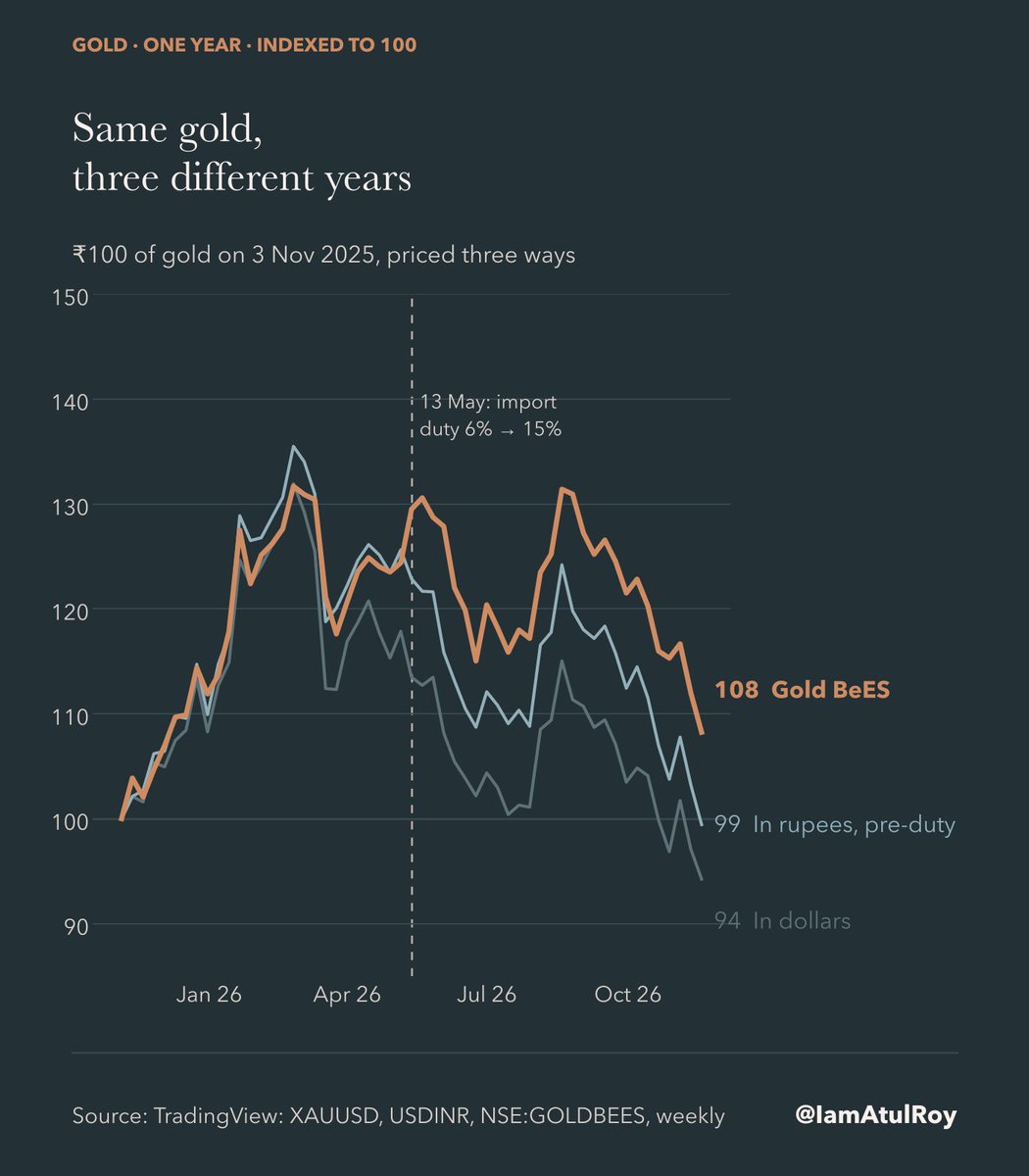
Gold's Worst Year Since 2015: Unless You Hold It in Rupees
In short:
→ In dollars, gold is down 30% from January and 6% in a year
→ An Indian gold ETF bought a year ago is up about 8%
→ The real damage is with the crowd that bought in January
A. THREE PRICES OF THE SAME GOLD
1) In dollars, gold closed at $5,418 on 28 Jan. Today it is around $3,770, down 30.4%. A year ago it was $4,002, so over 12 months the fall is 5.7%.
2) The rupee did part of the work. USDINR went from 88.67 to 93.52 in the same 12 months, up 5.5%, so gold in rupees is down only 0.6% for the year.
3) Then the government did the rest. On 13 May the import duty went from 6% to 15%, which adds about 8.5% to the price of every gram sold here.
4) Put together, Nippon's Gold BeES went from ₹100.05 a year ago to ₹107.86 today, up 7.8%. The math checks out: 0.994 × 1.085 = 1.078.
My read: "worst year since 2015" is a dollar headline. An Indian who bought gold a year ago and simply held it has made money, and almost all of that came from a weaker rupee and a tax.
B. WHO BOUGHT THE TOP
1) In the 11 sessions from 19 Jan to 2 Feb, Gold BeES traded about 21.5 crore units a day. In October the daily average was about 2 crore, so that was almost 11 times normal.
2) Gold BeES closed at ₹146.53 on 29 Jan, its highest. Today it is ₹107.86, down 26.4%.
3) And Indians kept buying on the way down. Gold ETFs took in ₹49,399 Cr from January to October, 15% more than in the whole of 2025. October alone was ₹3,474 Cr, down from ₹4,451 Cr in September.
My read: this is the part that worries me. The biggest buying came at the exact top, from people who bought gold because it was going up, and that is the opposite of why anyone should hold gold.
C. WHY IT IS STILL FALLING
1) The US 10 year yield is 5.15% and the dollar index touched a 19 month high of 103.4 last week. When a safe bond pays more than 5%, holding a metal that pays nothing costs more every week.
2) The market puts the odds of a US rate hike in December at 89%.
3) Central banks are the floor. They bought 321 tonnes in Q3, up 42% from a year ago, and 675 tonnes so far in 2026.
My read: the direction is coming from US rates and the dollar. Central bank buying is why this is a 30% fall and not a 50% one.
D. WHAT I AM WATCHING
1) US 10Y: back below 5% and the pressure on gold eases.
2) $4,000: gold needs to get back above it before I would call this fall over.
3) The rupee: if it strengthens back towards 92, the Indian price falls faster than the dollar price, because the cushion works both ways.
4) The duty: a rollback to 6% would knock about 8% off Indian prices overnight. ETF holders should know that this cushion can go with one notification.
THE BOTTOM LINE
Gold in a portfolio is insurance, not a trade. For me 10 to 15% of the portfolio is enough, rebalanced once a year. If your gold has fallen below your share, top it up slowly through the SIP, not in one shot. And if you bought in January because everyone was buying, don't panic sell at a 26% loss either. Decide your share first, then let the SIP do the rest.
Indian steel makers made 5% to 24% more per tonne this September quarter than a year ago. And 6% to 12% less than in the June quarter.
So both things are true at the same time, the year is good and the quarter got squeezed.
I went through the steel chain layer by layer to see where the money is sitting right now:
L1 Iron ore
L2 Coking coal
L3 The mills
L4 The price, and the duty behind it
A thread 🧵
IndiGo's working capital days are −129.
In simple words, you pay for your ticket weeks before you fly, and IndiGo pays its suppliers, airports and lessors later. So for a few months at a time, its customers are funding the airline.
That is why it has ₹52,685 Cr of cash even in a year when it made a loss. And it is also why an airline can keep flying long after it has stopped making money, as long as the advance bookings keep coming in.
#IndiGo #StockMarketIndia
My rule: use EBITDA to understand the business, use cash flow and PAT to understand what reaches the shareholder.
If a company keeps talking about EBITDA and never about free cash flow, check the cash flow statement yourself.
Which number do you look at first when results come out?
#BusinessTerms #EBITDA #InvestingBasics
This results season, almost every company I wrote about this week led with one number: EBITDA.
IndiGo had ₹11,351 Cr of it in the last 12 months. It also had a loss of ₹4,105 Cr in the same 12 months.
So what is EBITDA actually telling you, and what is it hiding? A short explainer.
A thread 🧵
Where EBITDA does help.
Comparing two companies in the same business. EBITDA per tonne in cement and steel is one of the best numbers you can track. Dalmia going from ₹1,013 a tonne to ₹698 told you more than its PAT did.
And it is the base for EV/EBITDA, the valuation lens I use for companies with a lot of debt.
In two-wheelers, the market is paying more for the companies that make the least.
1) Q2 FY27 profit (standalone): Bajaj ₹3,354 Cr, Hero ₹1,456 Cr, TVS ₹1,377 Cr, Ather ₹1.26 Cr, and Ola a loss of ₹362 Cr.
2) Share of that profit: Bajaj 54%, Hero 24%, TVS 22%, Ather almost 0%.
3) Share of the market cap today: Bajaj 42%, TVS 30%, Hero 15%, Ather 10%, Ola 2%.
So Hero makes almost a quarter of the profit and gets 15% of the value. Ather and Ola together are still not making money and get 13%. And nearly a quarter of Hero's own value is its 32.8% stake in Ather.
The market is paying today for EV profits that haven't reached the P&L yet. Maybe it is right, because Ather's revenue grew 63% last quarter. But that is a lot of faith in one number.
Which side do you think is wrong here, Hero or Ather?
Nifty Auto +4.05% today. Nifty IT −1.33%.
Same market, same day, two very different stories. Brent at $89 is helping the car makers, and Maruti was up over 6%. IT is still paying for every AI headline coming out of the US.
Indians had ₹1.48 lakh crore of borrowed money from their brokers in stocks in August. In FY23 the average was ₹25,000 crore.
And around half of it is in stocks that are not even in F&O, where there is very little liquidity on the day everyone wants to sell.
If you track a steel stock, look at two things in every result: EBITDA per tonne against the June quarter, and how much of its iron ore is its own.
Which steel company do you think handles the coal squeeze best?
#Steel#StockMarketIndia#Metals
Indian steel makers made 5% to 24% more per tonne this September quarter than a year ago. And 6% to 12% less than in the June quarter.
So both things are true at the same time, the year is good and the quarter got squeezed.
I went through the steel chain layer by layer to see where the money is sitting right now:
L1 Iron ore
L2 Coking coal
L3 The mills
L4 The price, and the duty behind it
A thread 🧵
What would change this.
If coking coal goes up by $25 a tonne in Q3 as JSW expects, the November price hikes have to stick to cover it. And if the duty is ever diluted, Chinese steel at their prices would come straight into L4.
For now, the money in the steel chain sits with the mills that own their ore and sell into a protected market.