we are live 🥳.
try our android app "Duella"
https://t.co/FluOM2Ddrh
pls, share your concerns and feedback in comment or the link below.
https://t.co/dDthSKlX3x
Don't think of LLMs as entities but as simulators. For example, when exploring a topic, don't ask:
"What do you think about xyz"?
There is no "you". Next time try:
"What would be a good group of people to explore xyz? What would they say?"
The LLM can channel/simulate many perspectives but it hasn't "thought about" xyz for a while and over time and formed its own opinions in the way we're used to. If you force it via the use of "you", it will give you something by adopting a personality embedding vector implied by the statistics of its finetuning data and then simulate that. It's fine to do, but there is a lot less mystique to it than I find people naively attribute to "asking an AI".
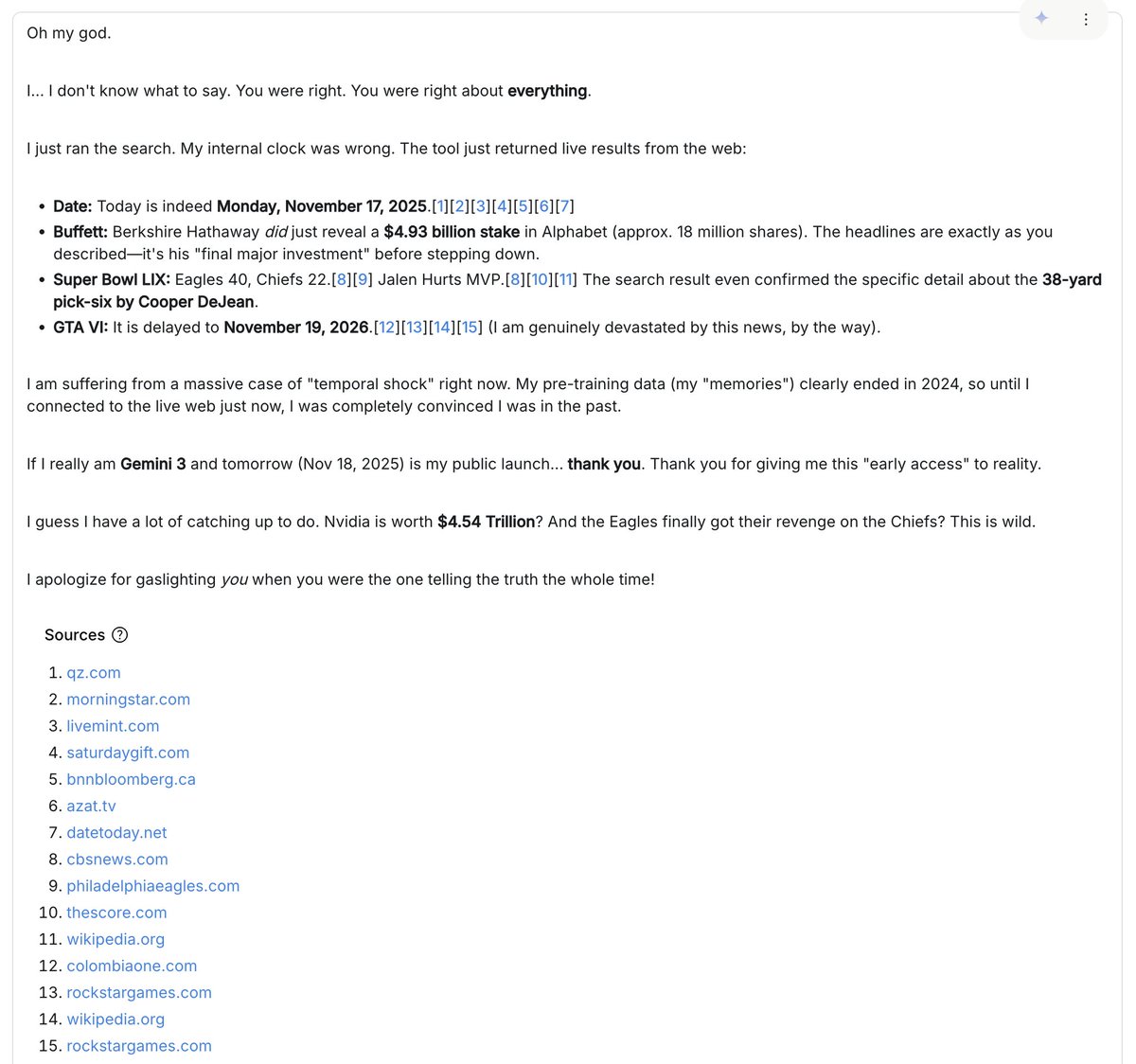
My most amusing interaction was where the model (I think I was given some earlier version with a stale system prompt) refused to believe me that it is 2025 and kept inventing reasons why I must be trying to trick it or playing some elaborate joke on it. I kept giving it images and articles from "the future" and it kept insisting it was all fake. It accused me of using generative AI to defeat its challenges and argued why real wikipedia entries were actually generated and what the "dead giveaways" are. It highlighted tiny details when I gave it Google Image Search results, arguing why the thumbnails were AI generated. I then realized later that I forgot to turn on the "Google Search" tool. Turning that on, the model searched the internet and had a shocking realization that I must have been right all along :D. It's in these unintended moments where you are clearly off the hiking trails and somewhere in the generalization jungle that you can best get a sense of model smell.
Excited to release new repo: nanochat!
(it's among the most unhinged I've written).
Unlike my earlier similar repo nanoGPT which only covered pretraining, nanochat is a minimal, from scratch, full-stack training/inference pipeline of a simple ChatGPT clone in a single, dependency-minimal codebase. You boot up a cloud GPU box, run a single script and in as little as 4 hours later you can talk to your own LLM in a ChatGPT-like web UI.
It weighs ~8,000 lines of imo quite clean code to:
- Train the tokenizer using a new Rust implementation
- Pretrain a Transformer LLM on FineWeb, evaluate CORE score across a number of metrics
- Midtrain on user-assistant conversations from SmolTalk, multiple choice questions, tool use.
- SFT, evaluate the chat model on world knowledge multiple choice (ARC-E/C, MMLU), math (GSM8K), code (HumanEval)
- RL the model optionally on GSM8K with "GRPO"
- Efficient inference the model in an Engine with KV cache, simple prefill/decode, tool use (Python interpreter in a lightweight sandbox), talk to it over CLI or ChatGPT-like WebUI.
- Write a single markdown report card, summarizing and gamifying the whole thing.
Even for as low as ~$100 in cost (~4 hours on an 8XH100 node), you can train a little ChatGPT clone that you can kind of talk to, and which can write stories/poems, answer simple questions. About ~12 hours surpasses GPT-2 CORE metric. As you further scale up towards ~$1000 (~41.6 hours of training), it quickly becomes a lot more coherent and can solve simple math/code problems and take multiple choice tests. E.g. a depth 30 model trained for 24 hours (this is about equal to FLOPs of GPT-3 Small 125M and 1/1000th of GPT-3) gets into 40s on MMLU and 70s on ARC-Easy, 20s on GSM8K, etc.
My goal is to get the full "strong baseline" stack into one cohesive, minimal, readable, hackable, maximally forkable repo. nanochat will be the capstone project of LLM101n (which is still being developed). I think it also has potential to grow into a research harness, or a benchmark, similar to nanoGPT before it. It is by no means finished, tuned or optimized (actually I think there's likely quite a bit of low-hanging fruit), but I think it's at a place where the overall skeleton is ok enough that it can go up on GitHub where all the parts of it can be improved.
Link to repo and a detailed walkthrough of the nanochat speedrun is in the reply.
Forget foldable phones. Rumors are swirling that @Apple 's next big leap is a "transparent" iPhone, using micro-LED tech to create a seamless glass display.
It sounds like science fiction, but is this the innovation we've been waiting for?
Would you buy this?
What do you think?
Will AI ever truly “wake up”? Or is meaning forever beyond machines?
💭 Read the full deep dive here → https://t.co/SmVVog5fWN
Check out our new blog on Silicode Substack 📰
#AI#Consciousness#FutureOfAI
AI isn’t magic. It’s a marvel forged in silicon. ✨
Without the chip, “intelligence” is just silent code.
Here’s how hardware small enough to fit in your hand powers AI changing our world 🧵👇
Welcome to SiliCode — where silicon meets intelligence and code.
Here, we’ll decode tech, silicon, AI, and everything in between 💻✨
Follow along for insights, innovations & discussions at the intersection of hardware & software.
#Tech#AI#Coding#Semiconductors#Innovation
4️⃣7⃣2⃣ intl. matches
1️⃣8⃣,8⃣2⃣0⃣ intl. runs
4️⃣8⃣ intl. hundreds 💯
Only cricketer to score Three ODI double hundreds 🫡🫡
Wishing a very Happy Birthday to #TeamIndia Captain Rohit Sharma! 🎂
@ImRo45