Pleased to share the updated version of our preprint, with @Mattowers1, @b_d_evans, @AlexGFletcher. https://t.co/3F8B7sByof. We showed that our strategy allows for accurate, understandable classification of another limited (but biologically unrelated) microscopy dataset. (1/4)
The Turing are delighted to be a part of this exciting new project advancing AI innovation for space safety & sustainability with @UniStrathclyde and @spacegovuk laying the foundations for an international virtual institute🚀#AI#SpaceSustainability#AISpaceTech
I was delighted Marysia Placzek was awarded this year's @_BSDB_ Waddington Medal. Few are more deserving
Read about her contributions "Her papers are masterworks in precise observation and elegant experimental design, and many have become foundational"
https://t.co/RPyfdcjdKq
🚨 2 math bio PhD projects available with me @shefmathbio @mathsatshefuni both close collaborations with experimental biologists! 1) Understanding tissue patterning in a fluctuating environment https://t.co/aQvZtpcWto
Congratulations to @emanalwani on passing her PhD viva subject to minor corrections! Eman worked on models of patterning and polarity. Thanks to examiners @BlindMath and @NickMonk14 for taking time out from a busy semester, and from relaxing in a hammock somewhere, respectively.
🚨 Funded PhD Alert! 📢 Looking for an interdisciplinary #PhD on #bioinspired#AI 🧠? Interested in #DeepLearning 🤖 and ants 🐜? If so, apply to work with @ProfAndyP, @InsectNav and myself at @SussexUni. Fully funded by EPSRC & open to all, deadline 13/5. https://t.co/iFSwzhUS4X
Surprisingly, when we unpick the decision making of our limb classifier, we find that limb morphology is a substantially stronger classifying feature than SHH expression. (4/4)
Pleased to share the updated version of our preprint, with @Mattowers1, @b_d_evans, @AlexGFletcher. https://t.co/3F8B7sByof. We showed that our strategy allows for accurate, understandable classification of another limited (but biologically unrelated) microscopy dataset. (1/4)
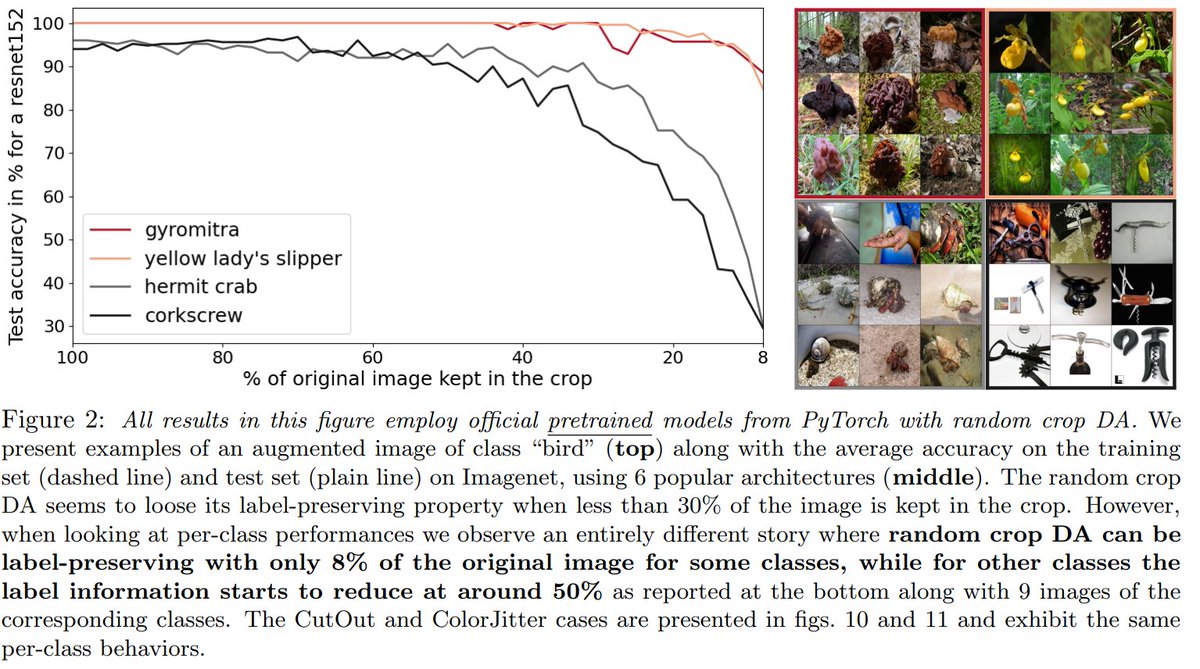
New paper:
"The Effects of Regularization and Data Augmentation are Class Dependent"
by Randall Balestriero, Leon Bottou, Yann LeCun
TL;DR: Turns out some types of data augmentation helps some categories and hurt others...
https://t.co/0K4ufsu0Na
Loss of Function of the Neural Cell Adhesion Molecule NrCAM Regulates Differentiation.... in Early Postnatal Hypothalamic Tanycytes https://t.co/UulmP1i2Zo
V happy to see @Alexthemessiah, @KChinnaiya et al published. @SethBlackshaw @DRN_Sheffield @RadcliffeBlade Thanks All
I'm presenting a poster (P257) at #BSCBDB22 on my work using deep learning to classify subtle morphology changes in the chick embryo. If you're interested, please come see and chat!
🚨Two days left to apply for two 3-year postdoc positions in math bio with me @mathsatshefuni @shefmathbio : visit https://t.co/FrY7luQWKX and search for UOS031828/UOS031829 for more details!🚨
Finally, saliency mapping provided the surprising insight that one of our sub-stages was best described with features that we didn't use to label the data, which will help inform future experiments.
7/7
I'm excited to share the preprint of our paper! (AFAIK the only authors on Twitter are @b_d_evans, @AlexGFletcher). https://t.co/MeVHVsaxWX
Here we systematically examine how to use domain expertise to expand a small microscopy dataset for DCNN classifier training.
1/7
We found that we could achieve high classification accuracies (relative to the size of our dataset) of up to 90.9% by fully exploiting these data processing regimes.
6/7