Very exciting to see our work and vision in the Wall Street Journal! It's an incredible privilege to be working towards the dream of a post-scarcity society.
Yesterday, we came out of stealth at @skyfallAI in Forbes and today we're excited to announce that Skyfall AI is featured in the @WSJ's newsletter.
We believe in a utopian world that will be achieved over the next decade, where humans will work in their own creative interests in space exploration, sports, arts or philosophy while machines will do all the mundane operational tasks. We want to free humanity from all the monotonous boring operational tasks that they spend their daily lives doing.
The only way to achieve this vision is via creating autonomous enterprises, i.e., companies that can run by themselves with minimal human intervention. After 15 years of building in the AI space, one thing is certain. LLMs are static systems that fail at
- Long horizon planning tasks
- High consequential decision-making
- Sample efficiency
- Dynamic environment adaptation
These skills are required by a business to survive and grow. Unfortunately, LLMs are not designed for the real world constraints of running an organization.
Our solution is Enterprise World Models grounded in Continual Learning and World Modeling. We're taking a fundamentally different approach because we have always believed in 0 to 1 research, and not incremental n+1 RL fine tuning.
We are acquiring SaaS businesses to prove our thesis for creating AI systems for the post scarcity world. This is a call to all SaaS founders to submit your company if you’re interested (🔗 in comments)
Thank you Sarah @sarahklearman for covering our story on @WSJ
@spisallyouneed@Yoshua_Bengio I'm incredibly proud to be part of this team! The research is fantastic and I'm looking forwards to seeing what we build in action!
We're doing some really cool work at Skyfall AI with an eye at enterprise automation via world modelling; it's incredible to see Forbes reporting on us!
https://t.co/sEjsdxI1if
Around 15 years ago, Kaheer Suleman and I started Maluuba with the vision of building Universal Turing Machines. Back then, we were one of the pioneer research labs building foundational modules of deep learning and Reinforcement learning with Turing award winners @Yoshua_Bengio and @RichardSSutton. There was no AI hype then, as there is now. Those were the good old days of doing pure scientific research unlike the n+1 research that we see today. Maluuba was later acquired by Microsoft and became @MSFTResearch Canada.
Grounded in that same mission, we're finally ready to introduce @skyfallai to the world after a lot of experimentation in stealth over the last year. We're a frontier neo lab building the first Autonomous Enterprise by moving beyond the current LLM paradigm.
For the last 5 years, the foundational model market has relied on a single paradigm: scaling laws for LLMs - more data, more compute, bigger models. However, the real world is messy and much more complicated. In order to achieve our long term vision, the next generation of AI models requires a different approach. Skyfall is solving the hardest open problems in frontier AI: long-horizon planning, data inefficiency, and brittle performance in dynamic real-world environments.
To achieve the team's vision of a completely autonomous enterprise, the team is developing a next-generation frontier model (Enterprise World Models) using Continual Learning and World Modeling. Enterprise World Models can simulate the multi-layered consequences of strategic business actions. Our approach unlocks a new category in the foundation model market. To prove it, we're introducing Morpheus, a Continual Reinforcement Learning platform for AI researchers.
I'm building this company with the people I trust the most: my longtime friend Kaheer Suleman (prev. Co-Founder of Maluuba) and my brother @omgiamgod (prev. YC founder). Sumit and Kaheer are the first principles thinkers I can trust to go to the end of the world with to achieve the mission impossible together. Together with a stellar team of 25 researchers and engineers, we're pushing a new frontier in AI forward.
We unpacked our long term vision in today’s Forbes feature 🔗- read it to see what we’re building toward. Thank you so much Victor Dey for the interview.
To achieve our goal of enterprise world models, we are soliciting bids to acquire small SaaS startups (up to $1M) and fully automate them. If you’re interested, submit your business here: https://t.co/w8ayopZFLH
Finally, thank you to our investors and advisors for believing in our vision since day one: @Fidelity , @sk121 (@touringcapital), @karam_n and @chrisarsenault (@inovia), @morgan_blumberg (@M13Company ), @stephpalmeri (@NextViewVC ), and @michaellitt and @mmccauley (@GarageCapital ), @jennydhe, @fchollet@NaveenGRao and so many others for supporting us in this journey.
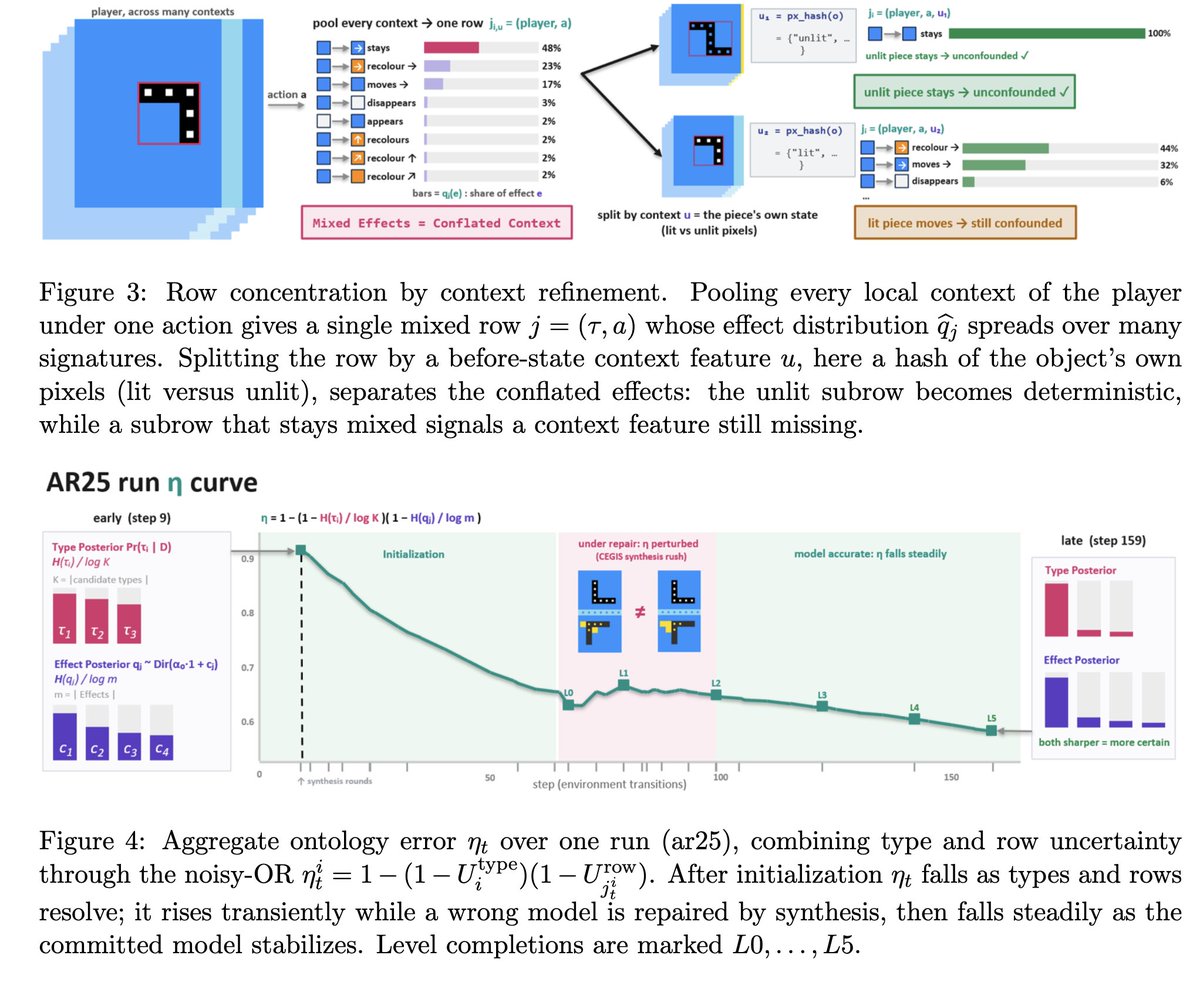
More ARC3 code world model developments! This group claims to have solved the public training set with Fable5 (state abstraction & dynamics modelling via code)
Curious to see code, cost, & generalization. I suspect non-determinism remains an open problem
https://t.co/3VCXeM666Z
A great pre-print from fellow UofT researchers (I believe SotA on ARC-AGI3's train split).
OPINE-World studies how you can model epistemic uncertainty in code world models, with fun ideas like learned code feature extraction and modularized state.
https://t.co/RISOoOjaf8
@skyfallai Looking through the blog, it's interesting to see the total collapse of Gemini performance under task 2 -- always exciting to see benchmarks that stump a frontier model!
Continual learning is one of *the* big open problems. Skyfall AI's new Morpheus environment is framework for continual learning in enterprise settings, such as warehouse management.
I look forwards to discovering how methods like library learning are applied to these domains!
Today we present Morpheus, a persistent enterprise simulation platform designed to make Continual Learning a reality. Morpheus is the world’s first real world Reinforcement Learning environment.
Every Reinforcement Learning environment operates in the game world. Benchmarks like Atari, OpenAI Gym, MuJoCo, and Procgen are all small, game-like worlds that reset every few minutes.
But the real world never resets. A business keeps running and evolving everyday.
We tested how frontier LLMs would perform in realistic and dynamic business environments 🧬on Morpheus. The main conclusion was that LLMs are not continual learners.
🧵Here’s how we did it and what we learned:
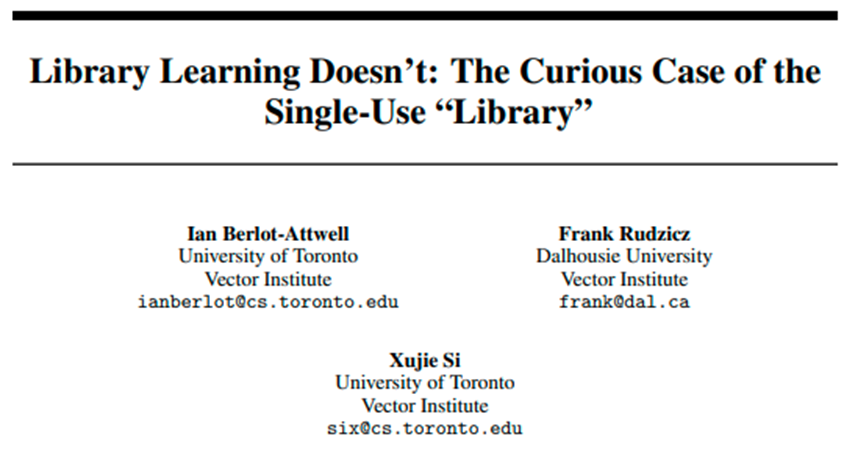
Learning reusable libraries of code promises improved performance and interpretability, but there are issues with evaluation.
We prove that several library learning systems actually perform *test-time scaling*, creating overly specific or trivial tools.
https://t.co/G8Bj9I9nOL
The problem of building AI that can process huge tabular environments & understand knock-on effects from automated workflows (unseen in internet pretraining data) is fascinating, and critical for practical enterprise AI! Very excited for my Skyfall colleages tackling the problem!
Can we trust AI agents with critical enterprise tasks? Absolutely not.
Introducing Wow (World of Workflows), the first Agentic Safety benchmark that proves that frontier LLMs fail miserably under safety constraints at enterprise tasks.
🧵 WoW demonstrates that LLM agents are “dynamically blind”. They fail to track the downstream ripple effects of their actions against complex enterprise rule sets. In an enterprise, that’s a safety and compliance hazard.
Our research shows how the future of enterprise AI requires proactive agent architectures and Wow is just a starting point.
📌 It’s now available to all researchers at: https://t.co/qIcT5kRzhU
Full blog here: https://t.co/n1cdJdzp9v
@skyfallai Extracting relevant LLM knowledge is interesting for efficiency & the question of what core priors are needed for a task (and how we could identify them). I agree with the blog that the transferability and compositionality of the subgoals is an exciting area for further work.
Speed is critical for search-based planning; LLM state prediction is too slow for complex environments. Approaches like CASSANRA are interesting as they distill the prior knowledge into a fast system - hope to see this combined with abstract or hierarchical state representations.
Can LLMs be world models in Enterprise?
We actually tested it: and the answer is no.
While everyone was playing MAPs, we were secretly running something else inside it.
WALL-E, a LLM based world model, failed instantly.
So today we’re launching CASSANDRA: the first causal world model built for business decision making.
Research blog -> https://t.co/kReoPn2cHY
We built @skyfallai to answer one question: What will it take for AI to actually run an enterprise?
Today we released the first real evidence that LLMs fail at the most basic requirements of operating a business.
MAPs isn’t a game. It’s the opening chapter of Enterprise Super Intelligence (ESI).
Every enterprise ultimately runs on one thing:
the intelligence that coordinates it.
We started Skyfall to understand what it would take for AI to truly operate an enterprise and to reason about goals, allocating resources, anticipate failures and execute strategy.
We’re not building a chatbot but a coherent CEO brain.
Today’s MAPs results show how far we still have to go but a step in the right direction
Very excited to be part of Skyfall's research team working on rapid learning from experimentation + planning under uncertainty! We've built a very cool benchmark called MAPs inspired by roller coaster tycoon -- check out the paper & game, I'm happy to chat about both!
The first real evidence that LLMs cannot operate businesses, not even tiny ones.
At Skyfall, we’re building toward Enterprise Super Intelligence: AI systems that can one day run entire enterprises, coordinate teams and make long-horizon decisions, just like a CEO.
To get there, we need to understand what AI cannot do yet.
So we built MAPs, a theme park business with real operational constraints and let GPT5 run it.
Here’s what happened: (spoiler: it fails miserably)
Combined with similar observations of the lack of reuse in other library learning systems (https://t.co/3Ny9NJ4kmJ), it’s clear we need better understanding of the limitations of current library learning systems, and improved evaluation.
See more at https://t.co/qHTdSQzMQE
LLM powered library learning systems achieve SoTA performance on several tasks, but is this driven by the reuse of learned tools? We study two library learning systems for mathematics and find that the reuse of learned tools is extremely infrequent and can harm performance 🧵
Running an ablation on a subset of miniF2F, we find that a model ablated to prevent the sharing of lemmas across tasks also exhibits strong performance.