Nobody wants to invest in Canada. We’re an outlier with our industrial carbon tax.
It’s complicated and they always model out the worst case scenario
Companies need to be either taxpayer funded or insane to invest in Canada
Cenovus CEO Jon McKenzie has stated plainly what many in industry have said for years: Canada is the only country among the top 10 global oil producers that imposes an industrial carbon tax on its producers. It is “nothing more than a cost.” It does not incentivize decarbonization in a global market where the price is set internationally and the cost cannot be passed on. Combined with methane rules, tanker bans, and permitting delays, it makes investment in Canadian energy less competitive than in the U.S. or elsewhere. Carney’s government has kept and is negotiating to raise the industrial price (toward $130/t in Alberta as part of pipeline talks) while scrapping only the consumer fuel charge. MSM coverage treats this as a technical dispute or “climate leadership,” not as a deliberate cost imposed on a major export industry.
On the industrial side, the EV battery and assembly strategy has delivered a string of pauses, cancellations, and failures after tens of billions in federal and provincial commitments (production subsidies, loans, equity): Honda’s $15B Alliston EV/battery plan suspended indefinitely; Stellantis Brampton production shifted to Illinois with the plant being sold (Carney called the outcome a “betrayal” while Ottawa pursues clawbacks); Ford Oakville EV plans scrapped; Northvolt’s Quebec gigafactory collapsed into bankruptcy with hundreds of millions in provincial equity and loans written down or at risk; other cathode and related projects delayed or cancelled. Headline “investment lost” figures circulating online sum announced private projects that never fully proceeded; actual taxpayer exposure is lower but still material. These are not abstract market forces. They follow years of policy that prioritized rapid EV transition, carbon pricing, and large subsidies over competitive conditions for existing auto and energy sectors.
The pattern is the same across affordability, housing, immigration volumes that outpaced infrastructure, and industrial policy: government sets the rules, taxes, and incentives; outcomes (higher costs for energy-intensive industries, delayed or cancelled projects, food-bank use up sharply since 2019, persistent grocery and housing pressure) diverge from the promises. MSM framing consistently attributes results to “global conditions,” “market demand,” or external shocks while under-emphasizing the domestic policy choices that raised costs or directed capital into projects that later stalled. Industry executives state the competitiveness problem in plain language. The data on project status and carbon-price effects is public. The refusal to connect the policy lever to the citizen and industry outcome is the choice.
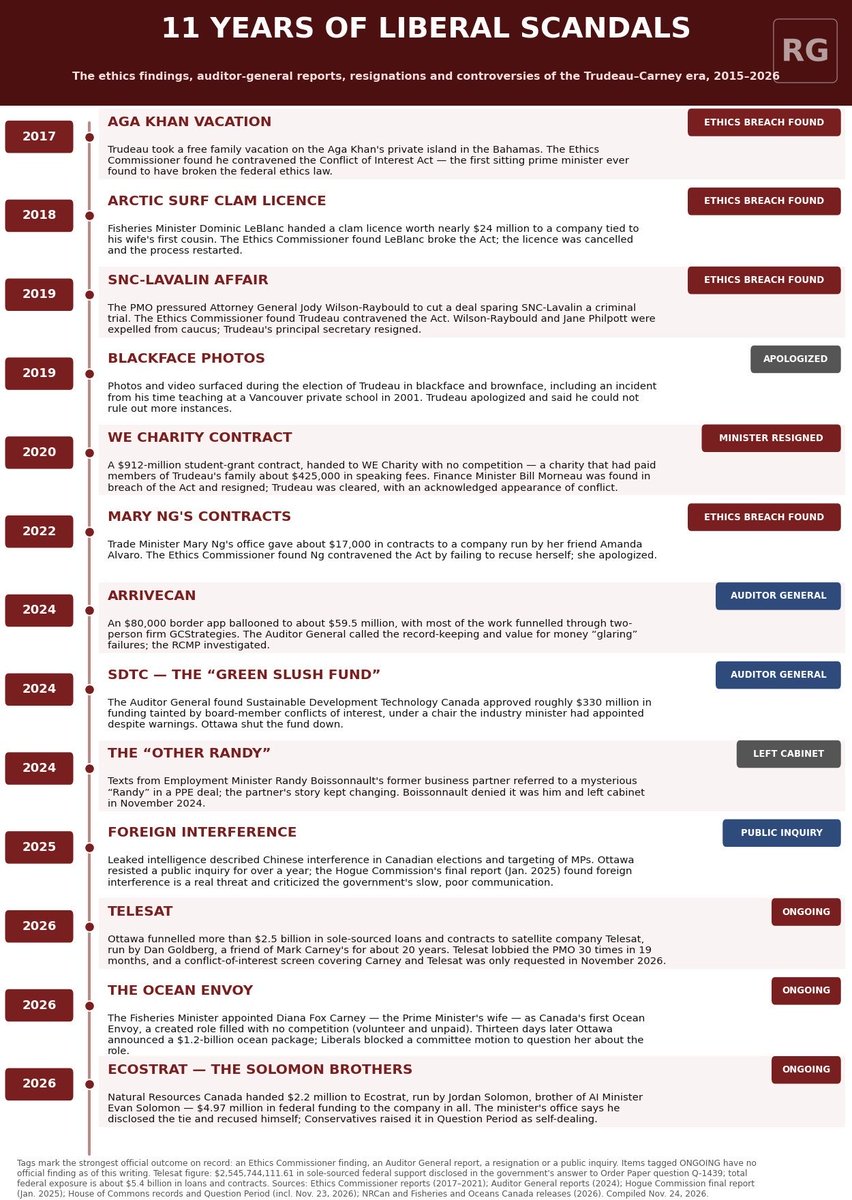
The Stellantis scandal, from a Liberal Minister who didn't even read the contract, to another Liberal Minister, who's brother has been awarded a $2.2 million dollar contract.
Time to drain the Ottawa Swamp.
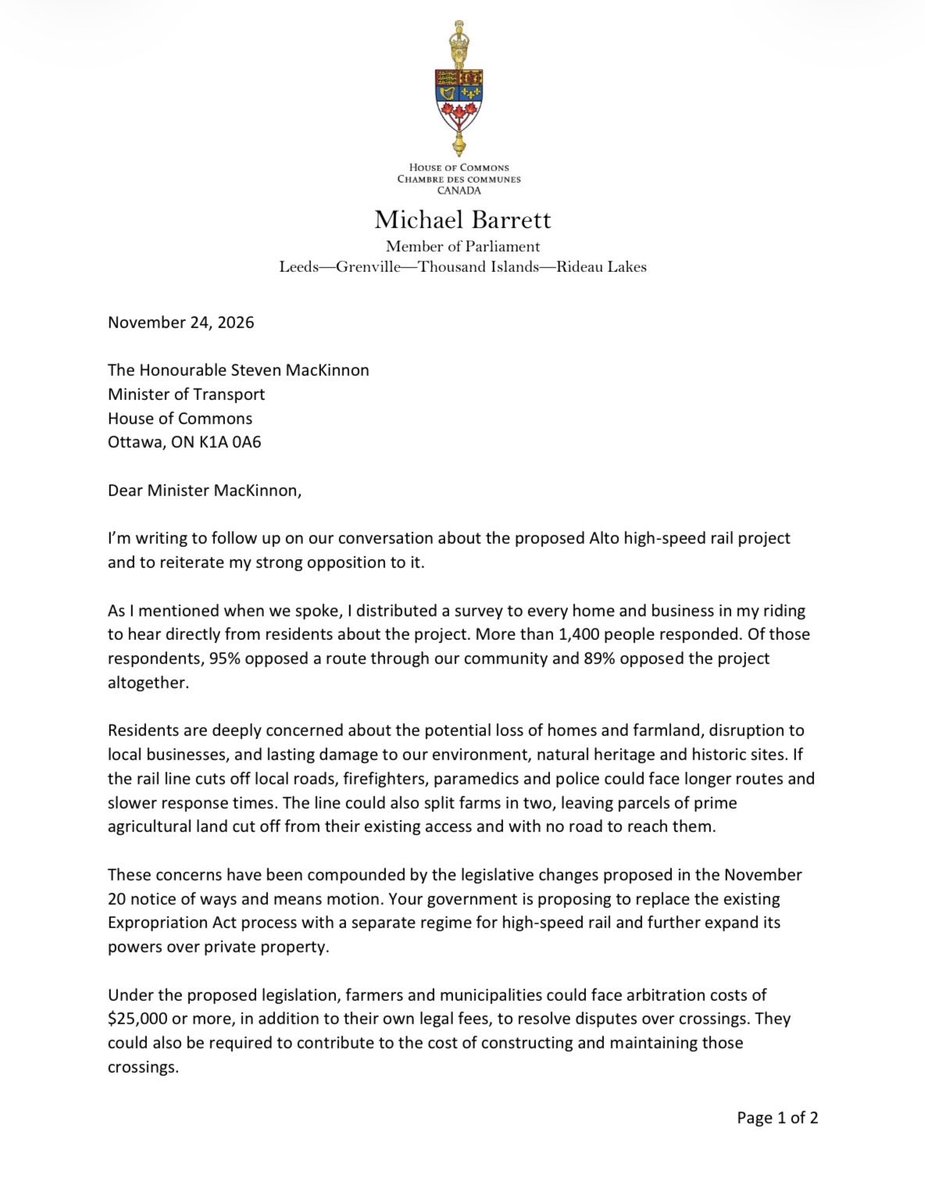
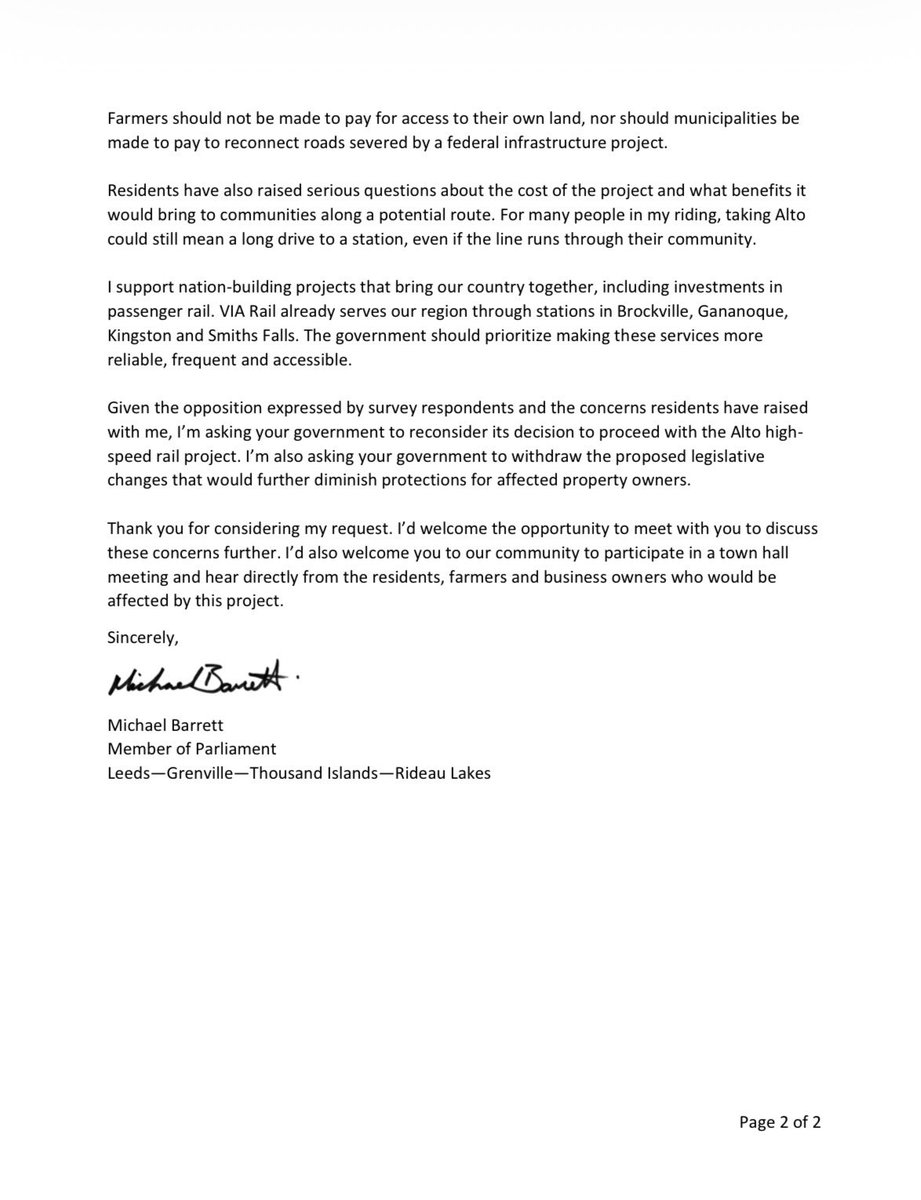
Buried in a 521-page budget motion are sweeping new expropriation powers for the Alto high-speed rail project. I’ve written to the Transport Minister urging him to reconsider the project and invited him to a town hall to hear directly from our community.
Williams speech, and why the Fed Will Need to Cut in 2027
Monday’s reinstatement of Jensen Huang as Nvidia’s chief executive was the first step, removing a cloud of uncertainty over the AI buildout.
John Williams’s latest speech is a second step in the right direction. Compared with Christopher Waller’s call for a half-point hike to “shock people,” the New York Fed president offered a welcome measure of restraint. But he needs to follow his analysis to its logical conclusion.
Consider his most important acknowledgement: “Although the effects of tariffs, geopolitical conflicts, and the AI surge are showing up in prices of certain categories of goods, there is little evidence of these spilling over significantly into broader and more persistent inflation.”
That is no minor qualification. It decides the policy debate.
The data back him. In the year to September, consumer energy prices rose 20 per cent; core goods rose 0.7 per cent. That is a supply shock, not a wage-price spiral.
Private-sector wages are up 3.1 per cent, and the five-year, five-year-forward breakeven, at 2.11 per cent, is lower than a year ago. Williams’s own forecast has inflation just above 2 per cent next year.
I’m sorry, but a focus on headline numbers is not good enough! And the Fed keeps hiding behind it!
A 2 per cent target never required every component to rise at 2 per cent. From 1995 to 2019, core PCE inflation averaged 1.7 per cent while services excluding energy and housing averaged 2.5 per cent and core goods 0.2 per cent. Services ran hot; goods did the balancing.
Now the energy shock is reversing, and fast. The 3-2-1 crack spread, the refiners’ margin, is now close to $ 38 a barrel, down from $ 79 in late September. West Texas crude is heading below $ 80, from $ 115 at its April peak. Wholesale gasoline is below $ 2.45 a gallon.
When crude and refining margins fall together, pump prices fall faster than either. Gasoline at the pump is already down 15 per cent since September, to $ 3.81, and retail margins remain 30 cents above normal. More relief is coming.
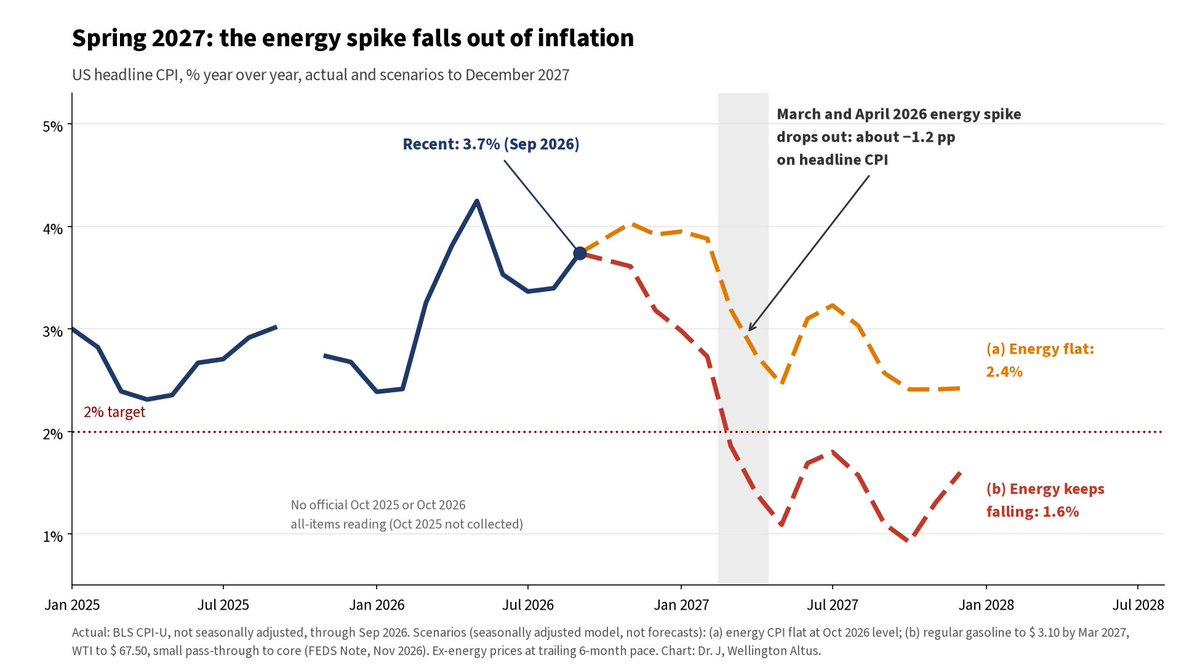
Then come the base effects. Energy prices jumped almost 11 per cent in March 2026 alone. Even if energy merely holds at October levels, that increase drops out of the annual comparison and subtracts about 1.2 percentage points from headline CPI inflation, and 0.6 from PCE, by April.
Here is what the hawks miss: the Fed can tighten without raising rates. Hold the funds rate at 3.75 to 4 per cent and let the real rate do the work. In our scenario, with gasoline easing to $ 3.10 and crude to the high $ 60s, headline PCE inflation falls to about 2 per cent by mid-2027. The real policy rate climbs from 0.2 per cent today to roughly 1.9 per cent, without a single hike. The New York Fed’s own models put the neutral real rate between 1.0 and 1.65 per cent; the FOMC says 1.2. Two cuts would be needed just to get back to the FOMC’s neutral; six to keep today’s stance unchanged.
Even the Fed’s own September projections, PCE inflation of 2.3 per cent and a 4.1 per cent funds rate at the end of 2027, imply a real rate of 1.8 per cent, well above its own neutral.
The hawks’ counterpoints are energy echoes: core’s three-month pace is inflated by transportation services, up 0.8 per cent in October alone, and Michigan’s one-year expectations jumped from 3.8 to 4.7 per cent when gasoline spiked in April.
Williams himself warned against being “overly focused on inflation’s path in the past.” Steering by the rear-view mirror is how a central bank tightens into a slowdown. With the 30-year mortgage rate at 7.28 per cent and existing-home sales at a 3.75 million pace, housing is already paying.
Huang’s return was the first step. Williams’s speech is the second. What is needed now is a Fed that is objective, apolitical and truly data-dependent. As energy falls, the data will say one thing: cut in 2027.
🚨 WHAT THE HELL ARE WE DOING TO THIS COUNTRY?!
Cenovus CEO Jon McKenzie warns that Canada’s industrial carbon tax is driving investment away.
We’re watching Canadian jobs and investment get squeezed while competitors abroad benefit.
And Ottawa wonders why people are furious?
ENOUGH ALREADY.
Mark Carney’s hand-picked tech czar, Patrick Pichette, is a walking conflict of interest—and CBC is pretending it isn’t happening
Pichette sat on Cohere’s board, invested via Inovia, and told the government to make Cohere a “national champion” with billion-dollar contracts. Then Carney put up to $1.6B of taxpayer money into the company and put Pichette in charge of the agency that buys the tech. He claims $1 a year, a not-yet-ready blind trust, and Bermuda-parked assets. Conservatives called for an ethics probe yesterday
This follows the Goldberg/Telesat mess: Carney’s longtime friend landed a $2.3B military satellite deal with no ethics screen until public pressure forced one
CBC covered the Telesat questions and repeatedly celebrated the Cohere investment. On this latest self-dealing story and the Hill press conference? Near total blackout
Taxpayer-funded CBC, selectively silent. Again Canadians deserve better @brodiefenlon
Mark Carney est en train de faire adopter à toute vitesse une loi qui va lui permettre de prendre possession de vos terres et de les céder à des entreprises pour des projets coûteux financés à même vos poches.
Son premier projet : le projet inutile Alto d’une valeur de 150 milliards de dollars, qui va coûter 10 000 dollars à chaque famille canadienne, alors que 90% d’entre elles ne vont jamais l'utiliser.
Mark Carney prend pour acquis que votre argent et vos terres lui appartiennent.
Signez cette pétition pour aider les conservateurs à se battre bec et ongles contre ce gouffre financier des libéraux visant à saisir vos terres : https://t.co/gzDLSSCfFQ
First @EvanLSolomon was fired from CBC for dirty,shady art deals with.....Mark Carney!
Now the same two just gave 2.2 million to Even Solomons brother for carbon capture.
Corruption is off the charts.
How quickly people forget the many Liberal scandals.
What’s most troubling is the fact that these have all but been swept under the rug.
A Government who is never held accountable, that never faces any consequences will continue to do as they please, when they please.