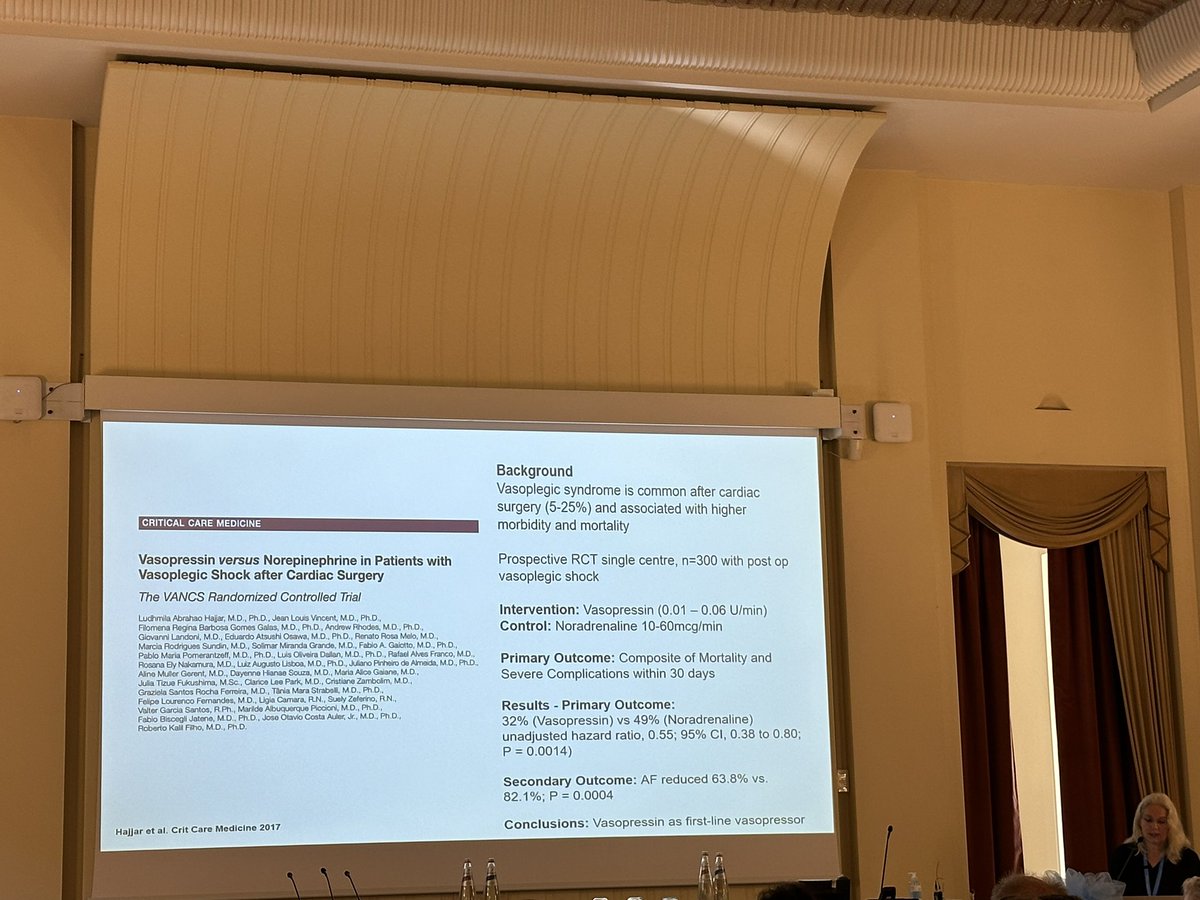
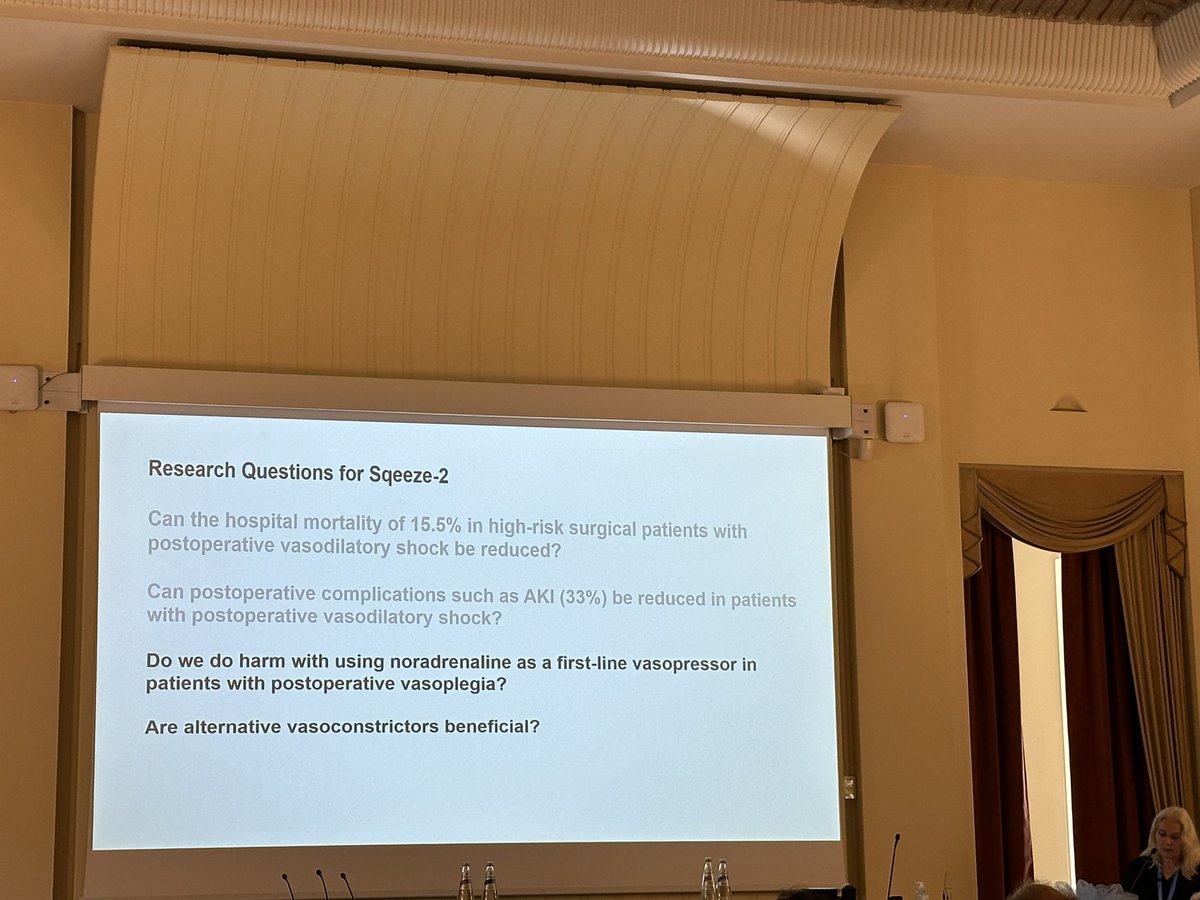
the squeeze study documented high rate of vasoplegia after non-cardiac surgery (and high mortality in these patients)
@gudokunst suggests that #angiotensin II and #vasopressin might be the solution
Interesting that 83% had elevated hsTnT preop - cutoff for predicting MACE/mortality was 34. Trop+frailty improved AUC.
High-Sensitivity Cardiac Troponin T and Frailty Predict... : Anesthesia & Analgesia https://t.co/SRBSn3gdPR
Hannah Arendt:
“The ideal subject of totalitarian rule is not the convinced Nazi or Communist, but people for whom the distinction between fact and fiction [.] and the distinction between true and false [.] no longer exists.”
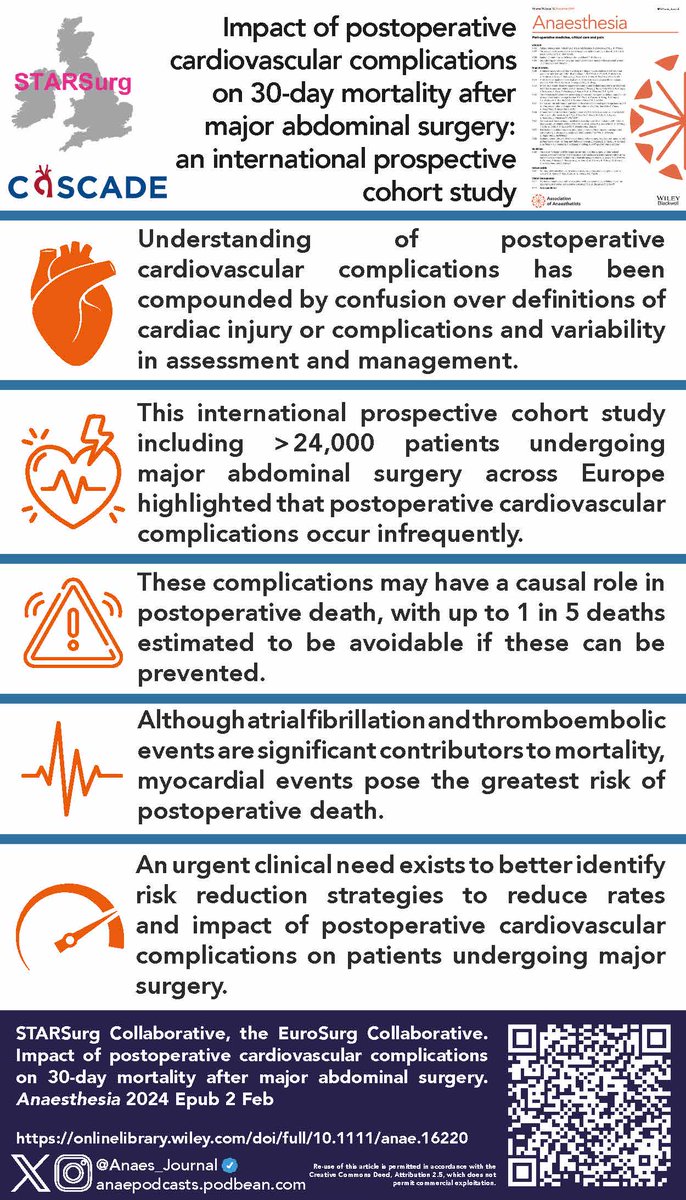
🔓Cardiovascular complications after major surgery are associated with increases in morbidity and mortality.
There is confusion over definitions of cardiac injury or complications, and variability in the assessment and management of patients.
This international prospective cohort study aimed to define the incidence and timing of these complications and to investigate their impact on 30-day all-cause mortality.
Data were collected on consecutive patients undergoing major abdominal surgery in 446 hospitals from 28 countries across Europe.
The primary outcome measure was cardiovascular complications as defined by the Standardised Endpoints for Perioperative Medicine-Core Outcome Measures for Perioperative and Anaesthetic Care initiative up to 30 days after surgery.
The secondary outcome was 30-day postoperative mortality.
This study included 24,203 patients, of whom 611 (2.5%) developed cardiovascular complications.
In total, 458 (1.9%) patients died within 30 days of surgery, of which 123 (26.9%) deaths were judged to be cardiac-related.
Mortality rates were higher in patients who developed postoperative cardiovascular complications than in those who did not (19.8% vs. 1.4%), which persisted after risk adjustment (hazard ratio (95%CI) 4.15 (3.14–5.48)).
We estimated an absolute risk reduction (95%CI) of 0.4 (0.3–0.5) in mortality in the absence of all cardiovascular complications.
This would confer a relative risk reduction in mortality of 21.1% if all cardiovascular complications were prevented.
Postoperative cardiovascular complications are relatively common and occur early after major abdominal surgery.
However, over 1 in 5 postoperative deaths were attributable to these complications, highlighting an important area for future randomised trials.
@i_jakaityte@Sivesh93@kouli_omar@STARSurgUK@EuroSurg
🔗https://t.co/f0I08jlGbV
The duration of crystalloids in the intravascular space is, well, disappointing. An argument for albumin is it lasts longer in the intravascular space. How long, though? 🎩 tip to the authors!
https://t.co/4Ise540F2X
Almost half of all countries have had a woman head of state or government at some point in their history. That is the "little-known improvement" of December 4th, and we'll post another one every day in December.
https://t.co/izPcPGUCIm
Balanced crystalloids versus saline for critically ill patients (BEST-Living): a systematic review and individual patient data meta-analysis - The Lancet Respiratory Medicine https://t.co/yBVjRsihQx
If you are an academic who constantly feels under stress due to work, here's a simple tip that may help you.
Once Joseph Heller, the famous American novelist, best known for his 1961 satirical novel "Catch-22" was at a party in New York.
Kurt Vonnegut, another famous novelist, was there too. Vonnegut told Heller that their host — a billionair, hedge fund manager — made more money in a day than his bestselling novel Catch-22 over the course of its publishing career.
Heller replied, "Yes, but I have something he [the billionaire] will never have...enough."
Heller's insight about having "enough" is such a powerful idea it may change the way you look at the world.
Say, you get up in the morning, read a paper or two, and write a couple hundred words. Then you do you house chores and spend some time with your family.
At the end of the day, you can choose to look at what you did in two ways.
You can either say to yourself: I should've read another paper or written a few more words. I should've done more.
This will make you feel unsatisfied and insecure. And you will end up resenting your work sooner or later.
Or, you can tell yourself: I did "enough" for today. Tomorrow, I will try to do it again.
This will make you feel satisfied with the day.
No matter how you look at your day, the amount of work you do will remain the same.
Get your work done for the day. Then choose enough and feel satisfied. Do it again the next day and the next...
ICYMI - the 4th edition of the Perioperative Quality Improvement Programme is out! @PQIPNews
👇Watch Chief Investigator @rmoonesinghe introduce the latest findings 👇
Read the report here 📖 https://t.co/TDR0ZwfrxZ
In the early 1930s my grandparents met as undergrads @Cornell...
Sept I'll be part of the Dept of Anesthesia at Weill Cornell @WCMAnesthesia@WeillCornell as the Vice Chair of Research.
Joining a fantastic Dept led by @HughHemmings.
Excited to meet and work with everyone!
@BarackObama Described by @EricTopol as a “brilliant new book” in his @nature review. An important story of medical history and innovation.
THE AUTUMN GHOST
@vindkl Omtrent 10.000 NOK i året. Og da er alt inkludert (km, bensin, leie, you name it). Men mindre vi planlegger sommer Norgesferie med en 9 seter i 3 uker. Da var det 15.000NOK ekstra, alt inkludert (1400km, bensin, bompenger, ect)
Just returned from #EA23 and found the copy of The Autumn Ghost by fantastic @wunschcritcare in the mail. Now looking forward reading about the history of the polio pandemic and the birth of Intensive Care.




![EthicsInBricks's tweet photo. Hannah Arendt:
“The ideal subject of totalitarian rule is not the convinced Nazi or Communist, but people for whom the distinction between fact and fiction [.] and the distinction between true and false [.] no longer exists.” https://t.co/gRxcJYa7tj](https://pbs.twimg.com/media/GFPukIXWQAAtAhb.jpg)


![MushtaqBilalPhD's tweet photo. If you are an academic who constantly feels under stress due to work, here's a simple tip that may help you.
Once Joseph Heller, the famous American novelist, best known for his 1961 satirical novel "Catch-22" was at a party in New York.
Kurt Vonnegut, another famous novelist, was there too. Vonnegut told Heller that their host — a billionair, hedge fund manager — made more money in a day than his bestselling novel Catch-22 over the course of its publishing career.
Heller replied, "Yes, but I have something he [the billionaire] will never have...enough."
Heller's insight about having "enough" is such a powerful idea it may change the way you look at the world.
Say, you get up in the morning, read a paper or two, and write a couple hundred words. Then you do you house chores and spend some time with your family.
At the end of the day, you can choose to look at what you did in two ways.
You can either say to yourself: I should've read another paper or written a few more words. I should've done more.
This will make you feel unsatisfied and insecure. And you will end up resenting your work sooner or later.
Or, you can tell yourself: I did "enough" for today. Tomorrow, I will try to do it again.
This will make you feel satisfied with the day.
No matter how you look at your day, the amount of work you do will remain the same.
Get your work done for the day. Then choose enough and feel satisfied. Do it again the next day and the next...](https://pbs.twimg.com/media/F5CqP80XEAAK-Av.jpg)


