After months of research and interviews we have released our report on Vulnerability Management for Cloud Native (and legacy) workloads.
These newer tools help us to be more effective with the limited resources of today’s cybersecurity teams.
https://t.co/axnp00AnTm
@SkSabata@MillieMarconnni obviously but how could i do that?
like what was the prompt and what ai tool did you use?
can you modify the content? like is it a pdf or png or word doc or power point?
@RamsaurFGC@MillieMarconnni Dr. Qing Li (the prominent immunologist and author of the international bestseller Forest Bathing: How Trees Can Help You Find Health and Happiness) is from China. He was born in a rural village in Shanxi Province, China, but moved to Japan in 1988 to further his medical studies.
@bettersoma@SFPD@SFPDTenderloin someone driving down the road hit and killed the thief while he was running away from two police officers. Thief died and the police officers sustained injuries. The driver remained and is cooperating.
MIT DEDICATED A FULL LECTURE TO GIT'S INTERNALS -- BECAUSE THEY FOUND MOST DEVS MEMORIZE THE COMMANDS AND HAVE NO IDEA WHAT THE TOOL ACTUALLY DOES
A whole 85 minutes MIT session that refuses to teach git as a list of commands to copy, and instead shows you the data model underneath -- the thing that makes every command finally make sense.
-> The moment it clicks, git stops being scary magic. You stop memorizing "The incantation that fixed it last time" and start actually knowing what's happening.
Most people learn just enough git to not get fired. Four commands, blind faith, and a prayer before every merge.
In 2026 that's not enough anymore -> git is the literacy test for being in the room, and "I'll just reclone it" is the fastest way to look junior.
An AI agent will branch, commit and rebase faster than you can read. When it tangles the history, untangling it runs on understanding the model MIT teaches in this one hour.
Anyone can run git push. The person who understands the graph underneath is the one who saves the repo when it breaks.
Bookmark & Watch it ↓
@robertgraham@QuinnyPig what about happy eyeballs
Happy Eyeballs is a clever algorithm that prevents your browser from freezing when visiting dual-stack (IPv4 and IPv6) websites. Instead of waiting for an IPv6 connection to fully timeout if it fails, the browser "races" both IPv4 and IPv6
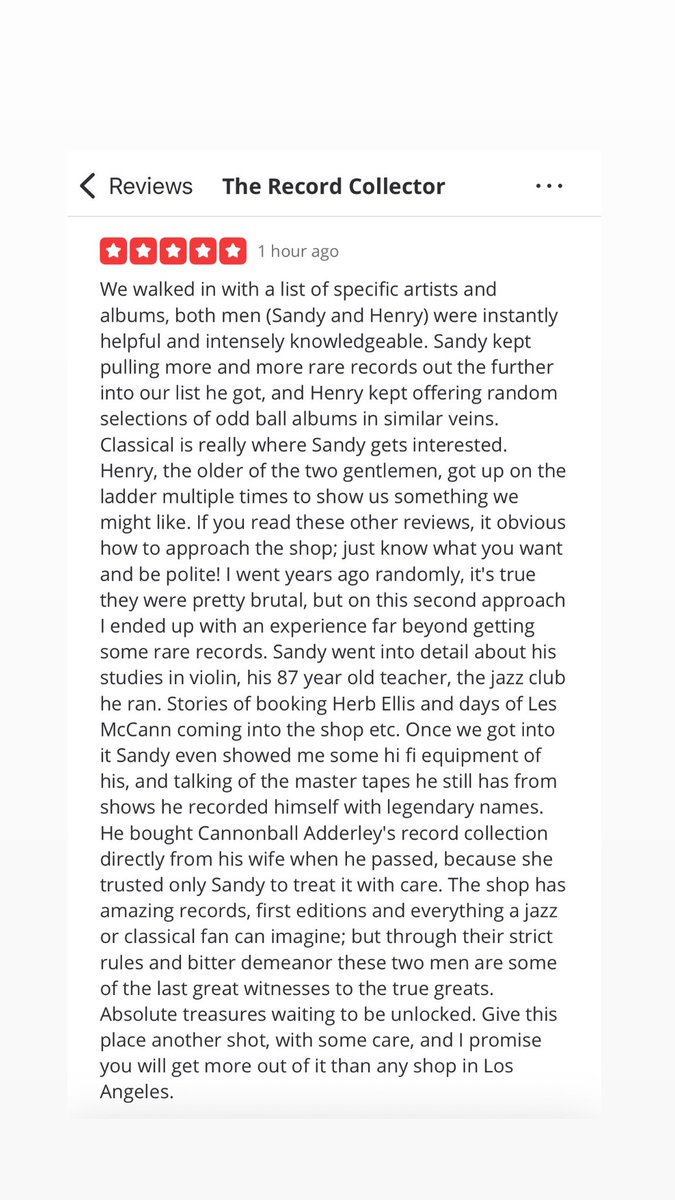
I went back today, with specifics in mind; and had an unbelievable experience.
My first Yelp review ever is below.
Don't let Sandy or Henry scare you. They have so much to tell and offer, they just are too afraid of the world now to share it most of the time. Who isn't. If you get a chance to go, do your homework; but I promise you won't regret it.
2/2
Fork your dependencies, trim them to only your use case, never update unless it breaks for your users. I’ve been vocal about this for 10+ years. I’ve always said that updating is way riskier than latent bugs (which can be tracked and CVEs monitored).
If you are updating a dependency, it’s on you to analyze every single commit in the full transitive set of dependencies. If you dont see anything compelling, dont update!
I remember at HashiCorp once in awhile an engineer would try to update a dep or replace a DIY lib with an external one and id always ask “show me the commit we need.” Dont update for the sake of it.
Feeling pretty swell about this mentality with all the supply chain attacks happening.
$97,000 AWS bill in 48 hours. Hacked account, Bedrock API, ~2 million tokens per minute. I guess long-lived access keys made it possible! 🔓
Here's what actually protects you:
1. 𝗗𝗶𝘁𝗰𝗵 𝗹𝗼𝗻𝗴-𝗹𝗶𝘃𝗲𝗱 𝗮𝗰𝗰𝗲𝘀𝘀 𝗸𝗲𝘆𝘀
I always thought that each /24 must have it's own DNS zone file for reverse IP Address resolution.
I looked it up.
TIL that you can have a giant /16 zone file for PTR records. Wow!
https://t.co/QaZzc40ugt
Why can't people spell On-Premises correctly?
K3s on On-Prem Infrastructures the GitOps Way: Writing a Custom k0rdent Template from Scratch https://t.co/lLn7XlGpU8 #cncf via @CloudNativeFDN