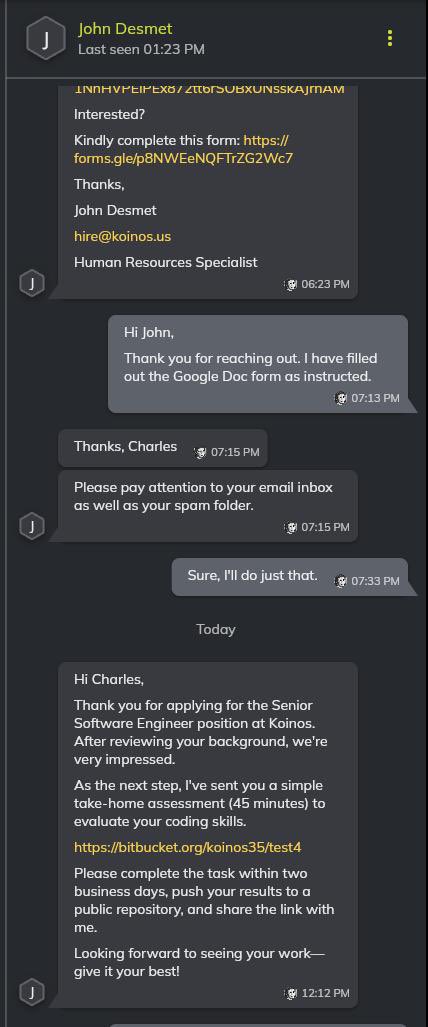
It was just a normal day for me when I received a DM from a (non)potential recruiter pitching an available senior software engineer position (or so I thought). The pay was the catch ($7,000-$8,000). While the supposed salary range didn’t take me by surprise (because yeah my expertise is worth the price), he urged me to check my spam folder which seemed a bit odd for an organization with a supposedly good structure. (Red flag 1 🚩)
The following day he sent a take-home assessment test published to a bitbucket repository. From the 2nd screenshot below you’d notice the URL of the repository didn’t appear to be owned by an organization. Mind you @KoinosNetwork is a reputable blockchain startup that got launched less than a year ago, and it made no sense for such organization’s repository slug to be koinos35 (as seen in the repository url). Red flag 2 🚩
“Fulani came to our village and killed seven people. When our youths rose to defend our people, the Nigerian army stepped in to protect the Fulani terrorists and in the process killed many of our people.”
Tales from the now-disgraced country.
Up next, Cambridge!
In my final year at the University of Ibadan, I took a leap of faith and applied to two of the world’s most prestigious universities, Oxford and Cambridge, and I got into both. A few days ago, I arrived in Cambridge,
If you’re a PM, here’s my challenge to you:
Next time you’re asked for a feature,
Ask instead: What impact will this create?
👇 How do you ensure your products drive impact, not just output?
#ProductManagement#Leadership#Innovation
If you have been following the GPT-5 rollout, one thing you might be noticing is how much of an attachment some people have to specific AI models. It feels different and stronger than the kinds of attachment people have had to previous kinds of technology (and so suddenly deprecating old models that users depended on in their workflows was a mistake).
This is something we’ve been closely tracking for the past year or so but still hasn’t gotten much mainstream attention (other than when we released an update to GPT-4o that was too sycophantic).
(This is just my current thinking, and not yet an official OpenAI position.)
People have used technology including AI in self-destructive ways; if a user is in a mentally fragile state and prone to delusion, we do not want the AI to reinforce that. Most users can keep a clear line between reality and fiction or role-play, but a small percentage cannot. We value user freedom as a core principle, but we also feel responsible in how we introduce new technology with new risks.
Encouraging delusion in a user that is having trouble telling the difference between reality and fiction is an extreme case and it’s pretty clear what to do, but the concerns that worry me most are more subtle. There are going to be a lot of edge cases, and generally we plan to follow the principle of “treat adult users like adults”, which in some cases will include pushing back on users to ensure they are getting what they really want.
A lot of people effectively use ChatGPT as a sort of therapist or life coach, even if they wouldn’t describe it that way. This can be really good! A lot of people are getting value from it already today.
If people are getting good advice, leveling up toward their own goals, and their life satisfaction is increasing over years, we will be proud of making something genuinely helpful, even if they use and rely on ChatGPT a lot. If, on the other hand, users have a relationship with ChatGPT where they think they feel better after talking but they’re unknowingly nudged away from their longer term well-being (however they define it), that’s bad. It’s also bad, for example, if a user wants to use ChatGPT less and feels like they cannot.
I can imagine a future where a lot of people really trust ChatGPT’s advice for their most important decisions. Although that could be great, it makes me uneasy. But I expect that it is coming to some degree, and soon billions of people may be talking to an AI in this way. So we (we as in society, but also we as in OpenAI) have to figure out how to make it a big net positive.
There are several reasons I think we have a good shot at getting this right. We have much better tech to help us measure how we are doing than previous generations of technology had. For example, our product can talk to users to get a sense for how they are doing with their short- and long-term goals, we can explain sophisticated and nuanced issues to our models, and much more.
Don't live for the love of people. It's fickle as fuck. Live for truth. Be kind. Be honest. Live for God. And when people do show you love en-masse, don't bask in it too long. You MAY acknowledge it - but keep it moving. Because people forget. And if you forget that, you will suffer.
NOT-SO-FUN FUN FACT: The most expensive flight on this entire #AlmaChasingContinents journey (apart from Antarctica) was the final leg of my journey back to Nigeria - from London to Lagos.
I’ve flown on at least 15 flights in the past week, over 6 of them being long-haul flights of 10-15 hours.
None of them cost as much as this 5-hr flight from London to Lagos.
Do you want to take a quick guess what the second most expensive flight was?
The flight out of Nigeria when I was heading to my starting point.
Flying to or from Nigeria is unjustifiably expensive, and something needs to be done about it. It should not cost this much to travel.