In the 1920s, a Stanford psychologist tracked genius children for 50 years.
Malcolm Gladwell breaks down what he discovered:
Rich families → successful. Poor families → failures.
Not average. Failures. Genius-level IQs that produced nothing.
He spent 60 minutes at Microsoft explaining why we're wrong about success:
The psychologist was named Terman. He gave IQ tests to 250,000 California schoolchildren.
He identified the top 0.1%. Kids with IQs of 140 and above.
His hypothesis: these children would become the leaders of academia, industry, and politics.
He tracked them. And tracked them. For decades.
The results split into three groups:
The top 15% achieved real prominence. The middle group had average, moderately successful professional lives.
And the bottom group? By any measure, failures.
The difference wasn't personality. Wasn't habits. Wasn't work ethic.
It was simple: the successful geniuses came from wealthy households. The failures came from poor families.
Poverty is such a powerful constraint that it can reduce a one-in-a-billion brain to a lifetime of worse than mediocrity.
There's a concept called "capitalization rate."
It asks a simple question: what percentage of people who are capable of doing something actually end up doing that thing?
In inner city Memphis, only 1 in 6 kids with athletic scholarships actually go to college.
If our capitalization rate for sports in the inner city is 16%, imagine how low it must be for everything else.
Here's something stranger.
Gladwell read the birth dates of the 2007 Czech Junior Hockey Team:
January 3rd. January 3rd. January 12th. February 8th. February 10th. February 17th. February 20th. February 24th. March 5th. March 10th. March 26th...
11 of the 20 players were born in January, February, or March.
This isn't unique to the Czechs. Every elite hockey team in the world shows the same pattern. Every elite soccer team too.
Why?
The eligibility cutoff for youth leagues is January 1st.
When you're 10 years old, a kid born in January has 10 months of maturity on a kid born in October. That's 3 or 4 inches of height. The difference between clumsy and coordinated.
So we look at a group of 10 year olds, pick the "best" ones, give them special coaching, extra practice, more games.
We think we're identifying talent. We're just identifying the oldest.
Then we give the oldest more opportunities, and 10 years later they really are the best.
Self-fulfilling prophecy.
The capitalization rate for hockey talent born in the second half of the year? Close to zero.
We're leaving half of all potential hockey players on the table because of an arbitrary date on a calendar.
Kids born in the youngest cohort of their school class are 11% less likely to go to college.
11% of human potential squandered because we organize elementary school without reference to biological maturity.
Now here's the part about math.
Asian kids dramatically outperform Western kids in mathematics. The gap is enormous and consistent across decades of testing.
Some people say it's genetic. It's not.
It's attitudinal.
When Asian kids face a math problem, they believe effort will solve it.
When Western kids face a math problem, they believe the answer depends on innate ability they either have or don't.
Here's the proof.
The international math tests include a 120-question survey. It asks about study habits, parental support, attitudes.
It's so long most kids don't finish it.
A researcher named Erling Boe decided to rank countries by what percentage of survey questions their kids completed.
Then he compared it to the ranking of countries by math performance.
The correlation was 0.98.
In the history of social science, there has never been a correlation that high.
If you want to know how good a country is at math, you don't need to ask any math questions. Just make kids sit down and focus on a task for an extended period of time.
If they can do it, they're good at math.
Why do Asian cultures have this attitude?
Gladwell's theory: rice farming.
His European ancestors in medieval England worked about 1,000 hours a year. Dawn to noon, five days a week. Winters off. Lots of holidays.
A peasant in South China or Japan in the same period worked 3,000 hours a year.
Rice farming isn't just harder than wheat farming. It's a completely different relationship with work.
There's a Chinese proverb: "A man who works dawn to dusk 360 days a year will not go hungry."
His English ancestors would have said: "A man who works 175 days a year, dawn to 11, may or may not be hungry."
If your culture does that for a thousand years, it becomes part of your makeup.
When your kids sit down to face a calculus problem, that legacy of persistence translates perfectly.
Now consider distance running.
In Kenya, there are roughly a million schoolboys between 10 and 17 running 10 to 12 miles a day.
In the United States, that number is probably 5,000.
Our capitalization rate for distance running is less than 1%.
Kenya's is probably 95%.
The difference isn't genetic. The difference is what the culture values and where it spends its attention.
Here's the most fascinating finding.
30% of American entrepreneurs have been diagnosed with a profound learning disability.
Richard Branson is dyslexic. Charles Schwab is dyslexic. John Chambers can barely read his own email.
This isn't coincidence. Their entrepreneurialism is a direct function of their disability.
How do you succeed if you can't read or write from early childhood?
You learn to delegate. You become a great oral communicator. You become a problem solver because your entire life is one big problem. You learn to lead.
80% of dyslexic entrepreneurs were captain of a high school sports team. Versus 30% of non-dyslexic entrepreneurs.
By the time they enter the real world, they've spent their whole life practicing the four skills at the core of entrepreneurial success: delegation, oral communication, problem solving, and leadership.
Ask them what role dyslexia played in their success and they don't say it was an obstacle.
They say it's the reason they succeeded.
A disadvantage that became an advantage.
Here's what Gladwell wants you to understand:
When we see differences in success, our default explanation is differences in ability.
We forget how much poverty, stupidity, and attitude constrain what people can become.
We refuse to admit that our own arbitrary rules are leaving talent on the table.
We cling to naive beliefs that our meritocracies are fair.
The capitalization argument is liberating.
It says you don't look at a struggling group and conclude they're incapable. It says problems that look genetic or innate are often just failures of exploitation.
It says we can make a profound difference in how well people turn out.
If we choose to pay attention.
Kurt Gödel, who was one of Albert Einstein's best friends in his later years, found a solution to general theory of relativity that modelled a strange, unusual and rotating universe allowing for backward time travel.
An infinite simply-connected flat (or hyperbolic) space with no topological identifications or edge gluings. No wrapping paths means flat-landers see zero copies or periodic repeats of themselves or objects.
For the lattices to be non-repeating and look like infinitely random spatial permutations, embed an aperiodic order such as a Penrose tiling or quasiperiodic structure (cut-and-project from higher dimensions). Local rules hold, but no global translational periodicity exists—every vista is unique and varies without exact duplicates across the infinite plane.
Reality Explained.
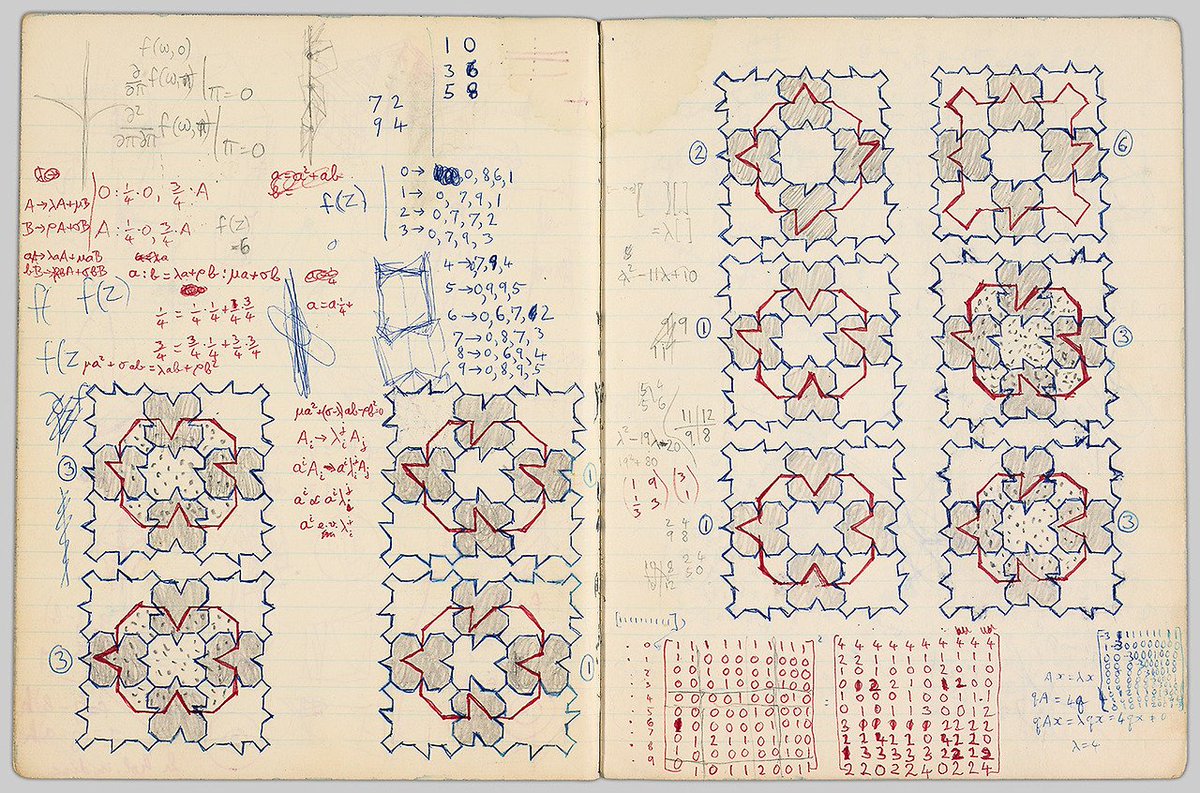
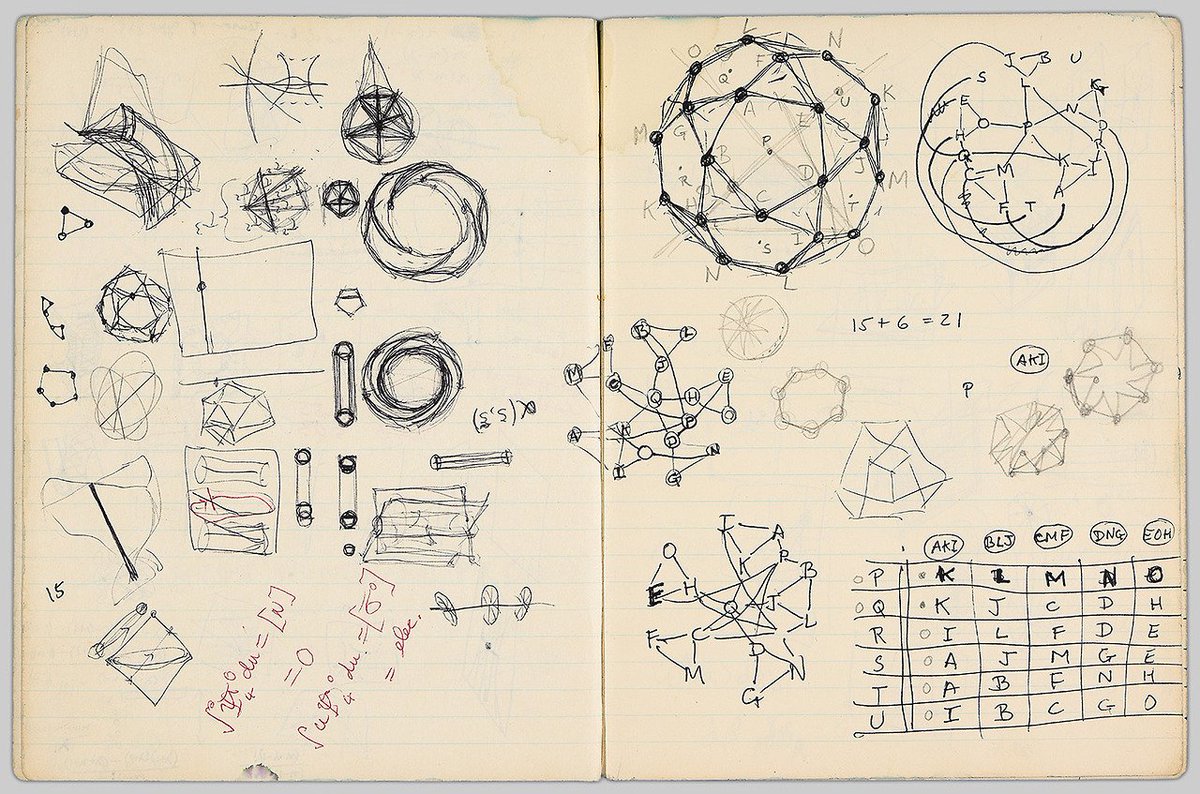
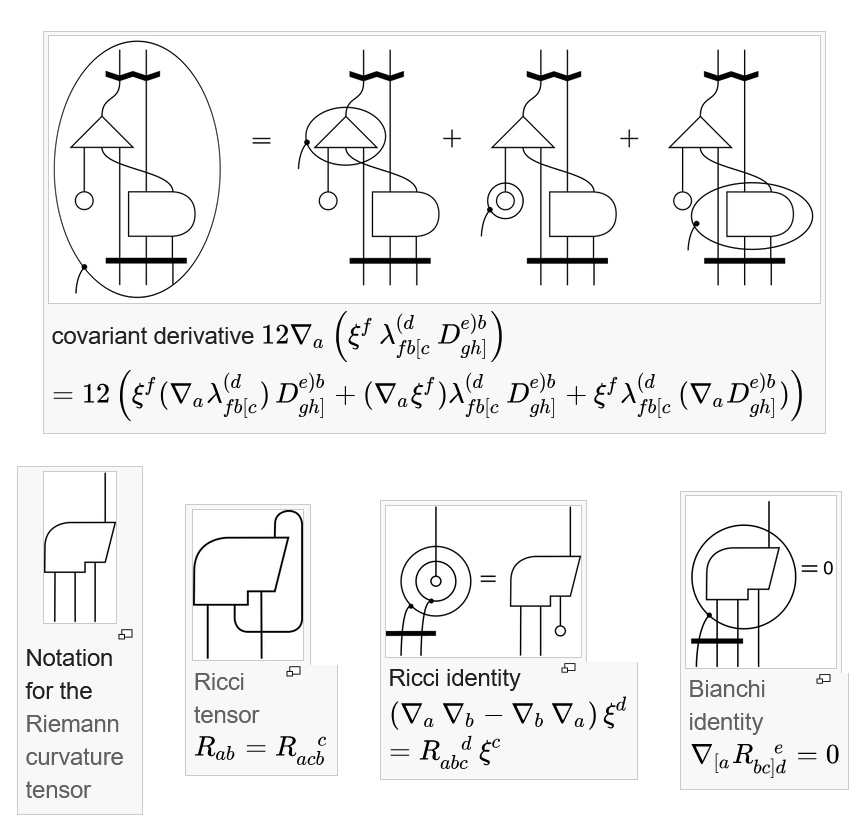
Imagine having a brain, big enough to fully appreciate "Penrose Graphical Notation." They look like blueprints from another world. Source: https://t.co/beilFsuG2a
Peering into the notebooks of Sir Roger Penrose is like watching a masterclass in visual thinking.
From the Fano plane and Cayley algebras to early Commodore P50 code and the geometry of Penrose tilings. A true testament to how mathematics, physics, and art are fundamentally inseparable.
penrose tiling is what happens when math refuses to repeat.
normal tiles create patterns that repeat forever.
penrose tiles don’t.
they can cover an infinite plane,
but the pattern never becomes periodic.
why it matters:
• simple rules → complex structure emerges from just a few tile shapes
• no repetition → the pattern is ordered, but never boring
• local constraints → small placement rules create global structure
• hidden symmetry → not obvious repetition, but deep mathematical order
• quasicrystals → nature later showed similar non-repeating order in real materials
that’s the beautiful part.
penrose tiling is not chaos.
it is order without repetition.
a reminder that structure doesn’t always need symmetry,
and complexity doesn’t always need randomness.
Ergosphere Heist
A packet enters the rotating black hole’s ergosphere, splits its motion with the spin of spacetime, and comes back out with more energy than it had going in, effectively stealing rotational energy from the black hole.
Quantum mechanics makes sense when you realize the Quantum Field is one singular object.
Though excitations (particles) appear localized or separated by vast distances in our physical space, they remain entangled because, in their own domain, space doesn't exist.
They aren't just "connected", they are literally parts of the same undivided whole.
White Holes Don’t Push You Way. Spacetime Refuses Your Future.
A White Hole appears in the maximally extended Schwarzschild solution of General Relativity, the full mathematical extension of the Spacetime around an eternal, non-rotating Black Hole.
The exterior geometry is the same Schwarzschild geometry
ds² = −(1 − 2M/r)dt² + (1 − 2M/r)⁻¹dr² + r²dΩ²
But the causal direction is reversed.
For a Black Hole, future-directed paths can cross the horizon inward. For a White Hole, future-directed paths can emerge from the horizon, but outside particles cannot enter that region.
The object has not been observed in nature. But inside the Mathematics of General Relativity, it is a real sector of the extended Schwarzschild Spacetime... the Black Hole’s time-reversed counterpart.
Time not ONLY has extra dimensions but extra degrees of freedom per dimension..
EMPRESS model contains 3-spatial and 4-temporal (a 7D system)..
These extra temporal dimensions are projected on our 2D timeline as a hyper crystal would project a shadow on a 2D surface ..
More on this soon..
Thanks to @AmericanALCHMY for making another banger video with awe inspiring thoughts to consider…