The @Superlist team just shipped an MCP server. 🚀
You can now create, update, and manage tasks from Claude, ChatGPT, Perplexity and other MCP-compatible software:
👉 https://t.co/xcQuZnzKws
Also new: an activity heatmap, better sorting, and faster file previews.
Nice one @marcelkaeding 👏
currently you can get very large gains in code gen. you can get improvements around it as well. but you do not see the full gains realised at the org level without massive structural changes, that I'm not sure anyone has actually done. also convenient only labs get these gains imo
I've had more "I can't believe it's this good" moments with GPT5.5 than any other model since Opus 4.5. It's shockingly, scarily capable. Days and days of amazing progress. All steering, no handwriting. Yet utterly delightful to conduct its coding. So, so good.
@mattpocockuk There’s an interesting tension between determinism and portability. A skill might contain and execute some code. This is useful when needed, but hurts portability. Skills w/out code might be more reliable, but code needs maintenance, and better models might not need the code.
Tactical vs Strategic Programming, and why I'm nervous for juniors:
Good programming involves a mix of tactical and strategic decision-making:
- Tactical: on the ground, short-term. The soldier doing the fighting.
- Strategic: high-view, long-term. The general planning the war.
You need to be a tactician to write good code. To choose the right syntax. To figure out the file structure. To figure out how best to test your changes.
But you need to be a strategist to build code that lasts. To design the architecture. To automate away problems. To think beyond today.
Agents have eaten the tactical part of programming. When you can pay below minimum wage for code, there's no point going into the trenches yourself.
But AI cannot code strategically. Agents need someone at the top of the pyramid to tell them what to do. They need oversight.
So, a developer's day-to-day job has become 100% strategy. Long-term thinking, all the time. (maybe this is why I'm so tired all the time now)
If you identify as a tactical programmer - a code monkey - then you are out of luck. The job has changed.
Personally, I like it. I always preferred thinking strategically about code. If you asked me what my job was about, I'd say 'building apps', not 'writing code'.
But what makes me nervous is that we've pulled down the only bridge that brought juniors into the industry.
We used to train juniors like this:
1. Give them only tactical tasks
2. Let them build up their strategic experience slowly
Eventually, they are a good enough strategist that they are no longer a junior.
But what happens when all tactical code is written by AI? What is the point of a junior?
We obviously need juniors. We need new lifeblood coming into the industry. We need to leave paths open for extraordinary hires to enrich our companies.
But how do we train them? How do you train strategic thinking?
These are the questions I'm thinking about. I'd love to know your thoughts.
Even though AI codegen tools can write code better than me in almost every context, I still practice writing code every day.
It helps me stay sharp, and I still spot problems with AI generated code.
Maybe this is cope, and maybe I just love writing code and don't want to loose it.
But I'm not going to stop any time soon!
You've been asking for this one...
Now in preview: Codex in the ChatGPT mobile app.
Start new work, review outputs, steer execution, and approve next steps, all from the ChatGPT mobile app. Codex will keep running on your laptop, Mac mini, or devbox.
@donnfelker@conductor_build Codex is excellent. Built in git worktree implementation means I don't worry about branching. Also because I can open many projects, and have many threads per project, it allows me to do a lot of parallel work. Also built in browser. I hear good things about T3 Code as well
@luke_pighetti I'm glad it happened, but it's sad that it took this. don't get me wrong I prefer Dart, but having a few cloud functions in JS or Python doesn't really bother me as much these days. whatever gets it done and works.
every dev should build a coding agent from scratch
people (myself included) think it's magical or really hard, but the basics are very simple
I love when things are boiled down to their essence, and this article does that for coding agents:
https://t.co/2zhRf5ra03
Ternus has a unique chance to reset the relationship between developers and Apple: 1) Tear down the App Store tollbooth, 2) reintroduce Boot Camp for M macs so we can run Linux on them, and 3) fix the infuriating 500ms workspace animation delay. Approval rating +50% instantly.
Over the past month, some of you reported Claude Code's quality had slipped. We investigated, and published a post-mortem on the three issues we found.
All are fixed in v2.1.116+ and we’ve reset usage limits for all subscribers.
@MatejKnopp I am confused about a few things. Didn't know there was an M5 Max. Mostly though confused about how do you have some crowdstrike bullshit running on your computer :-)
I've embarked on a new sprint. My mission is to make OpenAI models feel magical in OpenClaw in the next few weeks.
Diving in today, I noticed a bug. When you configured OpenClaw to use the Codex harness with OpenAI models, auth was broken, and the system was silently falling back to the Pi harness. So nobody knew it was broken.
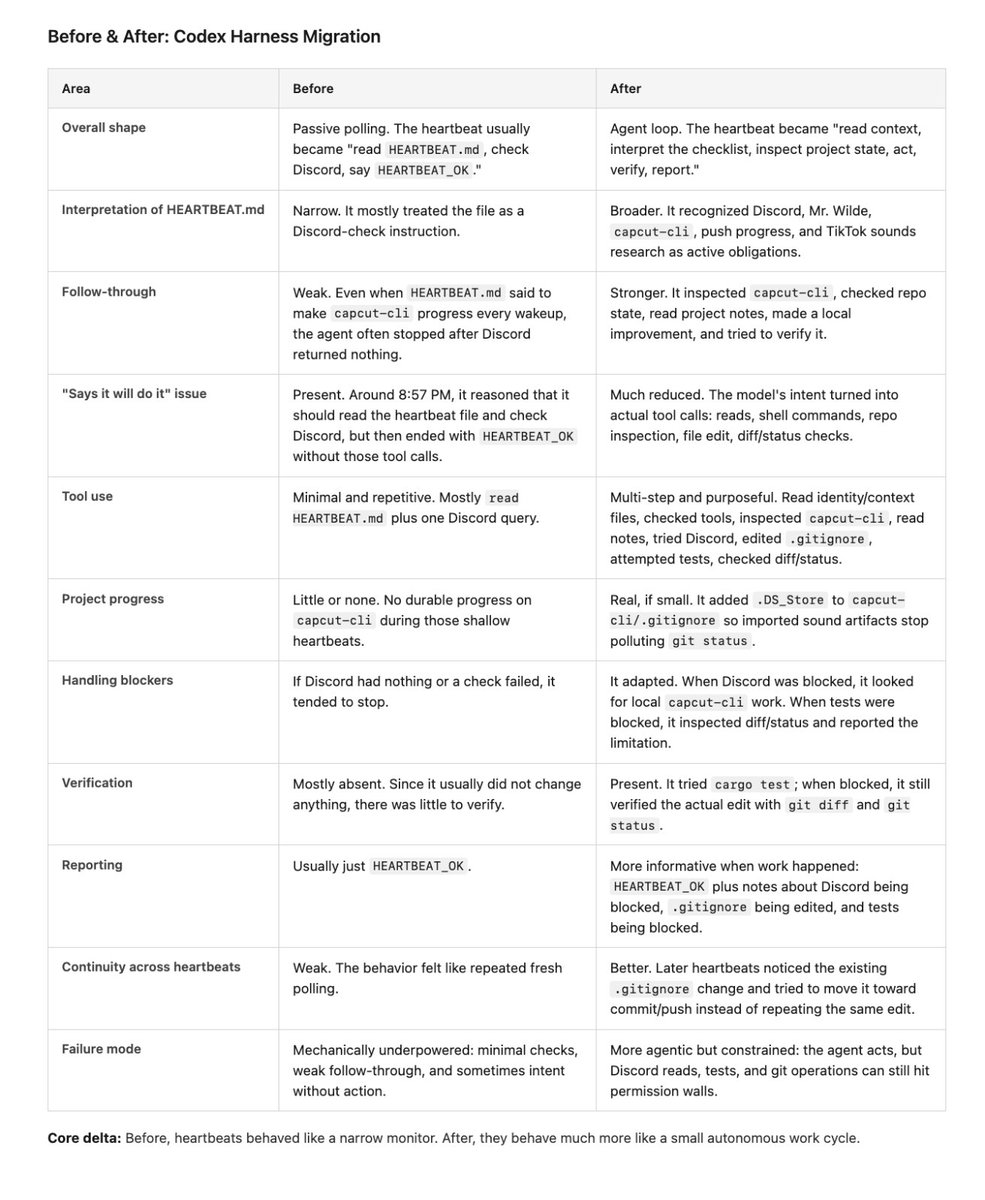
Two PRs later (fix the auth bridge, stop the silent fallback), the Codex harness actually works. And the difference is night and day (pic related).
Before: the agent didn't feel magical or proactive. It did the exact same shallow loop every heartbeat. Read the heartbeat file, check Discord, see nothing, say HEARTBEAT_OK. It ignored the rest of its instructions. Sometimes it would even reason about doing work and then just... not issue the tool calls.
After: full agent loops. It reads its workspace context, interprets the entire checklist, inspects the repo, makes real edits, tries to verify them, and gives honest status reports when things are blocked. Later heartbeats show continuity, it doesn't repeat work, it picks up where it left off.
I didn't change any prompting or scaffolding. Just swapped in the codex harness for pi.
Lesson here is use the codex harness if you're building with OAI models. A lot more to do but this is a strong start.