Freedom looks different for everyone. For us, it means holding multiple currencies, getting paid internationally, and moving money without borders. That freedom is yours with GreyFreedom looks different for everyone. For us, it means holding multiple currencies, getting paid internationally, and moving money without borders. That freedom is yours with Grey.
ADC’s decision to reduce nomination costs for young aspirants and women says something important about the kind of political party it is trying to build.
For aspirants aged 18 to 35, the party announced a 50% discount on nomination forms. Women and persons with disabilities received a 25% discount.
That is not a complete solution to the cost of Nigerian politics.
But it is a measurable step in the right direction.
Because one of the biggest barriers to political participation is money.
Talented young people can have ideas, education, community support and energy, yet still discover that the cost of entering a serious contest is designed for people who already have access to wealth or powerful sponsors.
The same problem affects many women.
They are encouraged to participate.
They are praised as important to democracy.
But too often, the financial structure of party politics makes meaningful competition unnecessarily difficult.
ADC is showing that inclusion can be more than a slogan.
It can be built into the rules.
Lowering nomination costs gives more people a realistic chance to step forward, compete, organise and test their support.
That matters because Nigeria needs a wider pipeline of leaders.
More young professionals.
More women with administrative experience.
More entrepreneurs.
More community organisers.
More people with local credibility who may never have belonged to the traditional political class.
A stronger democracy is one where entering politics does not require first becoming wealthy enough to buy access.
That is where ADC can distinguish itself.
Not by claiming every youth or woman automatically deserves a ticket.
But by making the doorway wide enough for more credible people to enter and compete.
Then let merit, organisation, ideas and grassroots support decide who advances.
That is healthier politics.
And politically, it gives ADC a powerful argument in 2027.
A party that wants to change Nigeria should also be willing to change how people gain access to political opportunity.
Fifty percent for young aspirants.
Twenty-five percent for women and persons with disabilities.
Those numbers are small compared with the larger transformation Nigerian politics still needs.
But they represent something concrete.
A political institution deliberately lowering one of the barriers that keeps new people outside the arena.
That is how renewal begins.
Not only by changing the names at the top.
But by changing who gets a genuine chance to rise from the bottom.
WHEN SOLUTION ARRIVES, THE MOVEMENT FEELS IT.
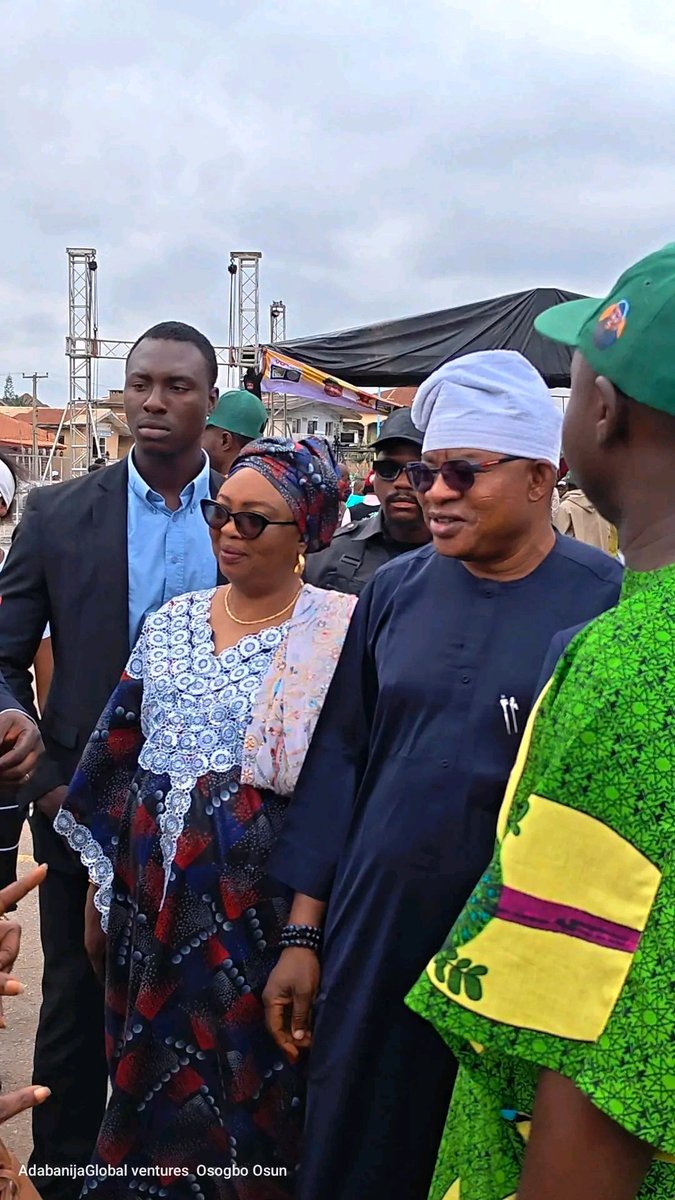
The atmosphere at the Osun ADC Governorship Campaign Mega Rally became even more electrifying with the arrival of Oloye Taofeeq Adegboyega, popularly known as “Solution,” the Oyo State ADC governorship candidate.
His presence in Osun is more than a ceremonial appearance. It is another powerful reminder that ADC is building a political family that understands the importance of solidarity, regional cooperation and collective victory.
From Oyo to Osun, the message is becoming clearer: the future of the South-West does not have to remain tied to the same political arrangements that have dominated the region for years.
Oloye Taofeeq Adegboyega represents a fresh political energy in Oyo, and his decision to stand with the Osun ADC family at such a crucial moment reflects the growing unity and confidence within the party.
This is how serious political movements are built.
Leaders show up for one another.
Structures connect across state boundaries.
Supporters begin to see that they are part of something larger than one election, one candidate or one state.
Today, Osun is the centre of attention.
Tomorrow, that same ADC energy can travel across Oyo, Ondo, Ekiti, Lagos and the entire South-West.
The arrival of “Solution” therefore carries a symbolic message:
ADC is not merely contesting elections. It is building a network of leaders capable of presenting Nigerians with a credible alternative.
Osun is rising.
Oyo is connecting.
The South-West is watching.
And ADC is steadily writing a new political story.
Arise and Shine, Osun.
Arise and Shine, Nigeria. ✊🏽
ROTIMI AMAECHI BRINGS SOMETHING NIGERIA URGENTLY NEEDS: AN INSTINCT FOR MOVING PEOPLE, GOODS AND THE ECONOMY.
Nigeria’s cost-of-living crisis is not only about prices in the market.
It is also about how expensive it is to move food, raw materials, workers and finished goods across the country.
That is where Rt. Hon. Chibuike Rotimi Amaechi adds serious value to the Atiku-Amaechi ticket.
Amaechi understands transportation not as a ribbon-cutting exercise, but as economic infrastructure.
Ports.
Rail.
Roads.
Logistics corridors.
Movement between farms and markets.
Movement between factories and consumers.
Movement between states and regional economies.
When these systems work, businesses become more competitive.
Food moves faster.
Waste reduces.
Transport costs fall.
Investment becomes easier.
Jobs expand.
And ordinary families eventually feel the difference.
This is what makes Amaechi politically important beyond Rivers State or the South-South.
He brings a practical understanding of how infrastructure can be used to unlock the economy.
Paired with Atiku Abubakar’s private-sector orientation and national economic experience, ADC can present Nigerians with a ticket that understands both capital and connectivity.
Atiku understands how to grow enterprise.
Amaechi understands how to move the economy.
That combination matters.
Nigeria cannot become a serious manufacturing and export nation while goods spend too much time trapped on bad roads, ports remain inefficient, farms are disconnected from markets and transport costs continue eating into household income.
The Atiku-Amaechi alternative can change that conversation.
Not transport as prestige.
Transport as productivity.
Not railways for photographs.
Railways that connect economic zones.
Not ports as isolated federal assets.
Ports integrated into national trade strategy.
Not roads built merely to announce contracts.
Roads that reduce the cost of doing business.
That is the kind of governing philosophy Nigeria needs.
Amaechi’s value is not simply that he has held office.
It is that his experience touches one of the biggest structural problems holding Nigeria back:
the cost of moving an economy of more than 200 million people.
By 2027, Nigerians should be looking for leaders who understand that reducing hardship requires more than subsidies and speeches.
It requires fixing the systems that make everything expensive in the first place.
That is where Rotimi Amaechi becomes a powerful part of the ADC proposition.
Atiku can help rebuild confidence in the economy. Amaechi can help rebuild the arteries through which that economy moves.
That is not symbolism.
That is a governing advantage.
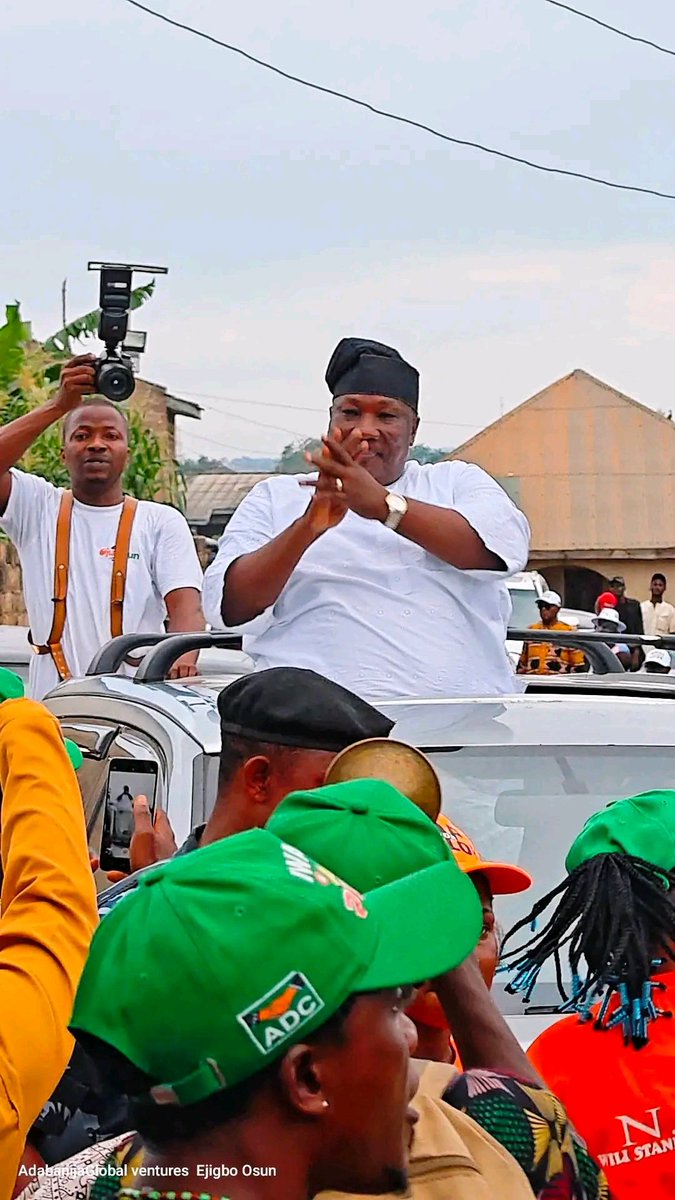
Yesterday, we were in Ejigbo to celebrate the 61st birthday anniversary of the African Democratic Congress (ADC) candidate, Dr. Najeem Folasayo Salaam, alongside the people of Ejigbo, who came out en masse to receive us.
I joined the Deputy Governorship Candidate, Mrs. Temitope Agiri, and other leaders of our great party in encouraging our supporters and the good people of Ejigbo to come out in their numbers to exercise their democratic rights, vote for our candidate and, importantly, protect their votes.
As the true heirs of Chief Obafemi Awolowo’s progressive tradition, rooted in quality education, accessible healthcare, social welfare, and opportunity for the masses, we believe Dr. Najeem Folasayo Salaam’s candidacy represents the continuity we need and the renewal we deserve.
ADC!
Arise and Shine!
OSUN MAY BE ABOUT TO TEACH NIGERIA A BIG POLITICAL LESSON.
For years, Nigerian politics has been conditioned to look like a contest between two giant establishments. Then comes an election where a third force has an opportunity to test whether organisation can defeat political entitlement.
ADC’s Najeem Salaam is not entering the Osun governorship race as a political stranger. He is a former Speaker of the Osun State House of Assembly, and behind the ADC campaign stands Ogbeni Rauf Aregbesola, a former two-term governor whose political structures and knowledge of Osun cannot simply be wished away.
That combination makes August 15 fascinating.
Because while APC is reportedly managing internal tensions and President Tinubu has been meeting party stakeholders ahead of the election, ADC has an entirely different opportunity:
Turn APC's anxiety into opposition momentum.
This is where political strategy matters.
ADC does not need to convince Osun voters that it possesses the biggest federal machinery.
APC already owns that argument.
ADC needs to convince them that another political centre is possible.
Take the campaign relentlessly into Osogbo, Iwo, Ikirun, Ede, Ile-Ife, Ilesa and the communities beyond the major towns.
Speak to traders.
Speak to teachers.
Speak to artisans.
Speak to farmers.
Speak to young voters who have spent most of their political lives watching the same establishments exchange power.
And make the election a simple question:
Must Osun always choose from the political arrangements already presented to it?
That is the opportunity Najeem Salaam and ADC have.
A victory would obviously give ADC a governor.
But politically, its meaning would travel much further than Osun.
It would tell Nigerians preparing for 2027 that the ballot can reorganise the political map faster than commentators imagine.
It would tell politicians sitting comfortably inside APC that incumbency is not immortality.
And it would tell opposition voters across Nigeria that a third force stops being theoretical the moment ordinary people decide to make it real.
APC has Abuja.
ADC must build from the streets.
Because sometimes political earthquakes do not begin in the capital.
Sometimes they begin with one state refusing to vote according to the old script.
Osun has the pen on August 15.
Nigeria will read what it writes.