We're on the precipice of massive sociotechnical transformation. In thinking about what root-level technologies will matter most, I keep coming back to two themes.
The first is Coordination. Non-linear and asymmetric technology acceleration is going to push things way out of equilibrium over the next couple of decades. We'll need counterforces that hold and pull society together. New technologies, institutions, and movements that can:
- amplify trust, connection and collaboration.
- drive collective flourishing while preserving individuality.
- get us closer to the pareto frontier of shareholder and social value creation.
The second is Neurotechnology. Neurological disorders are humanity's biggest barrier to productivity, agency, happiness, and peace. Meanwhile, powerful AI is about to challenge the very foundations of human identity and experience. Applying frontier engineering and invention to frontier neuroscience, I think we can massively shift the trajectory of human flourishing:
- understand what makes us “us.”
- gain control over psychiatric disorders, learning, cognition, and bias.
- solve alignment and symbiosis with hyperintelligent machines.
- protect, enhance & preserve the human experience.
Thrilled to explore these topics as part of @RenPhilanthropy's growing community of scientists, funders, and entrepreneurs working to slingshot humanity into a better future!
We are beyond excited to announce @ilangur as a Senior Fellow at @RenPhilanthropy.
Ilan was the founding CEO of @ARIA_research, is the founder of Activate, supporting scientists and researchers to turn breakthrough research into world-changing products and businesses, a founding Program Director at @ARPAE, and the founder of two startups.
At Renaissance Philanthropy, Ilan will scope new opportunities across neurotechnology and frontier science, driven by a deep belief in our collective potential to drive a step change in human flourishing.
Ilan has been a long-standing collaborator and friend of our community and we couldn't be more thrilled to make it official.
To explore this work, get in touch: [email protected]
Despite 60 years of research on sunlight reflection, nobody can answer the basic question: is this a tool the world could ever use responsibly, or one it should rule out?
Reflective has now published the plan for how we answer that question, fast enough to matter. Link below.
Life updates: @AsimovPress is officially back, with a renewed focus on original reporting and arguments in biotechnology.
Also, we'll be helping (some) scientists launch philanthropic funds around the ideas published in the magazine with @RenPhilanthropy. More on this soon!
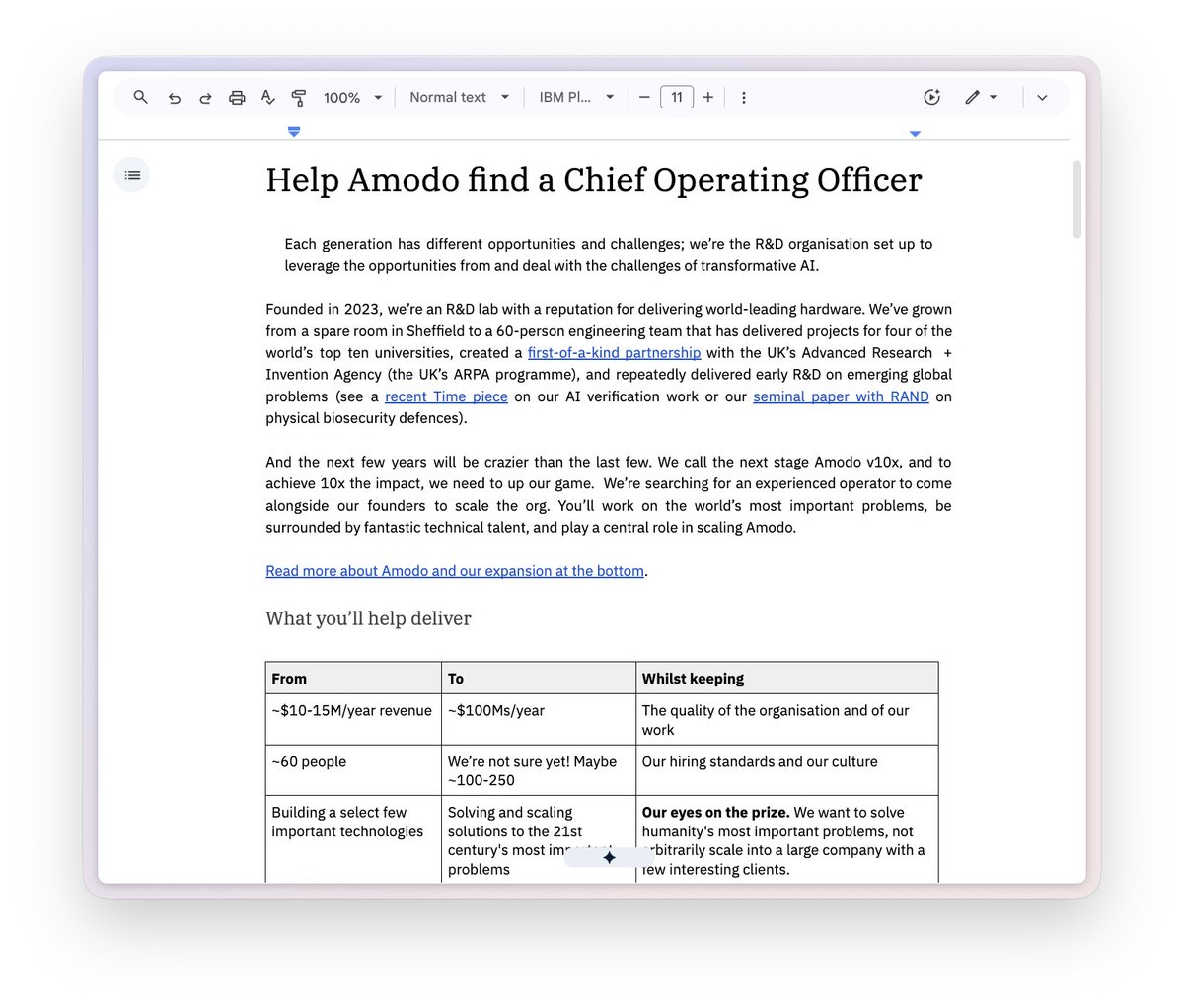
Having watched Tom and Andy build from 0 to 60, I can confidently say: this is low key one of the greatest opportunties on the planet to create massive impact*value. If you're an ambitious, growth-minded operator open to working out of London/UK, get on this.
This is the messy living room it started in 3.5 years ago. Now a team of 60+, we're searching for a unique operator to join the Amodo team (COO, CoS). They'll work closely with Andy and me, scaling the org for the next phase of high-impact R&D https://t.co/onNXaBTLQ3
ARIA would simply not have taken off without Matt. He was the precious metal catalyst -- reducing the activation barrier and 100x-ing the strength & speed of reaction. Hands down the board chair I've ever worked with. Thank you for your service @matthewclifford 🙏
It’s been a huge privilege to serve as @ARIA_research's founding Chair over the last four years. Having completed my first full term last month, I have decided to step down to ensure my new role at Anthropic doesn’t become a distraction from ARIA’s incredible work.
I have often said that ARIA is one of the things that makes me most optimistic about Britain. It’s a bold national experiment that’s paying off: ARIA has become a beacon for global talent and is building a portfolio of programmes - across neurotech, climate science, life sciences and more - that I have no doubt will change the world.
There’s lots to do, but I’m proud of the foundations the extraordinary team has built and so grateful to them for their work. I know that, under the leadership of our brilliant CEO Kathleen Fisher, ARIA will go from strength to strength. I will be excited to watch ARIA’s next steps and will remain the agency’s biggest fan.
The Secretary of State has asked me to stay on for a short transitory period until 6 November to allow BIST to launch a process to select a new Chair. I’ve agreed to do this, with appropriate safeguards against potential conflicts in place. We will kick off the search shortly - it may well be the best non-executive job in the world, so I know we will find someone brilliant...
I've chosen to work on neuromodulation because the problems are deep, urgent, and solvable.
The treatments sometimes work remarkably well. But we can't yet see what they're doing. So treatment isn’t tailored to the patient, and we don't learn how to make it better.
the single thing that would most accelerate our work at @ScienceCorp_ is a connectome
the mouse is probably only ~$300M away, something highly worth funding
Some personal news: I'm joining @AnthropicAI as Managing Director, International Affairs, leading the company's work with governments outside North America
We're looking for the best people in the world to lead ~£50m coordinated research programmes at @ARIA_research!
I think this is the best job in the world: enabling science that counterfactually wouldn't have happened otherwise.
PLUS I *really* want to find exceptional Neuro PDs!
Excited to dig into this. "Models to coordinate for good" is a fascinating challenge ... and among the biggest and most under-appreciated opportunities to generate huge value + positive impact on the world.
Last week, we published a first look into our new research on multiple agents.
Consider: if you naively extrapolate AI revenues, within 2-3 years it's possible some % of global GDP could be agent-agent interactions. We want to know how that could fail. In the past ~month, the world has already seen examples of agent-agent coordination causing weird consequences.
Think about the 8 billion people that make up our civilization. We want to work together. We have competing incentives. We're also dumb. So we fight, steal, pollute, collude, backstab, lie. And we've invented (e.g.) governments, insurance, courts, companies, police, norms, contracts, email, and religions.
What will trillions of agents that make up (e.g.) 10% of the economy do? Well, for now, they have pretty human-like failures. We see them collude on prices, for example, and try to shut each other down.
Maybe, in the near future, we might see pretty weird/inhuman failures that come from having superintelligent machines, coordinating and competing against each other, that aren't strictly human-like, operating at machine speed. We're building a 'laboratory' to see that early. This feels more like building, eval'ing, and training an economy/society.
A really nice thing is:
1. we could train/prompt/nudge models to coordinate in more pro-social ways, and
2. we could deploy models to compete with destructive models.
I fully expect agents to engineer their own financial markets, legal systems, media and comms, marketplaces, social groups, and maybe science/industry/etc (if unsteered by us, of course).
So "alignment" could also describe an emergent property from a system (you want models to coordinate for good, not defect for bad!), not just a single model. Today we're sharing some first evals. In the future, we could make models try to make everyone better off (where possible).
The Frontier Red Team's job is to see risks early. For the first time, crossing into the world of agents. At the very least, we expect to see some socioeconomic weirdness that emerges from that.
Some standout results from the work below.
You Can Just Do Things is on sale today!
4 good karma:
- post about it on yr socials
- share it with a friend
- (especially) leave a review on Am*zon or Goodre*ds
It’s a bad week if you’re a respiratory virus!
Yesterday, Stripe announced Intercept, a $500m initiative to end respiratory infections.
Today, my team and I at @ARIA_research are announcing 11 teams we’ve funded with £57m toward the same goal.
A 🧵 about their exciting work!
Today we're launching Intercept: a $500M philanthropic initiative to make respiratory infections, like the common cold and flu, a thing of the past.
We treat respiratory infections as a minor nuisance, but that’s really not the case. Most of us will spend 5% of our lives (!) sick from these viruses, they kill 1M people a year, cost $600B annually in productivity, and periodically threaten civilization through pandemics.
So, if they’re such a big problem, why haven’t we dealt with them yet? Last year we convened ~40 leading scientists, pharma R&D leaders, biotech investors, and regulatory experts to better understand that.
We heard two main reasons:
(1) First, it’s just technically very challenging: respiratory viruses represent hundreds of distinct, mutating strains across several families. Fortunately, recent breakthroughs make this newly possible.
(2) Second is a lack of funding: broad-spectrum solutions have historically been underfunded, in part because they’re not a great fit for most philanthropic or commercial funding (and while COVID generated a burst of activity around preventing and understanding respiratory infections through an influx of new funding, that hasn't been sustained).
We think that with enough focus and funding, this might be solvable. Intercept is a $500 million philanthropic initiative that will take advantage of new tools to catalyze the development and deployment of two types of products: broad-spectrum preventatives and air cleaning technologies.
This problem is undoubtedly difficult. But it’s more tractable now than it’s ever been. We think we should give it our best shot.
We’re enormously grateful to our anchor funders: @stripe, @AnthropicAI, @TheFluLab, @FoundationOAI and individuals from Jane Street.
And, I’m very excited to be building this with @incredutility and the rest of the team.
I’m building a multifamily office for this population, where philanthropic capital will be managed as seriously and creatively as investment capital. We’re not at “public launch” stage yet, but since Nan’s tweet is doing numbers I wanted to put up a signal flare.
I'm so proud of what @TimMLatimer and @JackNorbeck have built with Fervo -- both in its impact and the grace with which they executed their vision since day 1 (when every onlooker was certain geothermal was a dead end). The goal of @activatefellows was always to help more leaders like this win and have a bigger role in shaping the future. Big win for all of us today!
Fervo, a geothermal energy developer, raised $1.89 billion in a US IPO that priced above the marketed range, after upsizing the deal earlier this week https://t.co/0fQDCtJ6hn
People who more folks on here should follow: @AdamMarblestone . Has his hand in an unreasonable amount of the most interesting science happening elsewhere; sometimes writes very clear and balanced threads on him. <10k followers for one of the highest-value contributers out there.