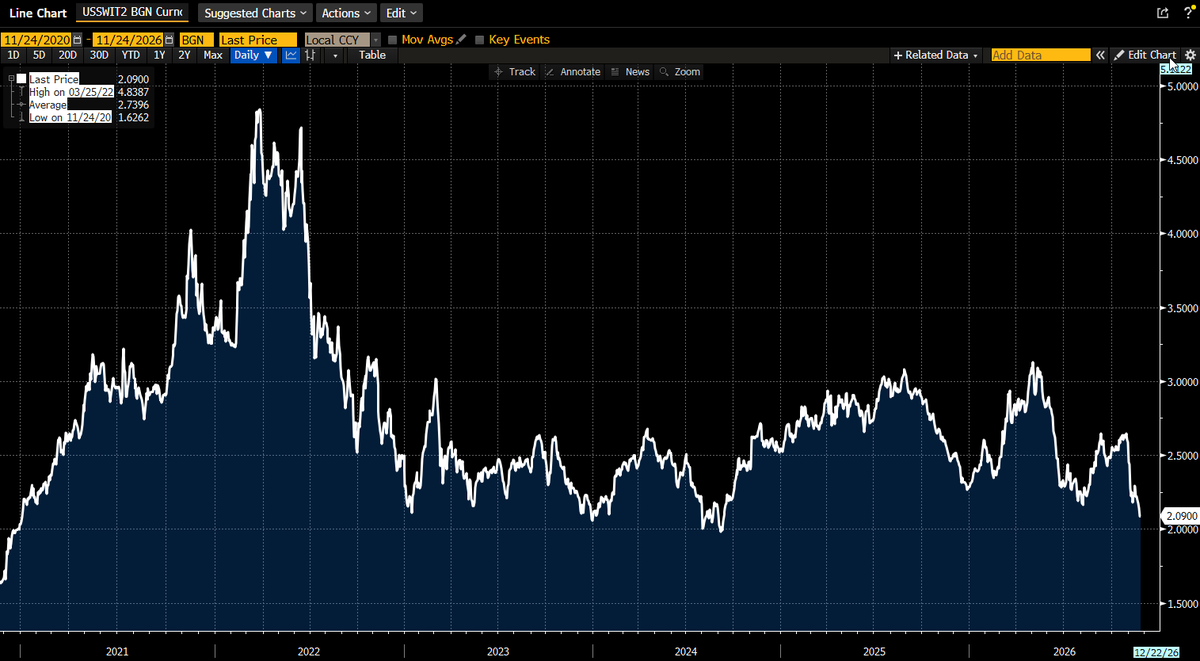
The question is not whether the Fed can raise interest rates high enough to return inflation to 2% without causing another financial crisis. It can't. The only question is when the Fed will be forced to stop pretending that it can.
Inflation is gone. Todays PCE report is from October. Since October oil is down 25% and the equity markets have lost 7-8 trillion in market cap. The Fed is sleep walking toward a mistake. The only question how big a mistake it will be…
🇺🇸 INSIGHT: Peter Schiff predicts the Fed will pivot not because inflation returns to 2%, but because rate hikes crash financial markets and the economy.
I've been warning about the risks of a strengthening U.S. dollar and the global liquidity squeeze it appears to be triggering. The longer this goes on, something breaks, forcing the Fed to respond. That's when I think real yields begin falling and the dollar ultimately reverses.
What's interesting is that gold surged roughly 67% in 2025 despite real yields remaining around 2%. Historically, that should have been a significant headwind, but instead, investors and central banks kept buying. To me, this suggests gold is increasingly trading on concerns about sovereign debt, currency debasement and confidence in the monetary system, rather than simply responding to interest rates.
But I wouldn't confuse being bullish on gold longer term with being bullish right now. During liquidity squeezes, gold and commodities can get hit hard as investors sell assets to raise cash, cover margin calls and reduce leverage. A strengthening dollar compounds the pressure. I think we could see further weakness until this liquidity crisis finally runs its course, even if the longer-term fundamentals remain compelling.
Here's the bigger question. If gold can rise 67% with real yields around 2%, what happens when the Fed is eventually forced to ease aggressively and real yields head toward zero or turn negative? That's when the dollar could reverse and gold could benefit from both falling real yields and growing demand for monetary insurance. I'm cautious near term, but increasingly bullish on what comes next. The liquidity squeeze may create the very opportunity that makes the next leg higher possible.
🗣️ Jose Mourinho menanggapi komentar gelandang Villarreal, Santi Comesana seusai laga v Barcelona yang mengatakan 'tekanan yang diberikan pemain Barcelona dan Real Madrid sangat keras sehingga bisa mempengaruhi keputusan wasit' :
"Dia mengalami amnesia, karena saat melawan Real Madrid, gol yang seharusnya membuat skor menjadi 2-0 dianulir, Vinícius diusir keluar lapangan, kami bermain dengan sepuluh pemain selama 20 menit ditambah 8 menit tambahan waktu.
Entah dia mengalami amnesia atau memang suka menyamakan kedua klub. Selama dia tidak menyamakan kami dengan mereka (Barça) dalam kasus Negreira, silakan saja dia terus mengatakan hal-hal konyol."
📝 Konferensi pers
JENSEN HUANG: “Bitcoin is taking excess energy and storing it into a new form... It's called currency. And you take that currency and you take it wherever you like. So you took energy from one place and now you've transported it everywhere.”
Trump Put in effect.. (this along with the Fed Put and the Vanguard Put is why you will never find me bearish long term as I'd rather create wealth than sound smart)
to give you an idea, the NVDA green candle today alone is equivalent to:
- 71 Zcash
- 22 Solana
- 250 NEAR
entire marketcaps -- in one minute
in fact it moved by almost the entire market cap of Bitcoin
we are basically playing with child money
Sejumlah barang bukti telah dikantongi Bareskrim Polri dalam penyidikan kasus dugaan makar yang menjerat eks Kapolri Jenderal Listyo Sigit Prabowo. Di antaranya, ada kaus bergambar salam tiga jari hingga bendera One Piece.
"Penyidik telah melakukan penyitaan terhadap barang bukti yang terkait dengan perkara tersebut," kata Kabareskrim Polri Komjen Asep Safrudin dalam jumpa pers di Mabes Polri, Jakarta, Senin (23/11).
Asep lalu memaparkan barang bukti yang disita. Berikut daftarnya:
- 39 barang bukti elektronik, yang meliputi handphone, laptop, CPU, dan harddisk;
- 250 pcs kaos berwarna hitam bergambar senjata api dan bertuliskan "All Cops Are Bastard";
- 251 pcs kaos warna hitam yang bertuliskan "Sadar Dipalak, Sadar Dibakar, Sadar Dimiskinkan" bergambar salam tiga jari dengan tulisan #IndonesiaSadar;
- Satu buah buku catatan hasil anev satgas berwarna biru.
- 20 pcs bendera One Piece;
- Uang tunai Rp 735 juta.
📸: Dok. TV Polri, kumparan/Pradya.
Baca selengkapnya dengan klik link di bio. Cari tahu berita update lainnya dengan download aplikasi kumparan di App Store atau Google Play.
📝: newsupdate | update | news | vidol | updateme | R129 | R384 | E099 | E164
#bicarafaktalewatberita #kumparan
it's a good time to accumulate bitcoin.
asian wealth is huge.
what’s missing is the right product, for the right money.
that’s Long Lens.
partnering with China Chengxin Indices is remarkable.
index is how long-term capital will own this.
looking forward to a great bull run.
The 2% inflation target was randomly set by a dude in New Zealand decades ago… based on his gut!
Grok says: It started with an off-the-cuff remark from New Zealand's Finance Minister, Roger Douglas, and central bank staff then turned it into an official number.
In April 1988, New Zealand's inflation had been running in double digits. When Douglas was asked on TV what he was aiming for, he said something like "around 0 or 1 percent." That wasn't based on any model.
He basically blurted it out, and the Reserve Bank's officials have since said they were caught off guard.
Then the Reserve Bank of New Zealand Act of 1989 gave the central bank one job, price stability, and required it to agree on a numeric target with the government.
The first agreement, signed in March 1990 by Governor Don Brash and Finance Minister David Caygill, set a range of 0 to 2% to be hit by 1992. Staff justified the range after the fact.
They argued that measured inflation probably overstates real inflation by about a percentage point, because price indexes miss quality improvements. They also wanted some room above zero so the economy wouldn't slip into deflation.
From there, the number spread around the world. Canada adopted a target in 1991, the UK in 1992, and others followed. Countries settled on about 2% as the midpoint, and the Fed made 2% official in January 2012 under Ben Bernanke.
Later academic work defended 2% for reasons like leaving room to cut interest rates. But the number's origin really does trace back to a politician's TV answer, not to research.