We Shall Never Forget: July 5, 1977 — the black day democracy was attacked & Quaid-e-Awam Shaheed Zulfikar Ali Bhutto’s elected government was overthrown.
Tribute to Shaheed Bhutto, Shaheed Mohtarma Benazir Bhutto & all who fought tyranny for people’s rule.
#5thJulyBlackDay
#WeShallNeverForget #BhuttoLivesOn
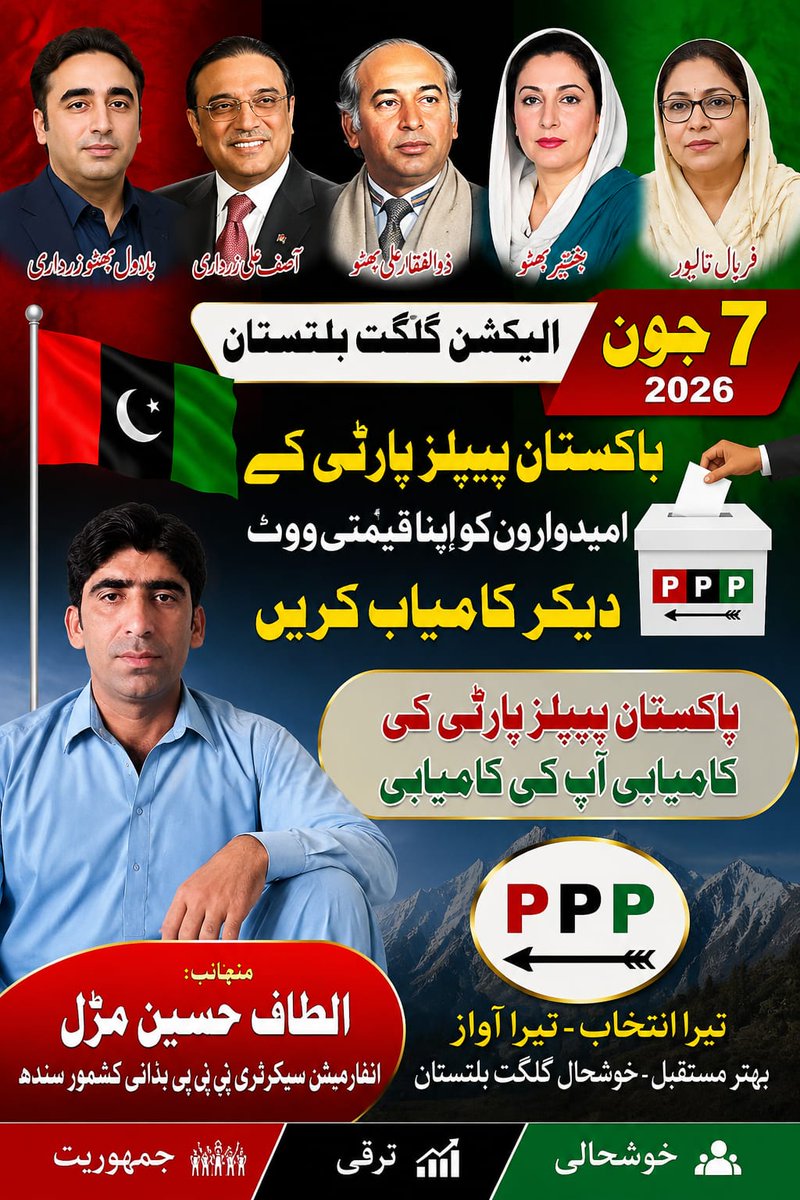
7 جون کو فیصلہ ترقی کا، فیصلہ تیر کا ✌️
۔
ووٹ بہتر روزگار کا۔
ووٹ روشن مستقبل کا۔
ووٹ گلگت بلتستان کے حقوق اور خوشحالی کا۔
آؤ مل کر چیئرمین بلاول بھٹو زرداری اور آصفہ بھٹو زرداری کے پیغام کو کامیاب بنائیں۔
@BBhuttoZardari@AseefaBZ
#جیکب_آباد
چیئرمین پاکستان پیپلز پارٹی بلاول بھٹو زرداری نے
جیکب آباد پہنچ کر ایم این اے میر اعجاز حسین خان جکھرانی سے انکے فرزند کی وفات پر تعزیت کی اور مغفرت کے لیے دعا کی۔
@BBhuttoZardari@Aijazjakhrani1
Respected Adi @FaryalTalpurPk
Many Happy Returns of the Day! 🎂🫶
Wishing you a beautiful year ahead filled with everlasting happiness, abundant love, excellent health, peace, prosperity, and all the wonderful things your heart truly desires. May your special day bring endless smiles to your face, immense joy to your heart, and countless blessings to your life, Aameen
Thank you for being such an inspiration. Have a fantastic birthday celebration! 🌹❤️
Lots of Love and Prayers ❣️
CPGS Strategic Assessment & Situation Report: US-Iran Ceasefire Dynamics & Islamabad Process – 20 April 2026 🧵2/4
➡️ Islamabad Talks Status & Delegations
The first round of direct talks (11-12 April) produced incremental progress on select technical issues but concluded without full agreement, highlighting persistent gaps on enrichment timelines, enriched uranium stockpile management, Hormuz navigation protocols, sanctions sequencing, and broader ceasefire assurances. Iranian state media and officials have stated that reports of a second round of talks commencing in Islamabad are not true, with no delegation planned while the US naval blockade remains in place. Tehran maintains a firm red line: the Strait of Hormuz remains fully closed under IRGC control until the US completely lifts its port blockade.
In a notable symbolic gesture during the first round, Parliamentary Speaker Mohammad Bagher Ghalibaf led the Iranian delegation aboard a flight named “Minab 168”, in honour of the victims of the 28 February 2026 strike on Shajareh Tayyebeh Girls’ Elementary School in Minab. Iranian authorities reported that the strike killed 168 people, the vast majority of them schoolchildren (primarily girls), along with teachers and others present. Empty seats on the aircraft were adorned with portraits, school bags, personal belongings, and flowers belonging to the young victims. Speaker Ghalibaf shared images on social media, describing the children as “my companions on this flight,” thereby presenting them as a solemn reminder of the human cost of the conflict and the moral imperative for accountability in the negotiations.
Iran continues to demand justice and accountability for the attack, along with compensation for economic losses incurred during the US-Israeli operations, unfreezing of assets, and comprehensive sanctions relief before full normalisation. A senior Iranian official with direct access to Tehran’s deliberations has warned that any resumption of US bombing would lead Tehran to cut off all diplomatic channels entirely, shift focus to fighting, and make conditions for any future deal significantly harder. President Pezeshkian has reiterated the need to end the conflict “with dignity” while preserving Iran’s nuclear rights. Iranian Foreign Minister Abbas Araghchi has stated that Iran “will use all its capabilities to safeguard its security” during recent talks with Pakistan’s Foreign Minister, underscoring Tehran’s determination to protect its core interests while engaging in the mediation process.
➡️ Analysis of US President Trump’s Statements & Domestic Fallout
US President Trump’s communications reflect a calibrated yet inherently dual-track approach: expressions of optimism for a mutually beneficial deal (sanctions relief, energy market stabilisation) juxtaposed with explicit threats of renewed strikes on Iranian infrastructure should talks falter. This messaging, while intended to maintain leverage, has generated measurable distrust on the Iranian side — exacerbated by perceptions of excessive US demands, unreasonable expectations, frequent shifts in positions, continuous contradictions, and the naval blockade itself being viewed as a violation of ceasefire understandings. Iranian officials describe these elements, along with threatening rhetoric, as having hindered progress and framed US media narratives as a propaganda & “blame game” campaign aimed at pressuring Tehran.
Domestically in the United States, the initiation of hostilities — widely viewed as unprovoked given ongoing US-Iran negotiations in Oman — has triggered significant criticism, public protests, congressional scrutiny over costs and timelines, debates on war powers, and discussions of broader policy implications. A recent US media poll shows President Trump’s approval rating has fallen to a second-term low of 37% amid the war on Iran.
🧵—Continued ⤵️
CPGS Strategic Assessment & Situation Report: US-Iran Ceasefire Dynamics & Islamabad Process – 20 April 2026 🧵1/4
➡️ Executive Summary The US-Israel military operations against Iran, which commenced on 28 February 2026, have transitioned into a fragile two-week ceasefire brokered through Pakistani mediation and effective since approximately 8 April. Large-scale hostilities remain paused, yet the US naval blockade of Iranian ports (in place since 13 April) and recent incidents in the Gulf of Oman and Strait of Hormuz continue to generate volatility. Iranian state media and officials have stated that reports of a second round of direct US-Iran talks in Islamabad are not true, with no delegation planned while the blockade persists. A separate Israel-Lebanon/Hezbollah ceasefire from 16 April holds amid reported ceasefire violations by Israel and strikes. US military posture in CENTCOM remains at one of its highest levels since 2003, indicating war readiness, enforcing the blockade, while exerting pressure to create diplomatic space. The process occurs against the backdrop of assassinations of senior Iranian leadership, including the Supreme Leader, and a heavy civilian toll that has deepened emotional and political stakes on all sides.
➡️ Recent Developments & Conflict Context The conflict phase inflicted significant leadership losses through the assassinations of Iran’s Supreme Leader and several top-tier figures, creating a notable command vacuum that has complicated negotiations and diplomacy while underscoring the urgency of restoring stable high-level channels. Civilian casualties have been substantial, including a strike on a school that claimed the lives of over 165 children, alongside widespread damage to strategic and civilian infrastructure. These human and material costs continue to shape Iranian narratives and red lines. On 19 April, US forces intercepted the Iranian-flagged vessel Touska near the Strait of Hormuz, citing blockade enforcement; Iranian authorities described the action as inconsistent with ceasefire understandings and indicated preparations for a proportionate response. Iran has maintained IRGC-coordinated control measures in the Strait, signalling that it will remain closed under such control until the US fully lifts its port blockade. President Trump has maintained a dual-track public posture — affirming openness to a “fair and reasonable deal” while warning of targeted infrastructure strikes (power plants, bridges) if progress stalls.
➡️ US Military, Marine & Naval Deployments | Security and Maritime Developments: Buildup, Targets, Escalation Risks and Theatre Expansion The United States maintains an exceptionally robust force posture in the CENTCOM region, exceeding 50,000 personnel. This includes multiple carrier strike groups — USS Abraham Lincoln and USS Gerald R. Ford actively deployed in theatre, with USS George H.W. Bush en route for late-April arrival — supported by 15-20+ surface combatants enforcing maritime measures. Amphibious capabilities feature the USS Tripoli (approximately 3,500 Marines) and the Boxer Amphibious Ready Group plus 11th Marine Expeditionary Unit (adding roughly 4,200 troops). Elements of the 82nd Airborne Division and advanced air assets at regional bases further enhance flexibility. The configuration signals full war readiness while focusing on port blockades, vessel interdiction, and deterrence of Iranian naval or affiliated forces. Operational assessments indicate Iran retains significant reserves of long-range missiles and thousands of drones due to pre-conflict dispersal. Escalation risks centre on Strait of Hormuz compliance, potential spillover from Lebanon-related incidents, and broader theatre expansion if regional networks activate. Targets remain primarily maritime and infrastructure-related, with careful calibration to avoid broader ground engagement.
🧵—Continued ⤵️
U.S.-Iran Talks: Pakistan’s Balancing Act With Saudi Partnership
By @salmanmasood@ForeignPolicy
“Saudi Arabia is a major source of energy supplies, financial assistance, and remittances from Pakistani workers in the Gulf,” said Sehar Kamran, a Pakistani member of parliament with long-standing connections in Saudi Arabia. “These ties naturally push Pakistan toward a closer alignment with Riyadh.”
https://t.co/pIgB4iTbX6
Welcome to Pakistan, H.E. Speaker @mb_ghalibaf.
May Allah سُبْحَانَهُ وَتَعَالَى accept the countless sacrifices of these innocent children and martyrs of #Minab168 — whose pure faces now travel with you as a solemn reminder of unimaginable loss. Grant them the highest ranks in Jannah, and bring healing, strength, and prosperity to their grieving mothers and the resilient Iranian nation, آمین
It was an honour to meet H.E. Foreign Minister @araghchi, along with H.E. Ambassador @IranAmbPak, at the Embassy of Iran in November 2024 during more peaceful times. Today, as you and the Foreign Minister arrive in Islamabad for these critical peace talks with the United States, I welcome you once again with sincere hopes and prayers.
May these negotiations, hosted on Pakistani soil, deliver justice for the innocent blood shed, an end to aggression, and a durable peace that the region so desperately needs — so you may carry hope and stability back home.
🇵🇰🤝🇮🇷
#PakistanIranFriendship #IslamabadTalks #Minab168
@PresOfPakistan
At times, even otherwise intelligent individuals fail to grasp the importance of timing, knowing when to speak and what to say. Truly disappointing to see this post.
No individual should ever be projected above the State’s interests. No sensible political mind should think otherwise. In moments of such sensitivity, those who understand the gravity of the situation must exercise restraint rather than make ill-timed suggestions.
Today, without a doubt, the nation feels proud and stands united behind the State of Pakistan at this critical juncture. A ceasefire has been achieved, and talks are set to begin, an outcome made possible through Pakistan’s timely and effective diplomatic efforts, led by PM Shahbaz Sharif, Field Marshall General Asim Muneer and Foreign Minister Ishaq Dar, recognised and acknowledged by world leaders and the international community.
At this moment, nothing is more important than ensuring these talks succeed, not just for the region, but for global stability. The focus of all stakeholders should be to support and pray for the success of this mediation.
Everything else can wait. Every other issue can, and must, be addressed at an appropriate time, through political dialogue and proper legal forums.
اسان پيپلزپارٽي جي اعلي قيادت ۽ پنهنجي حلقي جي نوجوان سياستدان ايم اين اي سردار علي جان مزاري جا شڪرگذار آهيون جو سندس ڪوششن سان ميگا پراجيڪٽ تحت بڊاڻي شهر جا روڊ ۽ رستا جلد تعمير ڪيا ويندا
@AliJanMazari1@BBhuttoZardari
MNA Sehar Kamran (TI) Pays Glowing Tribute to Quaid-e-Awam Shaheed Zulfikar Ali Bhutto on His 47th Martyrdom Anniversary
Islamabad, 4th April 2026: MNA Sehar Kamran (TI), Member National Assembly of Pakistan, paid glowing tribute to Quaid-e-Awam Shaheed Zulfikar Ali Bhutto, Nishan-e-Pakistan, on his 47th martyrdom anniversary, honouring the visionary founder of the Pakistan Peoples Party whose legacy continues to inspire generations.
MNA Sehar Kamran stated that Shaheed Bhutto awakened the people of Pakistan and gave them the gift of hope — hope for themselves and for the future of their country. He empowered the masses by making them aware of their rights and giving them a powerful voice. Shaheed Zulfikar Ali Bhutto introduced National Identity Cards for the first time, ensuring every citizen felt recognized and valued.
She emphasized that under his visionary leadership, Pakistan’s foreign policy became dynamic and assertive — a standard deeply missed today. This day reminds us that democracy is the only path forward for Pakistan, leading to stability, prosperity, development, peace, progress and unity.
Highlighting his contributions, MNA Sehar Kamran said initiatives such as the 1973 Constitution, internationalization of the Kashmir issue, the Simla Agreement, land reforms, major public sector projects like Pakistan Steel Mills, free and compulsory education, and above all the launch of Pakistan’s nuclear program remain enduring pillars of national strength. He also established key institutions including Allama Iqbal Open University — Asia’s first open university.
In today’s era of global challenges and geopolitical tensions, Shaheed Bhutto’s foresight has enabled Pakistan to stand tall as a sovereign, strong Muslim nation — the only nuclear state with robust defence capabilities. This strength continues to safeguard our sovereignty and allow us to navigate a turbulent world with confidence.
Shaheed Bhutto laid a clear path of Muslim unity through the historic 1974 Islamic Summit in Lahore. Today we must revive that spirit — overcoming differences and finding peaceful resolutions — so the Muslim Ummah stands strong.
Quoting Shaheed Bhutto: “We will eat grass, even go hungry, but we will get one of our own [the atom bomb]… We have no other choice!”
The sacrifices of Shaheed Bhutto and his family for democracy will forever be etched in golden words. His legacy of people-centric leadership, national self-reliance, and commitment to Pakistan’s security will continue to shine brightly. He will be remembered as one of the greatest leaders, with his footprints immortalized in the hearts of the people.
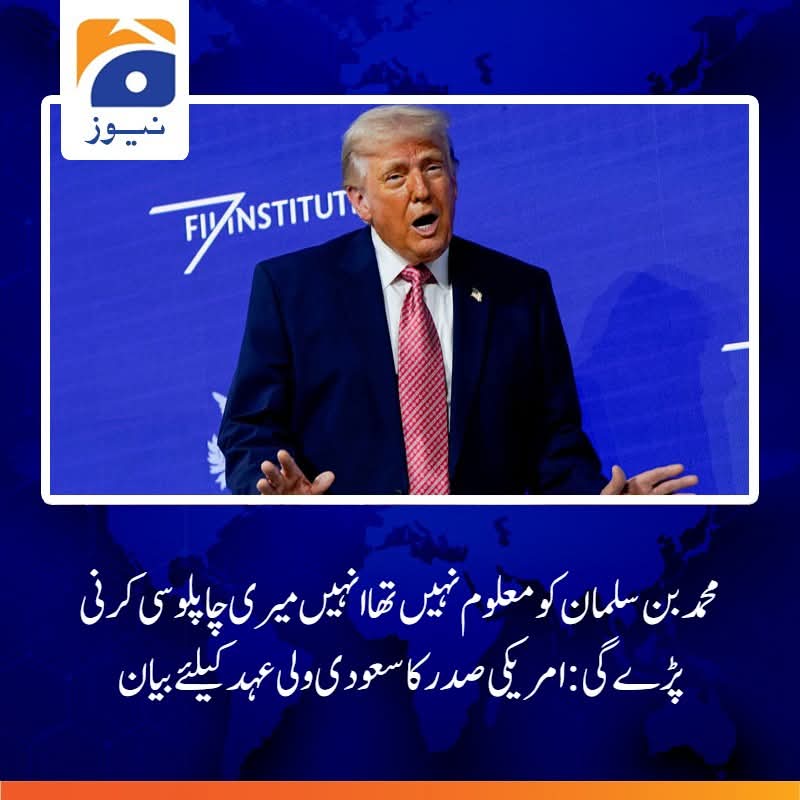
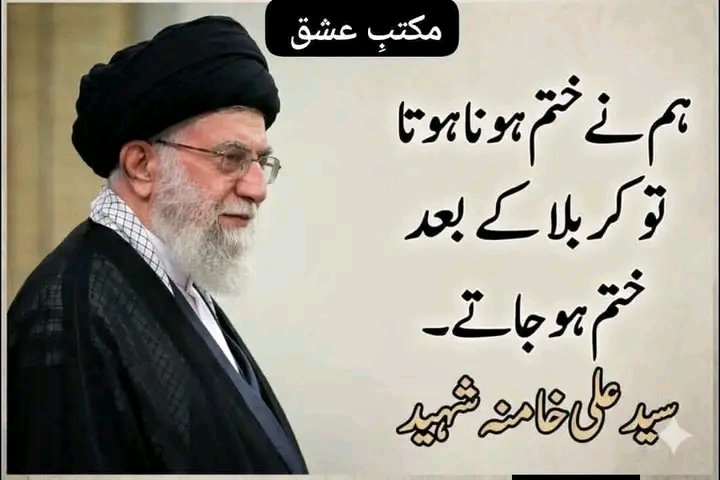
آیت اللہ خامنائی کی شہادت اور سعودی ولی عہد بن سلمان کی تازہ ذلت کے بعد امام حسین علیہ السلام کے اس فرمان کی سمجھ تو آ گئی ہوگی کہ انہوں نے فرمایا تھا
میں ظالموں کے ساتھ زندہ رہنے سے موت کو ترجیح دیتا ہوں
سر اٹھا کر جینے کی سيد علی خامنہ ائ کی طرح قیمت ادا کرنی پڑتی ہے۔
جبکہ سر جھکا کر جینے کا معاوضہ ملتا ہے۔؟ میرے خیال میں امت مسلمہ کے لیے سعودی ولی عہد کی زندگی بہت اہم ہے اس لئے چاپلوسی بھتر آپشن ھوگا؟🚩*
جن ممالک نےاپنی سیکورٹی کےلئے بیرونی،کتے،رکھےمگر اس مشکل وقت میں وہ، کتے سیکورٹی تو نہ دے سکےلیکن جان بچانے کےلئےسیکورٹی مانگ رہاہےبلکہ ان کتوں کی موجودگی ممالک کی سیکورٹی کےلئےخطرہ بن چکے ہیں اب ان کتوں کو سیکورٹی کےلئےرکھنا اور ان پر اربوں،کھربوں ڈالر لگاناکہاں کی عقلمندی ہیں
+







![SeharKamran's tweet photo. MNA Sehar Kamran (TI) Pays Glowing Tribute to Quaid-e-Awam Shaheed Zulfikar Ali Bhutto on His 47th Martyrdom Anniversary
Islamabad, 4th April 2026: MNA Sehar Kamran (TI), Member National Assembly of Pakistan, paid glowing tribute to Quaid-e-Awam Shaheed Zulfikar Ali Bhutto, Nishan-e-Pakistan, on his 47th martyrdom anniversary, honouring the visionary founder of the Pakistan Peoples Party whose legacy continues to inspire generations.
MNA Sehar Kamran stated that Shaheed Bhutto awakened the people of Pakistan and gave them the gift of hope — hope for themselves and for the future of their country. He empowered the masses by making them aware of their rights and giving them a powerful voice. Shaheed Zulfikar Ali Bhutto introduced National Identity Cards for the first time, ensuring every citizen felt recognized and valued.
She emphasized that under his visionary leadership, Pakistan’s foreign policy became dynamic and assertive — a standard deeply missed today. This day reminds us that democracy is the only path forward for Pakistan, leading to stability, prosperity, development, peace, progress and unity.
Highlighting his contributions, MNA Sehar Kamran said initiatives such as the 1973 Constitution, internationalization of the Kashmir issue, the Simla Agreement, land reforms, major public sector projects like Pakistan Steel Mills, free and compulsory education, and above all the launch of Pakistan’s nuclear program remain enduring pillars of national strength. He also established key institutions including Allama Iqbal Open University — Asia’s first open university.
In today’s era of global challenges and geopolitical tensions, Shaheed Bhutto’s foresight has enabled Pakistan to stand tall as a sovereign, strong Muslim nation — the only nuclear state with robust defence capabilities. This strength continues to safeguard our sovereignty and allow us to navigate a turbulent world with confidence.
Shaheed Bhutto laid a clear path of Muslim unity through the historic 1974 Islamic Summit in Lahore. Today we must revive that spirit — overcoming differences and finding peaceful resolutions — so the Muslim Ummah stands strong.
Quoting Shaheed Bhutto: “We will eat grass, even go hungry, but we will get one of our own [the atom bomb]… We have no other choice!”
The sacrifices of Shaheed Bhutto and his family for democracy will forever be etched in golden words. His legacy of people-centric leadership, national self-reliance, and commitment to Pakistan’s security will continue to shine brightly. He will be remembered as one of the greatest leaders, with his footprints immortalized in the hearts of the people.](https://pbs.twimg.com/media/HFDKPPPbIAAarZ7.jpg)