@ORGEarnWithMike Hi Mike. You have personally been a tremendous help to me for years!! Your website was the first I came across when looking for legitimate ways to earn online. I am so truly sorry such an unjust and completely unfair thing is happening to you! Reposted!
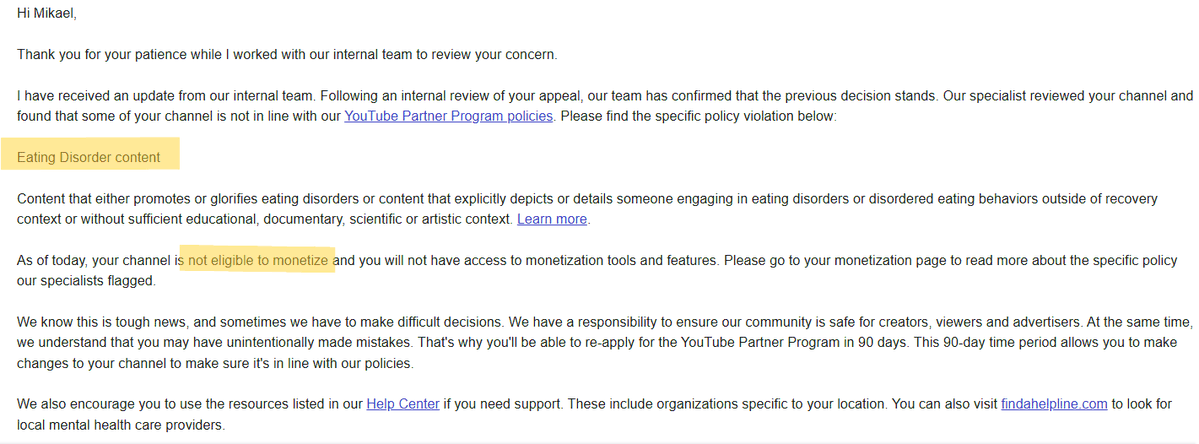
YouTube just demonetized my channel for "Eating Disorder content."
My channel is about paid survey sites.
I have had it for almost 10 years. I review survey sites and other ways to earn a bit of extra money online, with a focus on free methods and realistic advice. The channel has 2,000+ videos and 550,000 subscribers, and not one video, not one, has ever been about eating disorders. Or dieting. Or weight. Or anything within a hundred kilometers of the topic.
I thought it had to be a mix-up, and that maybe they reviewed the wrong channel. So I asked.
They confirmed it was my channel, so I asked them to show me where this eating disorder content is. Their answer: they cannot point to any specific video or moment. But the decision is final and cannot be reviewed again.
Read that again. My income was removed for content that nobody can locate, under a policy that has nothing to do with my channel, and there is no way to appeal it.
The best part? The rejection email helpfully included links to mental health resources and a helpline finder. Clearly, this is just an automated template reply, and no human being has looked at my channel at any point in this process. A human would have noticed within 10 seconds that I review side income methods.
And here is what makes it worse: this is not the first time. In January, YouTube's automated system wrongly flagged my channel and removed videos. Back then, their own Policy team reviewed the case, confirmed the removals were a mistake, and reinstated my videos. I have that in writing. They even promised that any future flags on my channel would be thoroughly reviewed by a human before action was taken, but five months later, this happens.
I have spent 10 years on this platform telling people the truth about survey sites and other free earning methods, including warning them about scams. I have done everything right, and I have helped thousands and thousands of people earn a bit of extra money online and avoid scams.
@TeamYouTube@nealmohan I am asking for the one thing every creator should be able to count on: that a human looks at a channel before its income is removed. Open my channel, look for five minutes, and tell me where the eating disorder content is. If you cannot find it, please reverse the decision.
Hard-working and honest creators deserve to at least have a real human look at their channel.
A Soviet psychologist walked into a café in 1927 and watched a waiter do something impossible.
He remembered every open order at every table. Perfectly. Without notes. Without effort.
Then a table paid their bill. She asked him to repeat the order.
He couldn't remember a single item.
She spent the next two years figuring out why. What she found is now the operating system underneath every platform fighting for your attention.
Her name was Bluma Zeigarnik, and she was a graduate student at the time, sitting with her professor Kurt Lewin, watching the waiters work the room. What caught her attention was something so ordinary that it had been happening in restaurants for centuries without anyone asking why.
The waiters could remember every open order with perfect accuracy. Table four wanted the schnitzel with no sauce. Table seven had changed their wine twice. Table twelve owed for three coffees and a dessert. Every detail, held without effort, without notes, without any visible system at all.
But the moment a table paid their bill, the information vanished. Completely. Lewin tested it on the spot. He called a waiter back minutes after a table had settled up and asked him to recite the order. The waiter could not do it. Not partially. Not approximately. The information was simply gone.
Zeigarnik went back to her lab and spent the next two years turning that observation into one of the most replicated findings in the history of psychology.
Here is what she proved, and why it changes how you think about attention, memory, and almost every piece of media you have ever consumed.
She gave participants a series of tasks. Some tasks they were allowed to finish. Others were interrupted before completion. Then she tested recall across both groups.
The unfinished tasks were remembered at nearly twice the rate of the completed ones.
Not slightly better. Nearly twice. The brain was holding the incomplete work in a state of active tension, returning to it, keeping it warm, refusing to file it away. The finished tasks were closed, archived, released. The unfinished ones were still running.
She called it the resumption goal. When the brain commits to a task and cannot complete it, it opens a file that stays open until resolution arrives. That open file consumes a portion of your cognitive bandwidth whether you are thinking about it consciously or not. It surfaces in idle moments. It pulls at the edge of your attention during other work. It is the thing you find yourself thinking about in the shower when you were not trying to think about anything at all.
This is not a flaw in human cognition. It is a feature. The brain evolved to finish things. An open loop is a signal that something important is unresolved. Keeping that signal active increases the probability that you will return to it and complete it. In an environment where most tasks had real survival stakes, this was an extraordinarily useful mechanism.
In the modern world, it is the most exploited vulnerability in human attention.
Netflix did not invent the cliffhanger. But it industrialized it in a way no medium before it ever had. When a show ends on an unresolved question, it does not just create curiosity. It opens a file in your brain that stays active until the next episode closes it. The autoplay countdown that begins at 15 seconds is not a convenience feature. It is a precise calculation about how long the average person can tolerate an open loop before the discomfort of not knowing overrides every other intention they had for the evening. One more episode is not a choice. It is your brain doing exactly what it was designed to do: return to what is unfinished.
The writers who built Lost, Breaking Bad, and Succession understood this intuitively without ever reading a psychology paper. Every episode ended on an open question. Every season finale answered three things and opened five more. The entire architecture of prestige television is a Zeigarnik machine running at industrial scale.
But television is not where this gets dangerous.
Every notification on your phone is an open loop. Every unread email is an open loop. Every task you wrote on a list and have not yet crossed off is an open loop. Each one is consuming a small but real portion of your available attention, pulling fractionally at your focus, degrading your capacity to be fully present in whatever you are actually doing right now. TikTok's algorithm does not just serve you content you like. It serves you content that ends one loop and immediately opens another, keeping the resumption system permanently activated so the cost of stopping always feels higher than the cost of continuing.
The research on this accumulation effect is striking. Psychologists studying cognitive load have found that unfinished tasks do not sit passively in memory. They actively interrupt. They surface at the wrong moments. They are the reason you are reading something and suddenly remember an email you forgot to send. The brain is not malfunctioning. It is running its resumption system exactly as designed. It is just running it across forty open loops simultaneously, in an environment that generates new ones faster than any human nervous system was built to process.
The most important practical implication Zeigarnik's research produced is one that most people use backwards.
David Allen built his entire Getting Things Done system on the insight that the only way to close a cognitive open loop is to either complete the task or make a trusted commitment to complete it later. Writing something down in a system you actually trust has the same effect on the brain as finishing it. The file closes. The bandwidth is released. This is why writing a task down feels like relief even before you have done anything about it. You have not solved the problem. You have simply told your brain that the loop is registered and will be returned to, which is enough for the resumption system to stand down.
The inverse is equally true and far more destructive. Every task that lives only in your head, unwritten and unscheduled, is an open loop burning cognitive resources around the clock. The mental cost is not proportional to the size of the task. A tiny nagging obligation consumes the same active tension as a major project. Your brain does not discriminate by importance. It discriminates by completion.
Zeigarnik published her findings in 1927. The paper sat in academic literature for decades before anyone outside psychology paid attention to it.
Then television got good. Then the smartphone arrived. Then the entire attention economy was engineered, largely by people who understood intuitively what she had proven scientifically: an open loop is the most powerful hook available to anyone who wants to hold human attention.
Netflix knew it. Instagram knew it. Every designer who ever made a notification badge red instead of grey knew it.
The café in Vienna is long gone.
The mechanism she discovered there is now the operating system underneath every platform fighting for your time.
Every "to be continued."
Every unread notification.
Every thread that ends with "part 2 tomorrow."
All of it is the same waiter, the same unpaid bill, the same brain refusing to let go of what it has not yet finished.
Zeigarnik noticed it over coffee in 1927.
A century later, it is the most valuable insight in the history of media.
And nobody taught it to you in school.
1866: Cotton seeds are agricultural waste. After extracting cotton fiber, farmers are left with millions of tons of seeds containing oil that's toxic to humans. Gossypol, a natural pesticide in cotton, makes the oil inedible. The seeds are fed to cattle in small amounts or simply discarded.
1900: Procter & Gamble is making candles and soap. They need cheap fats. Animal fats work but they're expensive. Cotton seed oil is abundant and nearly worthless. If they could somehow make it edible, they'd have unlimited cheap raw material.
The process they develop is brutal. Extract the oil using chemical solvents. Heat to extreme temperatures to neutralise gossypol. Hydrogenate with pressurised hydrogen gas to make it solid at room temperature. Deodorise chemically to remove the rancid smell. Bleach to remove the grey color.
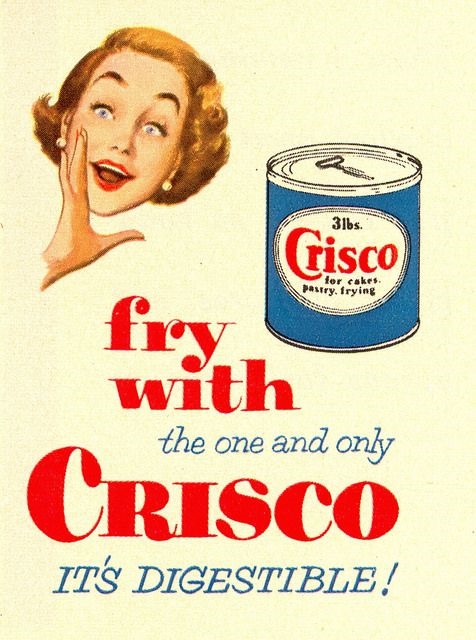
The result: Crisco. Crystallised cottonseed oil. Industrial textile waste transformed through chemical processing into something white and solid that looks like lard. They patent it in 1907, launch commercially in 1911.
Now they have a problem. Nobody wants to eat industrial waste that's been chemically treated. Your grandmother cooks with lard and butter like humans have for thousands of years. Crisco needs to convince her that her traditional fats are deadly and this hydrogenated cotton-seed paste is better.
The marketing campaign is genius. They distribute free cookbooks with recipes specifically designed for Crisco. They sponsor cooking demonstrations. They target Jewish communities advertising Crisco as kosher: neither meat nor dairy. They run magazine adverts suggesting that modern, scientific families use Crisco while backwards rural people use lard.
But the real coup happens in 1948. The American Heart Association has $1,700 in their budget. They're a tiny organisation. Procter & Gamble donates $1.7 million. Suddenly the AHA has funding, influence, and a major corporate sponsor who manufactures vegetable oil.
1961: The AHA issues their first dietary guidelines. Avoid saturated fat from animals. Replace it with vegetable oils. Recommended oils: Crisco, Wesson, and other seed oils. The conflict is blatant. The organization issuing health advice is funded by the company that profits when people follow that advice.
Nobody seems troubled by this. Newspapers report the guidelines as objective science. Doctors repeat them to patients. Government agencies adopt them into policy. Industrial cotton-seed oil, chemically extracted and hydrogenated, becomes "heart-healthy" while butter becomes "artery-clogging poison."
1980s: Researchers discover that trans fats, created by hydrogenation, directly cause heart disease. They raise LDL, lower HDL, promote inflammation, and increase heart attack risk more than any other dietary fat. Crisco, as originally formulated, is catastrophically unhealthy. This takes 70 years to officially acknowledge.
Procter & Gamble's response: Quietly reformulate without admission of error. Remove hydrogenation, keep selling seed oils, never acknowledge that their "heart-healthy" product spent seven decades actively causing the disease it claimed to prevent.
Modern seed oils remain. Soybean, canola, corn, safflower oils everywhere. Same chemical extraction process. Same high-temperature refining. Same oxidation problems. Just without hydrogenation so trans fats stay below regulatory thresholds.
These oils oxidise rapidly when heated. They integrate into cell membranes where they create inflammatory signalling for months or years. They're rich in omega-6 fatty acids that promote inflammation. They've never existed in human diets at current consumption levels.
But they're cheap. Profitable. And the food industry has spent a century convincing everyone they're healthy. The alternative, admitting that industrial textile waste shouldn't have been turned into food, would require acknowledging the last 110 years of dietary advice was fundamentally corrupted from the start.
Your great-grandmother cooked with lard because that's what humans used for millennia. Then Procter & Gamble needed to sell soap alternatives and accidentally created the largest dietary change in human history.
We traded animal fats that built civilisations for factory waste that causes disease.
The soap company won. Your health lost.
Brilliant summary by Kylie Malchus on Facebook:
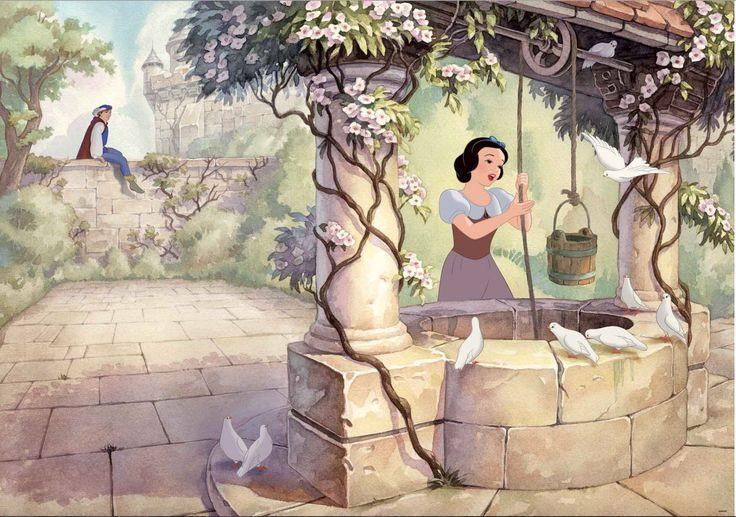
The original Snow White film was a Christian allegory.
The story centers on a girl who is defined by her innocence and purity, reminiscent of Eve in the Garden of Eden.
We first meet Snow White as she draws water from a well—a setting where multiple women in scripture experienced sacred encounters with God.
She sings a plea into the well: "I'm wishing for the one I love to find me today." This "wish" is a prayer to escape her abusive situation.
And of course, her prince finds her as a direct answer to this song/prayer. (No, Rachel Zegler, he doesn't "stalk" her. And no, it's not "weird.") He arrives on a white horse, which might be a nod to Revelation 19:11-16, where Christ rides in on a horse. Jesus Christ is, of course, known as the 𝑃𝑟𝑖𝑛𝑐𝑒 of Peace.
But the queen, our Satan figure, despises Snow’s innocence and orders her death. As a result, Snow is expelled from the safety of the castle into the dangerous wilderness. This mirrors Eve’s expulsion from Eden into the harsh, desolate world where she faces trials and opposition.
The queen’s initial plot fails, and Snow adapts to her new reality. She sings her famous song, "Someday My Prince Will Come." This is not purely a romantic ballad. This is also a song about waiting for God's deliverance.
The queen, however, persists in her plot. She conceals her identity and tempts Snow with an apple. Biblical symbolism doesn't get any more obvious than this.
Snow takes a bite and dies, just as Eve was warned of death for partaking of the forbidden fruit.
But the Prince returns a second time—reminding us of Christ’s promised return—to save her. Through true love’s kiss (or genuine love), he alone could rescue Snow from the apple’s curse. He resurrects her and redeems her from the fall.
In the final scene, the Prince carries Snow to his glowy, ethereal kingdom in the sky. The Prince (the biblical "Bridegroom") carries His bride (the Church) to heaven.
This is the genius of the original Snow White. It can be viewed as a beautiful love story and nothing more—and there's nothing wrong with that. It's a simple enough story for children to appreciate.
But it's also a profound allegory for humanity’s spiritual journey and Christian redemption.
Modern writers, in all their arrogance, think they're so enlightened they can improve upon a classic. But in the process, they're proving they never understood it in the first place.
What if I told you that a single income once provided a home, a car, and a comfortable life for an entire family?
One shift in the economy made sure that would never happen again.
Here’s how they used feminism to double the workforce, slash wages, and turn two incomes into a necessity🧵
We live in turbulent times—anyone with eyes to see and ears to hear knows that. The 4th Turning. The West has been unraveling, its moral fabric torn apart by decades of relativism, secularism, and a creeping authoritarianism dressed up as progress. In this chaos, Christians have a choice: cower in silence or stand firm with a declaration that cuts through the noise like a blade—Christ is King. This isn’t just a phrase; it’s a lifeline, a rallying cry, and a defiant assertion of truth. It’s essential for Christians today because it anchors us to the eternal when everything else is sinking sand. And make no mistake: those who smear it, who try to shame or silence it, aren’t just attacking words—they’re waging war on the soul of Western civilization. We must oppose them, not out of spite, but out of necessity if we’re ever to restore a moral core to our society.
Let’s start with why Christ is King matters. For Christians, it’s the cornerstone of our faith—Jesus Christ isn’t just a teacher, a philosopher, or a feel-good mascot for self-help seminars. He’s the sovereign Lord, the Alpha and Omega, the one who conquered death and reigns forever. In a world spiraling into confusion—where men can’t define "woman," where children are mutilated in the name of identity, where power is worshipped over principle—proclaiming Christ is King is a rejection of the madness. It’s a reminder that there’s a higher authority, a transcendent order that doesn’t bend to the whims of ideologues or the tantrums of the mob. When everything’s falling apart, when the institutions we trusted turn against us, Christians need that anchor. It’s not optional; it’s survival.
But here’s the rub: say those three words out loud, and the longhouse comes for you. You know the type—self-appointed speech police who clutch their pearls and cry “bigot” or “extremist” the second you step outside their script. They’ll call it divisive, offensive, even dangerous. They’ll dig through your past, twist your words, and sic their digital mobs on you. Why? Because Christ is King threatens their game. It’s a declaration of independence from their suffocating dogma, a refusal to kneel to the gods of the age—whether that’s DEI, climate hysteria, or whatever new fetish the left cooks up next. They can’t stand it because it’s a power they can’t control.
This isn’t new. Speech policing is a hallmark of the left, straight out of the longhouse playbook. You’ve seen it: the endless lists of forbidden words, the committees formed to enforce them, the nagging tone that demands compliance or else. It’s the same dynamic that’s choked Western culture for too long—matriarchal scolding masquerading as moral superiority. The longhouse doesn’t want debate; it wants submission. And when Christians say Christ is King, they’re not just speaking—they’re rebelling. They’re tearing down the idols and putting the true King back on His throne. That’s why the smears come fast and furious. It’s not about the phrase itself; it’s about what it represents—a refusal to play by their rules.
Look at the groups leading the charge against it. You’ve got the usual suspects: progressive activists, legacy media, atheists, NGOs, and those squishy “tolerant” Christians who’d rather sip lattes with the culture than stand for anything. They’ll say it’s “weaponized” by extremists, or that it alienates people, or—my favorite—that it’s “not the gospel.” Funny how they never cared about alienation when they were ramming their agenda down everyone’s throats. No, this is about power. They want to define what’s acceptable for Christians to say, to shrink our faith into a neutered, inoffensive box. Oppose them? You’re darn right we should. If we let them win this fight, we’re not just losing a phrase—we’re losing the ability to speak truth at all.
Restoring a moral core to the West starts here. It’s not about nostalgia or some utopian rewind to the 1950s. It’s about rebuilding on a foundation that lasts. Christ is King isn’t a political slogan; it’s a metaphysical reality. It reminds us that justice, beauty, and goodness don’t come from human schemes—they flow from Him. The left’s longhouse can’t offer that. Their lists and committees just breed resentment and division. We’ve seen where their road leads: a society of atomized, anxious drones, afraid to say what they believe. Christians have something better—a King worth following, a truth worth defending.
So stand up. Say it loud. Christ is King. Let the smears come—they’re a sign you’re hitting the target. Oppose the speech police, not because it’s easy, but because it’s right. The West hangs in the balance, and we’ve got a fight on our hands. Turbulent times call for bold faith. Anything less is surrender.
When you stand before God, you cannot say, "But I was told by others to do thus." Or that, "Virtue was not convenient at the time." This will not suffice.
@CLT_Exam "The line separating good and evil passes not through states, nor between classes, nor between political parties either -- but right through every human heart." - Aleksandr Solzhenitsyn