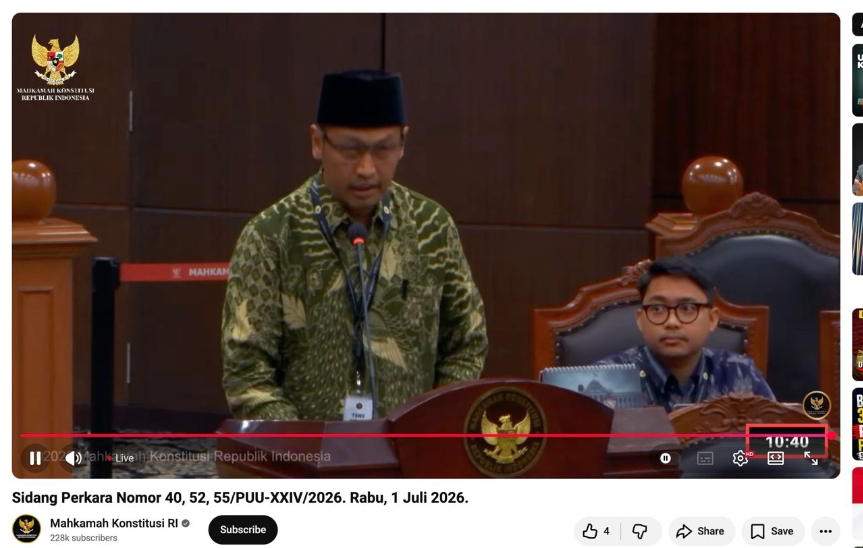
Dan ternyata, Ahli DPR dalam gugatan MBG di anggaran pendidikan adalah Dekan FH UI, dekan saya sendiri, Bapak Parulian Paidi Aritonang. Betapa kecewanya dan sedihnya saya ketika menyaksikan hal tersebut dan vis a vis dengannya di MK.
bayangin ini jalur resmi masuk Pertamina lewat BPS tesnya puanjanggg dan soalnya susah gila. kalo lu ga pinter, cerdas, kritis, bahasa inggrisnya bagus, paham isu terkini terkait bidang yg didaftarin, dan lainnya ga bakalan mungkin lolos. tiba-tiba ada bocah 27 tahun jalur fast track timses jadi komisaris yg gajinya bisa nyentuh 200jt sebulan like what the hhhh..???
Ketika Presiden bilang Danantara mau begini mau begitu, ingin jadi temasek, swf ini swf itu,
sll ingat bahwa bnyk direktur dan komisaris bumn itu:
-orang parpol
-timses pemilu
-sanak famili
ga akan kemana2 itu Danantara
dan mereka mulai aktif cari utangan😂
u can expect what will happen next
Saying that the protest is unnecessary because the market and rupiah are making a rebound is like saying you can cancel your dentist appointment because the painkillers stopped your toothache. The symptom improved, not necessarily the problem.
The next major headache for the Indonesian government may not be foreign portfolio outflows. It may be Chinese investors quietly looking for the exit.
Reports of Tsingshan considering Madagascar, Lygend looking at Tanzania, and renewed interest in New Caledonia should not be dismissed as isolated developments. They are signals. Capital rarely leaves overnight. It leaves gradually, one project at a time.
The concern is not that existing operations will suddenly shut down. Billions of dollars have already been invested and those assets cannot simply be picked up and moved elsewhere. The bigger issue is future capital allocation. Once investors begin directing incremental investment toward alternative jurisdictions, the long-term growth trajectory changes.
The timing is particularly concerning because Indonesia’s broader investment momentum is already slowing. Foreign direct investment reportedly declined 6% in 2025 after growing 19% the previous year. Mining investment peaked in 2024, while new investment into base-metal refining appears to have plateaued. That should command policymakers’ attention.
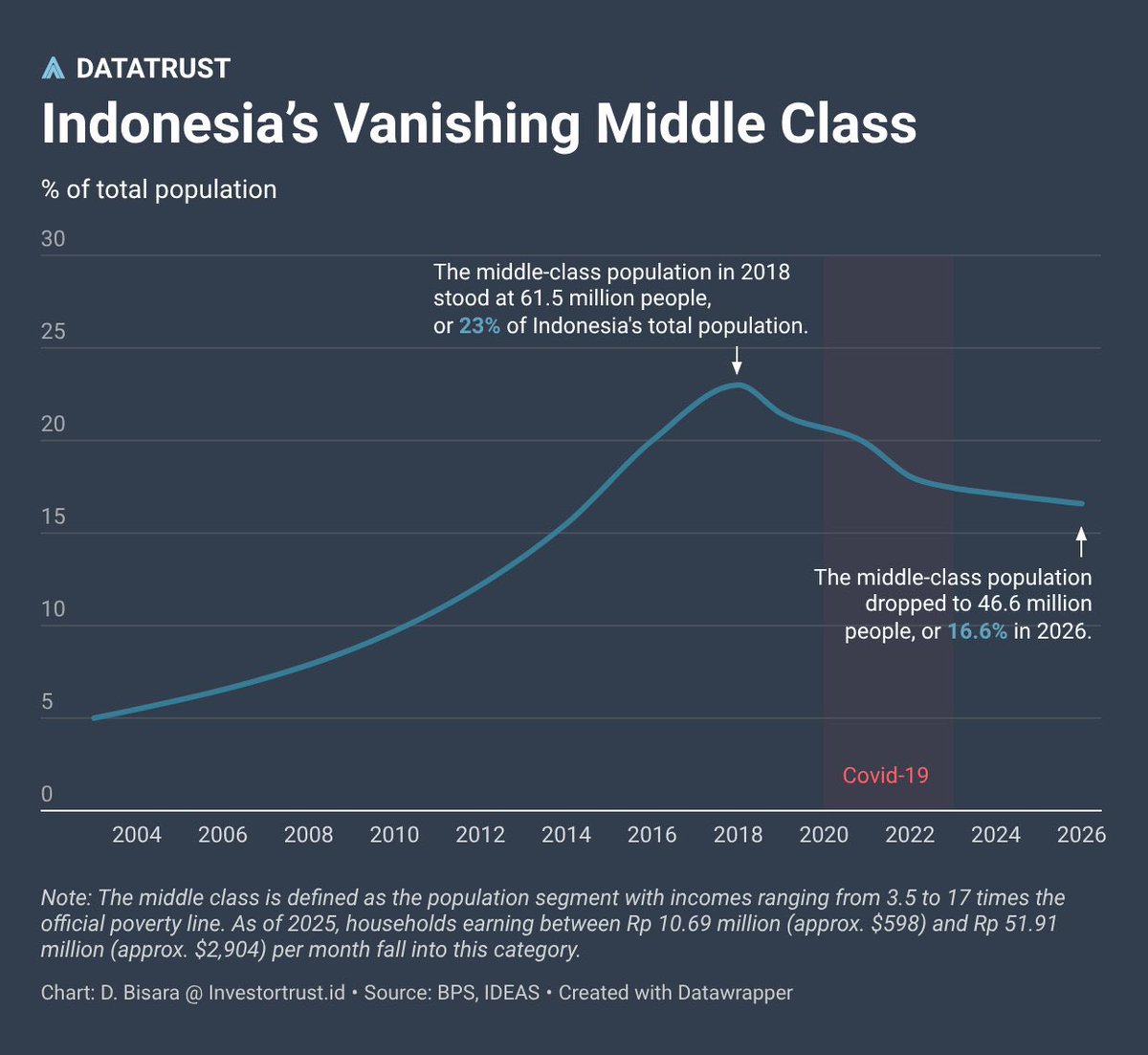
This chart should terrify policymakers. Indonesia’s middle class did not merely slow down. It went into reverse.
After two decades of expansion, the middle-class population peaked at 61.5 million people in 2018, representing 23% of the population. By 2026, that figure had fallen to just 46.6 million people, or 16.6%. That is not a cyclical slowdown. That is structural deterioration.
For years, policymakers celebrated GDP growth, infrastructure projects, commodity booms, and headline investment numbers. But the ultimate scorecard of an economy is whether ordinary people become wealthier over time. This chart suggests millions of Indonesians are moving in the opposite direction.
The middle class is the economic engine of every successful country. They buy homes, cars, insurance, consumer goods, education, travel, financial products, and healthcare. They generate tax revenue. They create small businesses. They drive domestic demand. When the middle class shrinks, the economy loses its most important customer.
The uncomfortable question is simple: where did the gains go? If GDP is growing, if conglomerates continue expanding, if commodity exports remain large, then why are fewer Indonesians qualifying as middle class than eight years ago?
More importantly, if you are born poor in Indonesia today, what ladder exactly are you supposed to climb?
If you are exceptionally good looking, perhaps you can monetize attention through social media. If you are academically gifted, perhaps you can break into an ultra-competitive institution like MBB, survive years of brutal expectations, and eventually use that platform to do something bigger. If you are entrepreneurial, maybe you build a business against overwhelming odds. If you are lucky, perhaps you benefit from family connections, inheritance, or access to opportunities unavailable to most people.
But an economy cannot rely on exceptionalism. A healthy economy creates millions of pathways upward, not a handful of lottery tickets.
The situation becomes even more concerning when you consider that well-paying white-collar jobs are becoming increasingly scarce. Many multinational companies that once established regional operations, technology centers, shared-service hubs, and professional offices in Indonesia have either downsized, relocated, or shifted future expansion elsewhere.
Those jobs were not valuable merely because of the salaries they paid. They were valuable because they transferred knowledge, management expertise, technical skills, global best practices, and professional networks into the local workforce. Over time, they helped develop intellectual capital that could later be recycled into entrepreneurship, leadership positions, startups, and domestic businesses.
When those opportunities disappear, the loss is not limited to employment. The country also loses a training ground for future managers, engineers, consultants, analysts, and business leaders. Human capital compounds just like financial capital. Once that pipeline weakens, rebuilding it can take years or even decades.
The bigger risk is that social mobility slows. When people stop believing hard work leads to a better life, trust in institutions weakens. Aspirations decline. Consumption slows. Talent leaves. The country’s most productive people increasingly look elsewhere for opportunity.
This is why Indonesia’s biggest economic challenge is no longer growth. It is upward mobility. A country cannot thrive without a growing middle class, a steady pipeline of high-quality jobs, and a clear path for ordinary people to join it. And right now, all three appear to be moving in the wrong direction.
Forcing SOEs to buy back shares to stabilize the market that has been destablized by the government's policies is as silly as drilling holes in a boat and then ordering the crew to row harder.
Kopdes Merah Putih akan menggantikan gerai Alfa Mart di Lombok Tengah? Kalau ini benar maka ini jd contoh tdk berperannya Rule of Law. Alfa Mart adlh entitas bisnis yg punya legalitas hukum, jadi tempat hasil usaha kecil dan menengah menjual produknya, tempat kerja banyak orang.
@kangrozin Any credible economist offered hot seat of finance minister must request authority to cut MBG+KDMP by at least 80 % and cut fuel subsidy to reallocate some saving to crash work (padat karya), social asistance & regional transfer . Otherwise the core problems remains....
@kangrozin Or the new finance minister will only tarnished his/her reputation as official seatholder when the economy goes from bad to worse. Dont accept to be Captain of Titanic midway unless you are given authority to steer the ship from crashing to mega iceberg...
@pinkbourbon8898 Kantin Karyawan PP, di P2 Mas, yg paling laku Kantin Nino masakan Menado, ngak jauh sebelahnya ada Chinese food. Ngantri panjang berjibaku sama anak2 EY, IDX , PMI etc
Indonesia gak punya gandum tapi ekspor mie instant ke mana-mana. Singapura gak punya minyak tapi mengimpor minyak mentah dikilang lantas diekspor. artinya apa? kepemilikan SDA bukanlah kunci. Kuncinya kemampuan manufaktur secara efisien dan kreatifitas
Entah kenapa, tiap bahas asal-usul makanan Indonesia, begitu disebut ada pengaruh China, selalu ada yang defensif 😅
Padahal selain India, pengaruh budaya China di kuliner Indonesia itu besar sekali. Nasi goreng, bakso, bakmi, bakwan, kecap, lumpia, siomay, tahu...