Trump admitted recently he wasn’t heaven bound.
I think he’s so demonically possessed that he can’t even pretend for Christians anymore.
He’d rather blaspheme Christ, mock Christ & admit he’s not a heaven guy.
I feel sick to my stomach waiting around today to see what atrocity Trump has in mind for the people of Iran this evening. It's hard to fathom that our other elected leaders aren't able to check him in any meaningful way. It's really an indictment not just of the electorate but of our whole system of government. We're ruled by a mad king.
Sky News Australia host gets completely dismantled in a surreal interview.
They accidentally bring on the wrong guest an anti war academic and it backfires instantly.
Former U.S. Army Colonel and State Department official Anne Wright flips the script and absolutely roasts the host on air.
#Iran War Update No. 35 (focus on Iranian strategic narrative):
🔹The most consequential development of the day was the downing of a U.S. F-15E over Iran, but the incident expanded into a broader operational setback. Later reports indicate that a U.S. A-10 was also hit during the rescue phase and that multiple helicopters involved in the mission came under fire, with some sustaining damage.
🔹This matters because the vulnerability was not limited to the initial shootdown. The rescue effort also became challenging, showing that U.S. forces can face sustained risk not only in strike operations but also in recovery missions inside Iranian airspace.
🔹Iranian messaging is treating the incident not as an isolated success, but as proof that the United States misjudged not only Iran’s air defenses but also its capacity to sustain pressure under attack. This helps Tehran rebut the impression that the balance is shifting irreversibly against it.
🔹The fate of the pilots has also taken on strategic significance in Iranian commentary. The successful extraction of one crew member shows that the U.S. retains operational reach, but the challenging environment is being framed as evidence that scaling such operations would come at increasing cost.
🔹This has fed into Iranian assessments of a possible U.S. ground operation. The logic being advanced is that if rescue operations were uncontested, they could lower the threshold for deeper incursions, but the fact that additional aircraft were hit today is being interpreted as a signal that escalation would face immediate challenges.
🔹In parallel, reports of internal reshuffling in the U.S. military leadership are closely scrutinized in Iranian expert circles. Reports that Pete Hegseth has dismissed several senior U.S. military figures are interpreted not as a routine restructuring but as political preparation for escalation.
🔹Iranian analysts frame the dismissals as an effort by the Trump administration to sideline commanders perceived as cautious about a ground campaign and to consolidate a command environment more aligned with a higher-risk strategy toward Iran.
🔹Trump’s public threat to strike Iranian bridges and power plants has given Tehran a new opening in the information battle. Iran is now portraying Washington not as a coercive actor in control of escalation but as a power drifting toward infrastructure destruction because it has failed to secure a decisive military outcome.
🔹In the same vein, the war is increasingly framed as an assault on Iran’s scientific, civilian, and administrative backbone, which could broaden the social constituency of resistance beyond the state’s core security base.
🔹The strike on Shahid Beheshti University was especially important in that respect. Iranian media and commentators present it not simply as damage to a facility, but as an attack on knowledge production itself, allowing Tehran to fold universities and research infrastructure into its broader deterrence narrative.
🔹That is a notable shift in framing. Earlier emphasis centered more heavily on military retaliation and economic chokepoints; today, the Iranian government can more clearly fuse national scientific autonomy, sovereignty, and wartime resilience into a single strategic message.
🔹In the meantime, state media maneuver on the claim that Washington may already be looking for a pause after recent setbacks. The reported rejection of a U.S. proposal for a temporary ceasefire was presented by Iranian media as evidence that battlefield pressure is forcing Washington toward a halt in operations, but not that diplomacy is gaining ground.
🔹In other words, Tehran is trying to establish that any U.S. move toward de-escalation reflects pressure and miscalculation, thereby making continued Iranian escalation look like confidence rather than compulsion.
🔹At the same time, the article by Javad Zarif in Foreign Affairs, in which he outlined a proposal for ending the war, has faced intense pushback from hardliners. Several members of parliament sharply criticized Zarif, accusing him of aligning with the enemy and attempting a “coup.” Simultaneously, pro-government speakers at rallies of Islamic Republic supporters accused him of treason and called for security agencies to take action against him.
🔹Meanwhile, Tehran issues more direct warnings to the Gulf states. The line is no longer just that U.S. forces in the region are at risk, but that states enabling American operations – in any shape or form – may themselves be drawn into the retaliation envelope unless they distance themselves from Washington’s campaign.
🔹In effect, Iran wants to extend deterrence from military platforms to political geography. Tehran is signaling that basing arrangements, overflight permissions, and quiet logistical support can all become strategically punishable choices.
🔹Another notable development on Day 35 was the apparent partial reopening of Hormuz for “politically acceptable” shipping. Reports suggest that a French-owned CMA CGM container ship, three Oman Shipping tankers, and a Japanese-linked LNG vessel managed to cross, often signaling their non-hostile identity en route.
🔹This suggests Iran is no longer communicating a simple binary of closure versus reopening. Instead, Tehran appears to be moving toward selective access, using passage through Hormuz as a political filter that rewards neutral or friendly states while preserving leverage over the wider market.
🔹But in any case, limited transits by French, Omani, and Japanese-linked vessels point to a controlled easing rather than normalization, which allows Iran to reduce some diplomatic pressure without surrendering the price and supply shock it has already created.
🔹Overall, day 35’s picture suggests Iran is refining its war narrative around three linked claims: the United States cannot operate over Iran without cost, infrastructure attacks reveal American frustration rather than control, and any further escalation will widen the conflict horizontally across the region’s political and economic system.
🔹The broader strategic direction, then, is not simply toward more violence, but toward a harsher bargaining environment. Tehran is trying to enter that phase with a stronger argument that it has preserved resilience at home, retained escalation options abroad, and denied Washington the ability to define either the pace or the meaning of the war.
Trump is seeking to pay for his new $1.5 trillion military budget by cutting the following:
$510 million - Grants for farmers and agricultural research
$82 million - Loans for rural small businesses (Fully eliminated)
$61 million - Support for farmers and food markets (Fully eliminated)
$240 million - School meals and food education for children abroad (Fully eliminated)
$659 million - Community building grants
$47 million - Support for minority-owned businesses (Fully eliminated)
$449 million - Economic development grants for communities
$1.6 billion - Weather forecasting, fisheries, and coastal protection (NOAA)
$993 million - Scientific research and technology standards
$150 million - Support for American exports and trade
$2.2 billion - Broadband and internet access programs
$8.5 billion - Funding for public schools
$1.5 billion - Vocational training and adult education (Fully eliminated)
$2.7 billion - College access and higher education support
$15.2 billion - Roads, bridges, and infrastructure projects
$1.1 billion - Home energy efficiency and clean energy programs (Fully eliminated)
$1.1 billion - Scientific research funding
$386 million - Environmental cleanup programs
$150 million - Cutting-edge clean energy research
$4 billion - Help paying home heating and cooling bills for low-income families (Fully eliminated)
$768 million - Refugee resettlement assistance
$819 million - Care and shelter for migrant children
$775 million - Local anti-poverty programs (Fully eliminated)
$5 billion - Public health programs, mental health services, and disease prevention
$5 billion - Medical research (NIH)
$129 million - Healthcare quality and safety research
$356 million - Emergency preparedness and disaster response
$1.3 billion - FEMA community disaster preparedness grants
$707 million - Cybersecurity protection for critical infrastructure
$52 million - Airport and transportation security
$40 million - Protection against chemical and biological weapons threats
$53 million - Funding for homeland security operations
$3.3 billion - Community development block grants for local neighborhoods (Fully eliminated)
$1.3 billion - Affordable housing construction grants (Fully eliminated)
$393 million - Programs to reduce homelessness
$529 million - Housing assistance for people living with HIV/AIDS (Fully eliminated)
$489 million - Housing and services for Native American communities
$50 million - Grants to help communities build more housing (Fully eliminated)
$60 million - Enforcement of fair housing and anti-discrimination laws
$58 million - Homebuyer and renter counseling services (Fully eliminated)
$45 million - Renewable energy development programs (Fully eliminated)
$1.7 billion - Grants for local law enforcement and public safety
$20 million - Civil rights mediation and legal access programs (Fully eliminated)
$1.6 billion - Job training for at-risk youth (Fully eliminated)
$395 million - Jobs program for low-income seniors (Fully eliminated)
$234 million - Worker safety and labor protection programs
$101 million - Enforcement of equal pay and workplace anti-discrimination laws
$46 million - Programs to combat child labor and forced labor abroad
$2 billion - International humanitarian aid
$1.2 billion - Food aid for hungry families abroad (Fully eliminated)
$4.3 billion - Global health and disease prevention programs
$2.7 billion - Funding for the United Nations and international partnerships
$642 million - International economic and treasury programs
$315 million - Democracy and anti-corruption programs abroad
$486 million - Grants for public transit projects
$4.2 billion - Electric vehicle charging infrastructure
$372 million - Airline service for rural and small communities
$145 million - Grants for sustainable and equitable infrastructure
$204 million - Loans and investment for underserved communities
$1.4 billion - IRS taxpayer services and enforcement
$100 million - Air pollution monitoring and reduction programs (Fully eliminated)
$1 billion - EPA grants to states for environmental protection
$2.5 billion - Clean drinking water and wastewater infrastructure funds
$90 million - Grants to reduce diesel pollution (Fully eliminated)
$3.4 billion - NASA space and earth science research
$297 million - NASA technology innovation programs
$1.1 billion - International Space Station operations
$143 million - STEM education programs
$309 million - Small business development and entrepreneurship programs
$170 million - Small Business Administration operations
$158 million - Loans for small businesses
A UAE “Spy Sheikh” secretly bought a $500M stake in Trump’s crypto company — then got access to guarded U.S. AI chips Biden had blocked. Deputy AG Todd Blanche deflected when confronted on ABC News. This is corruption, plain and simple. The White House is for sale.
Garcia: While you were being assaulted, you told the agents that you had filmed this on your phone?
Bazan: Yes.
Garcia: And that’s when they took your phone away. These agents didn’t just take your phone. They sold it. They pawned it at a kiosk for $250. Is that correct?
Bazan: Yes.
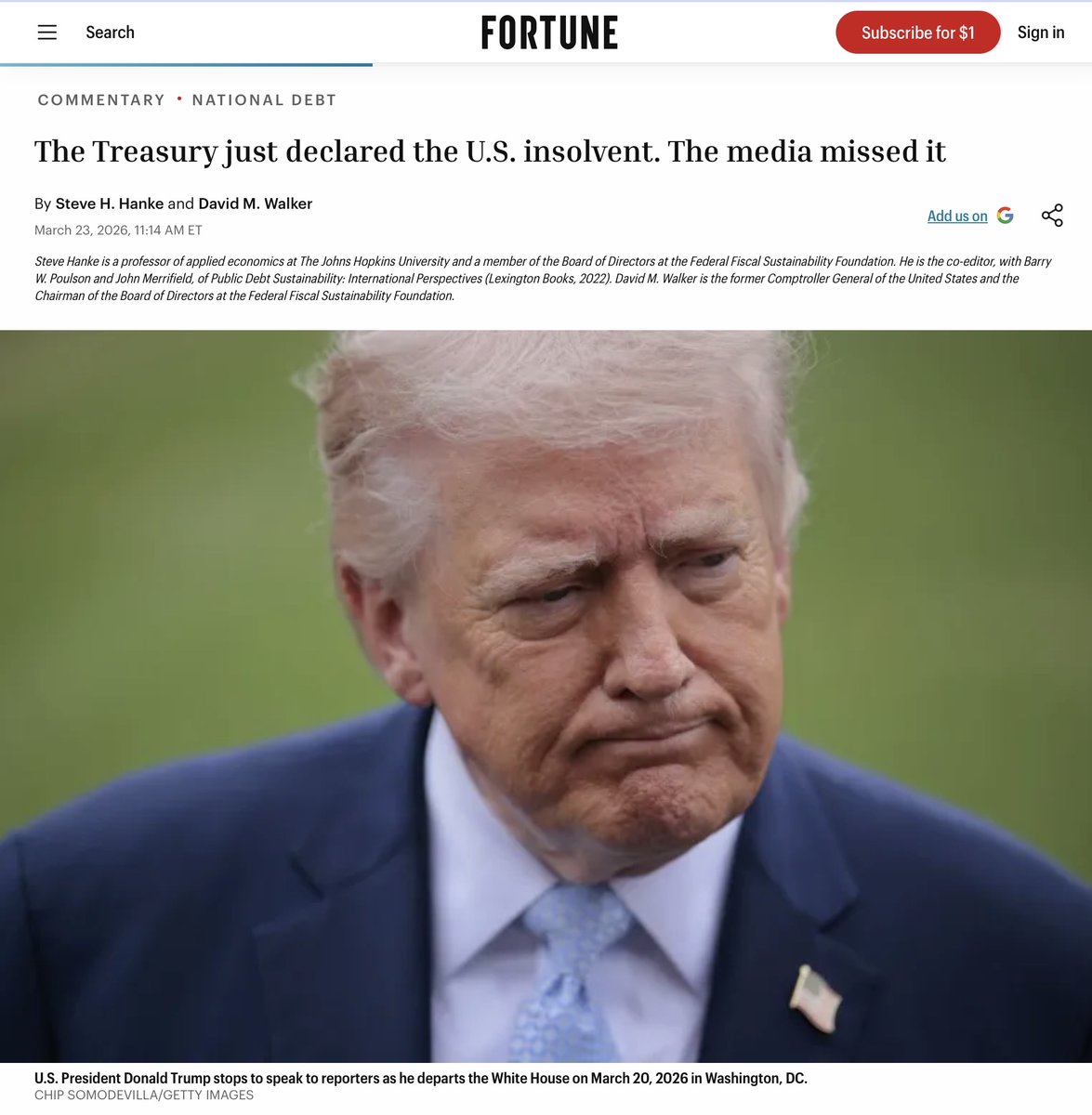
FORTUNE: “The U.S. government is insolvent.” — The Treasury Department’s own consolidated financial statements for FY25, released last week to near-total media silence, saying our country is BANKRUPT
We have 47T in total liabilities but only 6T in total assets
They're stealing it all
Chris Murphy: "We're gonna give Iran $14b to fund this war with the US? We're gonna give Russia billions of dollars to fund their war with Ukraine? We're literally putting money into the pockets of the very nations we're fighting right now. We've never seen this level of incompetence in war-making in this country's history, and frankly we've had a lot of incompetence in war-making."
Oh, so they want the Obama nuclear deal that Trump ripped up?
And the same terms Oman says Iran agreed to in negotiations before Trump bombed them?
Those commitments?
See……this is the B.S. I’m talking about. This is a disgusting thing coming from our Commander In Chief — especially about a VETERAN and PURPLE HEART recipient. #DamnShameful!
Obama agreed to $1.3 billion in sanctions relief for Iran as part of a deal that prevented both an Iranian nuke and a war.
Trump withdrew from the deal, started a war that will likely result in Iran obtaining a nuke, and gave Iran $14 billion in sanctions relief.
For the record, the president of the United States is now simultaneously claiming that he has won the war, is currently winning the war, needs help to win the war, and needs no help to win the war. All to destroy the nuclear program he claims to have already destroyed last year.