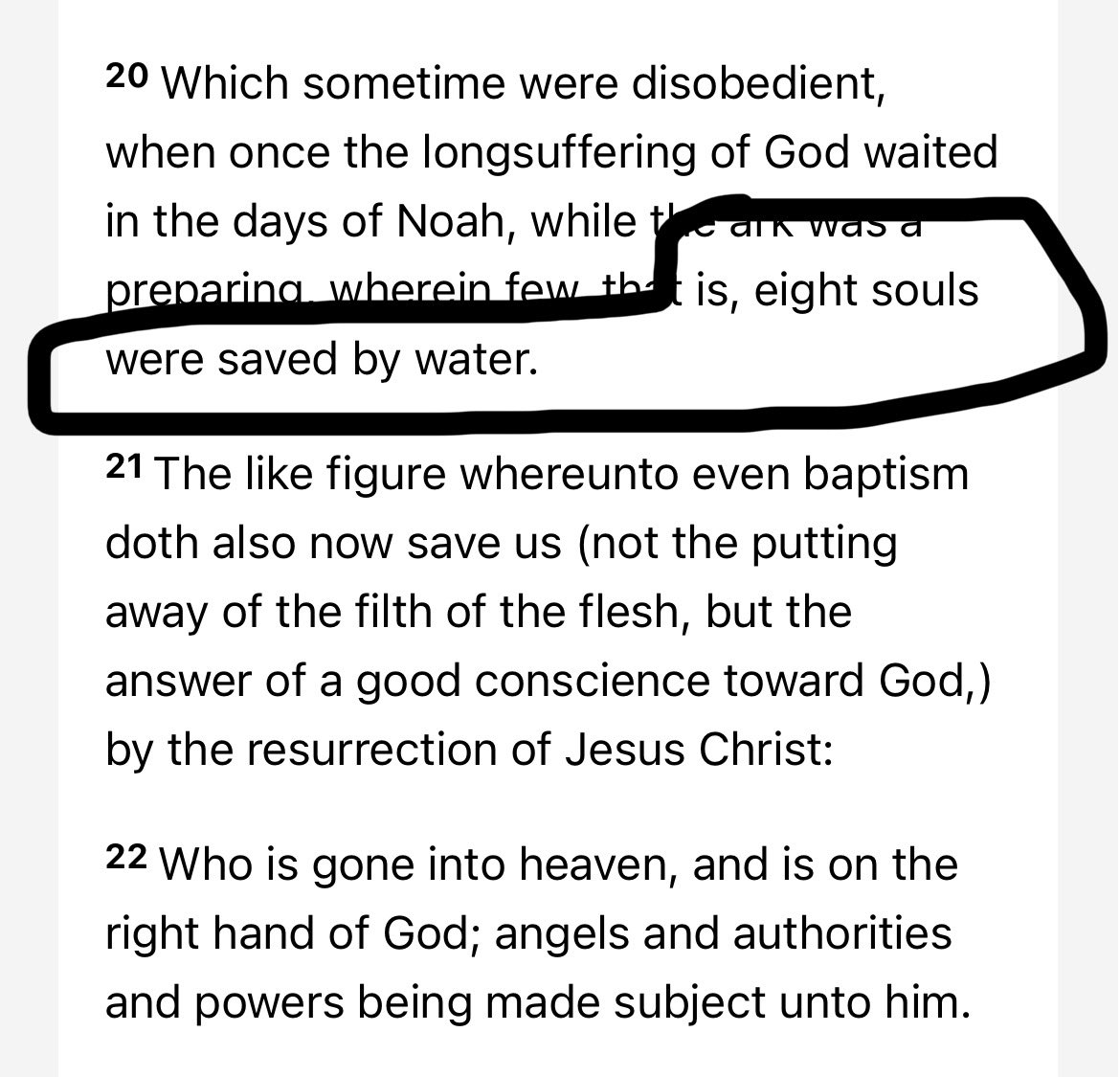
“Baptism now saves”
This seems like a controversial passage for many. I suspect much of the controversy stems from two things:
-A misunderstanding of baptism
-A misunderstand of Sola Fide
But Peter’s argument is straightforward, and can be easily understood if we take it at face value and in context.
Christ:
Peter starts by speaking of the work of Christ:
-The Righteous One suffered for the unrighteous.
-He was put to death in the flesh, but made alive in the Spirit.
-He did this in order to bring us to God
This will likely bring to mind another familiar passage often recited at Baptism:
“Therefore, we are buried with Him by baptism into death, that like as Christ was raised up from the dead by the glory of the Father, even so we also should walk in newness of life.” (Romans 6:4)
The connection is obvious, but even without it, Peter’s argument stands on its own.
Noah:
Peter makes a further connection between Noah and Baptism.
-God was patient with the disobedient world while Noah prepared the ark.
-When the ark was finished, God sent the floodwaters.
-Those waters brought judgment upon the wicked, yet Noah and his household were saved through those same waters.
Pulling the argument together:
Peter then brings the three threads (Christ, Noah, and Baptism) together.
-He explicitly states that the flood waters correspond to baptism.
-He explicitly states that Baptism now saves us.
-He clarifies that he is not speaking of an ordinary physical washing that removes dirt from the body.
-Rather, Baptism saves by cleaning the conscience before God through Christ.
-And that all of this is grounded and accomplished through the resurrection of Jesus Christ.
In short, Baptism gives us a good conscience before God, not by cleaning the outside of our bodies, but by washing away our sins and delivering the forgiveness of Christ through His resurrection.
Now, this often leads to the same common objections. But these are all easily answered from scripture.
Objections:
“But, baptism is the outward sign of an inward reality!”
This is a common refrain in the modern church. But it should be noted:
-It is not scriptural
-This is not the way that the Bible speaks of baptism.
-Peter doesn’t argue that baptism signifies salvation, reminds us of salvation, or is a public testimony of our salvation. He said that baptism saves.
-You will find this same emphasis from other NT writers as well.
“Water cannot save anyone. Only Jesus saves!” or “We are saved by faith, not by works”
-Agreed!
-It is not the water that saves. It is Christ who saves.
-Baptism is not a work of man, but a work of God.
-In Baptism, God gives and we receive.
-The fact that Baptism includes an outward sign does not make it a work of man.
-Just as Paul argues that people must hear the Gospel through the preaching of men (Romans 10), so too is it God who does the saving work through the means He has appointed. Nobody would argue that someone was saved by the Preacher merely because God used him to deliver the Gospel.
“But should it be interpreted as an “appeal” or a “pledge”?”
-It doesn’t matter
-Either understanding leaves you with Christ saving us in baptism
-Neither understanding leaves you with anything less than that.
“If Baptism saves, what about the thief on the cross?”
-The thief on the cross is not an argument against Christ saving us in baptism.
-The question is not whether or not Christ can save outside of baptism (of course He can)
-The question is whether we should reject the promises Christ has actually given us in baptism (of course we should not).
In short:
-We should be careful not to explain away what Scripture plainly states.
-Peter could have said “Baptism symbolizes salvation” or “reminds us of salvation” or “is a sign of our obedience”. But he didn’t. Instead, he used a 3 part argument to say that baptism actually saves us, through the power and work of Christ Jesus.
-The belief that Baptism saves does not replace Christ with water, make man’s work/obedience a part of salvation, or teach that the physical washing of the body saves.
-Instead, it teaches that Christ instituted Baptism, attached His Word and promise to the water, and has given it to the church as an actual means of grace.
We do not need to make Baptism less than what Scripture says it is.
We need to believe what God says about it.
@krombein Appreciate your confidence in me, bro. 😅
But that’s a pretty recent interpretation, and there were a lot of guys smarter than me for almost all of church history who wouldn’t see it your way.