Password resets and promo blasts should never share a domain.
Black Friday complaint spike → reputation drops → password resets hit spam → users locked out → support floods.
Fix: promos and transactional on separate subdomains.
Your receipts shouldn’t pay for your promos.
The good news about email deliverability? You can train attention, too.
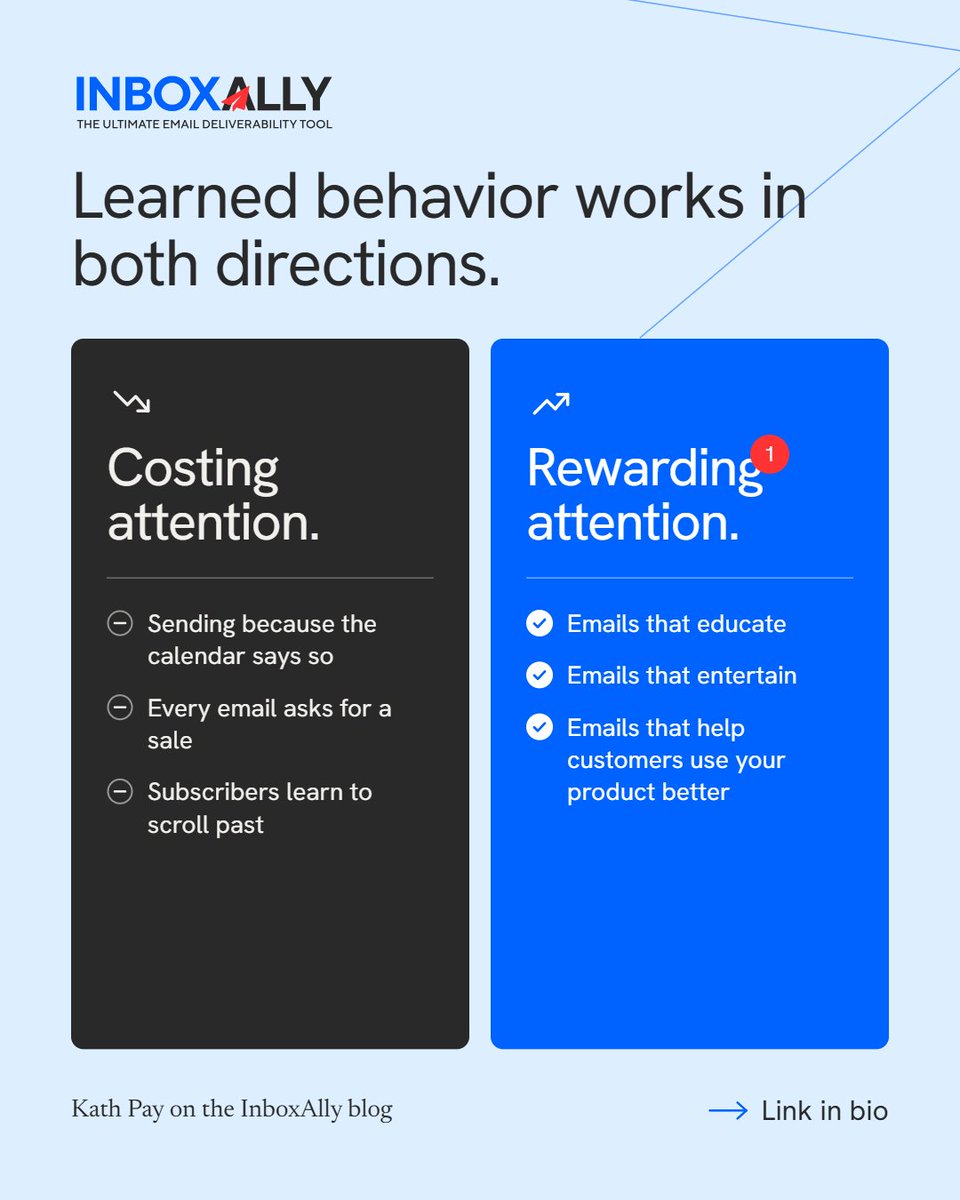
If subscribers consistently find value in your emails, opening them feels worthwhile. They get rewarded for their attention, and your sender reputation thrives.
Wrap up your week with Kath Pay’s full breakdown here: https://t.co/SrsymUVNtm
Relevance isn't just a conversion strategy; it's a deliverability strategy.
Before you hit send today, ask: "Does this email offer enough potential value to justify the interruption?"
More on fixing your email relevance from Kath Pay: https://t.co/JF48erNTU2
Your emails are landing in spam.
What's next?
Start with an inbox placement test. Then investigate authentication, reputation, content and sending changes.
Different symptoms need different tests.
Our troubleshooting guide + free tools 👇
https://t.co/hTmlwAt1k1
Every email you send shapes what your subscribers expect from the next one.
See brand -> Recognize pattern -> Keep scrolling -> Repeat.
Are you accidentally training your list to ignore you? Kath Pay explains how to break the cycle: https://t.co/JF48erNTU2
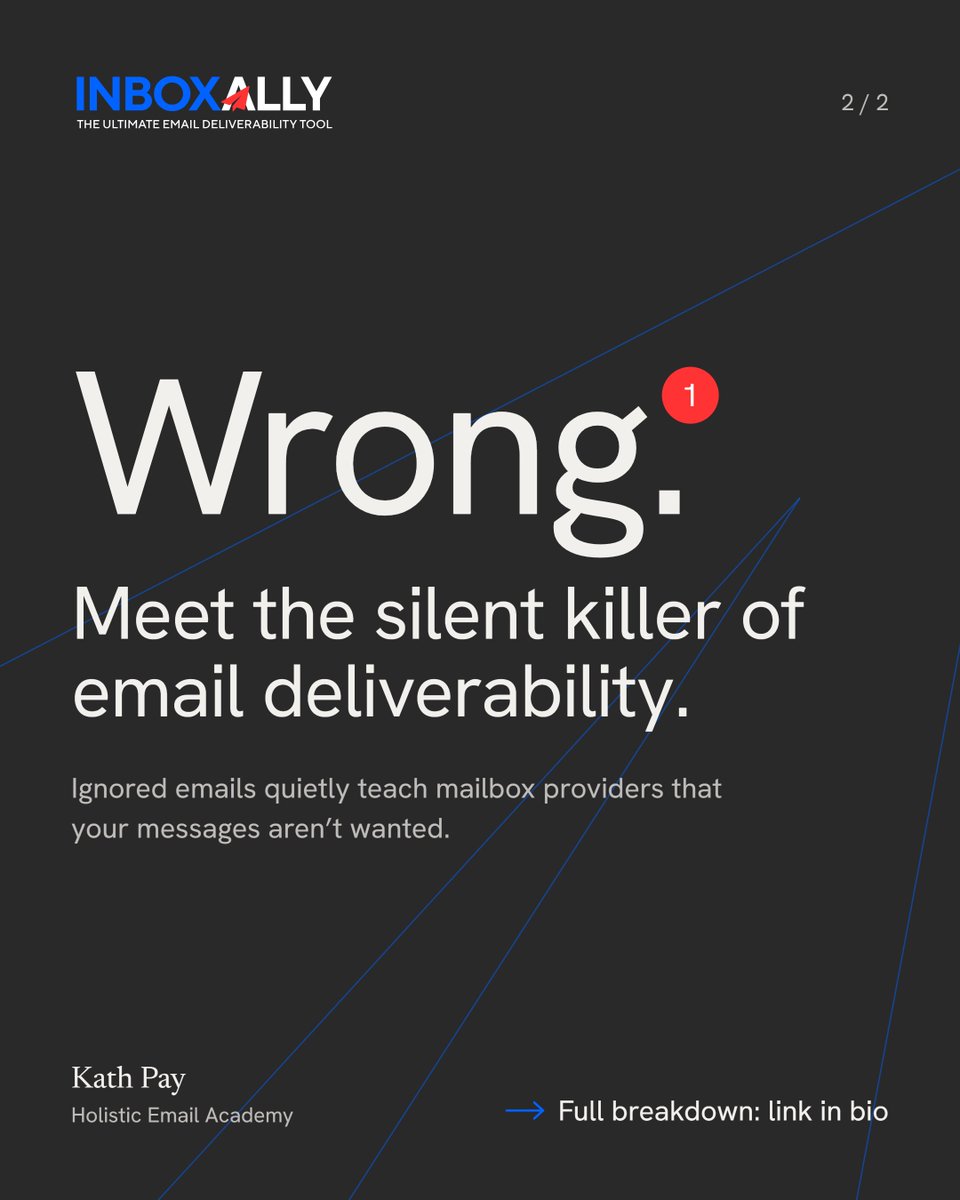
Most marketers think a healthy email list is one with low unsubscribes. The truth? If they are consistently ignoring you, your deliverability is quietly tanking. Kath Pay breaks down the hidden cost of ignored emails on the @InboxAlly blog today: https://t.co/JF48erNTU2
DMARC p=none is a starting point.
It doesn’t ask receiving servers to block mail that fails DMARC.
Collect reports. Identify legitimate senders. Fix alignment.
Then move toward quarantine or reject.
Publishing the record is step one. Acting on it is the work.
A famous brand won’t keep your email out of spam. Our COO Eric Jenkins tells @MarTechEdition why deliverability should be treated as a business metric, and how AI is changing the inbox. 👇
https://t.co/PO9DZxhuyW
DMARC p = none is a starting point.
It doesn’t ask receiving servers to block mail that fails DMARC.
Collect reports. Identify legitimate senders. Fix alignment.
Then move toward quarantine or reject.
Publishing the record is step one. Acting on it is the work.
Unpopular opinion: 2026 isn't rewarding bigger email programs. It's rewarding smarter suppression.
The playbook is changing:
- Mail more active users
- Suppress faster
- Forget "just one more campaign"
More volume ≠ more revenue.
IPv6 gives you more addresses.
It doesn’t give you a reputation reset.
Don’t rotate IPs to outrun complaints.
Keep sending IPs stable, configure authentication and reverse DNS, and monitor domain reputation.
Fix the sending behavior behind the problem.
📩 October Deliverability News is here!
🍂 Outlook's new Promotions feature
⚠️ Microsoft 365 sending limits
📱 iOS 27 Mail changes
🤖 AI agents and email reputation
What should senders know before the holiday rush?
Read our latest roundup 👇
https://t.co/uZ6mSgvJtT
Gmail spam rate hit 0.3%?
That’s a threshold to avoid, not a target.
Google recommends staying below 0.1% in Postmaster Tools.
Review your list quality, targeting, and sending frequency before complaints become a pattern.
Proud to see our COO Eric Jenkins sharing his perspective on email deliverability and building InboxAlly for scale. His focus on measurable outcomes and solving the right problems is exactly what customers need.
Worth a read: https://t.co/R32PFISUAm
Did your email reach the inbox?
Don’t guess.
InboxAlly’s free Email Placement Tester checks where your campaign lands at:
📩 Gmail
📩 Outlook
📩 Yahoo
Free. No account required.
See how it works 👇
https://t.co/jAlGzQjgyf
@EmailOpShop@jeajen
You crossed Gmail’s 5,000-email threshold once?
You’re a bulk sender now. Not just today. Not just during that campaign. Gmail counts volume across the same primary domain, including subdomains. And once you’re classified as a bulk sender, that status doesn’t expire. Your sending volume can drop. The requirements don’t.
Unpopular opinion: 2026 isn't rewarding bigger email programs. It's rewarding smarter suppression.
The playbook is changing:
- Mail more active users
- Suppress faster
- Forget "just one more campaign"
More volume ≠ more revenue.
Your email passed authentication. It can still land in spam.
SPF: PASS
DKIM: PASS
DMARC: PASS
Authentication ≠ reputation.
Complaints, poor list hygiene, or aggressive sending can still hurt placement. Authentication proves who sent it. It doesn't prove people want it.