People ask what I do when the market drops 10%.
Same thing I do when it rises 10%.
Collect the income and buy more. The paycheck does not care about the chart.
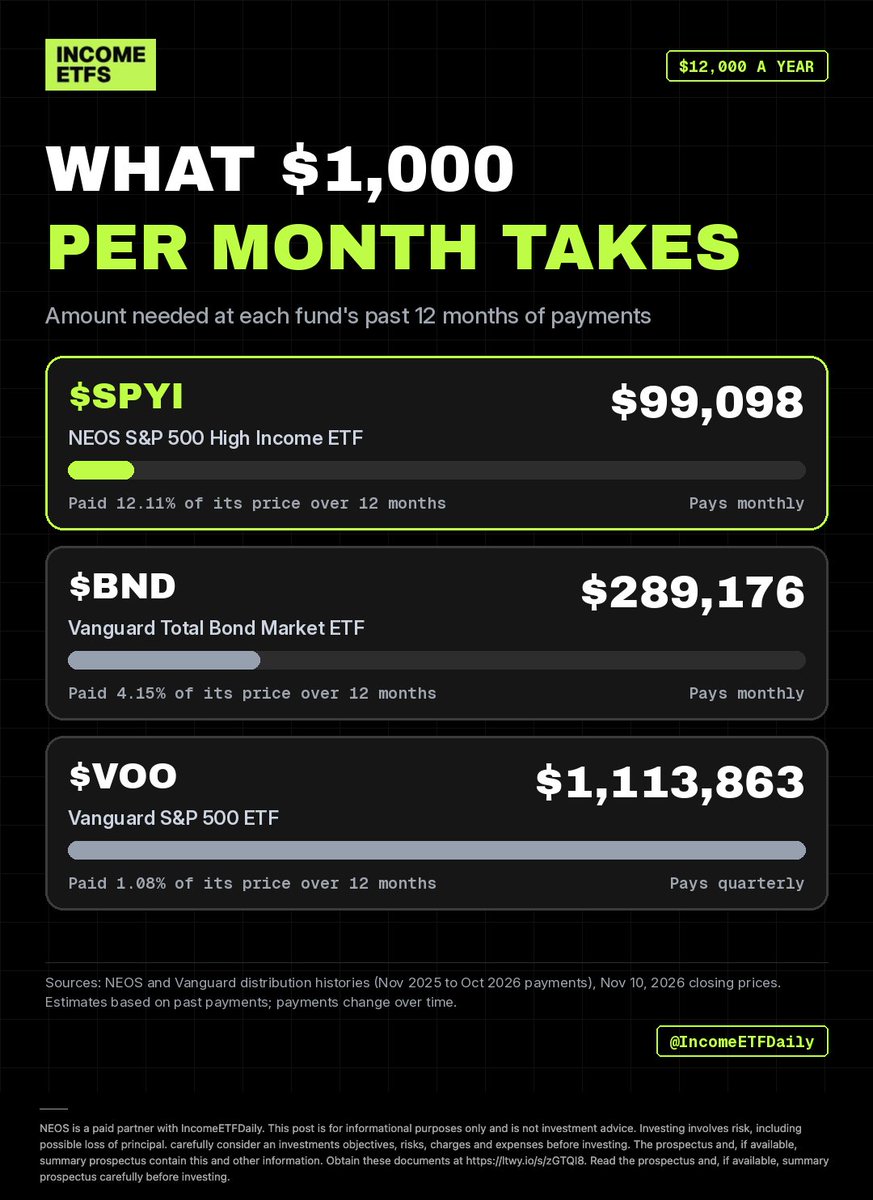
$1,000 PER MONTH TAKES ABOUT $99,098 IN ONE INCOME ETF AND ABOUT $1,113,863 IN AN S&P 500 FUND, BASED ON THE PAST 12 MONTHS OF PAYMENTS.
That's $12,000 a year. Here's the amount needed at each fund's past 12 months of payments and its November 10 closing price:
$SPYI NEOS S&P 500 High Income ETF
Past 12 months: $6.3222 per share, 12.11% of its price
Needed: about $99,098
$BND Vanguard Total Bond Market ETF
Past 12 months: $2.9517 per share, 4.15% of its price
Needed: about $289,176
$VOO Vanguard S&P 500 ETF
Past 12 months: $7.4282 per share, 1.08% of its price
Needed: about $1,113,863
$SPYI and $BND pay monthly. $VOO pays quarterly. Payments change over time, so these are estimates based on past payments, not a promise of future income.
Added shares here. My average cost is $31.
The price is down hard following Bitcoin, and the income is there to offset it.
That's the whole point of owning it.
Every month the same routine.
Distributions land, bills get paid, and whatever is left buys more shares.
No selling. No timing. No stress. That is the whole system.
I'm a Bitcoin growth maxi. I just hold it in ETFs now.
IBIT over a ledger, marginable, and my wife never has to learn a seed phrase.
If BlackRock and Robinhood go down, we have bigger problems than my portfolio.
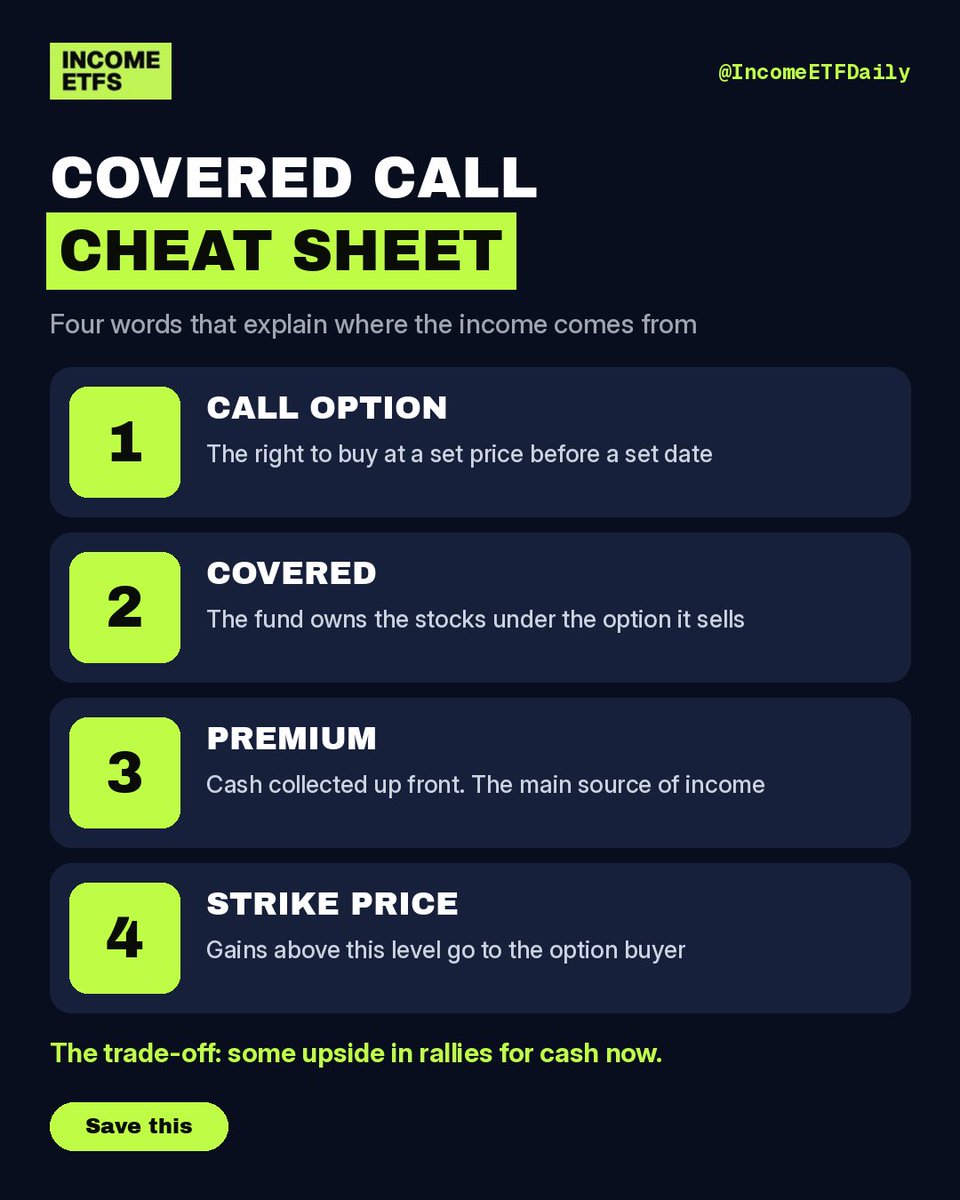
COVERED CALL CHEAT SHEET: FOUR WORDS EXPLAIN WHERE THE INCOME COMES FROM.
1. Call option: a contract that gives the buyer the right to buy a stock or index at a set price before a set date.
2. Covered: the fund owns the stocks underneath the option it sells, so it can cover the contract if the buyer uses it.
3. Premium: the cash the fund collects up front for selling the option. This is the main source of a covered call ETF's income.
4. Strike price: the set price in the contract. If the market climbs past it, the gains above that level go to the option buyer, not the fund.
The fund trades some of its upside for cash today. That's why covered call ETFs can trail the market in strong rallies while still paying income.
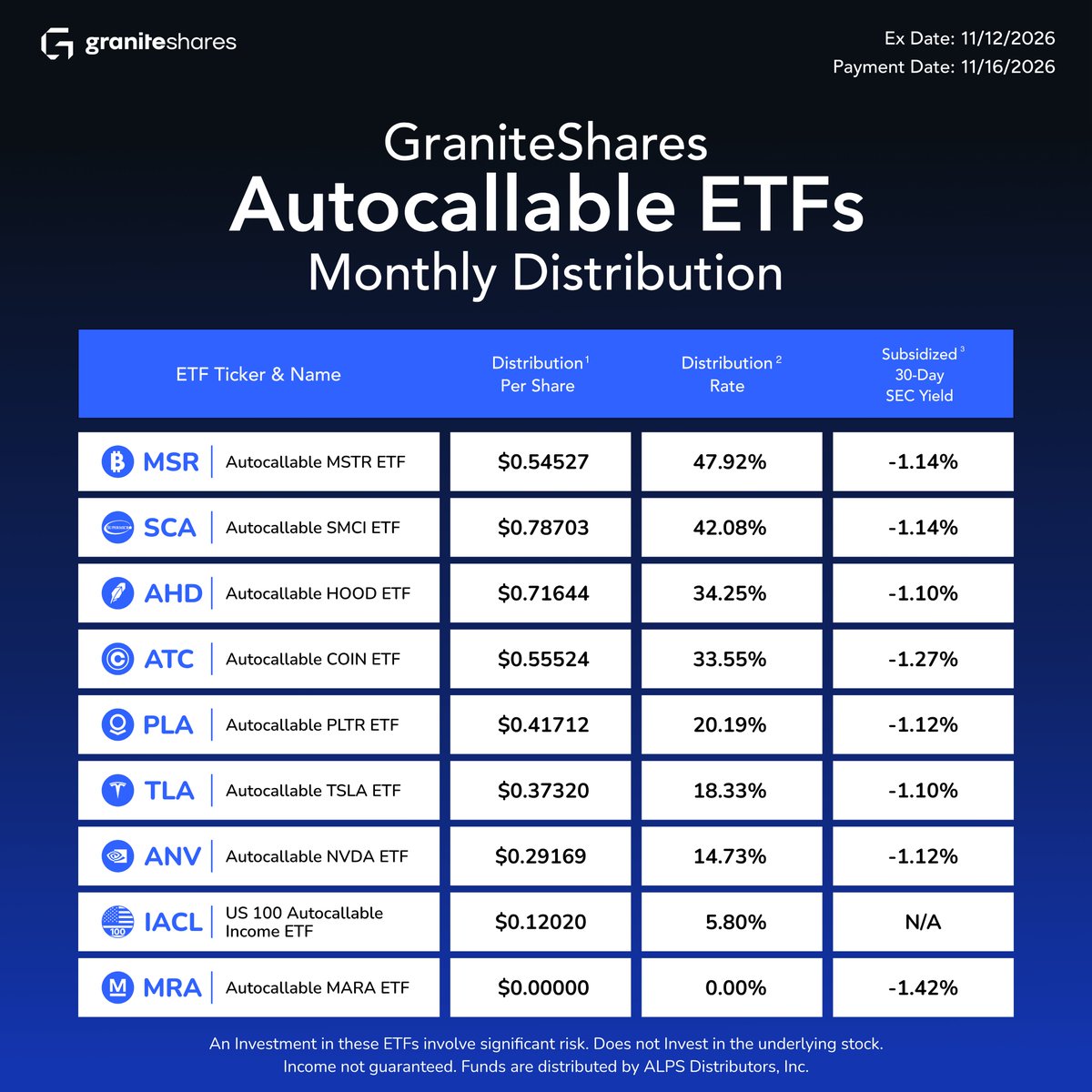
GRANITESHARES ANNOUNCED DISTRIBUTIONS FOR 9 AUTOCALLABLE ETFS.
These are the 5 highest distribution rates in the table.
$MSR Autocallable MSTR ETF 47.92% distribution rate
$SCA Autocallable SMCI ETF 42.08% distribution rate
$AHD Autocallable HOOD ETF 34.25% distribution rate
$ATC Autocallable COIN ETF 33.55% distribution rate
$PLA Autocallable PLTR ETF 20.19% distribution rate
https://t.co/ZWIHP5iwD1
Think of income ETF investing as a swing trade that pays you while you wait.
Buy the dip, collect the income, keep the appreciation.
The swing trader has to sell to win. I don't.
YIELDMAX ANNOUNCED DISTRIBUTIONS FOR 44 ETFS.
These are the 5 highest distribution rates in the Group 2 table.
$FIAT YieldMax Short COIN Option Income Strategy ETF 100.95% distribution rate
$WNTR YieldMax Short MSTR Option Income Strategy ETF 90.14% distribution rate
$MRNY YieldMax MRNA Option Income Strategy ETF 85.83% distribution rate
$CVNY YieldMax CVNA Option Income Strategy ETF 85.02% distribution rate
$HIYY YieldMax HIMS Option Income Strategy ETF 75.21% distribution rate
https://t.co/oiQJ4nPz8V
11.11.2026: YieldMax® ETFs announces Group 2 distributions.
See the latest distribution per share for each fund below.
Press Release: https://t.co/dXkFSemVIo
$MRNY $FIAT $AMDY $XOMO $TSMY
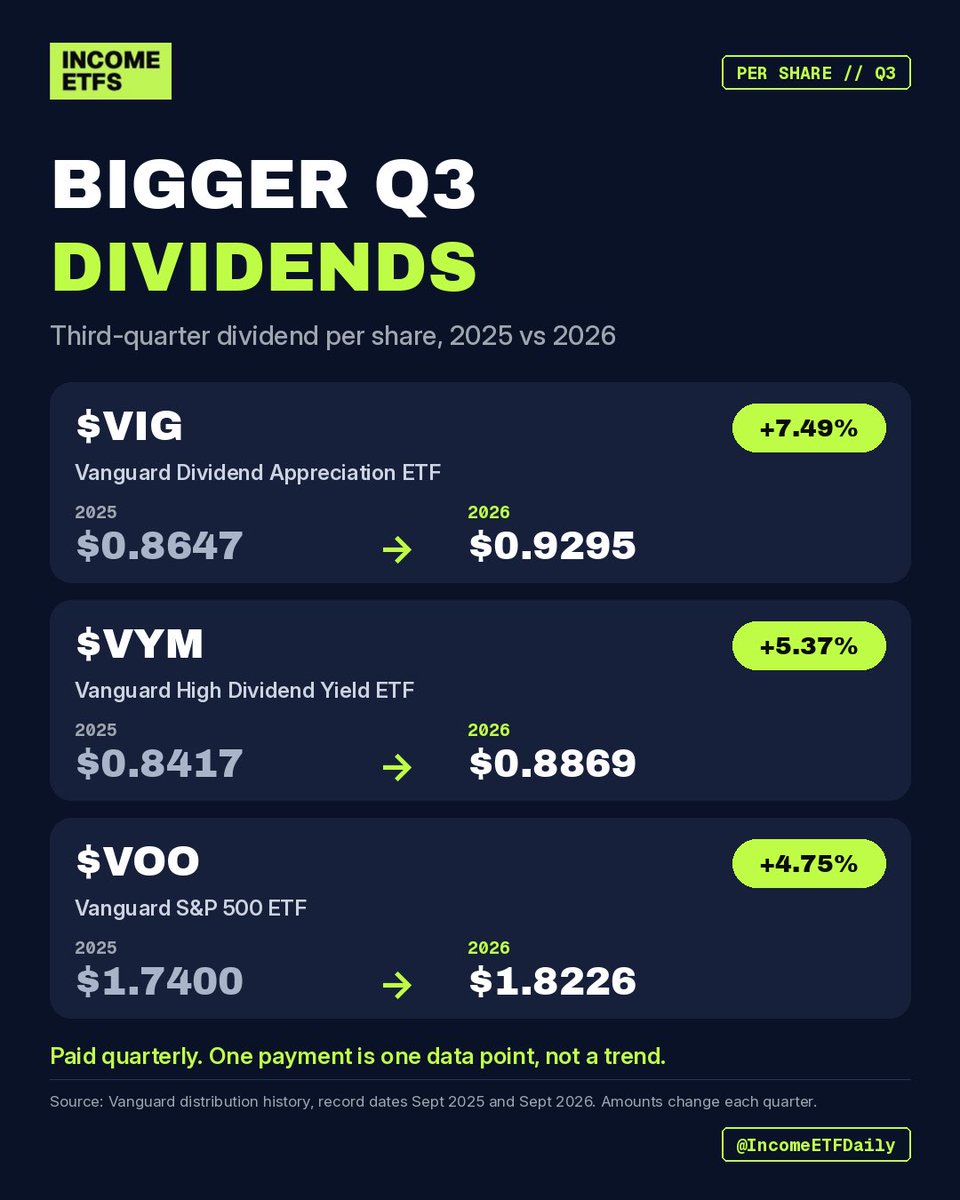
THREE VANGUARD ETFS PAID A BIGGER THIRD-QUARTER DIVIDEND PER SHARE IN 2026 THAN IN 2025
$VIG Vanguard Dividend Appreciation ETF
$0.8647 in 2025, $0.9295 in 2026, +7.49%
$VYM Vanguard High Dividend Yield ETF
$0.8417 in 2025, $0.8869 in 2026, +5.37%
$VOO Vanguard S&P 500 ETF
$1.7400 in 2025, $1.8226 in 2026, +4.75%
$XYLD GLOBAL X S&P 500 COVERED CALL ETF PAID BETWEEN $0.30 AND $0.41 PER SHARE EACH MONTH OVER THE PAST 12 MONTHS.
$XYLD owns the stocks in the S&P 500 and sells call options on the index to bring in income. The option income changes with the market, so the monthly payment changes too.
Monthly distributions per share by ex-date, from Global X:
November 2025: $0.40
December 2025: $0.33
January 2026: $0.36
February 2026: $0.34
March 2026: $0.39
April 2026: $0.35
May 2026: $0.40
June 2026: $0.34
July 2026: $0.41
August 2026: $0.31
September 2026: $0.30
October 2026: $0.31
INCOME CHEAT SHEET: ONE ETF PAGE CAN SHOW THREE DIFFERENT YIELD NUMBERS.
Here's what each one measures, using $QYLD Global X Nasdaq 100 Covered Call ETF as of November 9, 2026, from Global X:
1. Distribution rate: 12.57%. The latest monthly payment times 12, divided by the fund's NAV. It assumes that payment stays the same, which it may not.
2. Trailing 12-month distribution: 12.80%. What the fund paid over the past 12 months, divided by its NAV. It looks backward, not forward.
3. 30-day SEC yield: -0.02%. A standardized measure of dividend and interest income minus fund expenses over 30 days. Option premiums aren't counted, which is why a covered call fund can show a number near zero.
When you see a yield quoted for an income ETF, it helps to know which of the three it is.
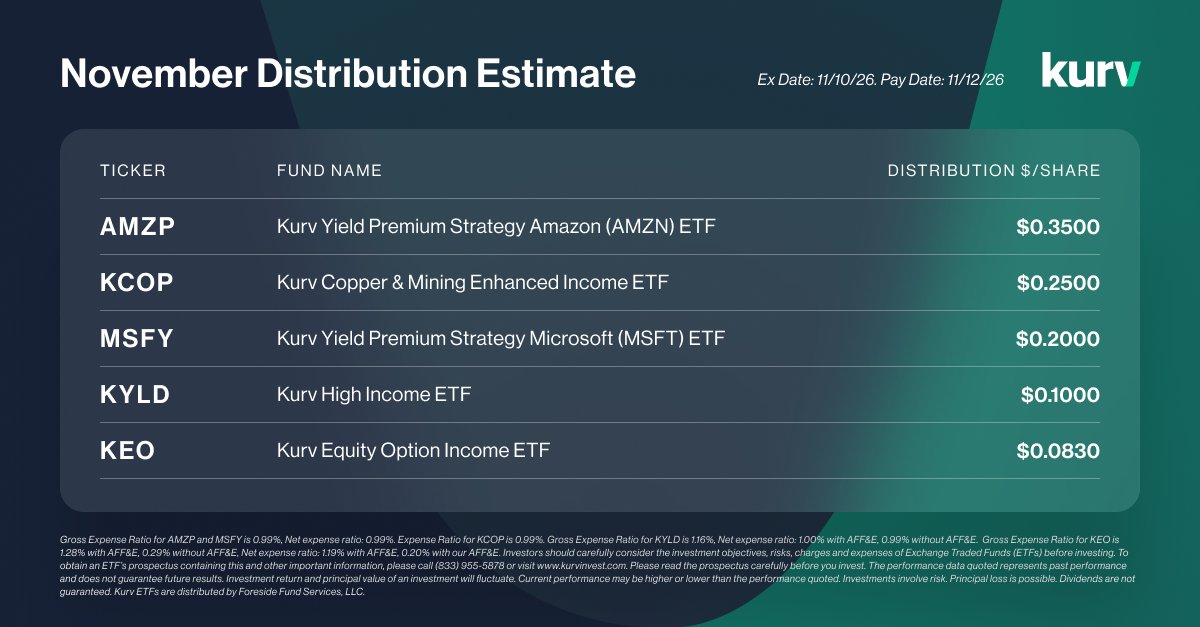
KURV PUBLISHED ITS NOVEMBER WEEK 2 DISTRIBUTION ESTIMATES FOR 5 ETFS.
$AMZP Kurv Yield Premium Strategy Amazon (AMZN) ETF $0.3500 per share
$KCOP Kurv Copper & Mining Enhanced Income ETF $0.2500 per share
$MSFY Kurv Yield Premium Strategy Microsoft (MSFT) ETF $0.2000 per share
$KYLD Kurv High Income ETF $0.1000 per share
$KEO Kurv Equity Option Income ETF $0.0830 per share
https://t.co/7IT5zVGf5V
$100,000 IN REALTY INCOME $O PAYS ABOUT $5,476 A YEAR AT ITS CURRENT DIVIDEND. THE SAME $100,000 IN $VNQ VANGUARD REAL ESTATE ETF PAID ABOUT $3,501 OVER THE PAST YEAR.
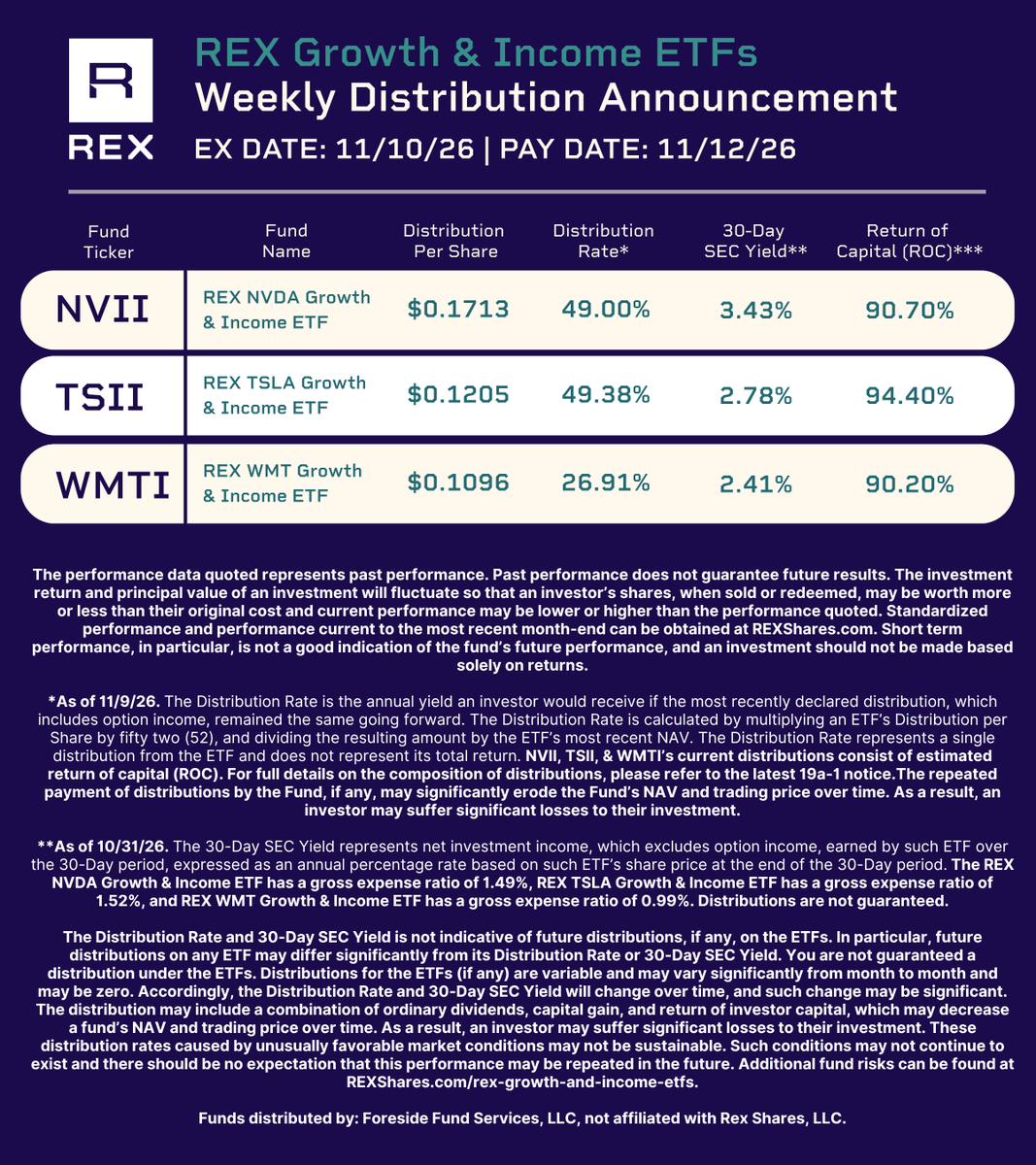
REX ANNOUNCED DISTRIBUTIONS FOR 3 ETFS.
$NVII REX NVDA Growth & Income ETF 49.00% distribution rate
$TSII REX TSLA Growth & Income ETF 49.38% distribution rate
$WMTI REX WMT Growth & Income ETF 26.91% distribution rate
Distribution News for REX Growth & Income ETF Holders!
Pay date: 11/12/2026
REX NVDA Growth & Income ETF $NVII
Amount: $0.1713
REX TSLA Growth & Income ETF $TSII
Amount: $0.1205
REX WMT Growth & Income ETF $WMTI
Amount: $0.1096
*As of 11/9/26. The Distribution Rate is the annual yield an investor would receive if the most recently declared distribution, which includes option income, remained the same going forward. The Distribution Rate is calculated by multiplying an ETF’s Distribution per Share by fifty-two (52), and dividing the resulting amount by the ETF’s most recent NAV. The Distribution Rate represents a single distribution from the ETF and does not represent its total return.
**As of 10/31/26. The 30-Day SEC Yield represents net investment income, which excludes option income, earned by such ETF over the 30-Day period, expressed as an annual percentage rate based on such ETF’s share price at the end of the 30-Day period.
***NVII, TSII, & WMTI’s current distributions consist of estimated return of capital (ROC). For full details on the composition of distributions, please refer to the latest 19a-1 notices. The REX NVDA Growth & Income ETF has a gross expense ratio of 1.49%, the REX TSLA Growth & Income ETF has a gross expense ratio of 1.52%, and the REX WMT Growth & Income ETF has a gross expense ratio of 0.99%. There is no guarantee that the Funds will be successful in their attempt to provide leveraged exposure to the underlying stocks or pay weekly distributions.
The Funds are not suitable for all investors. These distribution rates caused by unusually favorable market conditions may not be sustainable. Such conditions may not continue to exist and there should be no expectation that this performance may be repeated in the future. The performance data quoted represents past performance. Past performance does not guarantee future results. The investment return their original cost and current performance may be lower or higher than the performance quoted. Performance current to the most recent month-end can be obtained by calling 1-844-802-4004. Short term performance, in particular, is not a good indication of the fund’s future performance, and an investment should not be made based solely on returns.
NVII, TSII, & WMTI Prospectus: https://t.co/ZTznhs6NHH
NVII Fund Info and Standardized Performance: https://t.co/k3KDL8TzfT
TSII Fund Info and Standardized Performance: https://t.co/RgB8ohJeQm
WMTI Fund Info and Standardized Performance: https://t.co/VNgvmC1un6