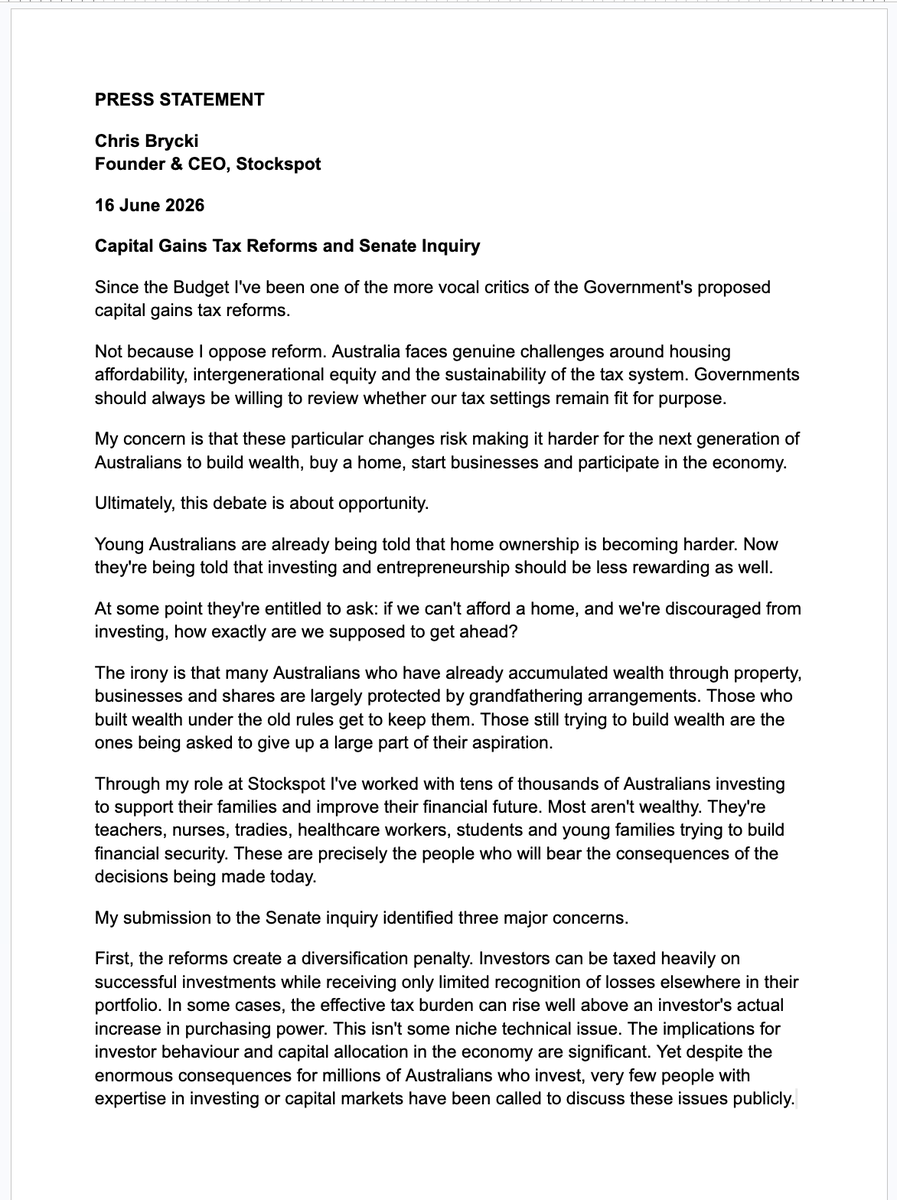
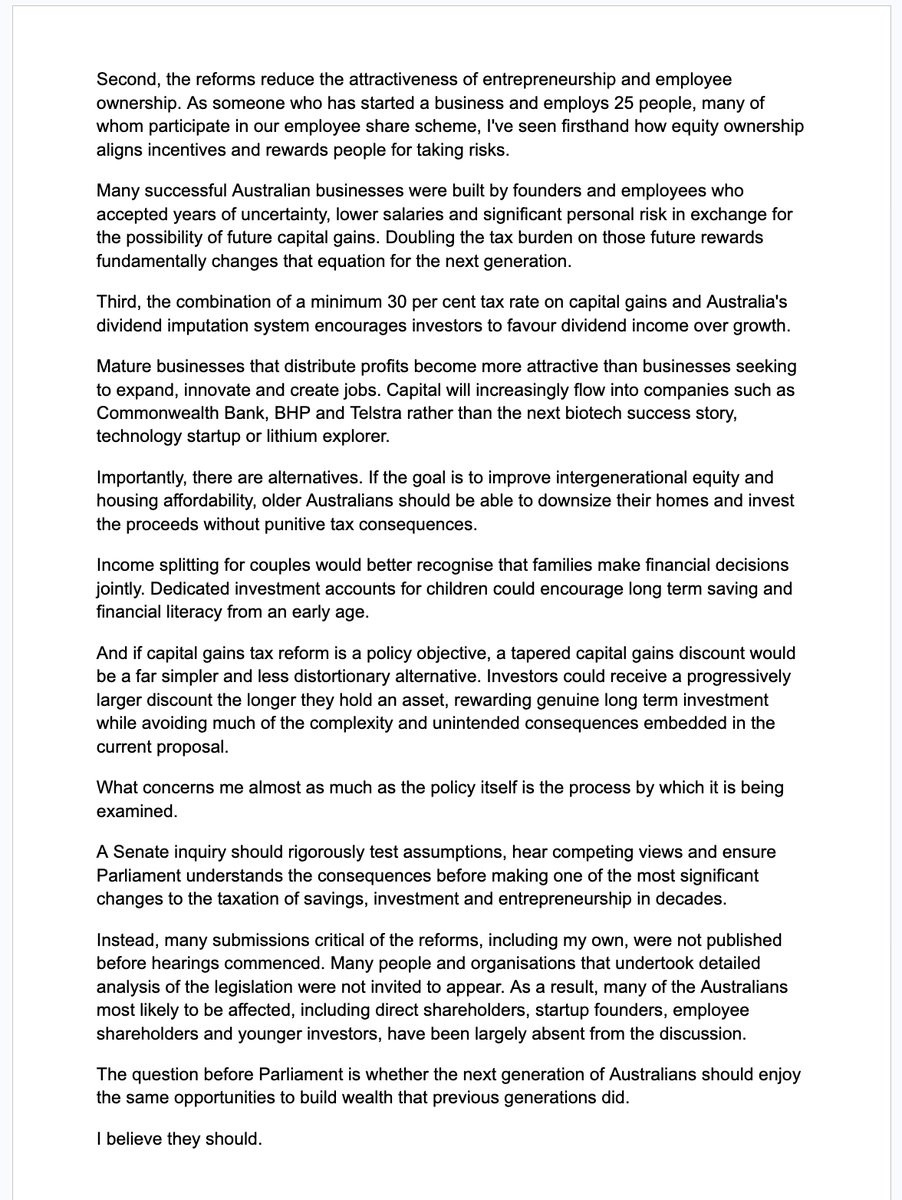
@parnellpalme Strong piece. The issue is no longer theoretical. If experts are still finding scenarios where investors can face tax above real returns, the policy is not ready. Major CGT reform should be withdrawn, properly modelled, and subjected to full scrutiny before legislation
Agree. Six weeks after the Budget, experts are still finding material flaws in the CGT design. That is not normal implementation risk; it is evidence the policy was not properly tested before announcement. A tax change that can produce punitive effective rates and distort investment should be withdrawn, modelled properly and taken back through full scrutiny
@JEChalmers@AustralianLabor The tax changes also weaken future opportunity. Higher CGT reduces after-tax returns for investing, startups, employee equity and small caps. That affects capital formation, business growth and wage creation, the things young Australians need to build wealth
This is not affordability policy. 21 homes and 5% deposits do not change the maths. Young buyers still need income, borrowing capacity and a deposit after rent, tax and HELP repayments. Treasury’s own estimate is only ~75k extra owner-occupiers over 10 years. That is marginal, not structural
This uses distributional data but omits lifecycle effects. Young workers save from after-tax wages, face HELP repayments, higher rents and far higher house-price-to-income ratios than earlier cohorts. Tax brackets are not automatically indexed. Lowering future after-tax investment returns does not address those constraints.
As a young Australian, this framing ignores opportunity. Concentration of capital gains is not proof the reform helps young people build wealth. The policy replaces the 50% CGT discount with indexation plus a 30% minimum tax, affecting shares, trusts, startups, employee equity and long-term investment. Lower after-tax returns reduce the incentive to take risk
It should be scrapped before it damages productivity and opportunity. The carve-outs confirm the design is unstable. CGT changes reduce the reward for risk capital, distort capital allocation and add compliance cost. That means less investment, fewer growth businesses and weaker future wages
A late carve-out does not correct the underlying design risk. CGT changes alter incentives for capital allocation across startups, employee equity, ASX small caps, exploration and long-term investment. Lower post-tax returns reduce risk-adjusted investment, capital formation, business scaling and future productivity
@chrisbrycki@linzcom Agree. If the policy now needs carve-outs for tech startups, that confirms the base design has broader economic problems. Exemptions don’t fix a flawed framework.
My business (and I personally) will qualify for the proposed tech startup carve out… but it's terrible policy.
If these tax changes are so damaging that the Government needs to create special exemptions for tech companies and a subset of small businesses, that's an admission the underlying policy has serious flaws.
Why should founders, employees and investors in one industry get relief while everyone else wears the cost??
What about the medium-sized manufacturers, retailers, healthcare businesses, agricultural businesses, professional services firms and the thousands of ASX-listed companies that employ millions of Australians?
And what about the 7.7 million Australians who invest in shares outside super? They don't get a carve out despite facing much higher tax on successful long term investments. That gaping hole in the policy hasn't been fixed!
This $77 billion transfer from the productive private sector and aspirational younger Australians to government will make Australia less competitive, discourage investment, productivity and entrepreneurship, and push more capital towards foreign investors who are often exempt from Australian CGT altogether.
It's a massive own goal for the country.
These changes affect housing, shares, trusts, startups, small business exits, employee equity and retirement planning. Treating that as a messaging fight rather than a technical economic reform is negligent. The public needs modelling, transition impacts and proper Senate review before passage
Your priority should be publishing the modelling, submissions and full economic impacts of major tax changes before legislation is rushed. Attacking critics does not answer the core issue: Australians did not vote on this package, and the Senate process has not provided adequate scrutiny
Some quality individual submissions have been trickling in to the Senate Committee's enquiry on the budget bill. Check out submission #141 (name withheld) from a young Australian share investor. This investor presents modelling simulating typical ASX share portfolios and finds that they would face a median effective tax rate of 55%. That's exactly the same result I got using US stock market data.
Great to hear from so many Australians at this morning's discussion on the proposed CGT changes.
We heard from a migrant from South Africa questioning whether Australia remains the best place for his family... a retired tax accountant concerned about the policy design... the founder of an AI engineering business who travelled down from Newcastle, and many others worried about the impact on younger Australians, entrepreneurship, investment and aspiration.
One theme came through clearly: this isn't just about tax. It's about opportunity for the next generation of Australians and Australian businesses.
Great to see Senator @ajamesbragg drop in and share his concerns about what many see as a rushed and one-sided inquiry process, where opposing experts and dissenting views have been excluded from the discussion.
I've attached the statement I delivered this morning. More photos and media coverage to come.
If policymakers genuinely want to understand the consequences of these changes, they should spend more time listening to the Australians who'll be affected by them.
Thanks @GeoffWilsonWAM and his team for organising, and everyone who attended.
If the government is now considering carve-outs, that confirms the original design was not settled. Major tax reform should not be corrected through last-minute exemptions after criticism. The impacts on investment, compliance costs and capital allocation should have been tested before introduction
The Senate process matters because these changes affect more than property. They affect shares, trusts, small business exits, startups, employee equity, retirement savings and risk capital. Proper scrutiny requires published submissions, modelling and expert evidence before hearings conclude
@JEChalmers@ato_gov_au Calling these reforms “fairer for workers and first-home buyers” ignores the process failure. Business groups have urged parliament to reject the CGT changes, the BCA says they reduce competitiveness, and Ai Group has called for amendments. A rushed inquiry is not proper scrutiny
That is one view, but it is not the only expert evidence. The BCA says the changes would reduce investment and add significant complexity. Grattan has estimated CGT/negative gearing reform can reduce housing construction. Fairness cannot be measured without supply, jobs and capital impacts