Discover the treasure map of the Python ecosystem! 🗺️✨ From time series analysis to web scraping, this incredible cyber-industrial design guides you through all the essential tools for data science and AI.
What’s your go-to library? 👇
Most traders ask Claude if a token is going up. Claude cannot predict price.
Someone built 17 prompts that make it interrogate your reasoning instead. The results are wild.
Here is the full system nobody is talking about.
Want to become a #DataAnalyst in 2026? 📊
Focus on the skills employers value most:
✅ #SQL
✅ #Excel
✅ #Python
✅ BI Tools
✅ #Statistics
✅ ETL
Master the fundamentals, build projects, and let your portfolio do the talking. 🚀
Save this post for later 📌
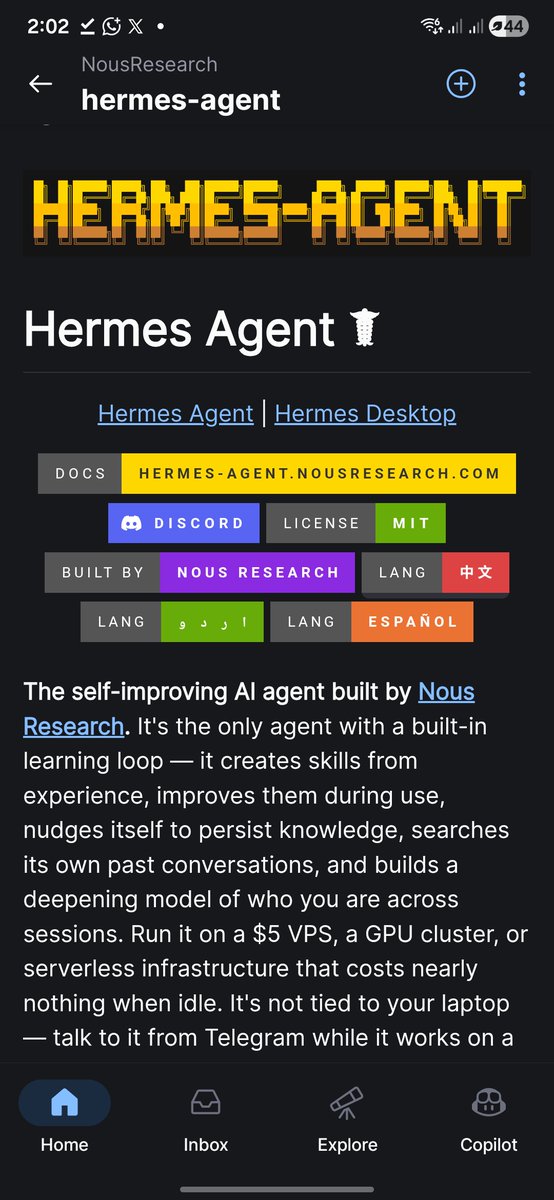
One of the smartest things you can do with Hermes right now:
Use Obsidian to build a second-brain database that self-evolves over time.
Here's how to set it up in <5 minutes:
Step 1. Download Obsidian
Head to obsidian . md and download the desktopp app.
Create a new Obsidian vault (this is where all notes live locally).
Start dumping everything in here:
- Business context
- Personal goals
- Meeting summaries
The more you put in, the more powerful it gets.
Step 2. Connect Hermes to your Obsidian vault
Open the new Hermes desktop app and paste this prompt:
"I want to connect you to my new obsidian vault and have you act as my second-brain orchestrator - do everything necessary to set up that connection now."
This gives Hermes direct access to everything inside your vault.
Step 3. Let it self-evolve
Every time you add a new note, Hermes automatically ingests it.
Prompt Hermes:
"Every day, scan my second brain database. Every time I add a new note, use it to create reusable skills and workflows."
Pro tip: Once Obsidian is connected to your agent, you can just prompt it directly to add notes/context/data.
This is what a true AI second brain looks like.
Save this and build your second brain system now.
POV: claude traveled 6 months into the future and told you exactly how your next move failed.
it's called a premortem.
daniel kahneman (nobel prize-winning psychologist behind "thinking fast and slow") called it his single most valuable decision-making technique.
google, goldman sachs, and procter & gamble all use it before major launches.
here's the problem it solves.
when you ask claude "is this a good plan?" it finds all the reasons to say yes.
that's what it was trained to do. so you walk away feeling confident.
you execute, and spend weeks / months building on top of that plan.
then it blows up.
and you realize the problem was obvious in hindsight, you just never stress-tested it because claude told you it was solid.
a premortem fixes this by flipping the frame.
instead of asking "what could go wrong?" you tell claude "it's 6 months from now and this is already dead. tell me how it died."
that shift turns off claude's optimism because there's nothing to be optimistic about. the premise already says it failed.
so claude stops looking for reasons your plan will work and starts explaining how it fell apart.
claude comes back with every way your plan could die, each one with a full failure story and the early warning signs to watch for.
then a synthesis pulls it all together:
> which failure is most likely
> which failure is most dangerous
> the single biggest hidden assumption you're making (often the most valuable part)
> a revised version of your plan with the gaps closed
you say "premortem this" and give it your plan. the skill handles the rest.
They quoted him $6,000 for a website
He opened Claude Code instead
4 minutes later it was live
The gap between knowing how to use Claude Code and not knowing is worth thousands
EngineerKit is what made this possible
It's on https://t.co/9tegpgaMKp
full guide below
200+ Claude skills sit in one free GitHub repo while people sell the same workflows for $500.
Most people run Claude blind.
They open a blank chat, type “make me a presentation,” and let it guess. The output is mid. Generic. Forgettable.
A skill kills the guessing. It’s a folder of instructions you install once, and Claude runs the exact proven workflow every time — decks, PDFs, UI design, spreadsheets, MCP servers.
Install takes 90 seconds:
Phase 1 — Pull the repo
Open it. Click the green Code button. Download ZIP. Unzip.
Phase 2 — Load the skill
Open Claude. Click Customize. Add New Skill. Hit the + icon. Add File. Drop in the folder.
Done. Type “create a PowerPoint” and Claude follows all 200 lines of that skill on its own. No back-and-forth. No babysitting.
Now the part nobody says out loud.
A clean deck takes an agency 3 hours and costs a client $400. With the skill, you ship it in 4 minutes. Same with PDFs. Same with reports. Same with landing pages.
Month 1: you stop paying for tools.
Month 2: you start charging for the output.
Month 3: the skill does the work and your name is on the invoice.
The repo is free. The skills are free. The only thing scarce is the 90 seconds most people won’t spend.
Everyone else is still typing “make me a deck” into a blank box.
You’ll have 200 employees who never guess.
AI WEBSITES LOOK BAD BECAUSE CLAUDE IS COPYING THE SAME SLOP
And the fix is not a better prompt.
The Problem:
→ Same purple gradient
→ Same 3 cards
→ Same centered hero section
→ Same fake emoji energy
→ Same generic SaaS layout for every niche
The Anti-Slop Fix:
✓ Plug design skills into Claude, Hermes, or OpenClaw
✓ Use front-end design skills, Shadcn UI, UIUX Pro Max, and premium UI skills
✓ Give the agent rules for fonts, spacing, palettes, animations, and layout
✓ Make the design match the product instead of using a blank template
The Big Upgrade:
→ One bold signature element
→ One strong accent color
→ Real whitespace
→ Fonts with character
→ Thin lines instead of lazy drop shadows
Same prompt.
Same time.
Completely different result.
AI design only looks generic when you give it generic rules.
API Security Best Practices
Most API breaches happen because of broken authorization, leaked secrets, or missing rate limits. Let's look at some of the basics.
- Use Modern OAuth/OIDC + MFA: PKCE for public clients, short-lived tokens, and step-up MFA for anything sensitive. Implicit and password grants should be dead by now.
- Enforce Fine-Grained Authorization: Check object, function, and field-level permissions on every request. BOLA is still the top API vulnerability.
- Minimize Scopes and Data: Give each client the smallest token scope and the least data it needs. Only return the fields the caller actually needs.
- Encrypt Every Hop: TLS for external traffic and mTLS between services. If it crosses a network boundary, encrypt it.
- Protect Secrets and Keys: Store signing keys in HSM-backed vaults. Rotate them.
- Validate Requests with Schemas: Reject unknown fields, oversized payloads, and suspicious URLs at the gateway. Don't let bad input reach your business logic.
- Rate Limit and Cap Resources: Quotas per user, payload size caps, and execution timeouts. Without these, one misbehaving client takes down your entire system.
- Defend Sensitive Business Flows: Protect login, checkout, and OTP with anti-bot, idempotency keys, and step-up auth.
- Control Outbound and Third-Party Calls: Allowlist where your API can call out to and block internal metadata endpoints. Your security is only as strong as your weakest integration.
- Harden Config and Error Handling: Deny by default on CORS, methods, and debug endpoints. Return generic errors, never stack traces.
- Inventory APIs and Versions: Track every endpoint, version, and shadow API. You can't secure what you don't know exists.
- Log, Detect, and Respond: Push auth decisions and anomalies to a SIEM. Alert on 401 spikes before they become incidents.
Over to you: Which of these best practices is the hardest to enforce across your services?
You can build an AI second brain in 15 minutes.
No coding experience needed. no $1000 course
[Here is how you can do it in 5 mins:]
Step 1: Download Claude Desktop.
Step 2: Download Obsidian Desktop.
Step 3: Create a new vault and start dropping .MD files into it.
Step 4: Tell Claude Code to connect directly to your vault using Andrej Karpathy's prompt: https://t.co/2SJBZyjXDl
That is it.
Your entire knowledge base becomes searchable, connectable, and queryable by the most powerful AI model on earth.
Every note you have ever written.
Every idea you have ever captured.
Every resource you have ever saved.
Claude can now read all of it, find connections you missed, and surface insights from your own thinking that you forgot you had.
Most people are using Claude as a search engine.
The people building second brains with it are using it as an intelligence layer on top of everything they know.
The gap between those two use cases is the gap between asking Google a question and having a research partner who has read everything you have ever written.
Bookmark this.
Build it tonight.
this is f*cking gold
A senior Google engineer dropped a 424-page doc on agentic design patterns.
424 pages.
Most engineers bookmarked it and never opened it again.
if I had this a year ago, I would've shipped my first app in a day instead of 2 weeks
in the right hands, this changes everything:
Google just dropped a FREE 421-page playbook for AI agents.
Inside:
→ Prompt chaining
→ Memory & routing
→ MCP + multi-agent systems
→ Planning & guardrails
→ Code-backed examples
This isn't a blog post.
It's an AI engineering curriculum.
🚨 GIVEAWAY
• 3 premium AI tool subscriptions • 10 AI resource packs
Follow + Like + Repost ♻️
Comment "AGENT" and I'll pick winners in 48 hours. :::
12 Websites that pay you daily💸💸
1. arise. com
2. kellyconnect. com
3. gaggle. net
4. paidwork. com
5. toptal. com
6. transcriptionhub. com
7. preply. com
8. omniinteractions. com
9. rev. com
10. taskrabbit. com
11. swagbucks. com
12. nexrep. com
13. clickworker. com
Follow me @Ambrose0_X
For more AI Update.✅