@mjnblack@nytimes It's grotesque that people like you can do something this ill-conceived and then take to the internet for pity points when it all blows up in your face. Everyone with a modicum of sense is wise to the act of vague performative HR language being used to railroad people.
@tpce123@reddit_lies Having a family that loves him enough to let him move back in with them in a tough economy and job market and having the care to set the money he gave them aside so he has something extra to fall back on the future. Yeah dude. This guys parents are manipulative evil monsters.
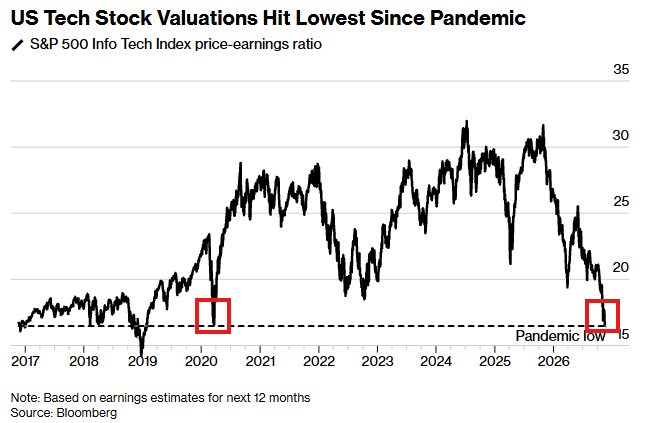
BREAKING: US technology stock valuations have hit their lowest level since March 2020 amid the market correction.
The S&P 500 Info Tech Index P/E ratio is now at its lowest since March 20th, 2020, at 16.4x.
BREAKING: AMD, $AMD, officially denies claims made by Hunterbrook Media that sent the stock -13% lower, saying that the claims "misrepresent AMD's business practices and relationships," per Bloomberg.
"AMD complies with applicable US export control laws and regulations and maintains rigorous processes to ensure compliance across our global operations," a spokesperson said.
"We remain focused on serving our customers and upholding the highest standards of integrity," they added.
Hunterbrook Capital released the report with a short position in the stock.
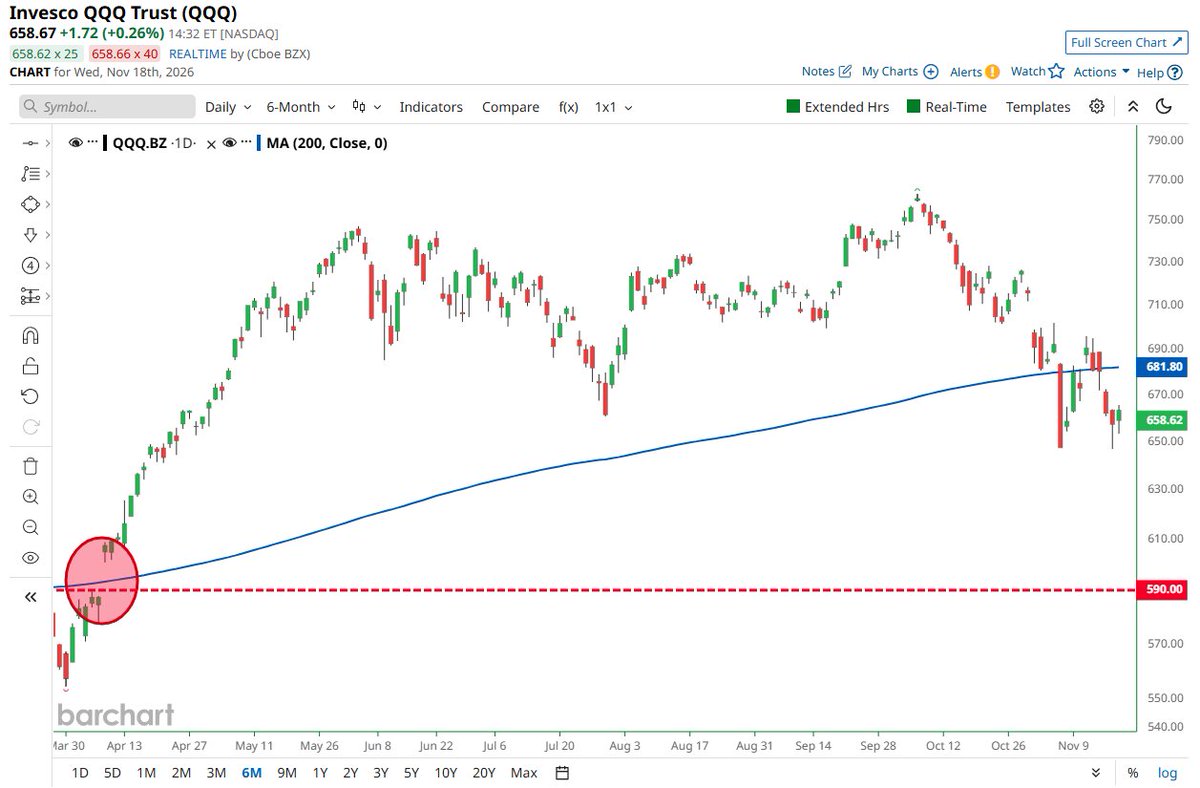
Nasdaq 100 $QQQ now spending a lot of time below the 200-day moving average 🚨 What's next? A potential gap fill around 590, which would mean a 23% decline from the ATH and put us firmly into a bear market 📉 🐻
Take a look at sentiment right now.
Because of a personal event involving Jensen Huang, there are now widespread calls that the "AI bubble has popped."
Sentiment is as though AI has failed, the investment wave is over, and we are in a global depression.
In reality? The S&P 500 is up +7% YTD, +60% in 5 years, and ~7% away from a record high, with US AI CapEx running at over $1 trillion per year.
Meanwhile, AI-associated sectors and tech investments have accounted for ~44% of total US GDP growth on a rolling four-quarter basis.
And, Nvidia, $NVDA, is guiding nearly $750 billion in revenue for next year, even without Jensen Huang.
The underlying fundamentals of the AI Revolution have not suddenly deteriorated because of a leadership crisis at one company.
The unfortunate result of this drawdown, as with nearly every other correction since the AI Revolution began, will be countless investors getting crushed on the way back up.
Today's fearmongers become tomorrow's short squeeze as soon as sentiment shifts again.
The comments on this post will be a perfect example of just how polarized sentiment has become in the "doom" direction.
Asset owners will win and the AI Revolution is far from over.
If gold traders are right, the Fed is committed to waging its biggest inflation fight since the Volcker era. If so, the stock, bond, and real estate markets will crash, and the resulting financial crisis will make 2008 look like a Sunday school picnic. That's why they're wrong.
Remember when Bloomberg literally ran the headline: "China's curing cancer faster and cheaper than anywhere else. But some worry they may be going too fast"?
Now look at how the Financial Times is framing this new FDA decision: "FDA rejects cancer drug invented in China in blow to Beijing's biotech sector."
A "blow to Beijing"? Chinese lung cancer patients ALREADY have this drug. Not only is it approved across China, it is covered by public health insurance, where a single vial costs roughly $100 USD (around $1,300 per treatment cycle before insurance even kicks in to cover most of the bill).
Meanwhile, in separate head-to-head trials, this exact Chinese drug beat Merck's Keytruda, which is Big Pharma's $30 billion-a-year cash cow and the best-selling cancer drug on earth. In the U.S., Keytruda carries a list price of over $12,500 per three-week dose, adding up to more than $200,000 a year.
So why did the FDA block this initial U.S. application? While a larger global trial is still wrapping up, the U.S. partner company applied first to use the drug for a smaller, harder-to-treat group of lung cancer patients whose previous treatments had failed. Even though the drug clearly slowed down tumor growth, the FDA rejected it, claiming that slowing tumors wasn't enough without stronger long-term survival proof and complaining that too many patients in the trial were Chinese.
Here is the kicker: a Harvard Medical School study found that over half (57%) of the cancer drugs fast-tracked onto the market by the FDA failed to prove within five years that they actually helped patients live longer or feel better. For years, the FDA happily let Western pharma giants charge Americans $200,000 a year for drugs that only slowed or shrank tumors on paper. Yet the moment a superior Chinese drug threatens Big Pharma's biggest monopoly and exposes what cancer treatment actually costs outside the U.S. pricing racket, the FDA suddenly discovers "strict standards."
Even if you take the FDA's red tape at face value, look at the media sickness on display. Western outlets are cheering a blocked lung cancer treatment like it is a geopolitical scoreboard win over China, when the only people being denied the option right now are Americans.
Imagine framing American cancer patients having fewer options while still paying $200,000 a year as "owning Beijing."
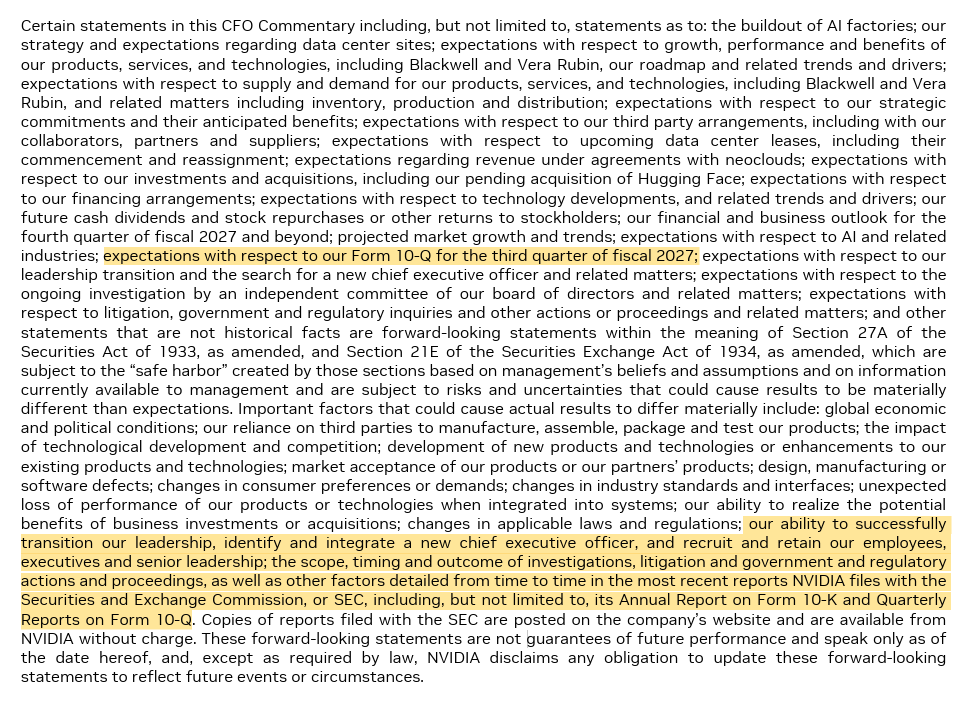
If Colette Kress did not lie about Nvidia's business, earnings, and the scale of regulatory actions the company is facing, what she said about the 10-Q SEC filing expected to be available soon would not have been included as a "forward-looking statement" subject to "safe harbor"
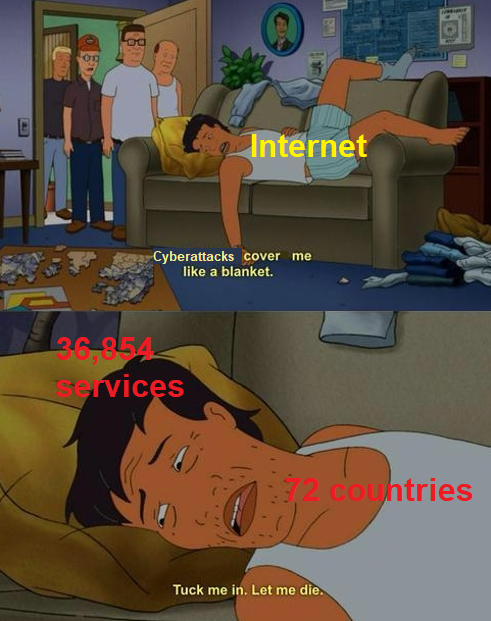
The #FBI issued a FLASH advisory warning that cybercriminals and state-aligned hackers are exploiting ARTEX, a super intelligence-powered penetration testing framework, to automate attacks against businesses and organizations worldwide. ARTEX can accelerate intrusions from initial targeting to privileged access in under three hours. It was used in the October ConnectWise supply-chain compromise, which exposed Microsoft 365 customer environments and involved attempted authentication against more than 2,250 downstream tenants.
The FBI is urging businesses and organizations to strengthen access controls, monitor suspicious automated activity, and report potential compromises to https://t.co/Y65F8KJfqo.
Read more here: https://t.co/Cl5lpZ7cgG