.....where to look....
stocks down > 75% over 12 months
Falls of 15% plus over the next 2 week
Trading at < 6% of NPV with clear sight on production within 36 months or in production being optimized
#10baggers in commodity Cyclicality abounded if purchased near cycle lows of 2024 through 1H 2025.
.....spot price lows coupled with cap lows
Here is where the value add is .....to have vision out 3-4 yrs for the next cycle peak (from 1H 2024).......moving on to 2027/28 spot #commodity prices +100-400% (#lithium #gold #silver #copper #ironore #coal #nickel etc)
......this results in our purchase valuation of 50% of our pre-production nano caps being <0.25x 2028 CF = #10baggers within 2-5yrs from 1H 2024.
Chinese #lithiumstocks surge today, while correction of ASX peers goes on.
Near-term lithium futures increased by 2.8%-3.2% today amid flat spot prices.
Another great chat between veterans of the lithium sector who understand what’s really going on in lithium. Looking forward to picking up my copy of #LithiumConfidential in person. This book will be compulsory reading for anyone investing in the sector as Joe was there when it all started and the only one of the OG’s to put pen to paper to date.
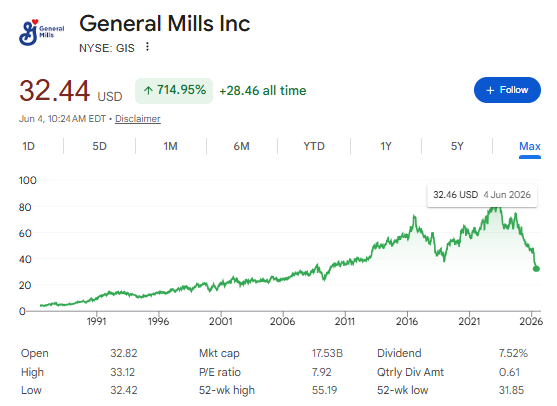
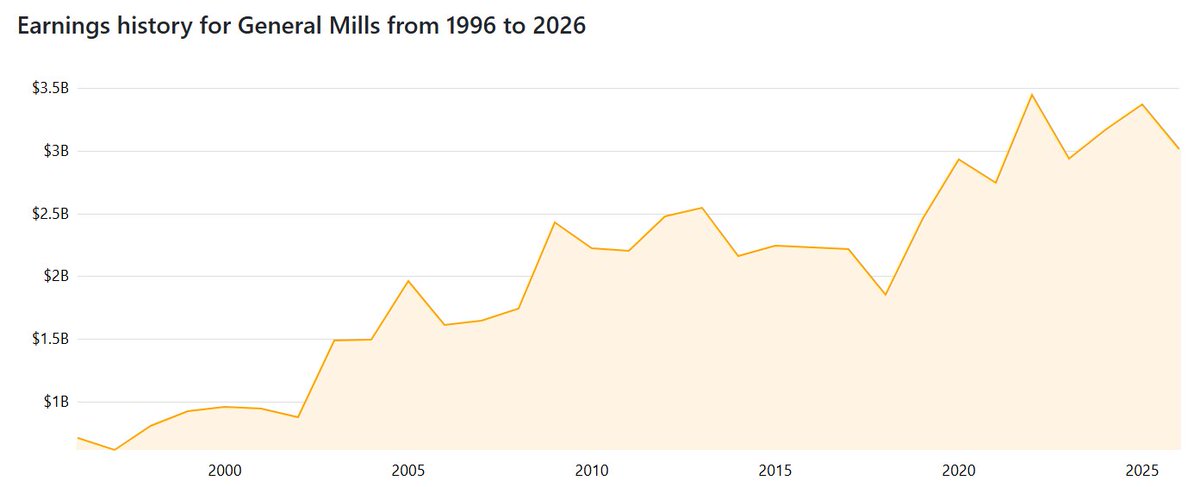
$GIS is at its cheapest since the GFC, despite having doubled earnings since then and having an all time high dividend payout
The yield is about twice as high as in any other point in the company's modern history
🚨 We may be looking at the rarest market setup in 50 years.
The S&P 500's four historic drawdowns since 1972:
– 1973 Inflation: -43%
– 1987 Liquidity: -30%
– 2000 Tech: -47%
– 2008 Credit: -55%
Each one was driven by ONE dominant risk.
Right now, all four are present at the same time.
1. INFLATION
A commodity supercycle. Energy, metals, agriculture all in multi-year base breakouts. The Fed's preferred inflation gauge has been above 2% for 18 of the last 24 months.
2. LIQUIDITY
The largest equity supply shock since 2000. SpaceX, OpenAI, Anthropic raising ~$275B combined. Google flipping from $60B/year buybacks to $80B net issuance. Over $1 trillion of IPO and lockup supply hitting the Russell 3000 in 2026.
3. TECH
Semiconductors trading 73% above their 200-day moving average – the largest stretch since March 2000. Climax run signals across the AI complex. Micron, Palantir, SMCI, the SOX index, all showing the textbook O'Neil sell pattern.
4. CREDIT
Apollo, KKR, BlackRock, Blue Owl, Cliffwater, Partners Group – all gating redemptions on their evergreen funds in the last 90 days. The private credit machine is freezing in real time.
Never in 50 years have all four risks been simultaneously present.
But here's the part nobody talks about
While the AI Big 10 has gone vertical, quality stocks have been left for dead.
– Berkshire Hathaway: trailing the S&P 500 by hundreds of basis points
– Coca-Cola, Procter & Gamble, Pepsi: trading at multi-year relative lows
– HEICO, Union Pacific, MSCI: making boring new highs while everyone watches Nvidia
– Healthcare vs. S&P 500: 25-year relative low
The last time this happened?
December 1999. Barron's ran a cover titled "What's Wrong, Warren?" – mocking Buffett for being a dinosaur, for missing the internet, for refusing to pay for growth at any price.
Berkshire was down 19% in 1999 while the Nasdaq was up 85%.
What followed:
– Berkshire +29% over the next 24 months
– Nasdaq -78% over the next 30 months
The setup today
Four historic risks stacked simultaneously, while the boring, durable, cash-flowing businesses that always survive these regimes have been treated like dead money for years.
The math doesn't get more asymmetric than this.
Quality stocks aren't out of style.
They're being orphaned.
That's when generational positions are built.
The boring stuff hasn't worked for a long time.
History suggests that's exactly the moment it starts to.
The reason of the price decline is deliberate price suppression by specific players. With long-side capital largely sitting on sidelines, these players are effectively accumulating inventories. Once their accumulation phase concludes, the market will likely see a sharp rebound.
......all you require is $1m in #drypowder near the next market/cycle low, it becomes $10m within 36 months......if you live another 40 years, then you will have > $500m following our process. We suggest you start today with #drypowder.
$NIO It’s not the fucking “experts” charting the stock. It’s not needing a fucking petition imploring the SEC to investigate, and it’s fucking certainly isn’t inadequate management.
Many longterm, and I mean fucking longterm investors know this.
What the fuck is it then?….
It is cold, hard mathematics.
I used the brain in my phone to help explain:
Here is how Citadel and Susquehanna actually control the tape, and how to read their playbook:
1. Market Makers Must Short
Citadel and Susquehanna aren't just shorting NIO—they actually hold a record 13M+ long shares. But because they are Market Makers, they are mathematically forced to short underlying stock to hedge the risky options contracts they sell to retail traders. They aren't trying to destroy NIO; they are staying "delta-neutral" via algorithms.
2. The "Good Earnings" Algo Trap
Decent deliveries don't phase Wall Street anymore. Quantitative funds trade pairs (e.g., Long Tesla / Short NIO) to exploit valuation gaps. Until NIO consistently proves its targeted 17%+ vehicle margins and achieves sustained 2026 non-GAAP profitability, automated models will automatically suppress the upside on any earnings spike.
3. The Options Battleground
•The Target: NIO's "Max Pain" point sits tightly between $5.00 and $5.50.
•The Play: Market makers maximize profits when the stock is pinned inside this exact channel because it lets retail options expire completely worthless.
•The Trigger: A massive wall of retail calls sits at $6.00. If a massive catalyst forces NIO past $6.00, market-maker algorithms will be forced to buy millions of shares to hedge their risk—triggering a massive, automated gamma squeeze.
💡 The Reality
Institutions don't hate NIO. In fact, they are quietly stacking massive blocks of January 2027 LEAPs. They will flip aggressively long the exact second NIO’s fundamental upside outweighs the mathematical decay of keeping it pinned.
Fucking play the long game, not the daily manipulation narrative.
⛳️😎 have a pleasant day. I’m going to go chase the little white ball.
Elon Musk's biggest competitor is secretly paying him $1.25 BILLION per month.
SpaceX just revealed its financials for the first time in 23 years of existence.
And buried deep in the S-1 is a detail that changes how you should think about the entire AI race.
Anthropic, the company building Claude, the company that positions itself as OpenAI's biggest threat, the company valued at over $100 billion, is paying SpaceX $1.25 billion EVERY SINGLE MONTH for compute capacity through May 2029.
That is $15 billion a year flowing directly from Elon's top AI competitor into Elon's bank account.
Think about what that means:
Every time Anthropic trains a new model, improves Claude, or lands an enterprise customer, a massive chunk of that revenue goes straight to the guy who owns the competing AI product.
Anthropic is literally funding the war against itself.
And that's just the beginning of what this filing reveals...
The entire SpaceX IPO is structured around a bet most people haven't figured out yet.
In 2025, SpaceX spent $20 billion in capex. 60% of that, roughly $12 billion, went to AI infrastructure. Rockets and satellites got the leftovers.
In Q1 2026 alone, $7.7 billion out of $10 billion in total capex went to AI. The "rocket company" is spending like an AI company.
Meanwhile, xAI, the division that houses Grok, generated $3.2 billion in revenue for the full year of 2025. But its R&D costs TRIPLED to $5 billion.
It's burning cash at a pace that would have destroyed it as a standalone company.
Which is exactly why Elon merged it into SpaceX two months before filing the IPO.
And Starlink is the engine that makes the whole thing work:
$11.4 billion in revenue, $4.4 billion in operating profit, and 10.3 million subscribers across 164 countries.
It's one of the most profitable subscription businesses on the planet right now.
But the average revenue per user DROPPED from $99 per month in 2023 to $66 per month in March 2026. Subscribers quadrupled but each one is paying a third less.
Starlink is growing by getting cheaper.
SpaceX has lost $37 BILLION since it was founded. Net loss in 2025 was $4.9 billion. This is a company that has never turned an annual profit in 23 years of operation, and it is about to IPO at a $1.75 trillion valuation.
And the total addressable market SpaceX claims in the filing is $28.5 trillion. That is a QUARTER of global GDP.
So here is what investors are actually buying when this IPO prices:
They are buying the most profitable satellite internet business in history, stapled to an AI lab that is burning cash, wrapped inside a Mars colonization pitch that requires building a permanent city on another planet, funded by monthly billion-dollar payments from a direct competitor who has no other option for compute at that scale.
This is the kind of thing only Elon could pull off.
We update these positions as the play develops through scale out....#commodities (on average, some are 4th quartile, some are 2nd) are 35 minutes on the cycle clock....this is the holding phase, we don't buy, that ship has sailed. Many assume that > 100% returns remaining are a buy, they are not for us, we look for > 8x from near cycle lows.
"I see so many ghosts. They're already dead. They don't even know it."
A 45-year Wall Street veteran just said that about the current generation of finance professionals to me.
George Robertson started at Salomon Brothers in 1981 when bond yields were 14%. He's survived every blow-up from Long-Term Capital to 2008 to COVID.
And he's convinced a massive reset is coming that will produce RUIN for people who don't see it.
I just interviewed him, and let me walk you through the one thing most people in this space fail to understand:
The stock market has effectively become a single instrument.
Every major quant fund is staffed by the same MIT graduates running the same models through the same filters arriving at the same conclusions. There are maybe 4 or 5 ideas being expressed across the entire systematic trading universe at any given time. The diversity that makes markets function as a price discovery mechanism is GONE.
Jane Street just reported $16.1 billion in trading revenue in a SINGLE QUARTER. One firm. 3,500 employees. More trading revenue than JPMorgan or Goldman Sachs. Full year 2025 was $39.6 billion.
Lever that capital 10 to 1 across all the major quant players and you're looking at trillions in gross exposure approaching the monthly GDP of the United States. Until something overwhelms that kind of firepower, these firms effectively dictate market behavior.
The rest of us are passengers.
And that's why markets look so deceptively calm right now. Tight ranges, suppressed volatility, weeks and months where nothing seems to move.
But the calm IS the danger.
All the mispricing that should be correcting incrementally through normal price discovery is instead building up like pressure in a sealed system. And when it finally releases, it won't be a normal correction where you have weeks to adjust your positioning...
It will be years of stored mispricing detonating in DAYS.
We've seen the same thing before:
In the 1990s, Long-Term Capital Management was so dominant in fixed income that it killed price discovery across the entire asset class. Danish mortgages, basis trades, risk arbitrage, nothing functioned properly while LTCM existed. Normal pricing only returned after they literally collapsed.
Now apply that dynamic to the ENTIRE equity market.
And the agencies that were supposed to protect investors from exactly this kind of concentration have been gutted. Sherman Act enforcement is effectively dead. The AI industry operates as an informal trust, 3 or 4 companies integrated vertically and horizontally in ways we haven't seen since Carnegie and Rockefeller.
Trevor Milton rolled a truck down a hill, called it technology, and got pardoned. Crime pays. So who stops the next guy?
Meanwhile capital markets have grown to roughly 4x GDP. When I started in this business they were roughly the SAME size. So when the repricing comes, the damage to the real economy will be multiples of anything we've experienced.
Nobody has a clean answer for what to do about this. Not me. Not Robertson. Not anyone being honest with you.
But after 45 years doing this myself I know this much:
The correction WILL come.
Price discovery WILL return.
The only question is whether you survive it or whether you're one of the ghosts who never saw it coming.
@Wasim_Pervaiz ....the question should be, do we like the cycle $GEN.ax is exposed too....it's the cycle that dictates the view, not the 5 stock exposure in that theme.