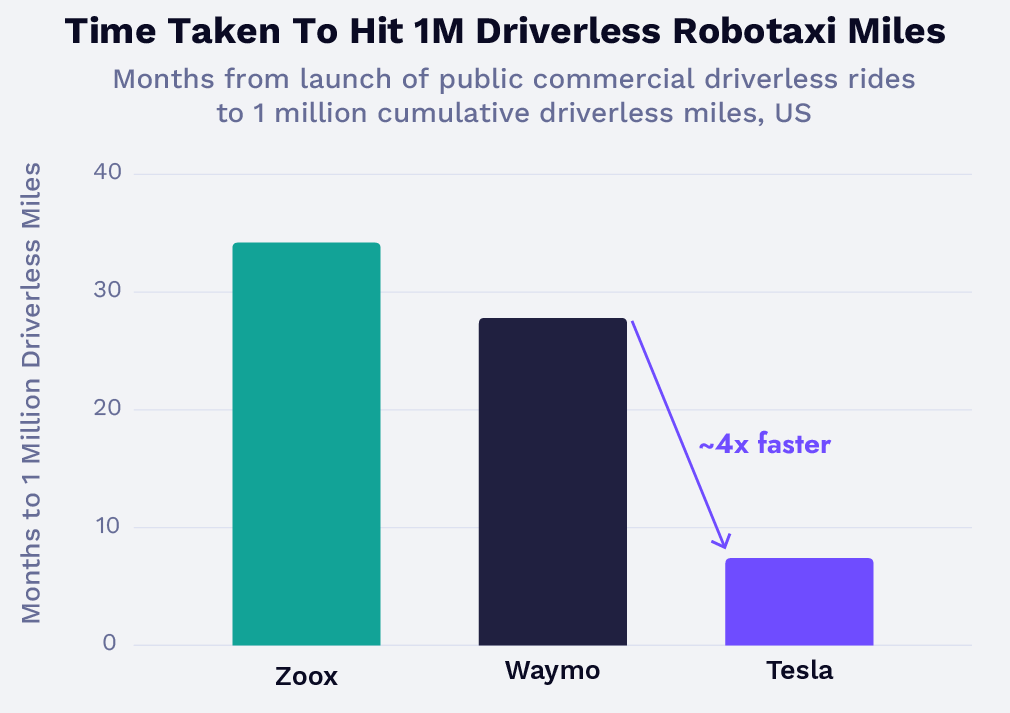
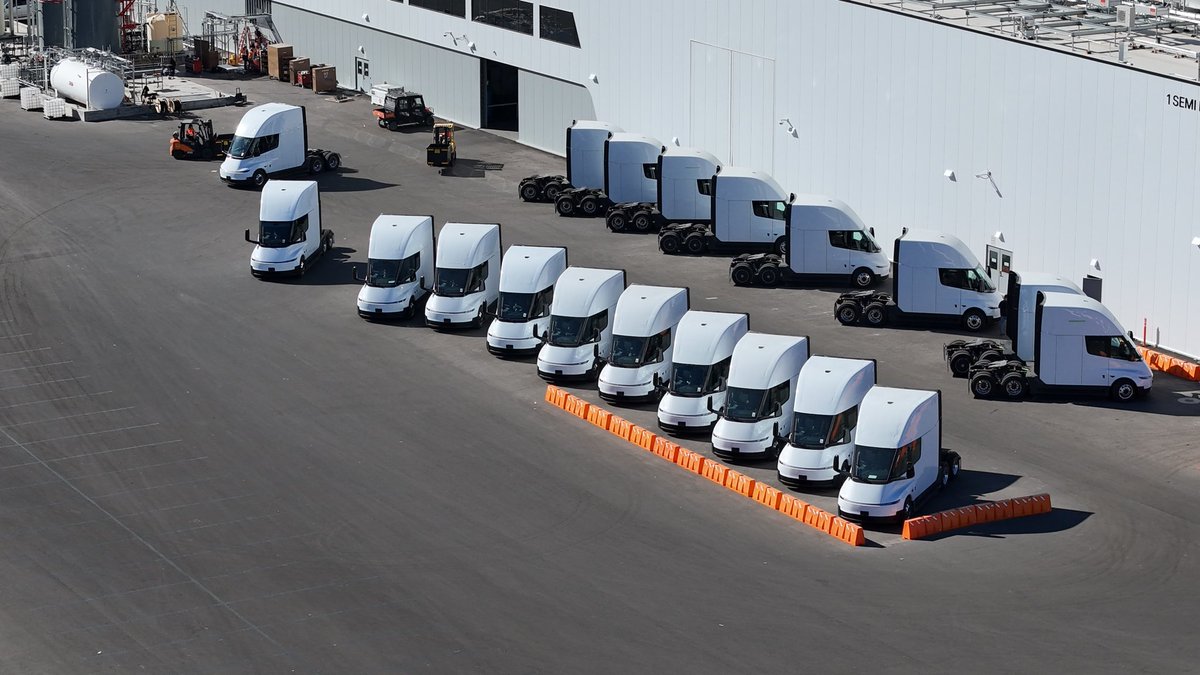
Ark Invest: "Tesla has scaled to seven cities across three states, and has completed more than 1 million unsupervised driverless miles in ~7 months, ~4x faster than Waymo’s first million. Tesla expects the ramp to accelerate with FSD V15 late this year. Tesla has framed FSD V15 as the gating factor for scaling its robotaxi service."
Elon: "In a nutshell, what this implies for SpaceX annual recurring revenue by the end of 2027 is somewhere between $500 billion and $1 trillion."
HOLY SMOKES!
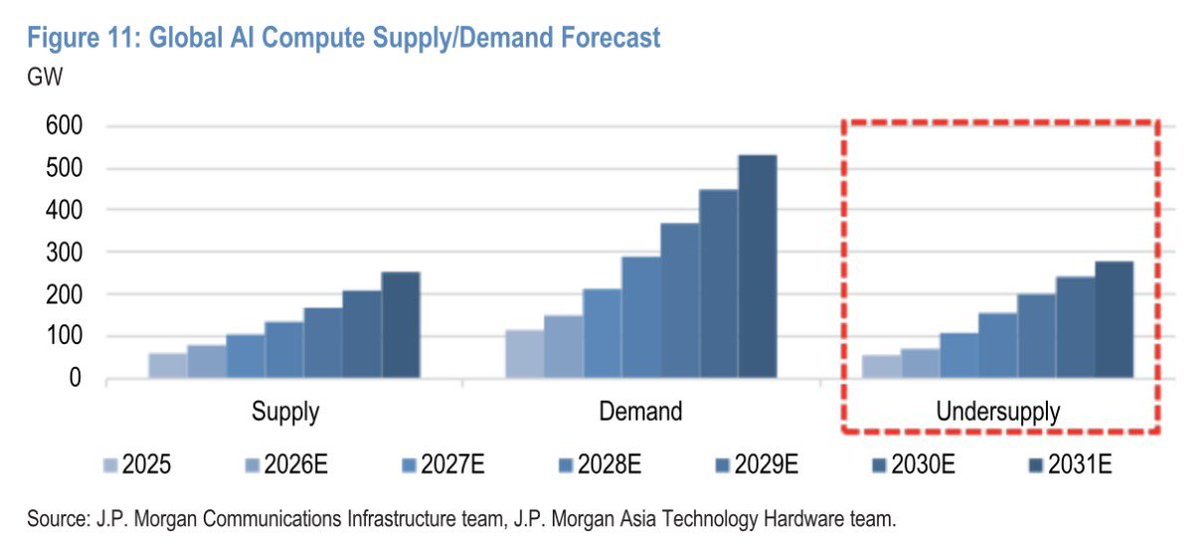
JPMorgan just dropped an ABSOLUTELY INSANE forecast for AI compute.
According to JPMorgan, global AI compute demand is expected to reach roughly 530 GW by 2031, while available supply is projected to reach just 250 GW. That leaves us with a staggering 280 GW shortfall, even after the industry spends hundreds of billions of dollars expanding capacity. We're talking about global AI compute supply potentially QUADRUPLING between 2025 and 2031, yet the shortage is expected to get even WORSE. In fact, JPMorgan estimates the gap between supply and demand could expand from roughly 50 GW today to nearly 280 GW by 2031.
And here's why this matters so much. When demand consistently outpaces supply, the companies controlling scarce compute capacity gain enormous pricing power. This is especially important for neoclouds like $NBIS and $CRWV, which are building out GPU infrastructure to serve customers that simply cannot secure enough compute capacity through traditional hyperscalers. If JPMorgan's projections are even remotely accurate, GPU rental pricing could remain stronger for much longer than investors currently expect, supporting higher utilization rates, long term contracts, and potentially stronger returns on deployed infrastructure. But the opportunity extends FAR beyond neoclouds. Companies like $NVDA and $AMD benefit from the continued need for accelerators, memory manufacturers like $MU benefit from increasing demand for high-bandwidth memory, and networking, storage, power, and cooling providers all become increasingly important as the industry attempts to close this gap.
And this is where I think the market is making a BIG mistake. Investors are so focused on whether AI companies are spending TOO MUCH money that they're overlooking the possibility that the industry STILL isn't spending enough to satisfy future demand. The real constraint isn't necessarily a lack of customers willing to pay for compute. It's the ability to manufacture enough chips, secure enough electricity, build data centers fast enough, and actually bring that capacity online. And that is EXACTLY why I continue to believe the biggest winners in AI won't necessarily be the companies building the models, but the companies supplying the infrastructure required to run them.
Walk into a new Chinese train station and airports suddenly feel small!
Glass roofs, marble floors, high-speed trains lined up below!
This is what happens when your country invests in infrastructures instead of funding wars!
@Chinaretold
Argentina’s #lithium resources and #copper potential give it a strategic role in securing mineral supplies, with the country’s economic direction carrying implications well beyond its borders.
At the @USChamber, President Javier Milei outlined his administration’s economic reforms and the changes undertaken to support #Argentina’s growth.
@JMilei
Once again, @D_Jimenez_Sch is right on the money. The tsunami of negativity is fascinating especially in a year where El Niño will negatively impact supply and the demand challenges for 2027 seem grossly exxagerated. Team 中国’s influence over the #lithium narrative is amazing.
SpaceX’s $SPCX next-gen AI/SI compute data centers is built on NVIDIA’s Vera Rubin, not the GB300s filling Colossus 2 today. Musk called it exclusively the best architecture available and committed the entire ten-gigawatt 2027 target to it. SemiAnalysis’s own math shows Vera Rubin NVL72 delivering up to 7.3x better performance per dollar than GB300 on agentic inference workloads — the exact thing Grokbot runs. That means the same power budget buys fewer chips but far more useful output, which is what actually gets rented.
On revenue, Deutsche Bank pegs 220,000 GB300s at about 26.7 billion a year. Swap in Rubin and the same footprint implies 36 to 50 billion. Scale that across six Minihards on 444 acres in Brownsville and you’re looking at theoretical annual revenue north of 180 billion from one site — before Starmind satellites add orbital capacity that doesn’t need land, substations, or cooling towers at all.
The market is still pricing SpaceX on today’s GB300 reality. Vera Rubin is the step-function most haven’t modeled.
Seriously I don’t think many people understand how big is this :
Now $SPCX is renting out 1 GW for $50B, and with the new Vera Rubin, 220,000 GPU that’s roughly around 0.5 GW will be able to rent out for $35B - $70B . So each GW = $70B - $100B
Are we talking about 10 GW in 2027?
Do your own math.
Stabilisation on the GFEX in the last two trading sessions even though the bears planned to take the price to Rmb80k. SMM cites collapse of LFP recycling economics (Recycling supplied 12% of China lithium carbonate output in Sept). Chemicals invs continue to fall...fundamentals reasserting themselves? Time will tell...
Tesla's robotaxi passed 1 million unsupervised driverless miles in about 7 months, roughly 4x faster than Waymo got to its first million, per @ARKInvest.
It's now in seven cities across three states, and Cybercab is part of the fleet.
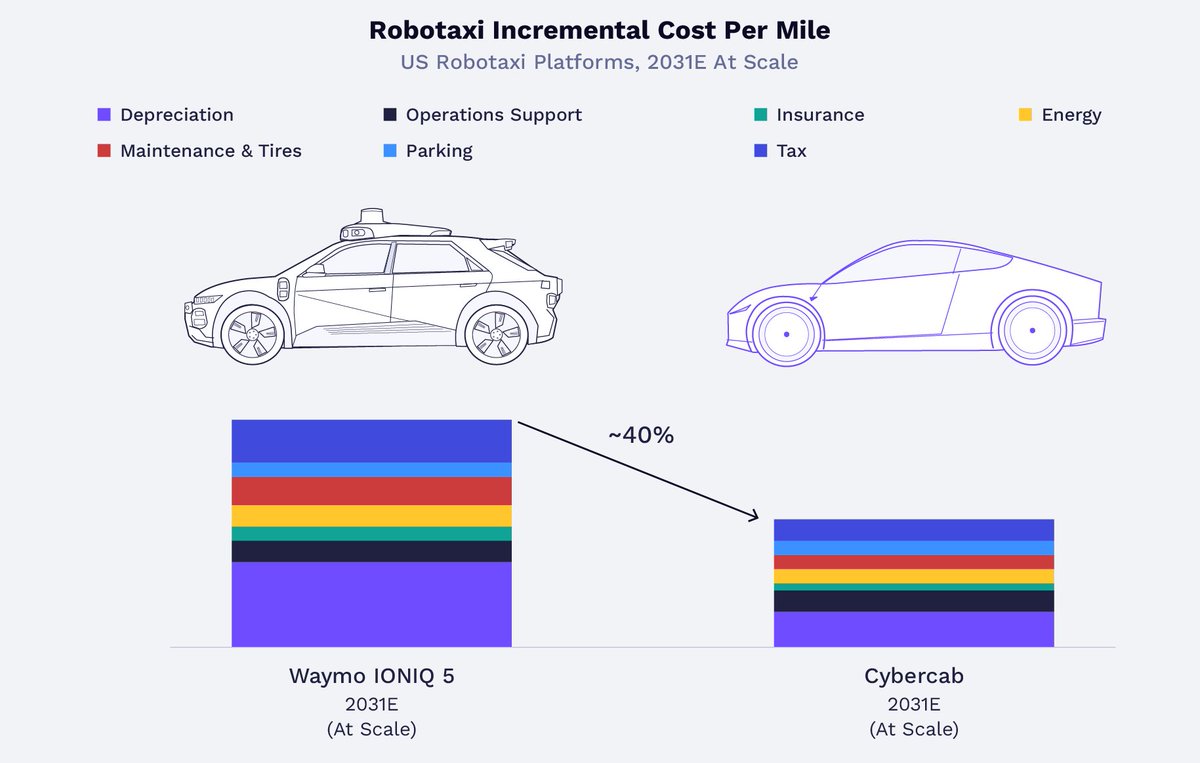
ARK's research puts Tesla's cost per mile about 40% below Waymo's next-gen robotaxi at the same utilization, thanks to vision-only and vertical integration. The base case is about 8M robotaxis by 2031, with FSD V15 as the key to scaling.
$TSLA
EVs on the table?
“Multiple sources said negotiators were discussing a shortlist of projects for potential Chinese investment in non-sensitive sectors in the US, with electric vehicles, battery storage and power equipment infrastructure among the sectors under consideration.” https://t.co/3KiSRerxKZ
🚨 BREAKING: Elon Musk just pledged to give one of his own SpaceX shares to EVERY child in America next year, a gift worth about $10.5 BILLION
PATRIOT 🇺🇸 👏🏻
"Next year, I will give one of my SpaceX shares to every kid in America. This will be the first of many."
There are just over 72 million Americans under 18, and SpaceX closed Friday at $146.03 a share
It's also not the first gift like this from SpaceX. In July, COO Gwynne Shotwell pledged one share to each of 2 million Trump Accounts
Elon is putting his money where his mouth is!
We don’t deserve him 🙏🏻
Elon just said he's giving one SpaceX share to every kid in America next year. So I did the math 🐰
There are about 73 million kids under 18 in the U.S., so that's roughly 73 million shares. At around $140 a share, we're talking about $10 billion.
Sounds like a lot, right? Not for Elon.
Elon holds about 6.42 billion SpaceX shares, so after the giveaway he'd still have around 6.35 billion. His stake drops from 48.4% to about 47.9%, and his voting control barely budges, since his Class B shares get 10 votes each.
He also says it's "the first of many." At this rate, he could do it about 87 times before he runs out.
For millions of kids, this will be the first stock they ever own: a real piece of the company building rockets to Mars.
That’s an incredible gift to an entire generation, and a great way to get them excited about the future 🚀
China's 🇨🇳 battery production in 2026 (Jan-Sep) has already surpassed its entire full-year 2025 output.
January to September battery production reached 1,833.1 GWh.
-->That is Up 🔼 63.4% Year-on-Year. This has already surpassed China's entire full-year 2025 output of 1,755.6 GWh in just 3 quarters.
--> Energy storage sales reached 595.4 GWh during Jan–Sep (+111.8% YoY), expanding at nearly triple the growth rate of EV power battery sales (+38.2% YoY).
"Even during Golden September typically peak season for batteries, Lithium carbonate spot price dropped 25% over the month, despite record battery volumes." #Lithium
https://t.co/QGfhACxjXV
🚨PROJECT VAULT JUST GOT PHYSICAL.
12,000 tonnes of COPPER have entered Project Vault—the first reported delivery into the $12B U.S. strategic minerals reserve.
Policy is turning into inventory.
STOCKPILE THE METAL. UNLEASH THE MINERS.
Source: FT / S&P Global