As requested:
Underwriting 101 for non-finance folks
If you know how to design or build a building, but don’t how to judge whether a project is a good financial investment or a waste of time, read on!
1.The Proforma
2.Underwriting
a. Market Study
b. Yield Study
c. Profitability Metrics
d. Sources and Uses
3.Fundraising
a. Debt – Local/regional banks vs private lenders
b. Equity - Self Funding vs taking on investors
Section 1 – The Proforma
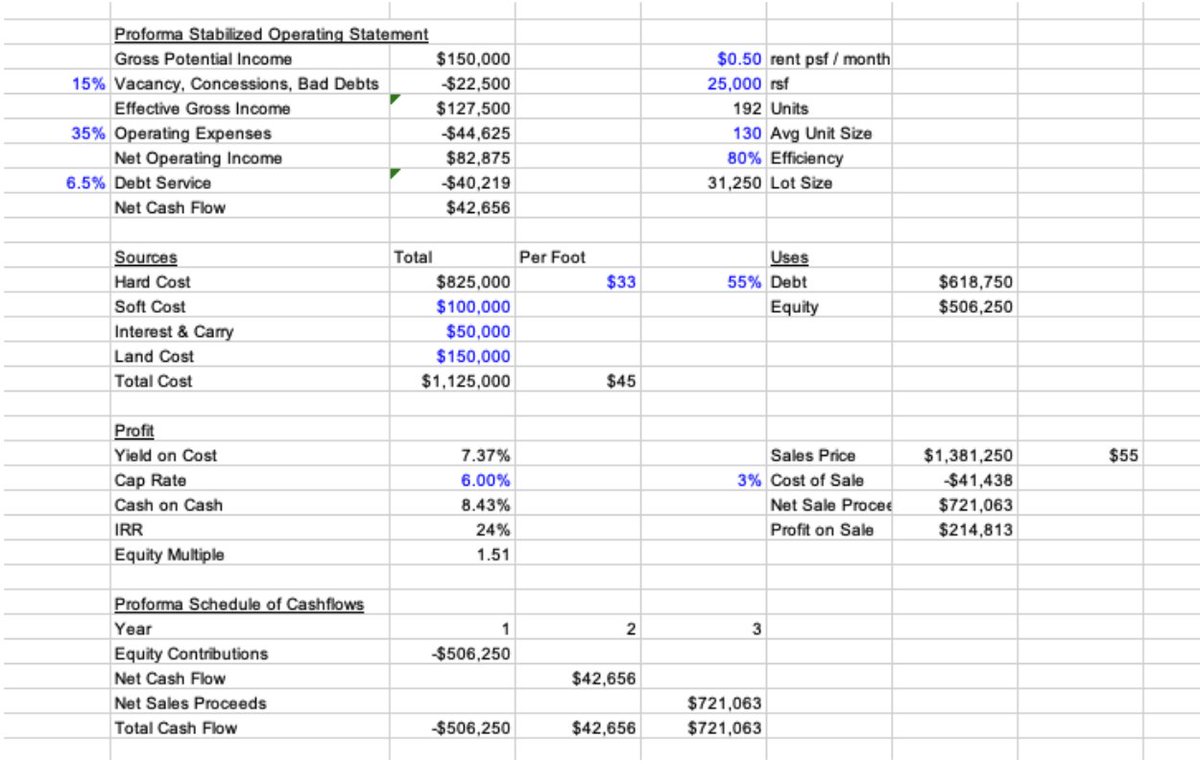
Below is a simplified proforma for a small development project. Don’t let the numbers scare you – we will break it down section by section, using simple examples.
To start, let’s pause and understand the mechanism for value creation in real estate development:
Yield on Cost - Cap Rate = the Development Spread
(Net Operating Income aka NOI / Cap Rate) - (NOI / Yield on Cost) = Value Created
Here’s a simplified example showing the development spread in action–
https://t.co/KMNomxsDk0 build a $600k project all cash, lease it up, and clear $60k per year (10% yield)
https://t.co/oLXWtFaEH9 find a buyer who is willing to pay $1mm for a leased building that clears $60k per year (6% cap)
3.Congratulations, you created $400k of value.
(60k NOI / 6% cap rate) - (60k NOI / 10% Yield on Cost) = 1,000,000 - 600,000 = $400,000
For those who haven’t seen these terms before, they are defined below:
Stabilized Net Operating Income is the annual net income received from your rentals after deducting vacancy costs and operating expenses.
Stabilized Net Operating Income = Rent at full
occupancy (aka Gross Potential) – Stabilized Vacancy - Expenses
Yield on Cost measures the investment yield of the asset to the developer, or how much annual profit the stabilized project will generate relative to its Total Cost.
Yield on Cost = Stabilized Net Operating Income /
Total Project Cost
Cap Rate measures the investment yield of the asset for the end buyer, or how much annual profit the buyer is receiving relative to their Purchase Price.
Cap Rate = Net Operating Income /
Purchase Price
Was this worth the headache? That ultimately depends on what you and your investors are looking for. But here are a few metrics we use to determine that:
Section 2 - Underwriting
Underwriting is the process of running the numbers to gauge the profitability of a potential investment and see if it's worth the brain damage and the risk
Your goal in underwriting is to identify all of the assumptions necessary to make a profitable project that is worth the brain damage and risk it takes to do it.
The first step in underwriting a development project is to calculate the yield on cost and compare it to the cap rate.
Calculating Yield on Cost
The first step for calculating the yield is defining your rent and occupancy assumptions by commissioning a market study. This report should define the boundaries of your market and assess the rents and occupancy within it. If the market study shows there’s a ton of vacancy, then you may want to skip that project.
Once you’ve confirmed the rents and determined you have a reasonable chance at leasing up, the next step is to define how much square footage you can build by commissioning a massing study. This study should determine how much rentable square footage (rsf) you can squeeze out of the site. Generally speaking for infill markets - the more density you can build, the more your property will be worth.
Next, get out in the market and talk to people. The fun part about real estate is that it’s a people business – you have to talk to people to learn the market. Here are some things you’ll need to find out to complete your underwriting:
1.Vacancy and expense assumptions for your asset
type in your market.
https://t.co/8EX7dUaIt5 cost to build (including fees).
3.Cap rates for similar projects
With this info in hand, you can finish your underwriting. Multiply rent by total rsf to get gross potential rent, then subtract vacancy and op ex to calculate NOI (Net Operating Income).
Divide NOI by Cap Rate to get your projected sales price, and compare to your all in cost. This is your total projected profit. Is it worth your time? That depends – to learn how to answer this question, please read on below.
Determining if a project is worth pursuing
To determine if a project pencils, you need to consider the following things
1.Who will the investors be (if any) and how long are
they comfortable holding the asset for?
https://t.co/Tp7kBcvz9X long is the holding period?
3.What are the returns?
4.What is the risk?
Defining your Hold Period
Your business plan can vary dramatically depending on you and your investors goals. Here are the two primary plans:
1.Long term hold – Hold the property for cashflow,
enjoy the tax benefits, and ride out long term rent
growth. This is best for HNW folks who don’t need
their equity back anytime soon. This maximizes
total proceeds.
2.Merchant build – Sell the property as soon as it’s
leased up (or sooner). You will be selling for a lower
price / ft than if you hold it a long time, but you will
get your money sooner.
Calculating the returns
Once you know your goals, here are 3 metrics you can use to gauge the profitability of your project.
1. Cash on Cash: Net Cashflow / Total Investment.
This is your actual cash yield from the asset. You can
compare this to owning a bond – it’s the actual %
return you are earning on your money while it’s tied
up in the asset. Depending on your situation, you
may be able to include tax benefits in the numerator,
further driving cash on cash for your investment.
2. IRR: total cashflows annualized over the hold
period. The shorter your hold, the higher your IRR.
Shortening hold period drives IRR more than
increasing sales proceeds does. Most Real Estate
Private Equity Firms derive their compensation from
how well they perform on this metric.
Most investors want to see 16%+ IRR for
development projects, but some huge developers
find investors willing to accept as low as 12% for
trophy assets.
3. Equity Multiple: Total Distributions (net cashflow
+ proceeds from sale) / Total Investment. Generally
speaking, the longer you hold the larger your
multiple will be. Fully leased and seasoned
properties generally command a higher price per
square foot than newly delivered product because
they have less lease up risk. Rents also tend to go up
over the hold period, and each $1 of net rent can add
$10 or more in sales value. (Remember, NOI / Cap
Rate = Sales Price)
Most investors want a 1.4 minimum multiple, or else
it’s just not worth the brain damage and the risk.
You can compare this figure to 10 year treasuries.
Most investors want to earn a spread over
the treasury (T+ 1% at least) to make development
worth the risk.
For long term holds, you are focused on maximizing
cash on cash return and total multiple.
For merchant builds, you are focused on IRR subject
to a minimum multiple.
Risk analysis
Here are some questions I like to ask in order to determine if the returns are worth the risk
https://t.co/2uYLbhq5Pu much is my total investment?
https://t.co/Tp7kBcvz9X conservative are my underwriting assumptions?
https://t.co/5nfvA2ne7i long will the project take to reach profitability?
https://t.co/hk3bTyf7dZ a worst case scenario, how bad can the deal get?
Be careful when you are underwriting high IRR projects with big budgets and short holds. The total multiple might be low, meaning there’s a risk of asset value being lower than your total cost to build should the market turn on you.
Section 3 – Fundraising
Once you’ve underwritten a project that appears to meet your team’s goals, the next step is putting together the Sources and Uses. This table summarizes the total project budget as well as the total sources of capital for funding the budget.
Sources, AKA total budget:
You can put a bracket on these figures by asking for data points from architects, loan brokers, and GCs.
Uses, AKA capital stack used to fund the total budget:
Generally, development projects are funded using a combination of both debt and equity. A loan broker can provide data points on how much you will be able to borrow to fund your deal.
Sources of Debt
1. Local bank / Credit Union – lowest rates but will
require you to personally guarantee repayment of
the loan (aka recourse).
This is typically the best execution available for
loans of under $5 million, but they aren’t always
open to funding construction costs.
2. Private lenders – high rates and high fees. This is
sometimes the only group willing to make small
construction loans.
Sources of Equity - the example attached proforma assumes you are self-funding. Many sponsors raise Other Peoples Money (OPM) through syndications or joint ventures (JV), which greatly reduces the sponsor’s total capital investment. Structures using OPM could be the topic of their own post, but I will provide a simple comparison of OPM vs self funding below
1. OPM: spread the risk, spread the reward. This
requires complicated legal documents and a higher
admin/accounting workload than if you fund the
deal yourself.
2. Self-Funding: all your money, all your risk, all your
reward. Simplest execution, least amount of legal
and admin headache.
If you liked what you read I’d appreciate if you gave me a follow, retweet, or signed up for my newsletter
Follow me @DeveloperDude_ for frequent content on development, deal structures, and running an SMB
Sign up for my newsletter for longer pieces like this: https://t.co/EAkAaASEYM
Hope that helped you better understand how to analyze real estate investments. Thank you for reading to the end!
@MasterStudent9
@beingjameson
@AmandaBuildsUp@SMBfella@k_thos
@scarrolsean
@sjwpeaceful
After a couple weeks of heavy Muse use, I'm personally kinda over it because the inference is weak.
It forgets things and it gets instructions wrong.
Only redeeming trait is that it can scrape Meta, so we'll keep using it a little for that but that's it.
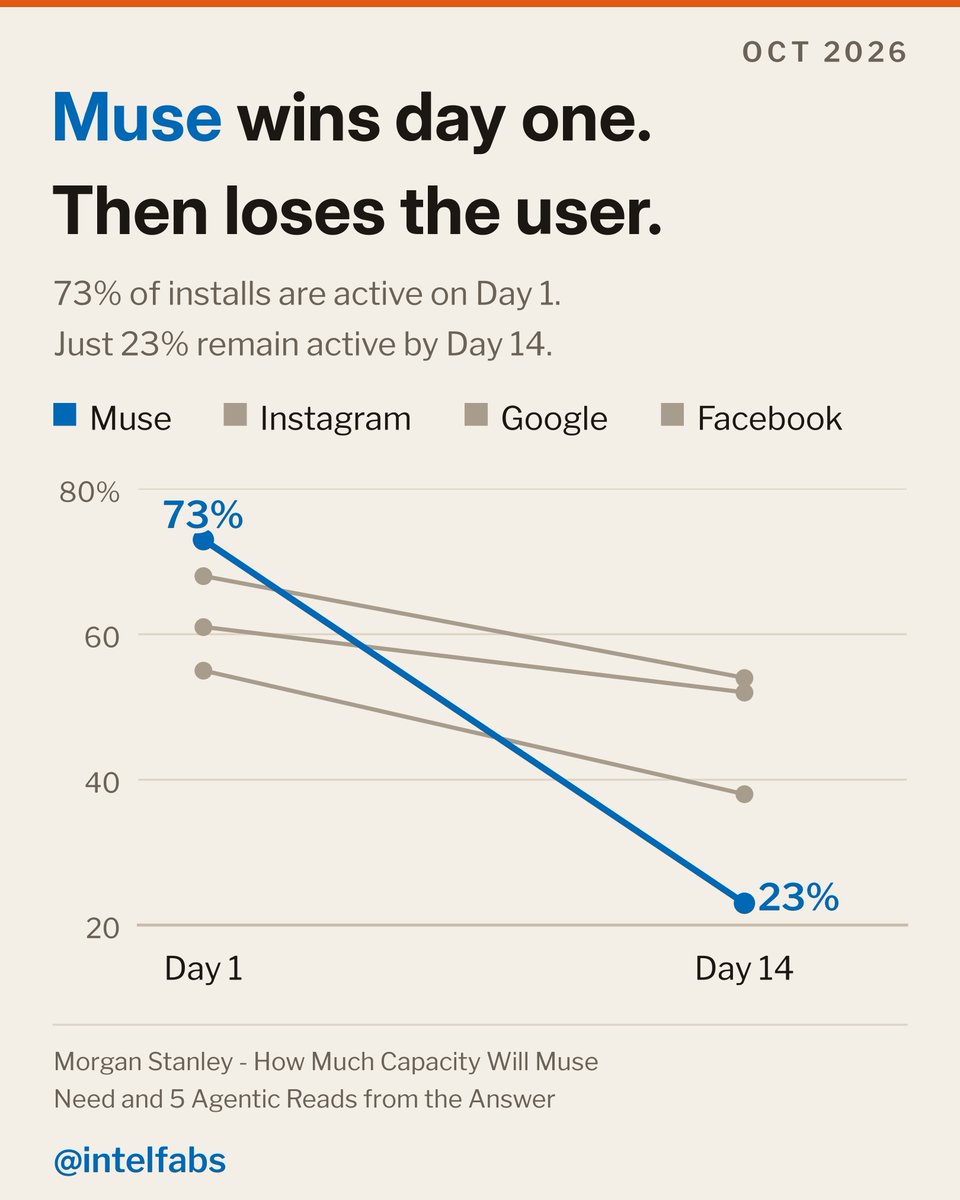
One of the big issues with Muse? Retention.
The bearish side of these agents is that consumers don't have much incentive to stick to them. What is the switching cost? None.
I believe Muse will do great, but a major work in progress still. Retention matters.
$META
Parking lots are the new country clubs, when it comes to raising capital in LA
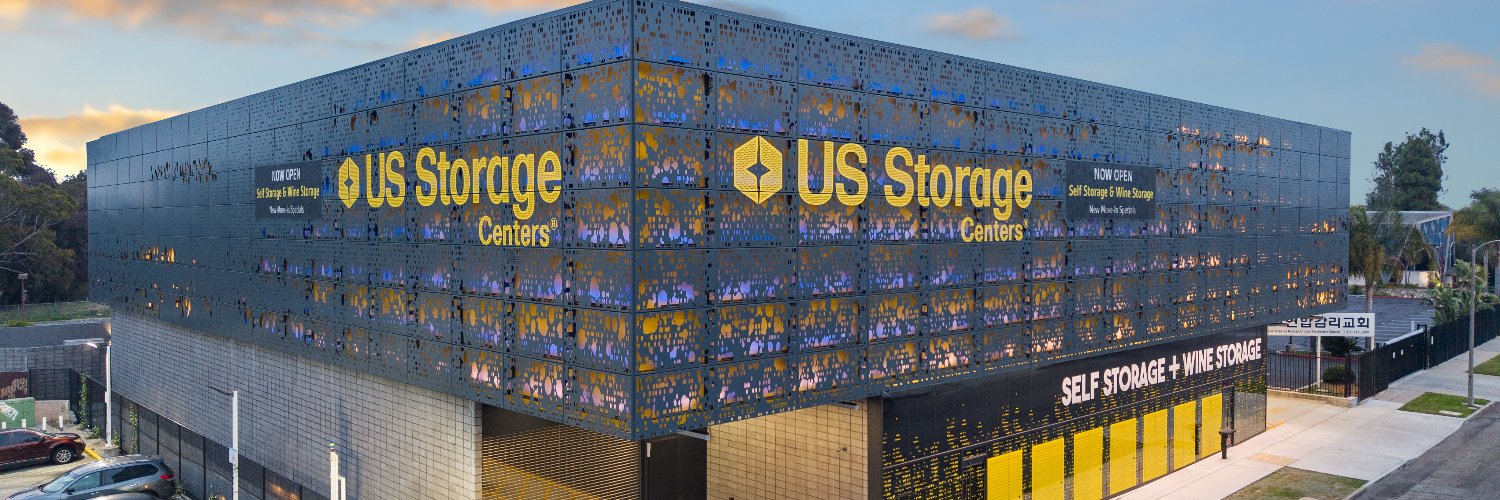
This past tech week I spread the word about storage investing in West LA, the #2 storage market in the country. I hit parking lots from Culver City to El Segundo across 15 different events and had a blast doing it.
If you're interested in a first hand account of commercial real estate operator pounding the pavement on a quest for investors during LA Tech week, drop a like and comment and I'll follow up with a full conference report.
@PerrySolem This is how you hit a 40% IRR everyone. Take notes lol
Seriously though, perry you would not believe how much we budget for op ex in wla lololol
@robbiehendricks Yep you said that right. Have fun with your vault. Just be careful with what you save to the vault - AI treats throwaway generations as immutable law, which can trip you up once the system gets sufficiently large
@credealjunkie@ReconveneLA The indexing is the key. You can't keep all of the meetings in context at once, the AI has to know where to find context and when go to searching for it