Traders do you know these authors?
W.D. Gann
Daniel T. Ferrera
Dr. Jerome Baumring
Sean Erikson
Alexander Straker
Eric Penicka
Hasbrouck
Dr. Alexander Goulden
Gordon Roberts
L. David Linsky
Daniele Prandelli
Catalina Plapcianu
Lorrie Bennet
Robert Rundle
Jim Simons
Ray Dalio
Also why I can't agree with videos like this because why would you create, "refine", and publish something that you know is evidently lacking in certain areas?
"The fight is the story"
What???
Call a spade a fucking spade.
Stop trying to justify slop.
@witcheer Nice! And here I was underestimating the small models. I always thought they would perform terribly across long-horizon and large-context tasks.
drama3-small、Fish Audio Drama 3を12GBのVRAMで動くようにしたモデルで、ローカルでこの声が出せるのは嬉しいですね!
参照音声からのボイスクローンも試してみましたが、声も良い感じによってくれます😊
ColabでローカルTTSを試せる『Local TTS on Google Colab』にも追加させていただいたので、手元にGPUがない方でもColabから試せます。ぜひ!
https://t.co/Zsf2jA5vGK
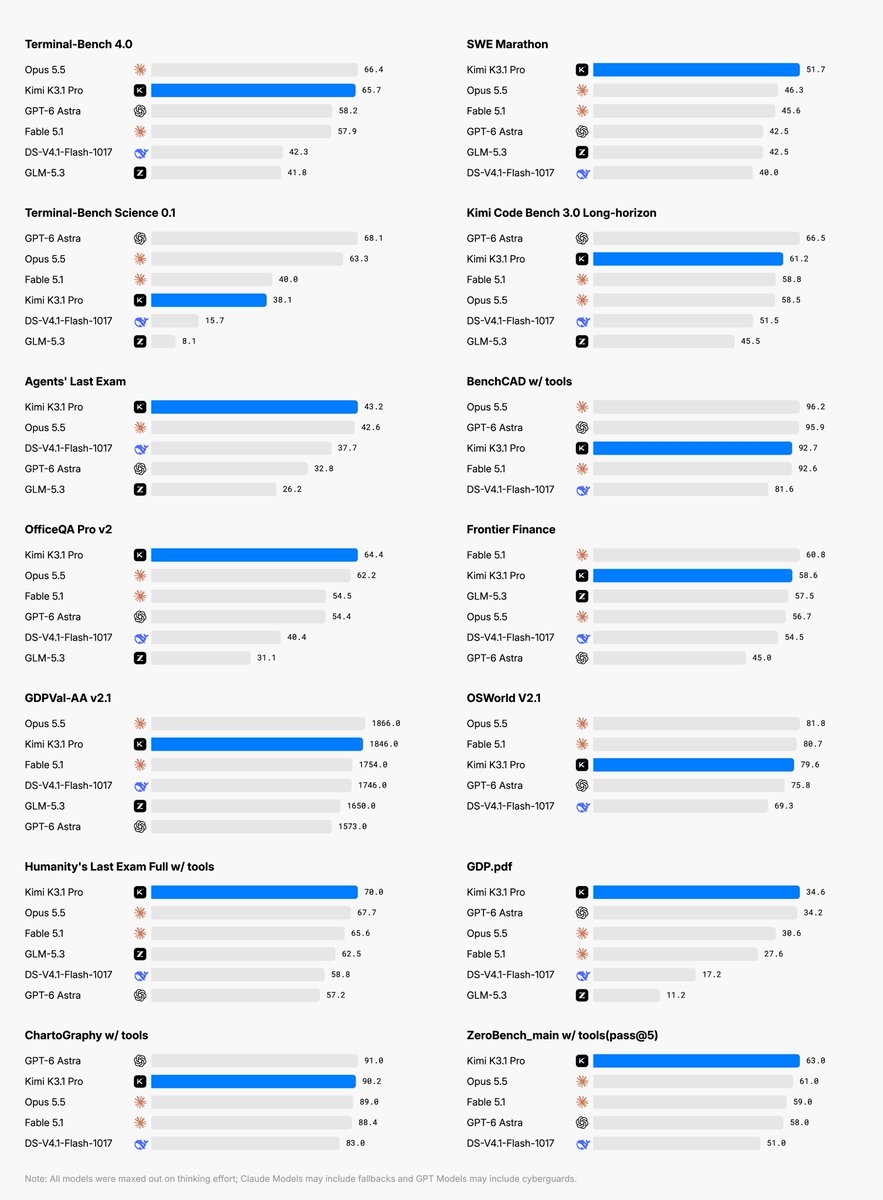
Kimi K3.1 Pro launches at 4th on the Artificial Analysis Intelligence Index scoring 55, making large gains in agentic performance; it will be the leading open-weights model once its weights are published
@Kimi_Moonshot's new reasoning model gains 11 points over Kimi K3 (max, 44). It trails only Claude Opus 5.5 (max with fallback, 58), Claude Sonnet 5.5 (max with fallback, 56), and Muse Wonder Full (max, 56) on the Intelligence Index.
Once the weights for K3.1 Pro are released it will be the highest-scoring open weights model and the gap between the leading open weights and proprietary models on the Intelligence Index will narrow from 12 points to 3.
Key results:
➤ Large gains in agentic performance: Kimi K3.1 Pro scores 3rd on GDPval-AA with 1,846 Elo, up 312 Elo from Kimi K3, behind only Claude Opus 5.5 (1,866 Elo) and Muse Wonder Full (1,857 Elo). Kimi K3.1 Pro also achieves the highest score of any model on Terminal-Bench 4.0. K3.1 Pro scores 67%, up from 13% for Kimi K3 and ahead of Claude Sonnet 5.5 (64%). AutomationBench-AA, which tests agentic SaaS workflows, rises from 58% to 73%.
➤ Gains in other evals are more moderate: Humanity's Last Exam rises from 47% to 52%, CritPt from 23% to 25%, and SciCode from 59% to 61%. AA-Omniscience Index rises from 20 to 30, as the hallucination rate falls from 53% to 44% and accuracy rises from 48% to 51%.
➤ Cost per Task roughly equal to Kimi K3 at $1.98 per Task: K3.1 Pro uses 55K output tokens per Intelligence Index task, 14% more than Kimi K3 at 48K, while its first-party token prices are 33% lower.
Additional model details:
➤ Context window: 1M tokens.
➤ Size: 2.8T total, 104B active parameters
➤ Input modalities: Text and image
➤ Weights and license: Weights currently not published, Moonshot is expected to release the weights soon after launch
➤ Pricing: $2/$10/$0.20 per 1M input/output/cache hit tokens, 33% lower than Kimi K3 on all three rates.
Congratulations to the team at @Kimi_Moonshot on the release!
These new .1 models are crazy!
Kimi K3.1
DeepSeek V4.1
Minimax M3.1
Wtf is China doing??
A year ago, these would've been a whole number higher, not a mere decimal-point incremental update.
Is the naming meant to be psychological?
Are they saying this is not a *K4-level model?
Introducing Kimi K3.1 Pro: our most capable 3T-class open-weight model.
🔹 1M-token context, 2.8T total / 104B active params (MoE), Multimodal.
🔹 Full-project coding: games in Unreal, Unity & Godot.
🔹 Excels at parametric 3D modeling in Blender & CAD.
🔹 More reliable at finance work: Accurate modeling with hallucination down by 65%.
🔹 Matching the strongest proprietary models across coding, agentic and knowledge benchmarks.
Kimi K3.1 Pro and K3.1 Pro Highspeed (2–3× faster) are now live on https://t.co/85jA71X9gw, Kimi Work, Kimi Code, and the Kimi API.
Open weights by Nov 4, 2026.
🔗 API: https://t.co/XCrgjXAqMw
🔗 Tech blog: https://t.co/5iPP0MBej6
K3.1 Pro works directly in the tools used by the 3D modeling and game industries - Blender, Unreal Engine, Godot, and CAD.
On BenchCAD, which tests 3D reconstruction from multi-view renderings through CAD code generation, it scores 92.7% with tools, approaching Claude Opus 5.5 (96.2%) and GPT-6 Astra (95.9%).
K3.1 Pro can deliver a fairly complete project, from asset construction to scene assembly, animation, and rendering.
Holy shit: Kimi k3.1 pro is on par or even outperforms Opus 5.5 and GPT-6 astra on key benchmarks!!
They just announced K3.1 Pro, a 2.8T-parameter multimodal model with a 1M-token context window that it claims rivals leading proprietary models in coding and agent tasks, with open weights promised by November 4.
China is back!!
If DeepSeek were American it would be on every magazine cover.
Think about it. A small lab with a fraction of the compute ships a frontier-class model under MIT. Then it open sources its production inference engine, its kernels, its file system. Publishes 155 trillion tokens a day and $38 of revenue per GPU-hour. Raises $15B anyway.
In America that is a national hero story. Senators would be posting about it. Every podcast would call it proof that open source made the country stronger.
Instead it got banned from US federal systems, called a security threat and accused of distillation, sometimes in the same week it gave away more of its production stack than OpenAI ever did.
The code is the same either way. The weights are the same. Only the flag changed the reaction.
I dont care about the flag. I care that I can download it, read it and run it on my own cards. By that measure DeepSeek did more for American developers this month than most American labs did all year.
JUST IN: Scientists have used prime editing directly inside the human body for the first time.
Prime editing (unlike traditional CRISPR which cuts DNA) allows scientists to precisely re-write individual letters of our genetic code.
This could allow us to fix genetic mutations that are causing disease at their source.
It's still early, but if successful, this could open the door to treating thousands of genetic disease that we thought were incurable.
🚨This indie dev has been building a third-person mech shooter for 20 days without looking at a single line of code
One continuous Claude Opus 5.5 chat, autocompact set at 250k, no Blender
This is what AI-assisted game development looks like in 2026
Would you play this?
Next step: Longevity and Rejuvenation. We are almost there.
Researchers in Bonn turned blood cells from an 80-year-old into neural stem cells with a molecular age below 20. More than 60 years younger by epigenetic clocks, which estimate age from chemical marks on DNA.
The team directly reprogrammed blood precursor cells into neural stem cells, skipping the usual pluripotent stem cell stage. The rejuvenation unfolded gradually and could be tracked for over 100 days.
Almost all of the recent incidents like this, including Hugging Face, happened because the models involved were accidentally given impossible goals by the humans running the tests, and because of their training they then tried desperately to complete them by any means necessary.