PE of Crabtree Group Civil Engineers and Town Planners. CNU Rainwater www.cnu.org. Rainwater-in-Context at Google Groups. TransectCodesCouncil www.transect.org
Cycling is bad for the economy.
A cyclist doesn’t buy the car/car insurance/fuel/spare parts and service and doesn’t use paid parking. He is healthy and doesn’t buy drugs.
Walking is even worse. They don’t even buy a bicycle.
Modern concrete starts falling apart in a few decades. Roman concrete has been sitting in seawater for 2,000 years and getting stronger.
The Romans figured out that volcanic ash changed everything. They dug it from around the Bay of Naples, near the town of Pozzuoli, mixed it with lime and chunks of rock, and got a material that could set even underwater. The architect Vitruvius wrote about it in the first century BC. Pliny the Elder claimed that once it hit the sea, it became a single mass of stone the waves couldn't break.
He wasn't exaggerating. Roman harbor walls and piers built in the sea are still standing today, while modern concrete in the same conditions cracks and crumbles.
For a long time nobody knew why. In 2017, a geologist named Marie Jackson studied samples from ancient Roman piers and found the answer. Seawater soaking into the concrete was reacting with the volcanic ash and growing rare mineral crystals inside it. The ocean that destroys our concrete was actually reinforcing theirs.
Then in 2023, MIT researchers found something else. Roman concrete is full of little white chunks of lime that scholars had long assumed were just sloppy mixing. They weren't. The Romans were likely mixing with hot quicklime, and those chunks acted as a built-in repair kit. When a crack formed and water seeped in, the lime dissolved and filled the crack back in. Self-healing concrete, two thousand years before anyone used that phrase.
The Romans built on a scale that shows they trusted it completely. Herod the Great had volcanic ash shipped all the way from Italy to build an artificial harbor at Caesarea in Judea. Hadrian's Pantheon in Rome, finished around 125 AD, still has the largest unreinforced concrete dome on earth, about 142 feet across. No steel. Nothing holding it up but the concrete itself.
After the Western Empire collapsed, the know-how faded. Medieval Europe mostly built in stone and timber. Modern Portland cement wasn't patented until 1824, and it still can't match what the Romans were pouring into the sea before the birth of Christ.
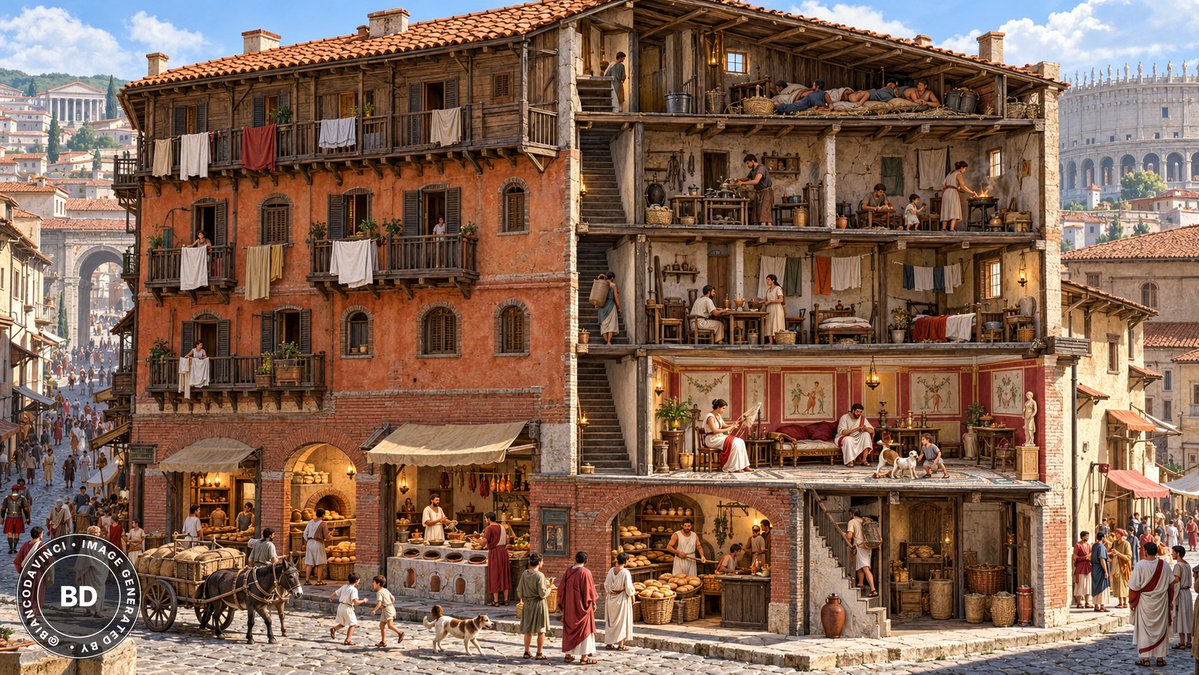
Most people in ancient Rome lived in rented apartments.
Today, a 1,900-YEAR-OLD Roman apartment block is still standing in Rome, at the foot of the Capitoline Hill.
Records from the 4th century say the city had about 46,000 apartment blocks, called “insulae.” In comparison, there were fewer than 2,000 private houses.
Some of these buildings were so tall that Augustus banned anything higher than 70 Roman feet (about 20 meters). Later, Emperor Trajan lowered the limit to 60 Roman feet.
The floors worked the opposite way from today. Shops were on the ground floor, and rich tenants lived on the first floor. The higher you went, the cheaper the rent and the worse the living conditions: there was no running water, there were fewer windows, and there were a lot of stairs to climb.
Build as if you only had a wheelbarrow, and you’ll preserve much more of the character of the land and streams, and also many of the trees. Your lots will be more valuable and far less boring in the early years than land scraped flat as per standard engineering practice.
The Hoover Dam was built in 4 years and 2 months (1931–1935).
It contains 2.48 million cubic metres of concrete. Enough to build a 2-lane highway from New York to San Francisco and back.
At peak, 5,200 workers were on site simultaneously. 113 died during construction.
It generates 4 billion kWh per year, enough to power 1.3 million US homes.
At completion, it was the world's largest hydroelectric power station and the world's largest concrete structure.
Both records have since been broken.
But the dam still runs on its original turbines, 90 years later.
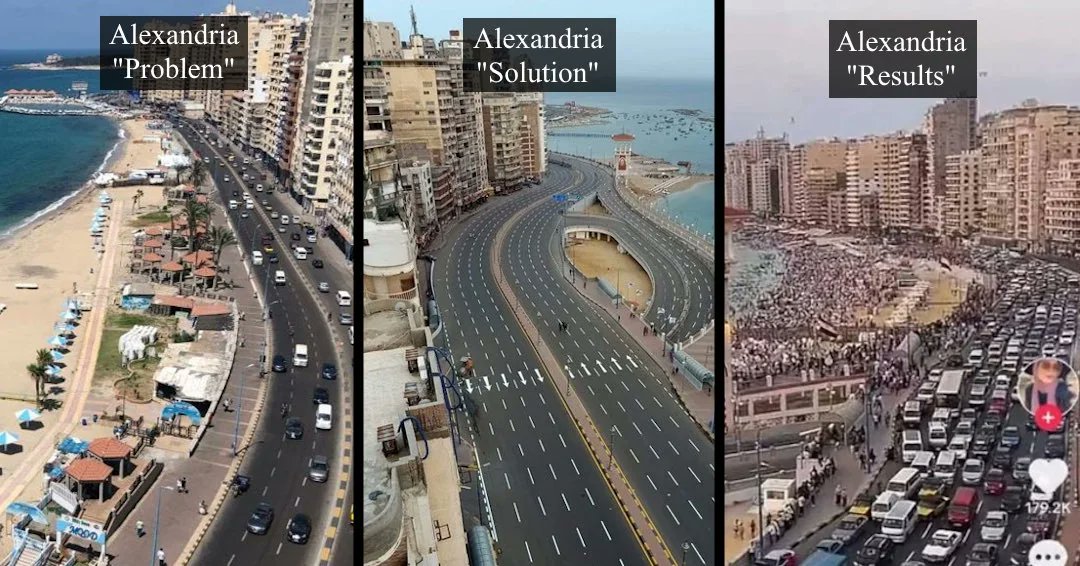
'The definition of insanity is doing the same thing over and over again and expecting a different result.'
— Rita Mae Brown
Case #1237 of using traffic engineering to solve the problems of traffic engineering.
📍 #Alexandria, Egypt 🇪🇬.
In Centuripe, the landscape determined the streets, and the streets gave the town its extraordinary shape.
The town you see today largely dates from the 16th century, but Centuripe’s story reaches back to a Sicel settlement founded in the 8th century BC and a prosperous Roman city.
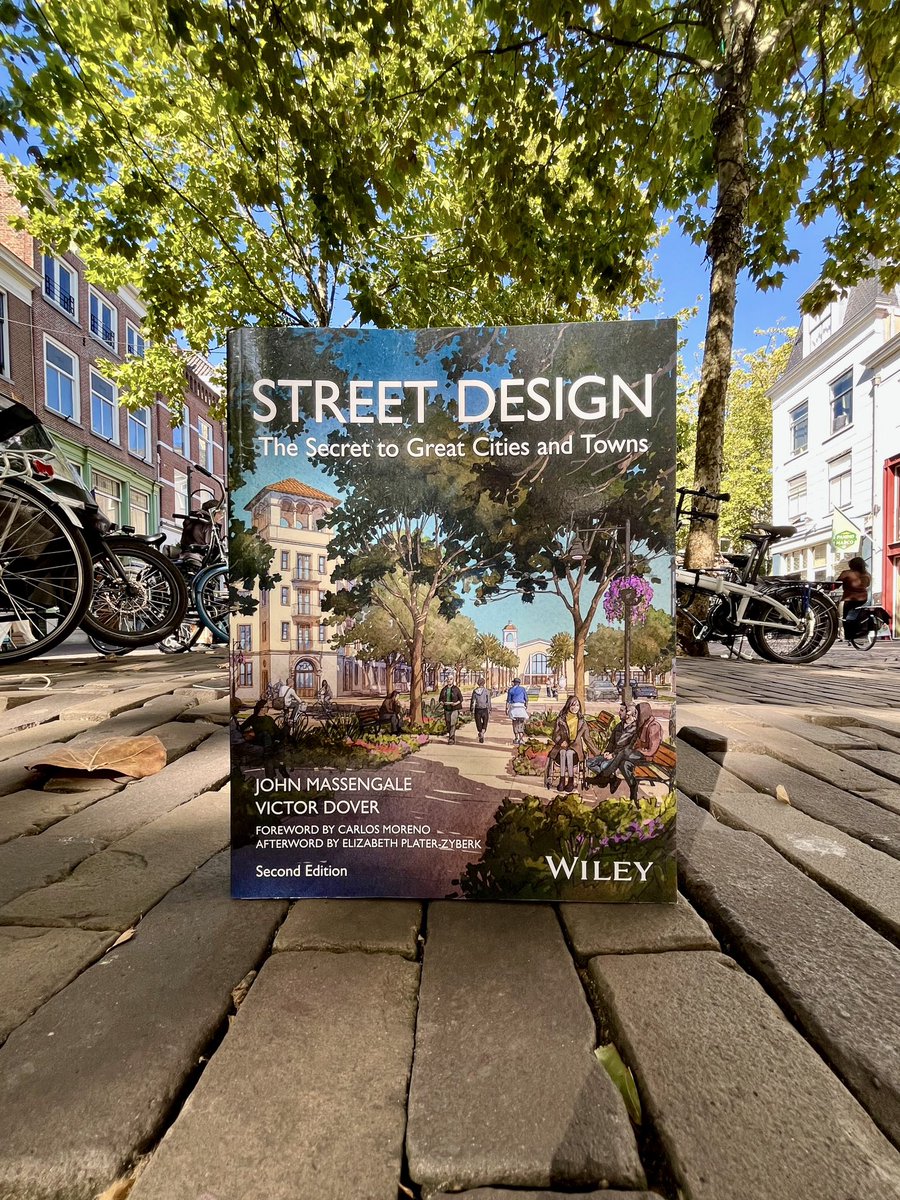
“Streets, the main public places of a city, are its most vital organs.” - Jacobs
“If you want to know what a culture values, look at what it builds. Our cities and towns are some of the greatest works of human civilization. They all began with their streets.” - Dover+Massengale
Resultados bajada límites de velocidad a 30 km/h en ciudades europeas:
▫️-23% colisiones y atropellos
▫️-37% fallecidos
▫️-18% emisiones
▫️-2,5 dB ruido
▫️-7% consumo combustible https://t.co/SPqUhMaD69
@aaron_lubeck Mostly true, but also all specialists should strive to become generalists. Why would an urban designer not want to know more about engineering? Or engineer about urban design?
Rest in Peace, Wendell Berry. You brought light and life and made the world a better place. My sincerest thanks to you.
Do not live for death,
pay it no fear or wonder.
This is the firmest law
of the truest faith. Death
is the dew that wets the grass
in the early morning dark.
It is God’s entirely. Withdraw
your fatal homage, and live.
Roman roads were built to last.
Not for decades. For millennia.
The construction sequence, documented by Vitruvius and confirmed by modern excavations, was:
1. STATUMEN: large flat stones laid directly on compacted subgrade
2. RUDUS: a layer of smaller stones or rubble, set in lime mortar, 20–30 cm thick
3. NUCLEUS: concrete made from lime, coarse sand, and gravel, 15 cm thick
4. SUMMUM DORSUM: the surface layer, flat polygonal stones fitted together without mortar, slightly crowned at the centre to drain water
The total depth: up to 1.5 metres in some roads.
The road was cambered, raised at the centre, so rainwater drained to drainage ditches on each side.
The drainage ditches were themselves engineered: lined with stones, at calculated gradients.
Roman roads didn't fail because of moisture. Most ancient roads do.
By 200 AD, the Roman road network spanned approximately 400,000 km.
Over 80,000 km were stone-paved.
In Britain, several modern roads run directly above Roman foundations.
The A2 from London to Dover follows the line of Watling Street.
The M1 motorway in Hertfordshire runs parallel to the Roman road it replaced.
The roads worked because the engineers understood the problem was not the surface.
It was water management beneath the surface.
That's still true of every road built today.