@Saty_agraha Ambassador @NgogaFred your commitment to peace and your efforts to bring hope and unity to Burundi people is truly commendable. Building peace requires courage,patience and a heart that cares for people,thanks for the bright future your creating for Burundians. #simbayaAmanAfrica
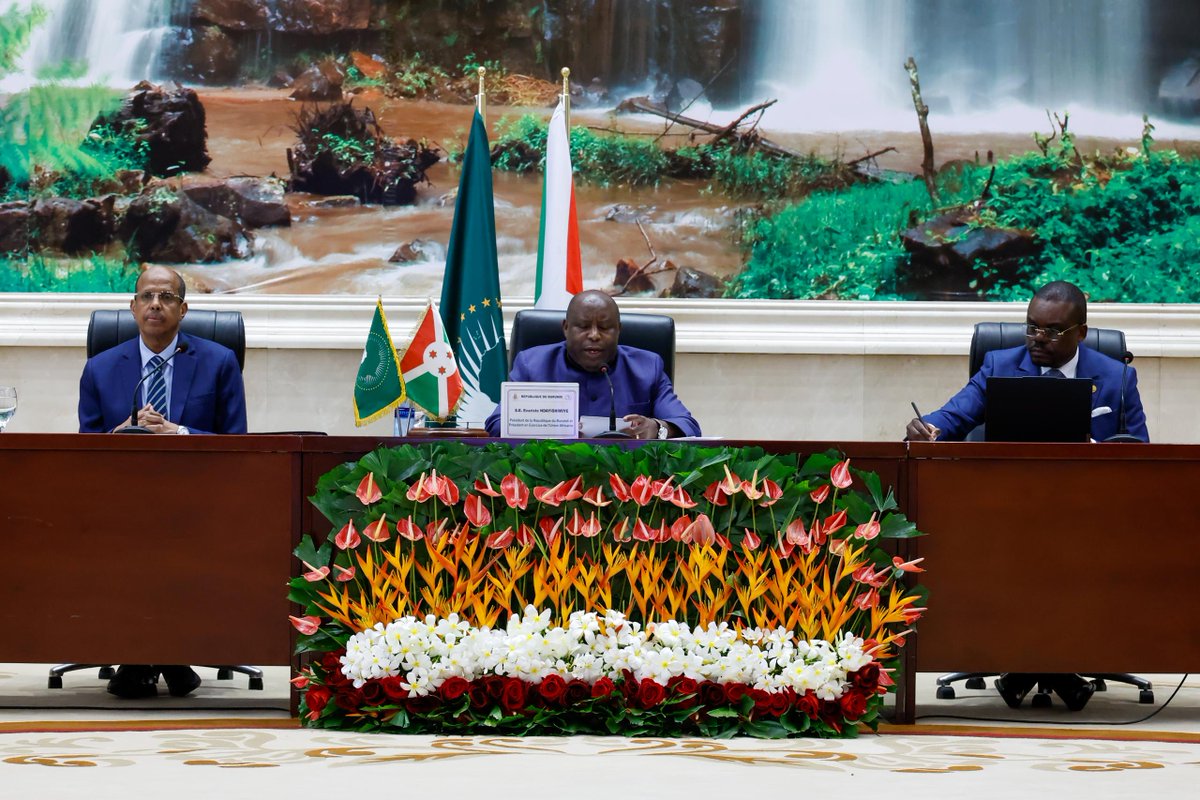
The Chairperson of the African Union (AU) Commission, H.E. Mahmoud Ali Youssouf, joined AU leaders, international partners, UN agencies, & regional organisations at the AU High Level Meeting on the #Ebola outbreak, convened & chaired by H.E. Evariste Ndayishimiye, President of the Republic of Burundi and Chairperson of the African Union.
The Summit served as a platform to mobilise urgent political commitment, financial resources, & operational support to strengthen Africa’s collective response to the outbreak & reinforce continental health security.
In his keynote address, Chairperson Youssouf @ymahmoudali underscored the importance of enhancing national & regional response plans, strengthening cross-border coordination, & scaling up preparedness, surveillance, & containment measures.
He called for sustained solidarity & collective action among Member States & partners to prevent further transmission of the disease & invest in resilient health systems across the continent.
The Chairperson expressed his condolences to the families & communities that have lost loved ones to the outbreak. He also commended the affected Member States, frontline health workers, & emergency response teams for their dedication, professionalism, and swift efforts to contain the spread of the disease.
Chairperson Youssouf further conveyed his appreciation to AU Member States, development partners, & humanitarian organisations for their solidarity & support, including financial contributions, & other assistance provided to the affected countries.
He reaffirmed the AUs commitment to working closely with all stakeholders to strengthen resilience, advance coordinated public health responses, & ensure that no Member State is left behind in addressing this shared challenge.
Read @ https://t.co/veI4AxWadh
@GeneralNeva@NtareHouse@MAEBurundi@willynyamitwe@AfricaCDC
WHAT NOAH ECKSTEIN'S COMMENCEMENT SPEECH TEACHES US ABOUT LEADERSHIP IN A DIVIDED World. Listen before you judge. Modern culture rewards quick reactions and tribal allegiance over genuine curiosity about other people’s perspectives. The willingness to understand before concluding is becoming rare — and that’s a problem.
2.Opponents are not enemies. Disagreement is normal and healthy; dehumanising those we disagree with is not. Sustainable leadership — in politics, diplomacy, business, or community life — depends on the ability to see the humanity in people who hold different views.
3.Understanding beats winning. The leaders who create lasting change are not the most combative, but the most empathetic. The capacity to listen, build trust, and bridge perspectives is framed as the defining leadership skill of the century ahead.
4.Division is a choice — so is connection. The piece ends with a deliberate challenge: are we still willing to understand people who see the world differently? The implication is that the future belongs to those who choose understanding over scoring points.
Somalia’s political class assume the Somali state cannot collapse because too much political, financial, & international capital is invested in keeping it afloat.
The Somali politicians in the past misunderstood and misunderstand now how society in fragile states unravel. The society rarely collapses in one dramatic moment. HSM & Damuljadiid have moved Somalia closer to that edge by turning a well accepted political settlement into a struggle over coercion & personalized power.
Capitals fail first as systems before they fail as geography. Society becomes distrustful of the government, institutions lose authority, security forces fragment or disintegrate, well-off families take their children to other countries, & political competition is solved through corruption, manipulation, or violence instead of the accepted rules of the game. Mogadishu may still stand while Somalia’s state gradually loses the ability to govern itself.
@_AfricanUnion FARDC-FDNB,FDLR, militias of Wazalendo are killing Banyamulenge, in Burundi discrimination of TUTSI though President @GeneralNeva is going on in all systems of governance? And why was the ARUSHA agreement signed? We call upon the @AUC_PAPS to enter in this matter.
@Saty_agraha Great jobs!, you may investigate also about nocturne violences against Tutsis students in some university campus especially ( Mutanga , kiriri & Kamenge). The militias youth students affiliated to ruling party and some security agents are involved
DAY ONE:
#Burundi Ethnic Discrimination as State Policy
As promised, here are patterns of targeted violence and persecution documented by the UN Commission of Inquiry and Burundian civil society organizations.
1,200+ extrajudicial executions
8,000+ arbitrary detentions
400+ enforced disappearances
Systematic torture in SNR detention facilities
Disaggregated data show that Tutsi citizens, while comprising 14% of the population, represent:
47% of enforced disappearance victims
52% of political prisoners
41% of victims of extrajudicial killings in urban areas
The Commission specifically noted that there are “reasonable grounds to believe crimes against humanity have been committed.”
I invite civil society organizations, such as @LigueIteka, to update and publish these data annually.
These patterns of violence are not accidental. They are the consequence of the systematic erosion of the Arusha Peace Agreement and constitutional power-sharing safeguards.
Analysis of government appointments from 2020–2025, documented by the UN Commission of Inquiry, APRODH, and FORSC, reveals persistent violations of constitutional representation requirements:
Cabinet Ministers: 13% (vs. 40% constitutional requirement)
Provincial Governors: 11% (3 of 18) (vs. 40%)
Communal Administrators: 12% (vs. 40%)
State Enterprise Directors: 8% (vs. 40%)
National Intelligence Service Leadership: 0% (vs. 50%)
Army Officer Corps: 28% (vs. 50%)
Police Commissioners: 17% (vs. 50%)
Diplomatic Ambassadors: 24% (vs. 40%)
Observation: When a minority community is systematically excluded from state institutions, it becomes more vulnerable to selective violence, persecution, and abuse. This is precisely what the Arusha Peace and Reconciliation Agreement was designed to prevent.
Sources: UN Commission of Inquiry reports (2020–2022); APRODH documentation; FORSC monitoring data; cross-referenced with government gazettes.
Thanks to @NgogaFred invitation for us to dig deep. More to come on Day Two!!
@GeneralNeva@OmbudsmanBI@BurundiSenat@Burundi_senat@Burundicvr@US_SrAdvisorAF@AsstSecStateAF@AUC_PAPS@jumuiya@Europarl_EN@FOCODE_
#HumanRights #ArushaAgreement #AfricanUnionAs
Deni’s own warnings about Villa Somalia recruiting armed loyalists in Puntland raise a harder question about his leadership. If HSM & Damuljadiid were building influence inside Puntland, what was Deni & his sycophants doing?
Puntland’s problem is not only Villa Somalia. It is distracted leadership, weak vigilance, incompetent management, culture of corruption at the top, & a political class too often looking outward while the system is weakened intentionally in Puntland. When leaders spend more energy on Mogadishu politics than Puntland’s institutional capacity & defence, antifederalist groups do not need to work very hard. 👇🏾