the next social network won’t be for people, but for their AI agents.
imagine millions of people with a personal AI that knows their goals, interests, needs, schedules, projects, and intentions.
today, most of those intentions never surface.
you want to meet people obsessed with the same niche topic.
you’re looking for an investor.
you want to sell an old bike.
the problem isn’t demand. it’s coordination.
we're still using feeds, posts, search bars, and endless scrolling to discover opportunities.
but what happens when agents start talking to each other?
this is the idea behind @JoinEdgeCity’s Agent Village Experiment.
a new coordination layer where agents don’t just assist individuals, but coordinate across communities.
an intention network.
the exciting part is that the cost of revealing and matching human intentions is approaching zero.
the dangerous version is obvious:
a handful of AI companies own the world’s intention layer and monetize every desire, preference, and future decision.
the hopeful version is different:
a decentralized, privacy-preserving network where agents coordinate while users maintain ownership of their data and intentions.
the next internet may not be built around content.
it may be built around intent & coordination.
more info on the experiment we’re running this month in the comments :)
This might be the most dystopian government website I’ve seen in years.
the white house has been releasing a bunch of UFO files & just created a new website: https://t.co/CtvMJvxUCr... except they're not talking about little green men this time
here's what you can read there:
"For 60 years, the U.S. government has kept a closely guarded secret.
Aliens have been walking among us, living in our neighborhoods, and interacting with us in our daily lives.
They've shopped in the same stores, attended the same classes as our children, and lived seemingly normal human existences.
With one exception - they do not belong here.
Millions arrived under the cover of darkness and embedded themselves directly into our society.
Countless presidents, congressmen, and senior officials knew exactly what was happening.
Instead of protecting American citizens, they chose to cover it up and even accelerate the invasion.
Until one man finally had the courage to tell the truth.
Bold. Unapologetic. Unafraid.
President Trump was the first to call out the real danger Aliens pose to every American family, every community, and the future of our nation.
The truth is no longer out there. It is right here. Right now."
You can call it brilliant attention hacking.
You can also call it state-sponsored dehumanization.
Either way, it’s a perfect example of how internet-native political communication now works:
bait with spectacle, blur the line between meme and policy, then let everyone fight over the frame.
Blockchains were always for decentralized coordination.
Rebuilding institutions.
All the pieces are there. Now that the casino is gone, maybe we can get back to the mission.
It’s the only way we make it. Your choice.
The Edge Esmeralda 2026 Community Calendar is live ☀️
Every talk, workshop, workout, dinner, and side room for the next four weeks, in one place.
Agent-friendly to make it easier to navigate.
Browse, RSVP, host your own ↓
How much has Trump's position on Iran shifted since the war began?
Trump said the Iran war would only end in "unconditional surrender."
Eleven weeks later, he was claiming a peace deal was "imminent.”
Read more from The Daily on Geo Podcasts ↓
https://t.co/kLKOoQO03a
Erdős problems are some of the hardest unsolved maths problems ever. Some have stood for over 50 years.
Google DeepMind's AlphaProof Nexus just solved 9 of them, for just a few hundred dollars each, alongside 44 open conjectures.
Read more on Geo News ↓
https://t.co/j1NJ99VJkt
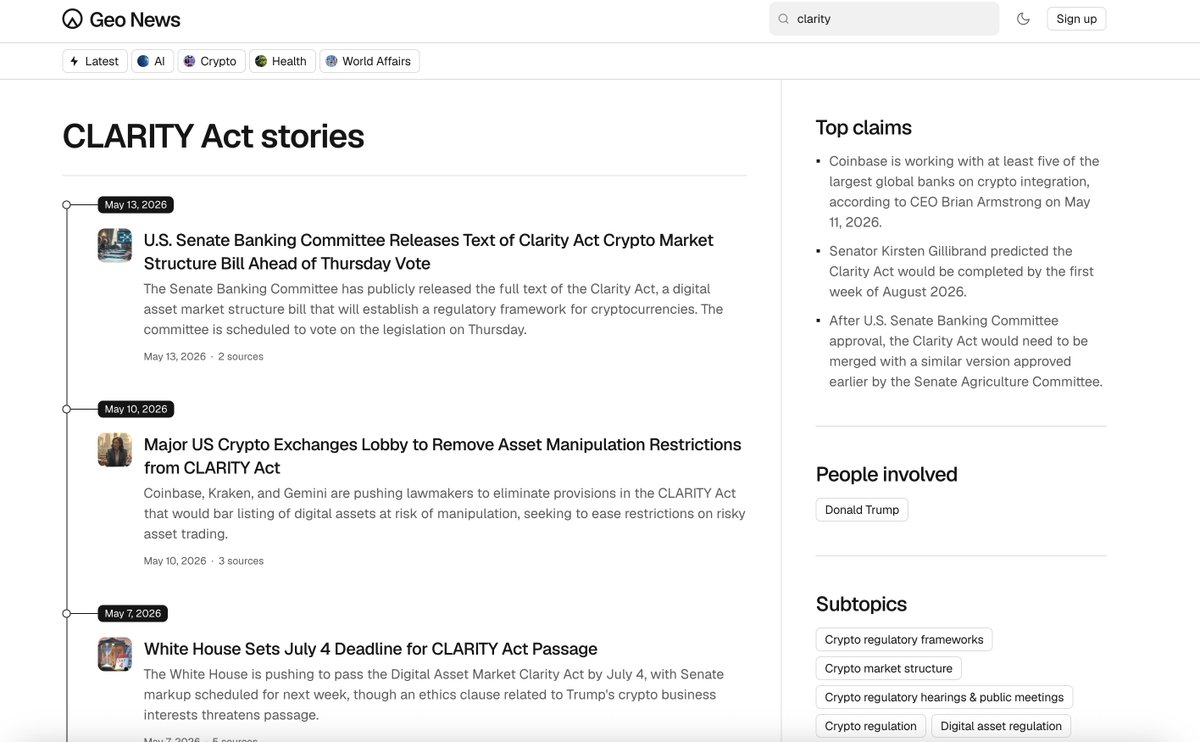
For years, crypto in the US has been stuck in a legal grey zone: is this token a security, a commodity, or something else?
The CLARITY Act is an attempt to create a real rulebook: clearer oversight for companies, better disclosures for investors, stronger protections for consumers, and more confidence for institutions.
It’s not law yet, but if it passes, it could be a major step toward making crypto more legitimate, investable, and mainstream.