19 years ago, a high school basketball coach put his team manager into a game for the final four minutes. The kid had never played a single minute of competitive basketball in his life. He scored 20 points.
Jason McElwain was diagnosed with severe autism at age two. He didn’t speak until he was five. He couldn’t chew solid food until he was six. He wore a nappy for most of his early childhood. As a baby, he was rigid, wouldn’t make eye contact, and hid in corners away from other children.
He tried out for his school basketball team every year and got cut every time. Too small. Too slight. Barely 5’6 and about 54 kilograms. But he loved the game so much that his mum called the school and asked if there was any way he could be involved. The coach created a team manager role for him. For three years, McElwain showed up to every practice and every game. He wore a shirt and tie on match days. He ran drills, handed out water, kept stats, and cheered every basket like he’d scored it himself.
On 15 February 2006, the last home game of his final school year, the coach let him suit up in a proper jersey and sit on the bench. With four minutes left and a comfortable lead, the coach sent him in.
His first shot missed. His second missed. Then something shifted.
He hit a three-pointer. Then another. Then another. His teammates stopped shooting entirely and just kept passing him the ball. He hit six three-pointers and a two-pointer. 20 points in four minutes. The highest scorer in the game. When the final buzzer went, the entire crowd rushed the court and lifted him onto their shoulders.
His mum tapped the coach on the shoulder, in tears. “This is the nicest gift you could have ever given my son.”
McElwain won the ESPY Award for Best Moment in Sports that year, beating out some of the biggest names in professional sport. He’s 36 now. He works at a local supermarket, coaches basketball, has run 17 marathons including five Boston Marathons, and travels the country speaking about never giving up.
When asked about that night, his coach still gets emotional. “For him to come in and seize the moment like he did was certainly more than I ever expected. I was an emotional wreck.”
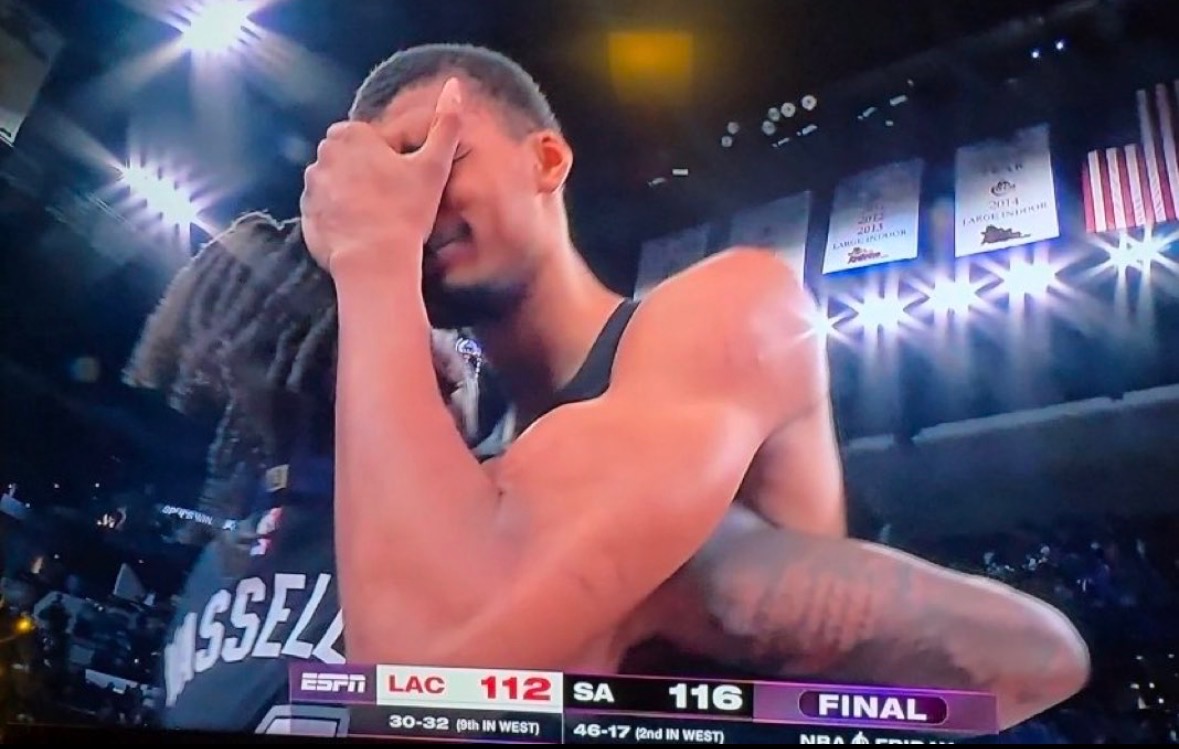
NBA superstar Victor Wembanyama (Wemby) broke into tears after the Spurs’ 25-point comeback against the Clippers.
The “too cool to care” mentality is a dead end.
Trying hard is cool. Pushing yourself to get better is cool. Stepping into the arena is cool. Caring deeply is cool.
Somewhere along the way it became uncool to care. But this is nonsense. The only people who say it’s not cool to care are the people who are hiding their own fear of failure and insecurities.
After Wemby collected himself, he told the media: “I thought I was going to pass out,” he said. “That’s close to being the hardest game of my life.”
We respect others when they give it their all. And the same is true for ourselves.
When you hold yourself back because you fear failure or looking “uncool,” you sacrifice growth and potential and mastery and fulfillment and intimacy and love (and all the other good stuff in life) for short-term safety and comfort. It’s a trap. Get over it.
The best athletes care deeply.
The best artists care deeply.
The best leaders care deeply.
The best coaches care deeply.
The best teachers care deeply.
The best doctors care deeply.
The best writers care deeply.
The best scientists care deeply.
The best parents care deeply.
Enough with the nonchalance.
Try hard and give a damn.
This team and this organization is special. Their hidden secret is their incredible player development pipeline. This group has done the whole draft, develop, and trade thing better than anyone recently.
Working on your mental game isn’t only for fixing things that are going wrong. It’s about finding processes that work for you for different situations like how to start strong, dig deep, rebound after a mistake, maintain focus, and compete in close games.
Regarding coach-athlete relationships:
High expectations + Low support = Fear of failure and fragility.
Low expectations + High support = Complacency and softness.
High expectations + High support = Confidence and Internal drive.
If you admire something about someone, make sure to tell them. It won’t be as awkward as you think. You never know how much they might need to hear it.
@FBGreatMoments He had great burst and vision and also look at some of those blocks he got from everyone from o-line, TEs, and receivers. It takes a team to run the ball like that.