-How does #India deal with #China
-Trade deficit with factory of the world is over $100 billion
-Does that pose a threat to India's economy?
Watch|Share|Review
https://t.co/CAH5s07QZ9
-Big development: #USA deploys "on-orbit space control weapons"
-US Air Force Sec Troy Meink confirmed that the Space Force possesses systems capable of defending American forces & potentially disrupting, degrading or destroying adversary space assets
-Details remain classified:
1. Weapon type
2. Number of systems
3. Orbit and launch date
4. Operational range
5. Intended targets
6. Tested or not
-It is not a sudden development. Space already had military com, navigation, intel, missile warning & precision targeting
-What has changed: Offensive-capable weapons physically deployed in orbit
-Move is aimed at #China & #Russia's satellite jamming, cyber operations, directed-energy systems, co-orbital manoeuvres & A-sat weapons
-Increases risk:
Miscalculation involving unidentified spacecraft, attacks on dual-use & commercial satellites
-#India needs:
1. Satellite survivability & redundancy
2. Space situational awareness
3. Anti-jamming & cyber protection
4. Secure military communications & navigation
5. Rapid satellite replacement
6. Enhanced launch capability
7. Counter-space doctrine
-Resilient military & commercial space systems is no longer optional—it is a strategic necessity
-Dedicated Freight Corridor (DFC)
-A network of electrified, broad-gauge railway lines built exclusively for freight trains
-It has revolutionized the way we do business in #India
Watch:
https://t.co/FwXUDWwWgs
Can this weekend’s BRICS summit in Delhi be the much-hyped “reset” with China or will Doklam & Galwan remain the trust-breakers that no handshake can paper over?
Xi’s first visit to India in 7 years. Another apex meeting. Talk of guardrails, flights, visas and “stabilising” ties. Trust remains low.
We’ve heard the reset script before. The LAC still decides how far any reset can go.
What do you think…real opening, or another round of cautious discussions? I do think that we can work out a win-win in some areas atleast while balancing where caution is warranted.
(On a related topic, do watch this podcast by @InsightGL
https://t.co/gNDvoVYusF)
#China’s military purges raise questions:
Did #India’s border strategy after #Galwan play a role?
The Galwan Valley clash boosted India’s morale and showcased its resilience, while for China it exposed military weaknesses and led to leadership fallout.
The article👇🏻is paywalled, so I’ll try to answer only the visible argument.
The tweet’s claim is that Pakistani subs & anti-ship missiles make Indian naval compellence a “questionable pursuit”. This untenable claim gives more credence to a (very meagre) sea-denial toolkit than to what *already* happened (many times) in a live crisis.
The argument treats Pakistani submarines and anti-ship missiles as some sort of a ‘veto’ on Indian compellence. #OpSindoor already tested that claim. When the shooting started, the Pakistan Navy *did not* even try to contest the northern Arabian Sea. It tucked in its tail & pulled ships into commercial berths at Karachi / took shelter at Gwadar. The Indian CBG’s mere presence…not even a full fledged offensive fleet action…kept PN hiding in port, raised insurance on Pakistani trade and put Indian ships minutes from striking from the sea. That *is* compellence. The bottom line is that Pak Navy *hid* when it mattered. 1971, #OpParakram & #OpVijay Redux.
Certainly, Subs and AShMs complicate close-in operations. They do *not* cancel superiority. We *need* to, of course, factor the fact that PN is expanding. I’m sure the @indiannavy will plan accordingly. Having said that, their diesel AIP boats are scarce & need to survive. P-8Is, MH-60Rs and a growing ASW screen aren’t there just for show.
Shore & air-launched missiles create a coastal bubble, not a free hand across the Arabian Sea. India does not have to even actually deploy a carrier on the Makran coast to hold Karachi, their energy imports and Pakistan’s war economy at risk.
1971 is the wrong lesson here. Let’s see it anyway. One Pakistani submarine sank Khukri. Sad. India still imposed a formidable blockade, annihilated their only major port, decimated their navy and decided the war at sea. Their country was split in two and the largest ever surrender post WW2 was there for all to see.
A denial force can *at best* inflict *some* pain. PN has not ever shown it can stop India from shaping Pakistani behaviour at and from sea. Equating tactical risk inside an A2/AD envelope with strategic failure is how you talk yourself out of a tool that *already* worked.
IMHO, India does not need to fight *inside* Pakistan’s missile envelope to keep imposing costs. Yes, when the ‘push comes to shove’, we may lose a few ships. Hopefully not. But realistically we may. They will lose what’s left of their country!
Confusing “dangerous (somewhat) inshore” with “compellence is questionable” misreads both the last crisis and the very purpose of naval superiority.
The famous saying goes “A ship in harbor is safe, but that is not what ships are built for”. The IN realises that. The PN hides the best it can. Op Sindoor is ongoing. Any further misadventure & the quote 👆🏻may need revision. Pakistan Navy ships might not be safe in harbour either!
@arunp2810@AJS_subdriver@abhijit227@CaptDKS@amansinha51204@KRANTII01@kumarpvr@SandeepUnnithan@sneheshphilip@InsightGL
"Democracy is the worst form of government, except for all the others."
Government was never sacred. It was technology. Democracy is just the newest version - and the blindfold has just come off.
Comment 👇 if you resonate/disagree, I'd love to debate!
-Did architect of Doklam & Galwan become too big for his boots & purged by #China?
-Was #India behind the his purge?
-That and much more:
https://t.co/3i1nfrjT2Z
You exercise in the gym…your body gets stronger. How often do you exercise your mind? I had asked a few days back if ‘fluid intelligence’ can be honed.
I joined team @cdf_23 yesterday as they partnered with the United Service Institution of India (@USIofIndia) to conduct specialised workshops for Indian Air Force @IAF_MCC officers on out-of-the-box thinking, strategic decision-making, and a custom ‘GARUDA’ workshop employing red teaming.
In an era of multi-domain & grey-zone conflict the ability to challenge assumptions, anticipate adversary intent and decide under uncertainty is as decisive as platforms and sensors. Structured training builds this cognitive edge and strengthens professional military education.
A fun day with everything from game-theory, a bit of maths, solving cryptic crossword, red-teaming greyzone scenarios and “deliberately provocative sessions”😆😉.
@cdf_23@VGK_India@KRANTII01@SAK02209619@SanjayJSingh1
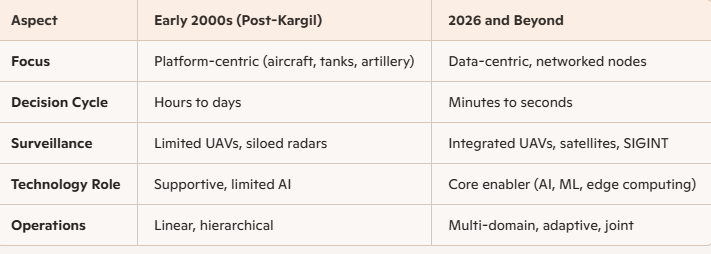
-How Indian Armed Forces have evolved in last 2 decades
-From Safed Sagar to Sindoor #India has come a long way
-What lessons #IndianArmy & #IndianAirForce learn from these wars
In-depth analysis:
https://t.co/my6AQQcMnh
Over the last two decades, the #Indian Armed Forces have shifted decisively toward network-centric warfare, moving from platform-heavy operations to data-driven, multi-domain integration.
#Kargil#OperationSindoor#IndianArmy
-How Indian Armed Forces have evolved in last 2 decades
-From Safed Sagar to Sindoor #India has come a long way
-What lessons #IndianArmy & #IndianAirForce learn from these wars
In-depth analysis:
https://t.co/my6AQQcMnh
#India’s tactical #UAV vision is centered on #ANRITA, an AI-first ecosystem designed to rival global benchmarks like the US V-BAT drone.
While V-BAT is already operationally mature, ANRITA aims to differentiate itself by offering sovereign technology ownership, modular payloads.
A V-Bat style drone can be really, really useful. For all the forces, but especially maritime.
🇮🇳’s ANRITA concept developed by Bengaluru-based SGPL needs to be supported. I don’t know the firm…understand it is ‘Spatial Geotech Pvt. Ltd.’…go SGPL go!
@indiannavy@INNavylife
*Pakistan Military Mindset after a defeat: ‘Fremdschämen’ or ‘Revanchism’?
I have been thinking about the points made by @kartha_tara in the article👇🏻.
Mostly agree with her. However in military history / military psychology terms, it comes down to ‘fremdschämen’ vs ‘revanchism’.
Pakistan was thrashed in #OpSindoor. FACT. The false bravado and statements by Pak establishment for consumption of their domestic audience are understandable from the psychological viewpoint. However, and this is important, their top military leadership as well as the youngest serving officers KNOW that they got a bloody nose. The question is how will they respond?
In military history, the ‘expected’ response is most often tied to the ‘fremdschämen’ (or ‘trauma’) cycle, where the generation that fought and lost retains a deep aversion to conflict again, while the next generation (which lacks personal memory of the horror) may be more willing to fight. The generic statement that a nation takes a generation to go to war again after a major defeat is, however, only partially true as a psychological and sociological concept. History shows it is not an absolute rule.
History is also filled with many examples where a major defeat caused rapid militarisation and a desire for revenge (revanchism), causing wars to spark much sooner. It depends on the economy and how soon they think they can build capacity.
Which way will Pak go? Tough to answer. I think their army has repeatedly shown that they lack the stomach for a fight. Another historical fact (with numerous examples) is that ‘proxy warfare’ can circumvent this generational fright. The ‘losers’ (literally and figuratively) often take the perceived easier way rather than a direct fight. Pakistan took this route after 1971. Sindoor changed that. It is also true that a radicalised mind does not think rationally.
I think we should keep our powder dry and give them a ‘bit of a spanking’ every once in a while (whenever they are naughty) to keep their memory fresh.
It’s game on. #GameTheory is being played live. #OpSindoor is ongoing…
@CaptDKS@amitabhprevi@alpha_defense@acorn@kakar_harsha@InsightGL@KRANTII01@prakashmenon51@SanjayJSingh1@sanjeevsanyal