#GTC21 available on-demand: See how enterprises can now deliver the most complex, immersive #VR and #AR experiences from a remote server across 5G and Wi-Fi networks to any device.
Make sure to also watch for more on NVIDIA's Cloud XR SDK. @InsightfulVR
https://t.co/TT1AWnLhVw
@nothings Yeah, our "framework" is all of the modular components we've written for our lightfield rendering/game engine that we've built over the past 4.5 years. Though due to its extreme modularity, it's effectively so much more than that.
It's akin to npm and lots of modules for C/C++.
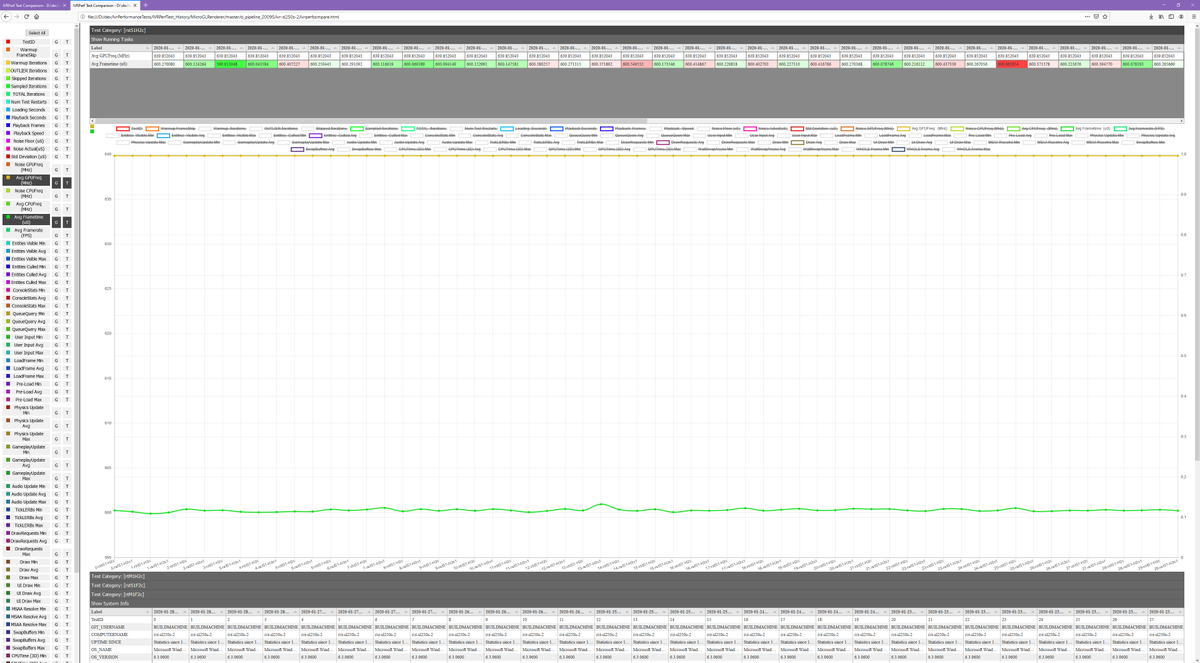
Average Standard Deviation = 0.15 uS!
Across 30 separate CI Automated Performance Tests of our GPU Renderer.
I've lost count of how many people told me a system like this would be too noisy and a waste of time.
It works, and it's saved us time & time again!
Anyone Interested?
@bob_burrough@enjrolas@LKGGlass Sadly, I'm having an issue where hp_drawLightfield( ); does nothing :/
So, while I'm waiting for support to help with that, here's a video of 12 views from of the 45 view quilt blitted directly onto the display (no per-pixel lightfield partitioning for the micro-lenslet array):
I wonder how badly twitter will decimate this screenshot.
What it says at the top is:
Total: 5.64ms
CPU: 4.67ms
GPU: 0.97ms
Using glFlush(); to *serialize* CPU and GPU.
It's 32 views x 173 draws per view x 214 CPU FPS =
1,184,704 draw calls per second on single-thread GL 3.0!
While preparing an important demo build, the night before getting on a flight... our whole building, which never loses power... lost power.. we're now eating delivery food by candlelight.. wondering when we can finish making the build... Murphy's Law?
Calling it early: @InsightfulVR lightfield rendering is #gdc 2019 best demo. Jaw dropping seeing fully production workable lightfield a running content on extremely low powered devices virtually indistinguishable from on my rtx2080. Highly recommend checking it out