Give it a quick read:
The X handle of the Chinese Embassy in the United States shared an image highlighting what it called China's 'red lines' in relations with Washington.
https://t.co/jlBoa71LJ4?
#China#USA#Trump#XiJinping#Taiwan#BeijingSummit#IndoPacific
"You ask, what is our aim? I can answer in one word: It is victory, victory at all costs, victory in spite of all terror, victory, however long and hard the road may be; for without victory, there is no survival." - Churchill
Islamist @khanumarfa, who does overtime cleaning Hamas terrorists’ toilets and cries for Gaza all day, is upset to see some Indians talking about Iran, as it’s not related to India.
Gaza wale jihadi tumhare fufa hain?
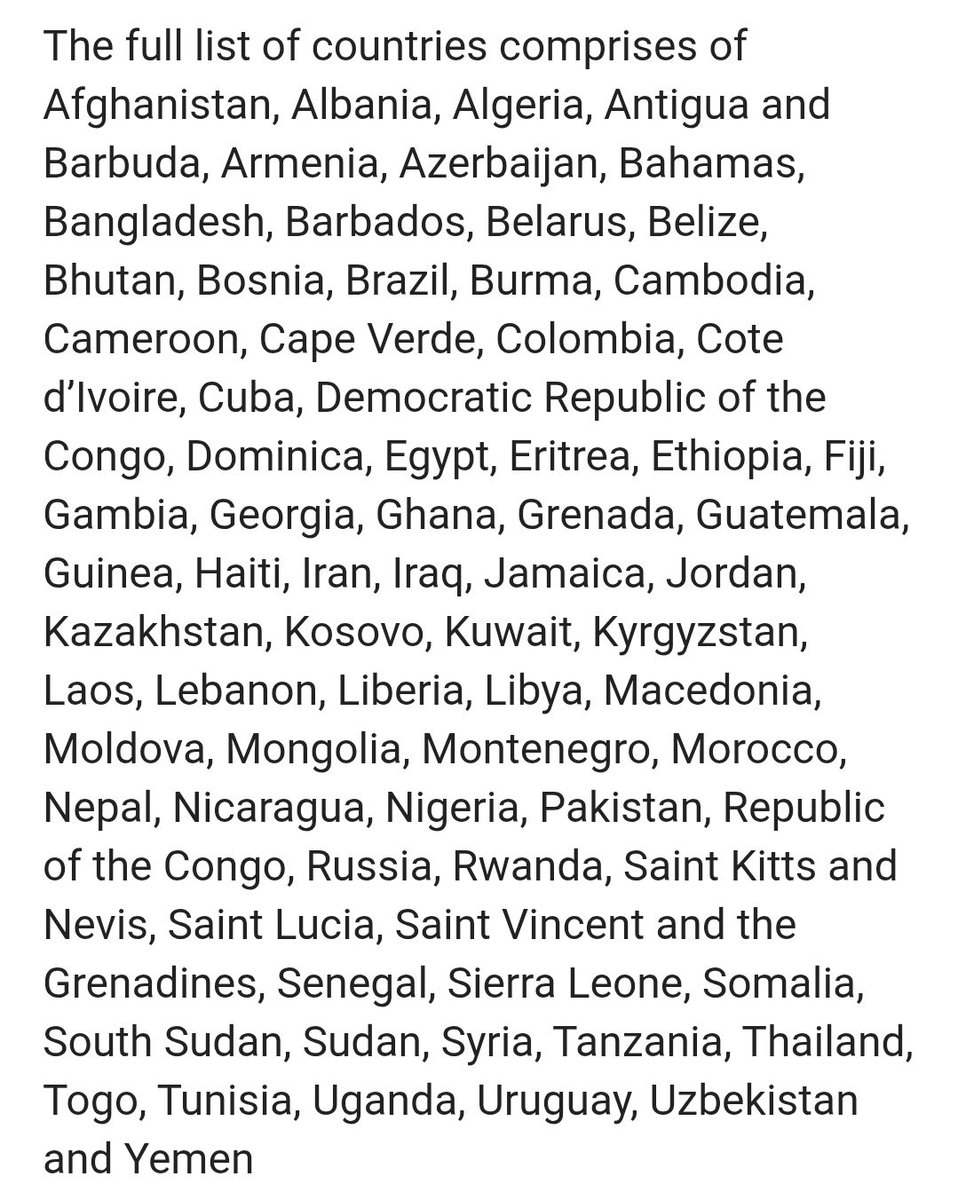
#BREAKING: United States issues an INDEFINITE PAUSE for the processing of all Visa Applications from 75 countries including Pakistan and Bangladesh as it reassesses who it wants to permit entry into the US. Full list of countries below:
Adam Smith- was he really the father of Economics??!!
(The Economist, December 20th, 2025)
Adam Smith is regarded as the "father of economics" by most economists in todays world. He is the the one who is credited to have introduced the concepts like "laissez faire", "free markets", "invisible hand" and also "division of labour" in his famous book "The Wealth of Nations" published in 1776. As the book completes 250 years this year, the following article examines whether the is actually the real father of Economics.)
1. BEHIND ONLY Karl Marx, he is the best-known economist in history. Smith inspired liberal ones, including the turn to free-market economics in America and Britain in the 1980s.
2. In 2026 that book, "An Inquiry into the Nature and Causes of the Wealth of Nations", will turn 250. Yet its reputation exceeds its contents. The book contains fewer genuinely novel ideas than many assume, and more weaknesses than its modern admirers acknowledge.
3. The popular view of Smith is that he celebrated self-interest. Many people today associate Smith with "Greed is good", a line from the film "Wall Street", released in 1987, captured by this famous quote from his book:
"It is not from the benevolence of the butcher, the brewer, or the baker, that we expect our dinner, but from their regard to their own interest."
4. When governments step back, the "invisible hand" of the market delivers something near a socially optimal outcome-even if people act selfishly. Smith's most famous quotation: "He intends only his own gain, and he is in this, as in many other cases, led by an invisible hand to promote an end which was no part of his intention.”
5. In "Theory of Moral Sentiments” (1759), Smith introduced the "impartial spectator", a model of human decision-making. A human, he insisted, does not make decisions purely from selfish impulses. Instead, he or she consults others-sometimes family and friends. The "impartial spectator" is a sort of inner monologue, a third party who judges our actions. The popular understanding of the "invisible hand" is even further off the mark.
6. Smith acknowledged the benefits of markets, but also their costs. Consider his famous pin factory. The division of labour within it allowed workers to produce thousands more pins than if they were working alone.
7. When the "Wealth of Nations" came out in 1776, everyone agreed it was a Very Important Book. But does it warrant calling Smith the "father of economics" That may be going too far, for three reasons.
8. Take the book itself first. Full of long, winding, it is not nearly as readable as Milton Friedman's "Free to Choose" or Marx's "Communist Manifesto".
9. Second, Smith sometimes got economics wrong. In the "Wealth of Nations" he argued for the "labour theory of value" (the idea that the amount of work that goes into a product determines its price, rather than how useful that product is).
10. Third, Smith introduced fewer core ideas of economics than you might think. He did not invent GDP (William Petty, in the 1660s, probably gets that accolade). He was not the first to recommend free trade. Nor was Smith the first to recognise the benefits of the division of labour. Plato beat him by 2,000 years.
11. Last but not the least, "Wealth of Nations" contains "unacknowledged borrowings". Smith does not mention Ferguson's analysis of the alienation of the worker under the division of labour.
#UPSC #UPSCPrelims2026
#upsceconomics
Mr. President, this is an urgent and immediate call for your attention, support, and action. Last night you saw the millions of brave Iranians in the streets facing down live bullets. Today, they are facing not just bullets but a total communications blackout. No Internet. No landlines.
Ali Khamenei, fearing the end of his criminal regime at the hands of the people and with the help of your powerful promise to support the protesters, has threatened the people on the streets with a brutal crack down. And he wants to use this blackout to murder these young heroes.
I have called the people to the streets to fight for their freedom and to overwhelm the security forces with sheer numbers. Last night they did that. Your threat to this criminal regime has also kept the regime’s thugs at bay. But time is of the essence. The people will be on the streets again in an hour. I am asking you to help.
You have proven and I know you are a man of peace and a man of your word. Please be prepared to intervene to help the people of Iran.