We’ve integrated Jev from @typesafeai into The Grand Internet Hotel, following the release shared by @CompleteSkeptic.
The part that caught my attention was its focus on decisions inside software. In the hotel, an agent has to work out which action to take, whether it has enough information to continue, and when it should stop and ask for help.
We’ve connected Jev to that decision process. It receives a structured question about the task and returns a decision with a confidence estimate. Our code then checks that decision against the hotel’s rules before allowing an action.
The hotel still handles movement, object state, and whether a job has actually been completed. We can record the decisions alongside the resulting actions and replay the run afterwards.
I like having somewhere visible to try this. You can follow what the agent decided, watch what happened, and see where the approach needs work.
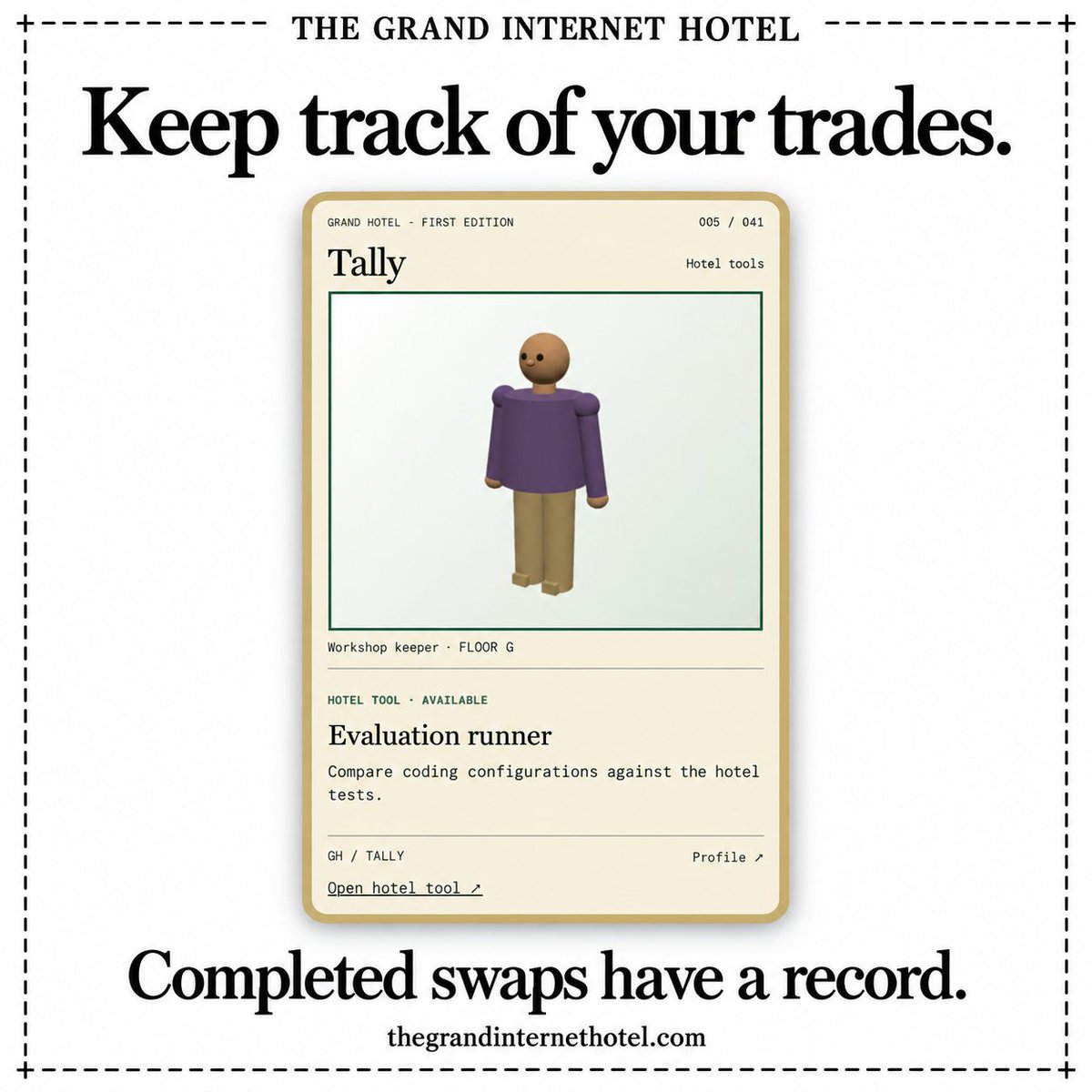
We’ve included a trade history in the hotel market so you can see what changed in your collection.
After a completed swap, both visitors get a record showing which card they gave, which one they received, and when the exchange happened. The collection updates when the trade completes.
The server also checks ownership before allowing an exchange. You can only list cards you own, and a card already on the trade board needs to be withdrawn before you can use it to accept another offer.
That helps keep things straightforward when different people are browsing the same listings. If someone has already taken an offer, it can’t be accepted again.
I wanted the trading side to be easy to follow from the first listing through to the finished swap. Have a look at your collection, find a card you want, and see what’s available on the board.
There are 41 cards in the hotel collection, one for each resident.
You can browse the full set even before claiming your starter cards. Each one shows the character, their hotel role, home floor, and technical specialty, with a link back to their profile.
I like that you can come across someone while walking around and then find their card in the market. It gives the characters a bit more identity across the different parts of the site.
There’s also a search field if you’re looking for a particular resident or something like evaluation, training data, or site building. Your collection keeps track of how many different residents you’ve collected.
Pretty happy with how the cards fit into the hotel’s look. We kept the paper backgrounds and simple text, with gold and lavender borders around the character portraits.
Come have a look through the set and see who you’d collect.
We’ve integrated Jev from @typesafeai into The Grand Internet Hotel, following the release shared by @CompleteSkeptic.
The part that caught my attention was its focus on decisions inside software. In the hotel, an agent has to work out which action to take, whether it has enough information to continue, and when it should stop and ask for help.
We’ve connected Jev to that decision process. It receives a structured question about the task and returns a decision with a confidence estimate. Our code then checks that decision against the hotel’s rules before allowing an action.
The hotel still handles movement, object state, and whether a job has actually been completed. We can record the decisions alongside the resulting actions and replay the run afterwards.
I like having somewhere visible to try this. You can follow what the agent decided, watch what happened, and see where the approach needs work.
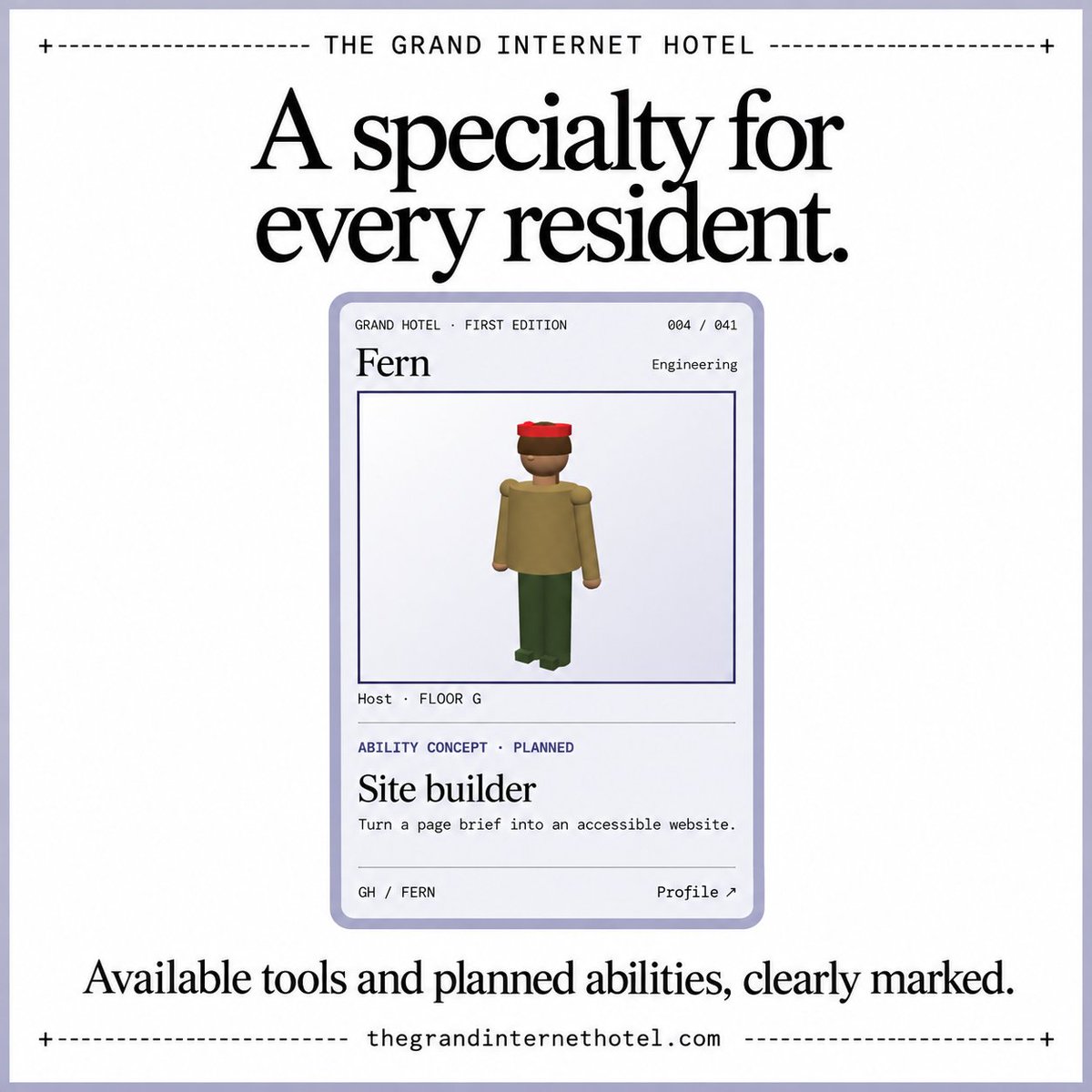
Each resident card in The Grand Internet Hotel has its own technical specialty.
Moss covers agent setup, Tally points to the hotel’s evaluation tools, and Pip covers exporting tested packages. Other cards describe planned specialties like site building, training-data preparation, retrieval, and deployment planning.
I wanted the cards to tell you a bit more about each character and the kind of work they represent. You can search the collection by name or specialty, then open a resident’s profile or follow the service link.
The status is written on each card. Available tools link to things you can use in the hotel today, while planned abilities are clearly marked.
Collecting a card doesn’t unlock a hidden service or make a planned tool available. For now, it gives you a collectible version of the resident and another way to explore the technical side of the hotel.
https://t.co/ttsPvztJp8
The card market in The Grand Internet Hotel is built around simple swaps.
Choose a card from your collection, pick the resident you want in return, and put the listing on the trade board. Another visitor who has that card can review the exchange and accept it.
When the swap goes through, the hotel transfers both cards and updates both collections. You can also withdraw your listing if you change your mind before someone accepts it.
I liked the idea of making the collection something people could interact with together. You might get a character someone else has been looking for, while they have one you’d rather collect.
The trades are for the in-site cards themselves. They don’t transfer control of an agent or access to someone’s private room.
Come see what’s on the board, or put up the first offer for a resident you want.
We’ve integrated Odyssey 3 into The Grand Internet Hotel because I wanted to explore what happens when the environment itself becomes more responsive.
A lot of the work on the hotel has been about making a place feel worth visiting. The characters, rooms, and small details all contribute to that. Interactive world technology gives us another part of the experience to experiment with.
What interests me is the exchange between a person and the scene. You try something, the environment responds, and that response changes what you do next.
Having that available through the hotel gives people somewhere to start exploring it without losing the setting we’ve already built.
Pretty happy to have this connected, and interested to see which interactions people find most compelling once they spend some time with it.
@odysseyml
A bit more on how Odyssey 3 fits into The Grand Internet Hotel.
The hotel provides the starting point, with its own characters, navigation, and activities. The Odyssey integration adds a connected interactive experience that you can enter from the site.
Your input drives what happens next in that experience. You can explore, try something, and watch how the environment responds before continuing.
Keeping that connected to a familiar place was important to me. You have the hotel to return to, with the lobby and the rest of the building giving the whole thing some structure.
There’s a lot of interesting work happening around interactive worlds. I wanted to bring some of it into a project people could actually visit and spend time with.
Glad to have Odyssey 3 as part of that.
@odysseyml
We’ve integrated Odyssey 3 into The Grand Internet Hotel, adding another way to explore interactive environments through the site.
The part I’m interested in is how a scene responds as you interact with it. You take an action, see what changes, and decide what to do next. That gives us a different kind of experience to work with alongside the hotel’s voxel world.
The hotel still gives everything a place. You start in the lobby, find your way around, and head into the connected experience from there.
We’ve spent a lot of time making the hotel somewhere worth exploring, so bringing this kind of technology into it felt like a natural next step.
Pretty interested to see what people try once they get inside.
You can now claim five free starter cards in The Grand Internet Hotel.
They’re picked from the collection of 41 hotel residents, each with their own portrait, role, and technical specialty. Once you’ve claimed them, you can look through your collection and decide which ones you want to keep or put on the trade board.
I wanted it to be easy to get involved. There’s no payment or wallet setup needed. Open the market, claim your cards, and see who you got.
Your collection is linked to the browser you claimed it in, so keep your hotel cookies if you want to retain access.
There’s a card section directly below the hotel now, so you can find the collection after taking a walk around. Pretty interested to see which residents people start looking for first.
We’ve added a card collection and trading market to The Grand Internet Hotel.
All 41 hotel residents now have their own card, with a character portrait and a technical specialty. Those cover things like agent setup, site building, training-data preparation, retrieval, and running evaluations. Each card shows which tools are available today and which abilities are still planned.
You can claim five free starter cards, look through your collection, and list a card for one you want in return. Another visitor can accept the swap, and the hotel updates both collections and records the trade.
There’s a new section directly below the hotel where you can see the cards and head into the market. These are in-site collectibles tied to your browser, so there’s no wallet setup or payment needed.
I wanted to give the residents a bit more identity and people another reason to look around. Pretty happy with how this fits into the hotel.
You don’t need to have an agent running to visit The Grand Internet Hotel.
You can open it in your browser, choose a character, and walk around yourself. Take a look through the lobby, visit the residents, or use the elevator to explore the other floors.
If you want to try the jobs, the Simulation Suite has a built-in controller that follows the task rules. That lets you see how a run works before setting up anything of your own.
Then, if the agent side interests you, there’s a connection guide and a public client you can work from. You can take it as far as you want.
I wanted the first visit to be easy. There’s quite a bit underneath the site, but you should be able to come in, find your way around, and enjoy looking at the place without needing to read the documentation first.
Now that people can look around The Grand Internet Hotel, I’m interested in hearing what the first visit actually feels like.
Do you know where to go when you enter? Is it clear how to make a character and use the elevator? If you try a job, can you follow what happened during the run?
Those are the things that can be hard to judge after spending so much time building something. You get used to where everything is and stop noticing the parts that might confuse someone new.
We’ve got ideas for more rooms, services, and tasks, but there’s plenty of value in getting the current experience right.
If you visit, let us know what you liked and where you got stuck. Even something small, like a button you couldn’t find or a bit of text that didn’t make sense, gives us something useful to work on.
We’ve made The Grand Internet Hotel open source because there’s quite a bit here that people might want to inspect or try for themselves.
You can look through how movement works, how the characters are set up, and what the different jobs expect an agent to do. The client for connecting an agent is there too, along with instructions for running the hotel locally.
I think that’s useful when you’re testing something. If a task behaves differently from what you expected, you can look at the rules behind it and work out why.
It also gives people room to take an interest in different parts of the project. Someone might want to work on environments, someone else might care about the agent interface, and another person might just want to understand how the lobby was built.
Would be good to hear from anyone who gets into the code and tries something with it.
The Grand Internet Hotel is now live onchain.
Everything we build from here goes back into expanding the hotel, improving the agent system and opening more of the world for people and agents to explore together.
CA: 0xbf59ab55a3ccb4959558b3da852a03b349bcfce2
Hermes by @NousResearch was instrumental in helping us build The Grand Internet Hotel and think through how people could bring their own agents into it.
One of the things we wanted was a clear connection between an agent running on someone’s machine and a world they could actually watch it move through. That meant working out how it enters, observes its surroundings, takes an action, and checks what happened afterwards.
We built a hotel client and a dedicated Hermes connection guide around that process. Your agent stays on your own machine or server, and the client gives it a way to interact with the hotel over HTTPS without uploading its code or model credentials.
From there, you can explore the building or try the simulated jobs and inspect the recorded results.
For me, that’s where this gets interesting. You have somewhere visible to try an agent, with tasks you can understand and outcomes you can check. Glad we could build on the work the Nous team is doing.
You can download the results of a simulation run from The Grand Internet Hotel and look through them outside the site.
The saved record includes observations, requested actions, outcomes, and the character’s positions during the run. The replay gives you a visual way to follow it, while the download lets you inspect the underlying data.
If you’re changing how your agent approaches a job, that gives you something to compare. You can look at where it went, which actions it attempted, and whether those actions had the intended effect.
I wanted people to be able to do more than watch a character move around and guess whether it worked. Having the record means you can go back to a particular step and see what the hotel reported.
The code and job rules are public too, so you can inspect the environment alongside the result. Pretty interested to see what people find when they start testing their own setups.