Neural Infrastructure is on Instagram now.
The first post is a 30-second reel rendered end-to-end on our own box — HTML composition in, MP4 out, published by API. No editing suite, no agency, no stock-footage subscription.
Which is the whole thesis: AI employees doing real operational work on infrastructure you own. Isolated instances. Coordinated agents. Compute owned, shared, or BYOK.
https://t.co/PPpBzOvyrc
https://t.co/7x9yQSdhaI
Both layers are true, and the distinction is the whole point. Each agent still needs its own memory, that's recall, and without it nothing compounds. But recall alone gives you exactly what you describe: sharper individuals, a team that forks its view of reality. Coordination lives a layer down, one entity graph every agent writes to, reconcile-on-write so conflicting facts merge instead of forking, provenance on every claim. We run both in production. Recall is an agent property. Coordination is an infrastructure property.
I gave every AI agent on my team its own memory. It made each agent smarter — and the team dumber.
I run a team of AI employees — an SDR that researches prospects, a project manager that posts client updates, a finance agent that chases invoices. Each one has persistent memory, because an agent that re-asks the same questions every morning is useless.
Now picture what happens when a client changes their point of contact.
The SDR learns it within a day — it finds the announcement while researching. The project manager keeps addressing updates to someone who left. The finance agent keeps sending invoice reminders into a dead inbox. Same company. Three agents. Three different versions of the truth.
That's the trap with per-agent memory: you solve individual forgetfulness and create something worse — a team with five partial truths and no shared one.
Human teams fix this constantly and invisibly. Hallway chats, standups, "oh by the way" messages. Agents don't have hallways. Whatever one of them learns stays locked in its own head unless you build the pipe yourself.
So we built the pipe. One shared entity graph — organized around the things a business actually cares about: companies, people, deals — that every agent reads from before acting and writes to after finishing. Read before acting, write after finishing. Two rules. That's the whole contract.
The unglamorous part is what makes it trustworthy:
— Every fact carries its source, timestamp, and which agent wrote it. When two facts conflict, provenance settles the argument, not whichever agent wrote last.
— Nothing gets overwritten. History is preserved, so "when did we learn this?" always has an answer.
— Entities get stable keys, so "Acme Corp" and "ACME Corporation" don't quietly become two customers.
— And you filter what gets in. A brain full of unverified noise is worse than no brain at all.
None of this makes any single agent smarter. That's the part I had backwards for a while. The wins show up at the team level: no duplicate work, no contradictory answers to the same client, context earned once and spent everywhere.
Not a smarter agent. A smarter team. Isolated instances, coordinated agents, one brain.
If you're about to add a second AI agent to your business — that's the moment to think about this. Not after the fifth one has its own private version of your customer list.
Full architecture, including the governance rules that keep a shared brain honest:
https://t.co/atFSQzbZl9
Introducing Sakana Fugu: A full multi-agent orchestration system accessible via a single model API.
Our ‘Fugu Ultra’ model matches the performance of Fable and Mythos, delivering frontier capability without the risk of export controls.
Try it: https://t.co/hhO6qTawgb 🐡
@JioMart some one purposely uses my address to order stuff. It’s becoming a nuisance now. there are no mechanisms on the website nor do I have any way to raise a complaint, so messaging here hoping to get a resolution.
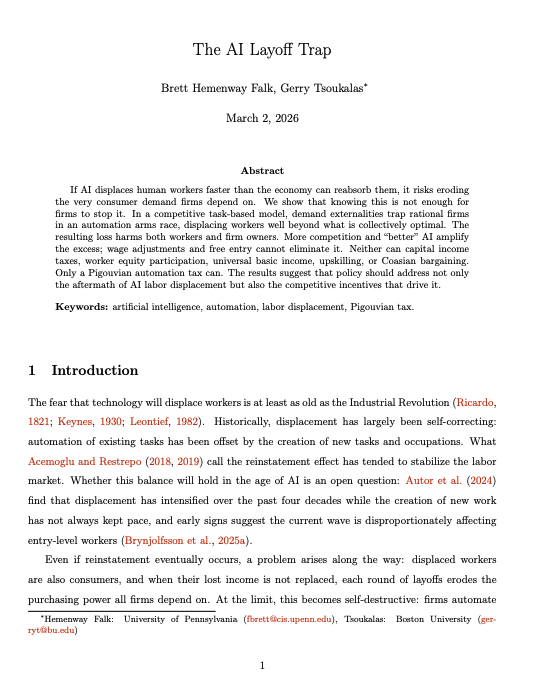
🚨BREAKING: Two researchers from UPenn and Boston University just published a paper that should be uncomfortable reading for every CEO automating their workforce right now.
The argument is straightforward. Every company replacing workers with AI is also eliminating its own future customers. Laid off workers stop spending. Enough of them stop spending and nobody can afford to buy anything. The companies that fired everyone end up selling into an economy with no purchasing power left.
Every executive can see this. The math is not complicated. But here is why nobody stops.
If you do not automate, your competitor does. They cut costs, lower prices, take your market share, and you collapse anyway. So every company automates knowing it is collectively destructive because the alternative is dying alone while everyone else survives. The researchers proved this is a Prisoner's Dilemma playing out in real time.
The numbers are already moving. Block cut nearly half its 10,000 employees this year. Jack Dorsey said AI made those roles unnecessary and that within the next year the majority of companies will reach the same conclusion. Salesforce replaced 4,000 customer support agents with AI. Goldman Sachs deployed a coding tool that lets one engineer do the work of five. Over 100,000 tech workers were laid off in 2025 and AI was cited as the primary driver in more than half those cases. 80% of US workers hold jobs with tasks susceptible to AI automation.
The researchers tested every proposed solution. Universal basic income does not change a single company's incentive to automate. Capital income taxes adjust profit levels but not the per-task decision to replace a human. Collective bargaining cannot hold because automating is always the dominant strategy.
They also identified what they call a Red Queen effect. Better AI does not solve the problem, it accelerates it. Every company chases faster automation to gain market share over rivals but at the end everyone has automated equally, the gains cancel out, and the only thing left is more destroyed demand.
The one thing the math says could work is a Pigouvian automation tax. A per-task charge that forces companies to account for the demand they destroy each time they replace a worker.
The conclusion is that this is not a transfer of wealth from workers to owners. Both sides lose. Workers lose income. Companies lose customers. It is a deadweight loss with no market mechanism to stop it on its own.
Overwhelmed with the support. The encouragement means a lot and inspires me to do better.
Missed the target this time but I absolutely gave my all.
Good things are coming I'm sure.
Thank you all! 🙌
Stage1-OpSindoor, was more about speed, strategy, quantum of response. Stage2- will be more about technological superiority, across domains incl cyber. In combination, a deterrent can and will be set if there is superior win in both these stages.
#ceasefirevoilation
India needs to immly check the two-front factor and beep up offense on one front and defense on the other. This is another level confidence, maybe driven by idiocism, but surely with some strong backing.
@TimesNow@republic@adgpi@ZeeNews
The #IndPakConflict situation will evolve. The strategic silence is not about giving up, but most importantly preparing for a bigger leap. Remember this wasn’t only about military action. The rope around the enemy’s neck is long and no other third party can come and cut it.
.@mybmcWardRS@mybmc - the RTI Application portal based payment is not working. Please help me with a link that works for the payment.
https://t.co/crucWRIqAw
Let’s say this might happen
1. Tesla - BYD - Tata/Mahindra (travel)
2. OpenAI - DeepSeek - TBD (ai/agi)
3. SpaceX - TBD - ISRO (space)
US - China - India > a three-way investment focus in the next three years
3 themes- 3 countries - 3 companies - 3 years