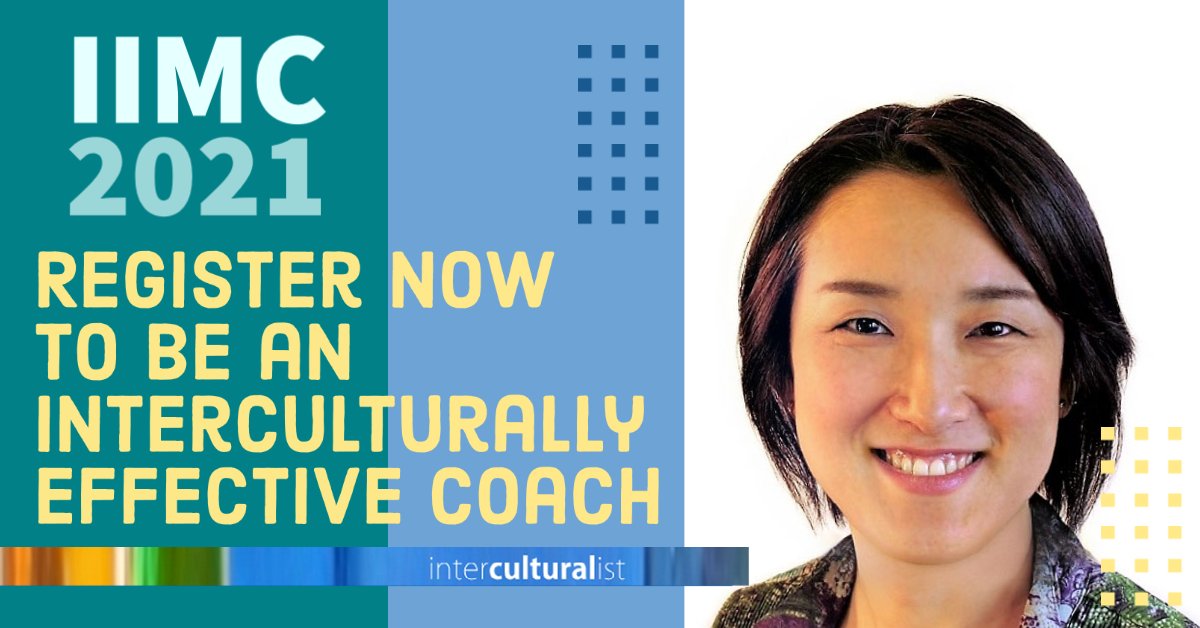
Intercultural competence is a critical coaching competency. If you're a coach looking for a professional development opportunity to become more effective across diversity, this is for you. Register now. https://t.co/Es4cChXONh
We're pleased to announce the third Intercultural Institute for Master Coaches (IIMC) May 6-8, 2021. IIMC is an advanced education program for masterful coaches, to add intercultural competence to their list of coaching strengths. Register now. https://t.co/QmvpMyEiBo
Akiko will be presenting at @TGLtohoku to students and staff later this month. The topic will be the intersection of BLM and intercultural development. Looking forward to a great discussion! https://t.co/Ogjg3cTJjL
Could be procrastination, but you could also think about it as being more polychronic, less future-oriented, and more relationship over task focus.
https://t.co/kfTMcFFY08
This is the base - the foundation for learning how to build an equitable, inclusive society. Can we begin with seeing both ourselves and others as having unconditional self-worth? https://t.co/JVjAe4odfL
We are honored to have our Principal, Akiko, be invited to give a keynote lecture this year at the Rits Super Global Forum. Akiko's lecture will be entitled: "Playing A Role In Creating The World You Want To Live In: Using The Lens of DEI"
https://t.co/jUz7lp386C
Tomorrow morning, Akiko will be speaking at the ACTO conference addressing two questions:
1. Why should intercultural competence be a coaching core competency?
2. What is the “gap” between intercultural awareness and intercultural practice?
https://t.co/TOdWqTSRmI
#increaseWE
@ELCA @Bp_Strickland Effective actions for social good occur when we have greater intercultural capacity. Yet, society comprises a diversity of *degrees of capacity*. As such, we engage from different vantage points. Therefore, we must be mindful of this kind of diversity to be effective. #ELCATalks
A nice read on how the culture-general framework of individualism can be perceived through the lens of collectivism. @Abebab grounds her essay in the Ubuntu concept of 'ena'. Perhaps there's some commonality with the Japanese concept of 'amae'.
https://t.co/sdP8RJwC1J
Internationalizing higher ed. can facilitate intercultural competence but it is not a certainty. Purposefully developmental curriculum is needed. #increaseIC https://t.co/ror7XzWLDK
Absolutist thinking, dichotomous thinking constrain our ability to address challenges with a wide range of possible solutions. Our task to nurture curiosity and empathy. #increaseWE
https://t.co/k795RwqFYd
How does diversity in intercultural development impact the world? Here's a great case from local US state politics (investigated by @newsmanual): https://t.co/YVEjP2An1e
Research tells us that stress inhibits our intercultural competence capacity. Psychological safety is the antidote. Check out advice from @AwesomeNeuro on how to nurture psychological safety during this uncertain time https://t.co/Pw2irAWV1L #increaseWE#NameItUntilYouTameIt
Being a member of a group and behaving as a member of a group have psychological consequences. There are consequences even when the other members are not immediately present.
~ Muzafer Sherif