The future is No-App. With InventDB, operate your business with AI driven app that takes the shape of your business data. No spending time, money and resources on building and managing custom software for your business. https://t.co/W4K8IMXiaq
You can try using InventDB Serverless as your Claude session centralized store, which any session on any system can use the whole teams or your own multi session reasoning trace. It is so flexible and can take in deep nested objects of Claude sessions. You can ask Claude itself to use the InventDB Serverless instance to push its session messages, all in real time, and in-turn use them throughout its sessions.
https://t.co/2NZ9eInoNE
We built our LLM inference engine, InventDB Sparkle, which we will be extending to support several most popular open weight models soon. Today it supports Qwen3.8-27B model with up to 262K token context and multi-modal input and text output.
InventDB Sparkle against vLLM 0.29.0. Qwen3.8-27B on one NVIDIA H200 141 GB, same pod, same client, same benchmark, one engine running at a time.
At 33,000 token prompts:
Cold start to first completion: 31.0 s against 157.3 s.
First token on a cached prefix, 1 stream: 35 ms against 332 ms.
Decode, structured output, 1 stream: 394.6 against 216.3 tokens/s.
Decode, prose, 1 stream: 253.9 against 172.6 tokens/s.
Decode, structured output, 8 streams: 250.9 against 148.1 tokens/s per stream.
Aggregate across 8 streams, structured output: 2,007 against 1,120 tokens/s.
InventDB Sparkle is one 11.3 MB binary plus its pinned CUDA runtime. No Python, no PyTorch, no virtualenv. Installing vLLM on the same pod took about six and a half minutes to build the environment and pull PyTorch and its CUDA wheels.
InventDB Sparkle runs int8 weights with an int8 KV cache, vLLM runs the FP8 checkpoint with its own recommended flags. Both engines booted one at a time after checking the GPU was free, with weights evicted from the page cache before each cold start.
We are waiting on @OpenRouter to accept our provider application. Hoping to be there soon.
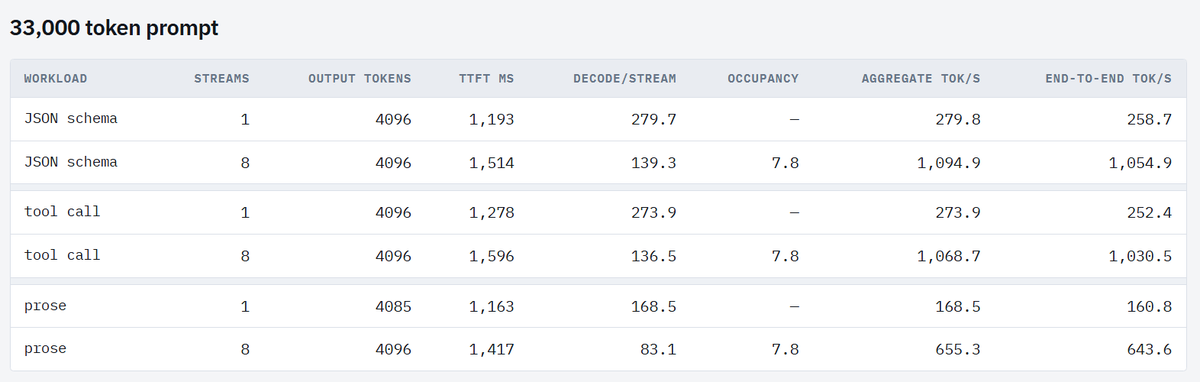
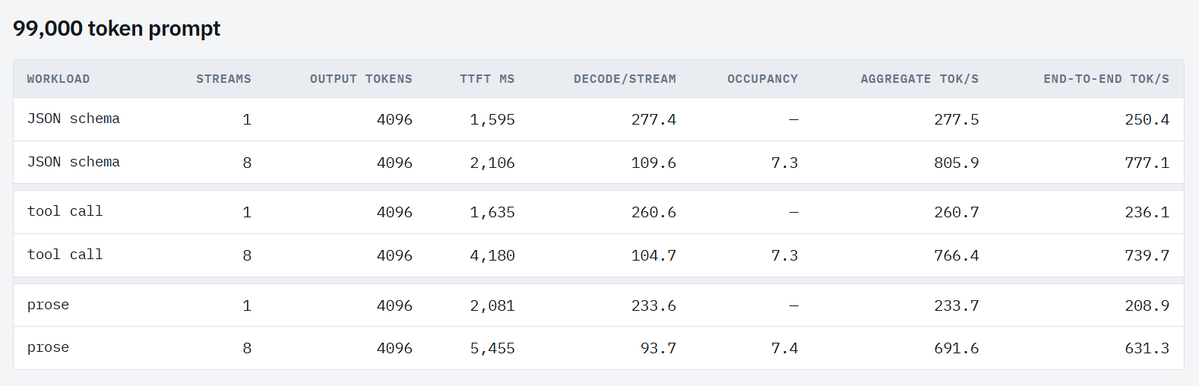
InventDB Sparkle inference engine with support for Qwen 3.8 27B model is available now for InventDB SOAR app. Try it out. We are currently being very conservative and have our GPUs sleeping when not used, so cold starts will be around 150 seconds, and warm requests will be 1-2 seconds for TTFT. Below is the matrix of current performance from our tests.
There is a classic trap of semantic search and matching. For instance, when I say, "give me all functioning models of this car" vs "give me all non-functioning models of this car", these two questions when seen by typical semantic search algorithms with vector embeddings, result is very high similarity score? if we cache the result of the first question and then try to semantically match the second question with similarity score, then it matches and we will get the 1st question answer for the 2nd, which is wrong. I'm hoping this is handled in a naive way by Redis Langcache.
We had implemented this in our AI data platform, InventDB SOAR, with some key guards. But still in testing phase. The 100% correctness of our AI engine that is linked to our customer database is non-negotiable.
@sridharfyi Sales, period. I would not take $1M without having a MVP in hand. We have a full-blown production ready product released, focused on sales now. Looking for money. are you ready 😉?
Arpit, check us out. We built our own multimodal input + text output inference engine from scratch in Rust for Qwen 3.8 27B & GLM 5.3 Flash to start with, which we will be releasing soon and using in our own data platform product. We are a new, proud Indian database company with comparable features and technology to PostgreSQL but for smaller non-clustered workloads. Innovating and Improving 24/7/365 using our Claude engineering team.
https://t.co/AKXa68qRmW
@mmalisper@pgrustdb Check us out folks. https://t.co/BlA6zXCStD. We are pure rust single binary database, built from scratch. Love to see what you guys will deliver with @pgrustdb
We built the whole InventDB data platform (database, apps) with Claude code and Anthropic LLMs (~75 billion tokens so far).
Key for maintainable code is to build in smaller chunks, having thorough tests and keep up-to-date documentation of the product and code (let LLM build it continuously), and always have your coding agent refer to the docs and keep updating them as they continue to build the software.
Just our personal experience.
Most AI uses today focus on coding related activities. With InventDB we bring the benefit of AI/LLMs to day-to-day business operations. Explore our InventDB+AI in business use cases. https://t.co/kKxlppdSPW
@kevinbrown201 Check us out, InventDB, https://t.co/W4K8IMXiaq. We are pushing the limits of database performance with flexible schema, automatic indexing on any property, and many other cool things.