Blackrock:
"Tenemos productos de indexación perfectos al 0,04% que replican el MSCI World prácticamente gratis"
Los putísimos inversores en dividendos:
“No, no, gracias. Yo prefiero pasarme 14 horas analizando empresas, montar una cartera de 37 acciones y cobrar 18€ al mes”
As two of the largest forces in equity markets -- growing index ownership and increasing amounts of capital controlled by extremely short-term-oriented, leveraged, volatility-intolerant investors -- converge, we have found occasional opportunities to acquire some of the most dominant long-term compounding franchises at attractive valuations.
For example, we acquired Alphabet $GOOG when the stock declined substantially on the release of ChatGPT in late 2022, Amazon $AMZN in the weeks following Liberation Day, and $META more recently on the market's response to the company's unexpectedly large cap ex guidance and expenditures.
In our 13F which we will file later today, we will disclose a new position in Microsoft, a company we have followed for many years now offered at a highly compelling valuation. While $PSUS will not be filing a 13F tomorrow, it has also recently made $MFST a core holding.
Microsoft operates two of the most valuable franchises in enterprise technology, which account for approximately 70% of the company's overall profits: M365 and Azure.
M365, the company's productivity suite, is the dominant operating platform for knowledge work, with over 450 million workers using Word, Excel, PowerPoint, Outlook, and Teams on a daily basis.
Azure is the world's second-largest hyperscaler cloud platform and, like AWS in our Amazon investment, is a direct beneficiary of the multi-decade migration of enterprise IT workloads to the cloud, which is now further accelerated by surging demand for AI inference workloads.
Both M365 and Azure are underpinned by Microsoft's unparalleled enterprise distribution and the security, compliance, and identity infrastructure it has built and refined over decades.
Beyond these core franchises, Microsoft also owns a portfolio of other leading businesses, including LinkedIn (the world's largest professional network with 1.3 billion members), its gaming platform (Xbox and Activision Blizzard), and search and news advertising (Bing and the Edge browser).
We began building our position in MSFT in February following a meaningful share price decline after the company reported its fiscal Q2 2026 results. We were able to establish our position at a valuation of 21 times forward earnings, broadly in line with the market multiple and well below Microsoft's trading average over the last few years.
Notably, MSFT's headline multiple does not reflect the value of Microsoft's approximately 27% economic interest in OpenAI, which would represent approximately $200 billion, or 7% of Microsoft's market capitalization, at OpenAI's most recent funding round valuation.
We believe Microsoft's recent share price decline has been principally driven by investor concerns around two key issues: i) the competitive positioning of M365 against increasingly capable AI lab offerings (notably Anthropic's Claude Cowork), and ii) the durability of Azure's growth, especially in light of Microsoft's evolving relationship with OpenAI.
In our view, investors underestimate the resilience of the M365 franchise given its deeply embedded role across enterprises and highly attractive price-value proposition. Unlike point software solutions, which may be vulnerable to disintermediation by better-performing AI alternatives, M365 is tightly integrated into the daily workflow of nearly every large enterprise and is supported by Microsoft's identity, security, compliance, and data governance infrastructure, which would be nearly impossible to replicate.
Attractive bundle economics further reinforce Microsoft's advantage, with monthly average revenue per user on the M365 suite at approximately $20, less than half of what customers would pay to purchase the underlying applications individually from different vendors.
Moreover, we are encouraged to see Microsoft prioritizing its R&D efforts and investment in Copilot, its own AI agent embedded across M365, with direct involvement from CEO Satya Nadella. We believe these efforts will translate into improved product velocity and greater customer adoption over time.
Alongside Copilot's rollout, the company has also begun shifting its pricing model from pure per-seat licensing to a hybrid model of seats plus metered consumption, which helps expand the company’s revenue opportunity as AI agents drive incremental usage that a seat-only structure would not capture. These initiatives should help sustain M365’s strong underlying growth momentum, which was already evident in the business unit’s 15% revenue growth (in constant currency) last quarter.
We believe concerns regarding Azure's growth trajectory are similarly misplaced, particularly in light of the franchise's exceptional recent performance. Azure revenue grew 39% in constant currency last quarter, with company guiding to modest acceleration through the second half of the year.
We view Microsoft's recent decision to restructure its OpenAI partnership not as a concession but as part of a deliberate pivot toward a more open, multi-model architecture that better serves enterprise customers, who increasingly seek optionality across model providers.
Microsoft recently disclosed that over 10,000 enterprise customers have used more than one model on Azure Foundry, the company’s modular AI model marketplace. This model-agnostic approach also strengthens Copilot, which can auto-route queries across multiple models to deliver the optimal output for a given task.
To support Azure's rapid growth amid persistent supply constraints, Microsoft has raised its calendar year 2026 capex budget to approximately $190 billion. Consistent with what we have observed at hyperscaler peers Amazon and Google, we view this spend as growth capex that should drive future revenue generation. This is particularly true for Microsoft, given that roughly two-thirds of its capex budget is allocated to server and networking equipment that correlates directly with near-term revenue.
Like our purchases of $GOOG, $AMZN, and $META, we believe that $MSFT offers analogous and compelling long-term value at today's valuation.
Brookfield $BN ha presentado un Q de Business As Usual.
Los DE crecieron +7% y, además, recompraron 470M$ en acciones a ~41$, como siempre, demostrando ser unos maestros en el timming.
Lo realmente importante es cómo se está fortaleciendo el motor de capital:
• 188B$ disponibles para invertir.
• 17B$ monetizados vía venta de activos.
• 11.8B$ de unrealized carried interest acumulado.
Y la lógica detrás de las monetizaciones es la de siempre: reciclar capital para aumentar la Equity y poder apalancar todavía más la pata de seguros.
La parte de Wealth Solutions sigue dejando buenas señales. Anualizada continúa generando >2B$, cumpliendo lo prometido, incluso pese al crecimiento plano YoY (430M$ vs 430M$).
Además, en los últimos 12 meses ya se está viendo más actividad en realized carried interest, algo que probablemente debería acelerarse conforme se acerque el final de la década.
También me parece relevante dónde están desplegando capital:
• Crédito oportunista.
• Infraestructura y financiación de activos reales.
• Energía.
• Real estate.
• ABS junto a gestores asociados.
Segmentos donde realmente creen tener ventajas estructurales y escala.
Sobre IA Brookfield cree que gana en ambos escenarios.
Si la IA acelera productividad y adopción:
→ harán falta más data centers, energía, transmisión y redes digitales.
→ precisamente donde ellos ya son líderes en equity y crédito.
Y si la IA termina generando dislocaciones financieras:
→ el crédito oportunista entra en su hábitat natural.
→ escasez de capital + repricing de riesgo = mejores retornos potenciales.
La fusión BN + BNT también encaja bastante bien estratégicamente. Brookfield lleva tiempo simplificando la estructura y ahora busca crear una plataforma totalmente integrada de seguros e inversión.
El negocio asegurador ya vale ~30B$ y gestiona cerca de 200B$ en activos. Con la integración, las operaciones de seguros tendrán acceso directo al balance corporativo y, además, podrán apoyarse en ~145B$ adicionales de efectivo, acciones e inversiones para seguir creciendo. Muy pocas aseguradoras tienen acceso a semejante base de capital.
Esta tarde a las ~19h estaré en directo con @ahidalgoa y @PaezFinance comentando estos y los del otro día de $BAM!
And this is why we do it✍️
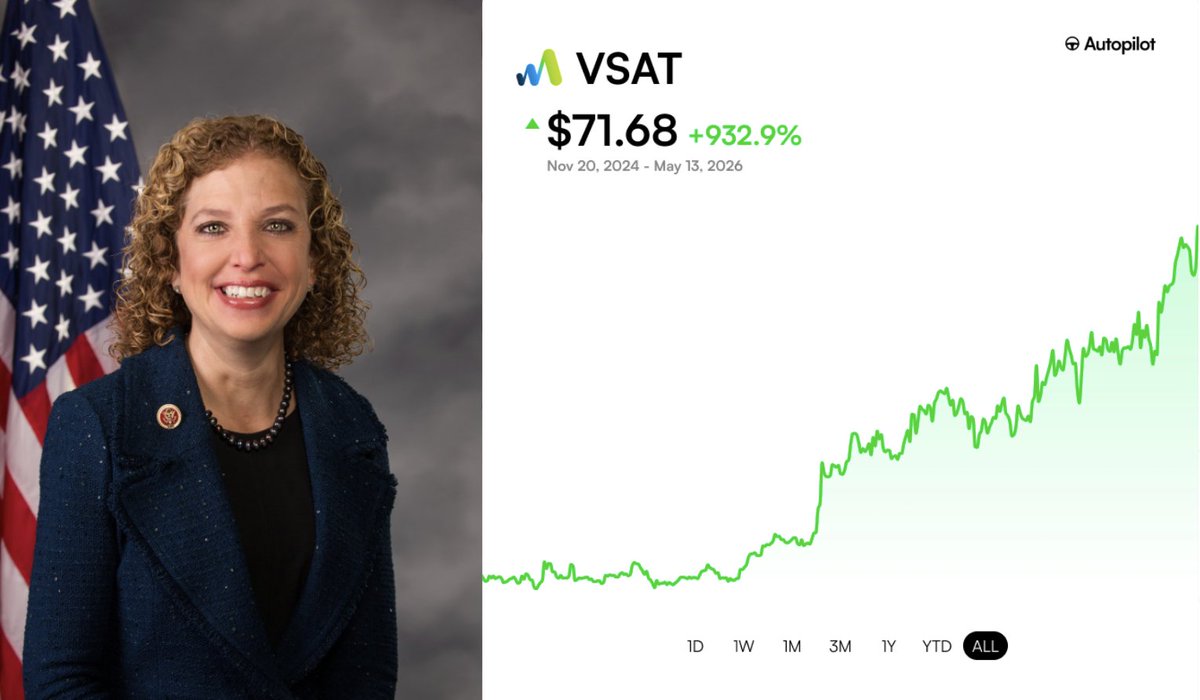
Back in November 2024, we flagged Debbie Schultz's buy of $VSAT
At the time, she sat on the House Military Construction Subcommittee
And Viasat... They focus on military communications equipment for the U.S. military
Since we posted, it's up around +759%
🧌 La Legendaria IP Inglesa 🇬🇧
Games Workshop $GAW
Analizamos una de las compañías más especiales que existen
Propietaria de Warhammer y empresa en la que el CEO escribe el annual report a mano
Muchas opcionalidades gracias a poder licenciar una IP que lleva construyéndose +50 años
Tesis completa en mi S*bst*ck 🔗 fijado en mi perfil
Se agradece mucho un ❤️🔁
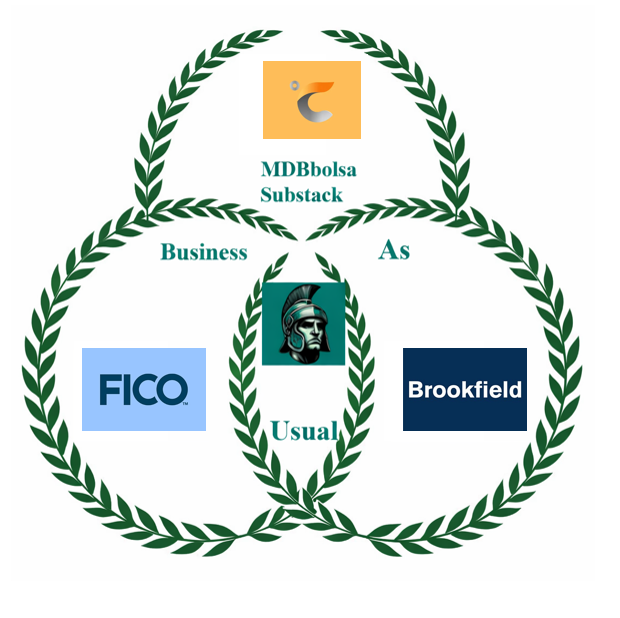
🔲 Business As Usual 🔳
De esos posts que pasarán desapercibidos
Pero que me cuesta meses escribir y recabar información
📉 $FICO: Peligra el monopolio de titulizaciones?
🧞♂️ $BN: Riesgos o Beneficios del Private Equity?
🍹 $CELH: Motivos de las caídas post resultados
La sección con más calidad del S*bst*ck 🟠
Si alguna vez os habéis planteado probarlo, aunque sea 1 mes, es para esto👇
@CarlosGalanRub Más sesgado imposible 🤣 el alquiler no es estático y en muchos casos la cuota de la hipoteca es bastante más barato que un alquiler (mi caso), por no hablar de que puedes conseguir hipotecas por encima del 90% como es la mía…
Es el mejor momento en años para aprender sobre $BAM
4.5% de Dividend Yield
Seguramente se duplique en 5-6 años
El riesgo del Private Equity en compañías de software no va con ella
Tenéis una tesis en profundidad de la misma 👇
Puedes probar 1 mes y ver si te gusta 👽
Como ya sabéis, desde hace 5 años presento la declaración con @tax_down ya que hacen que realizarla me lleve apenas 10 minutos
Yo ya la tengo lista ✍️
¿Y tú? 🧐
Si queréis 10€ de descuento en cualquiera de sus planes, por aquí os dejo mi enlace. ⬇️⬇️⬇️
https://t.co/Sj3JBlOpDh
📝 El negocio de Microsoft(2026-2029) tesis + Valoracion ,en abierto mi artículo más viral
En mi artículo analizo por qué Microsoft no es solo una empresa de software, sino la infraestructura crítica de la nueva economía de la IA.
La jugada con Anthropic: Cómo han convertido a un "rival" en un cliente que paga peaje en Azure.
Maia 200: El chip propio que va a disparar los márgenes al dejar de pagar el "impuesto" a NVIDIA.
El 96,7% de potencial: Por qué la baja adopción inicial de Copilot es, en realidad, la mayor oportunidad de crecimiento de la década.
Si quieres entender por qué Microsoft es mi primera posición en cartera y cómo se está preparando para el periodo 2026-2029, te dejo el análisis completo aquí: $MSFT
Artículo 📝 https://t.co/0Gh0pWNgtN
$RACE vende +80% de los coches que produce a clientes que ya tienen un Ferrari.
$RACE siempre produce un coche menos de lo que demanda el mercado.
Nunca hay exceso de stock. Siempre hay lista de espera.
$RACE elige a quién y qué vender.
Este finde publico la TESIS 😉⏳
☯️ En un mundo cada vez más polarizado
🥵 En el que cuanto más aprendo, más difícil me parece todo
🔳 En el que parece que solo hay blancos o negros
⚒️ No creo que se deba negar herramientas que nos puedan ayudar
Post para abrir paraguas ☔️☔️
Mi única intención es ayudar y mostrar la lógica de por qué, un analista fundamental como yo, también usa AT
Después de leerlo, no volverás a ver un gráfico de la misma forma...
PD. Alguien pilla la referencia de la portada 🤔
🤯 Llevo semanas investigando una empresa de la que se habla muy poco en la comunidad en español.
Tecnología submarina, defensa, monopolio regulatorio y Anduril como catalizador.
Una de esas ideas que aparecen una vez cada mucho tiempo.
Ya disponible el análisis completo 👇