Soy el sueño húmedo de Marx, un obrero propietario de los métodos de producción 🏗🛠
Alma libre, no garantizo encajar en tu paquete ideológico (sea cual sea)
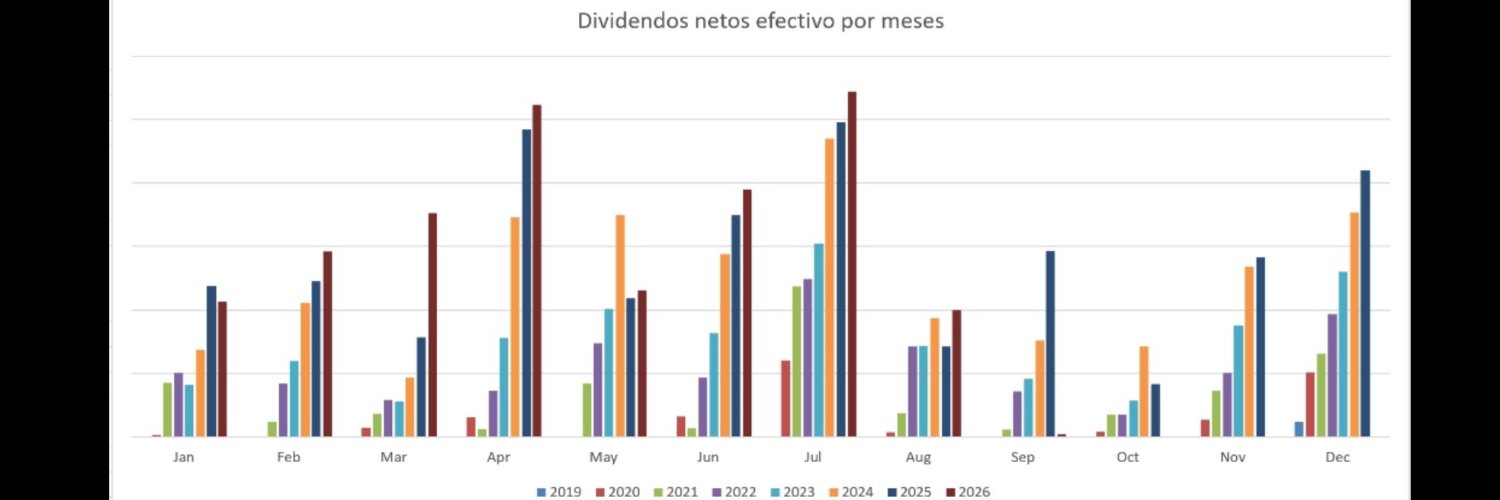
Otro año se acaba. Y con ello, llega el momento de hacer balance del año y ver en qué punto estamos, y hacia dónde iremos a partir de ahora.
Como dijo Séneca, "no hay viento favorable para el marinero que no sabe a dónde va".
@entro_banda Puede haber sanidad pública sin necesidad de mantener un tren inútil, te acabas de ir por los cerros de Úbeda con respecto a tu post inicial...
Repitan conmigo: los servicios públicos NO tienen que ser rentables.
Cuando trabajaba en Asturias, en lo que era FEVE, muchas veces iba con un solo viajero, pero es que quizás ese viajero es la única forma que tiene de ir a su casa. Servicio público siempre
@entro_banda Todo es dinero público y todo son impuestos extraídos de la población
Es dinero que si no se extrayese por la fuerza, seguiría produciendo riqueza (bienes útiles y deseados) a la población
Yo no juego a dónde está la bolita de las competencias, eso lo han decidido ellos mismos
@Alexelinversor Pues si el petróleo tb es materia prima, la verdad es que muy diversificado no estabas 😅 pero bueno, cambiará el ciclo en algún momento 🙂 ahora, a mantener la calma y hacer las cosas con cabeza
Once every ten days, a bright canary-yellow bullet train glides into Tokyo Station at full speed, yet not a single passenger is allowed to step on board.
Its windows are mostly covered from the inside, its timetable is never published for the public, and there are no ticketed seats in any of its seven cars.
In Japan, every child and every commuter knows this train by two English words: Doctor Yellow.
Since the Tokaido Shinkansen began running between Tokyo and Osaka in October 1964, Japanese bullet trains have carried more than seven billion passengers at speeds up to one hundred and eighty-five miles per hour with zero passenger fatalities from derailments or collisions.
Critics sometimes assume that kind of sixty-year safety record is a miracle of luck.
It is not luck; it is what happens when a nation builds a high-speed hospital train whose only patient is the steel track itself.
Why does Japan run a seven-car bullet train painted bright yellow with zero paying customers on board?
In the early days of high-speed rail, engineers realized that checking hundreds of miles of track on foot at night with hand gauges was too slow, and that tracks behave differently when a three-hundred-ton train slams over them at one hundred and sixty-eight miles per hour.
So Japanese railway engineers took a seven-car Class 923 Shinkansen trainset and packed every car from nose to tail with laser-optical sensors, gyroscopes, accelerometers, and high-speed cameras.
Running in the middle of the regular passenger schedule at a full one hundred and sixty-eight miles per hour, Doctor Yellow fires laser beams onto the left and right rails to measure track width, vertical dip, and curvature alignment down to one-tenth of a millimeter, about the thickness of a single human hair.
At the same time, two special observation domes built into the roof and laser pantographs check the overhead high-voltage copper wire for microscopic wear before a single spark can cause a power outage.
The instant Doctor Yellow detects a rail that has shifted by even a fraction of an inch, it beams the exact GPS coordinates to maintenance crews waiting along the line so they can fix the spot that very night after the last passenger train goes to sleep.
Because its schedule is kept secret so crowds do not pack the platforms, Japanese commuters treat spotting Doctor Yellow by chance as a genuine good-luck charm that brings happiness for the rest of the week.
Safety is never an accident when engineers check their work down to the width of a hair.
(Note: Every photograph-style illustration on my feed is created by AI.)
@Inversor_40 Yo la verdad es que la cambié por otras del sector cuando quitó el obsequio... 🥲
Además, no me importa tener un poquito más de volatilidad en las empresas de mi cartera, ayuda a ofrecer oportunidades de ampliación
🚨 BIGGEST SINGLE-DAY WIPEOUT IN US STOCK MARKET HISTORY
$2.8 Trillion has been wiped out from the US stock market today so far, the largest one in history.
Previously, the largest single-day wipeout was of $2.69 Trillion during the Covid crash.