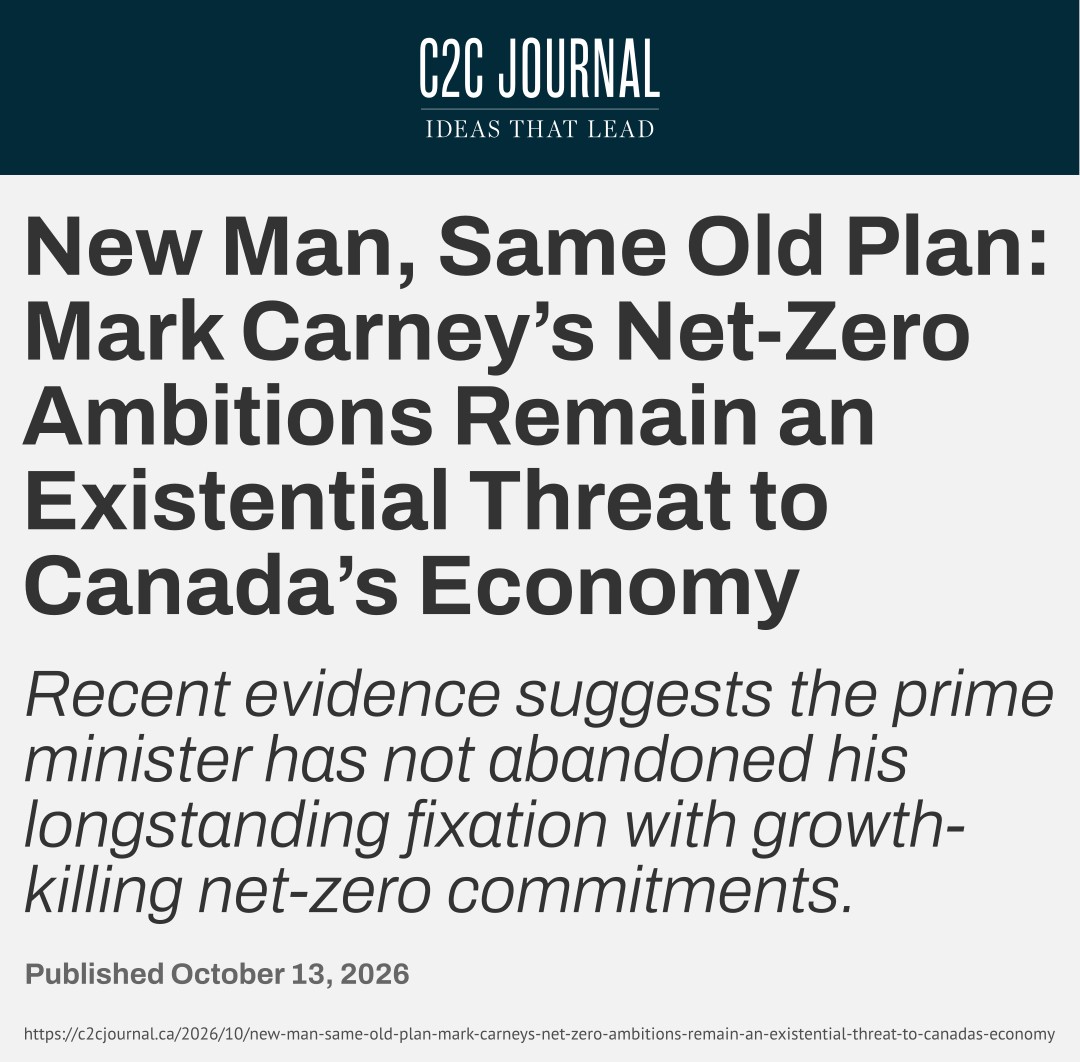
🚨WAKE UP CALL for Canada:
Mark Carney is still the same net-zero crusader. The “new” pro-growth Carney is just the opening act
His government’s “green taxonomy” is designed to label projects, steer capital, and starve out oil, gas, and heavy industry — the same playbook he pushed for years at GFANZ, the Bank of England, and in Value(s)
As Gina Pappano puts it: “Canada can either open itself for business, or it can commit to a net-zero future. It can’t do both.”
Bye-bye energy superpower. Hello stagnation @InvestNowOrg
While Prime Minister Mark Carney talks up his efforts to get major resource projects off the ground, his government continues to advance a “green taxonomy” that will have a devastating impact on the entire resource sector.
A green taxonomy ranks potential investments based on their perceived impact on the environment. It is meant to dissuade investors from backing major oil and natural gas projects. The first state-wide green taxonomy was the China Green Bond Endorsed Project Catalogue developed by the People’s Bank of China in 2015.
Despite recent complaints from environmentalists that “New Carney” is ignoring climate change, this is not the case. Throughout his entire career as a Wall Street, executive, central banker, pundit and politician, he has consistently promoted the use of global financial networks to impose a net-zero future on the world. The current green taxonomy is part of that plan.
Carney has recently supported greater ties between Canada and the EU. Europe is a pioneer of aggressive net-zero policies and the use of a green taxonomy to redirect investment away from the traditional energy sector. The result has been cripplingly high energy costs and “accelerating deindustrialization”. Following through on Canada’s net-zero commitments, including a green taxonomy, would replicate Europe’s economic decline here.
If Canada want to have a prosperous future, the prime minister must abandon his net-zero plans and immediately scrap the green taxonomy. Carney should focus on partnerships with nations that prioritize economic growth, not those that seek to stifle it.
Read the full story:
https://t.co/Fmu1ruJX9C
Market diversification is a sensible enough strategy for Canada, but Mark Carney’s fixation on closer ties with Europe is anything but. For one thing, argues business veteran Gwyn Morgan, we’ve already got comprehensive free trade deals with virtually all of Europe. Cozying up further to a dysfunctional, declining EU is pure folly. Far better for the Carney government to focus on Canada’s own self-inflicted economic problems – inflation, taxes, public debt, the disastrous drought in foreign investment. Oh, and the ongoing lack of free trade within our own borders. No need for overseas adventures, notes Morgan; there’s plenty of work to be done at home.
Read the full story:
https://t.co/py9enPB9X9
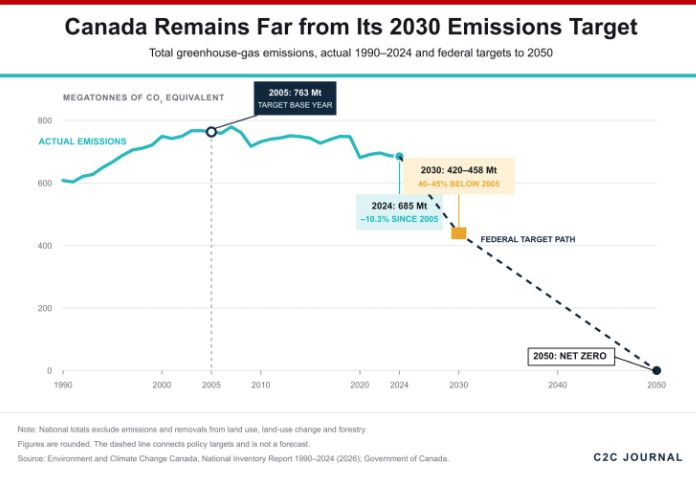
Canada has four years left to hit an emissions target that federal data show is a long way off.
Environment and Climate Change Canada reports that Canada’s total greenhouse gas emissions were 763 megatonnes of carbon dioxide equivalent in 2005, the base year for federal targets. Nearly two decades later, in 2024, they had fallen to 685 megatonnes, a drop of only 10.2 percent.
The Canadian Net-Zero Emissions Accountability Act, which requires net zero by 2050, remains in full effect. Critics call the 2030 target far-fetched unless achieving it is accompanied by a dramatic reduction in economic output. They also warn that steering investment away from the oil and natural gas sector could strand billions of dollars already invested in an industry whose products account for 20 percent of Canada’s merchandise exports.
To meet the target, emissions would have to fall to between 420 and 458 megatonnes by 2030, which is 40 to 45 percent below 2005 levels.
Critics say closing that gap in four years would demand far deeper cuts than Canada has managed since 2005, with the costs borne by the economy and Canadian taxpayers.
Should Canada keep its 2030 target or reset it?
Read the full story: https://t.co/Fmu1ruJX9C
In September 2026, Prime Minister Mark Carney pitched Canada to a room of investors who together control a staggering amount of money.
Protesters gathered outside the summit at Toronto City Hall as Carney assured investors and financial leaders that Canada is open for business. The pitch fits his new reputation as a conservative-minded builder of great projects. Carney has even spoken of making Canada an “energy superpower”, a term popularized by former Conservative Prime Minister Stephen Harper that refers almost entirely to oil and natural gas.
But critics argue that the Carney government’s climate commitments pull the other way. The Canadian Net-Zero Emissions Accountability Act remains in force, and Ottawa is developing a green taxonomy to steer investors away from emissions-heavy projects and toward those it considers environmentally friendly and consistent with net-zero goals. In other words, critics warn, the taxonomy would be used to discourage investment in natural resources and manufacturing, Canada’s traditional economic engines.
The investors at the summit collectively control $120 trillion in assets.
Critics argue that Canada cannot both be open for business and remain committed to a net-zero future — and that Ottawa’s choice will determine where that money goes.
Can Canada attract major investment while keeping its net-zero commitments?
Read the full story: https://t.co/Fmu1ruJX9C
Critics say European farmers’ protests over climate rules may offer a preview of what Canada’s industries could face.
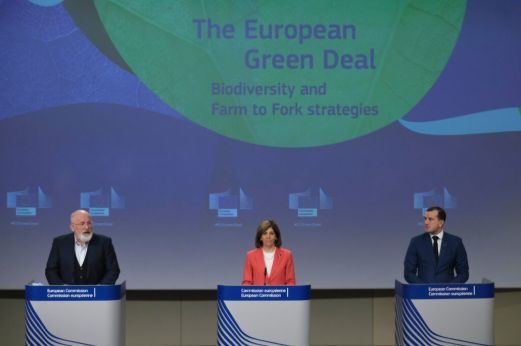
The European Green Deal, the EU’s plan to reach net zero by 2050, is backed by a legally binding green taxonomy that labels economic activities by their environmental impact. Critics say the Green Deal has made it increasingly difficult for industries that emit carbon dioxide to operate or raise capital. In March 2024, farmers in Łomża, Poland, protested its impact on agriculture.
Canada is developing its own version, the Canadian Sustainable Finance Taxonomy, a federally funded project whose draft was released in July 2026. It is intended to support the same net-zero goal, although initial reports suggest it will initially be voluntary. Critics argue a taxonomy only makes sense with a political mandate to reach net zero, since investors would otherwise be free to decide where their money goes.
As Canada and the EU discuss closer ties, some observers warn that integrating their climate-related financial policies would likely mean aligning their taxonomies and bringing similar constraints to Canada.
Those constraints would fall hardest on Canada’s resource and industrial companies, which depend on raising capital to build new projects.
Should Canada align its investment rules with those of Europe?
Read the full story: https://t.co/Fmu1ruJX9C
The first government-backed system for sorting investments by environmental impact came from an unlikely place.
These systems, known as green taxonomies, label economic activities by their perceived environmental impact to steer investors toward some projects and away from others. Under the European Union’s version, for example, vehicle manufacturing qualifies as a green economic activity only if the vehicles produced have zero tailpipe emissions. A private-sector version appeared in 2012, when the non-profit Climate Bonds Initiative created a taxonomy to promote “green bonds”.
Canada is now building its own. A December 2025 Department of Finance press release said the taxonomy reflects Ottawa’s commitment to “mobilizing public and private capital to promote investment in sustainability, as part of the transition to net-zero.” Critics argue its real purpose is to constrain how banks, insurers and pension funds invest their clients’ money.
But the first government to create such a system was Communist China, whose central bank published a green taxonomy in December 2015 despite the country’s deplorable record on pollution.
Critics argue Canada is following a model pioneered by China that could limit where Canadian capital goes.
Should Canada follow China and Europe in labelling investments?
Read the full story: https://t.co/Fmu1ruJX9C
In spring 2026, drivers in one small French town paid fuel prices that would stun most Canadians.
Europe has become known for its high energy costs, and fuel at the pump is no exception. Observers blame those costs on aggressive net-zero policies, carbon “pricing” and heavy regulation, arguing that such a policy package has driven deindustrialization across the continent.
Earlier this year, the CEO of JPMorgan Chase also criticized the EU’s economic performance, arguing that high taxes, weak capital formation and anti-business policies had caused its GDP to fall from roughly 90 per cent to 70 per cent of U.S. GDP. He also dismissed Prime Minister Mark Carney’s call for middle powers to band together as “a fantasy,” adding, “They did that, it’s called Europe.”
In April, a gas station in Grâces, a town in France’s Brittany region, listed fuel prices starting at the equivalent of Can$3.11 per litre.
Canada is weighing closer ties with the EU, and critics warn that would mean adopting the climate policies responsible for the EU’s ongoing economic collapse and high energy prices.
How much would you pay at the pump for climate policy?
Read the full story https://t.co/Fmu1ruJX9C
Every country in the European Union is legally bound to a climate goal that critics say no country has come close to meeting.
Under the European Climate Law, the EU’s 27 member states must become climate-neutral by 2050, which is what North Americans call “net zero”. Reaching it means cutting greenhouse gas emissions, mainly by slashing fossil fuel use, until any remaining emissions can be removed from the atmosphere or directly offset, for example by planting trees. Buying “carbon offsets” no longer counts. The European Green Deal, unveiled in 2019, aims to make Europe the world’s “first climate-neutral continent”. The legally binding European Climate Law puts that goal into law and requires EU policies across all economic sectors, especially energy and finance, to align with it.
Canada has its own version. The Canadian Net-Zero Emissions Accountability Act commits Canada to net zero by 2050. Critics argue that recent federal approvals, including LNG Canada Phase 2 and a fast-tracked Alberta-B.C. oil pipeline, would be impossible if Canada followed through on that law.
The closest any country has come, critics note with some irony, is Cuba, where power outages now routinely last 23 hours a day.
Observers argue that as long as the net-zero law stands, Canada’s biggest new energy projects are on a collision course with its own climate commitments.
Should Canada keep its 2050 net-zero law on the books?
Read the full story: https://t.co/Fmu1ruJX9C
A system first devised by Aristotle to sort sea creatures now has a financial cousin that would rank Canadian projects for investors.
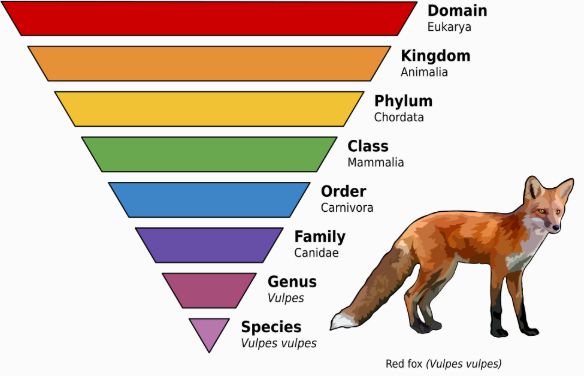
In biology, taxonomy groups living organisms by shared traits. Aristotle conceived it to organize the creatures he found in the Mediterranean Sea. The 18th-century Swedish biologist Carl Linnaeus expanded it into a system that is still in use today.
Canada’s draft green taxonomy, now in development, is intended to rate economic activities based on their perceived environmental impact. Activities that produce no ostensibly harmful emissions would be rated “Green” and thus favoured for investment. The “Transition”-rated activities — less attractive but still permitted — would emit today but be intended to lead to a greener future. The “Abatement” category would include activities that reduce existing carbon dioxide emissions.
All other activities, including projects that simply improve energy supplies or lower costs for consumers, would be rated “Excluded”, and capital markets would be expected to avoid it.
Critics warn that the proposed green taxonomy could steer investment away from Canada's resource industries.
Should governments or investors decide which projects deserve funding?
Read the full story: https://t.co/Fmu1ruJX9C
One of Wall Street’s most powerful bankers has a blunt verdict on Prime Minister Mark Carney’s push to bring Canada closer to Europe.
In January, at the World Economic Forum in Davos, Switzerland, Carney described a new world order led by resurgent middle powers, mostly European nations.
Jamie Dimon, CEO of JPMorgan Chase & Co., sees Europe’s record very differently. Speaking at a Council on Foreign Relations meeting earlier this year, he said Europe’s GDP relative to the U.S. has fallen from about 90 percent to 70 percent. He blamed heavy regulation and high taxes, along with weak capital formation and anti-business policies.
The gap is growing, and U.S. GDP this year is estimated to be 42 percent greater than the EU’s. Carney is still pursuing closer ties. Last month he and the president of the European Commission promoted the idea of Canada becoming an “associate” member of the EU, and a recent Leger poll found that most Canadians support it.
Dimon called Carney’s idea of middle powers banding together “a fantasy,” adding, “They did that, it’s called Europe.”
Dimon’s warning raises the question of whether binding Canada’s economy more closely to the EU would mean importing Europe’s aggressive climate policies and, along with them, its self-imposed economic decline.
Should Canada look to Europe or the U.S. as its main economic partner?
Read the full story: https://t.co/Fmu1ruJX9C
The European Union produces far less of its own energy than it did a decade ago.
The EU has become known for high energy costs, which critics blame on aggressive net-zero policies and carbon “pricing”. They also point to heavy regulation and the intermittency of wind and solar power.
Eurostat, the EU’s statistics agency, reports that EU industrial production fell 2.3 percent year-on-year in 2024, while the capital goods sector fell 7.5 percent. The EU’s energy-intensive industries, including vehicle manufacturing, chemicals, steel and fertilizer, have lost ground to competitors that have cheaper power and lighter regulation.
Eurostat data also show that the EU’s domestic energy production fell 16.5 percent between 2015 and 2024.
Some warn that Canada, a major energy producer, risks adopting the same policies as Prime Minister Mark Carney pursues closer ties with the EU, including a proposed “associate” membership.
Should Canada model its energy policy on that of the EU?
Read the full story: https://t.co/Fmu1ruJX9C
A draft rulebook meant to guide where Canadian banks and investors put their money drew a blunt warning from manufacturers this summer.
The draft Canadian Sustainable Finance Taxonomy, released in July 2026, would classify economic activities as “Green”, “Transition”, “Abatement” or “Excluded” to guide investors. The Canadian Climate Institute and Business Future Pathways run the project with federal funding, and this year they formed a Taxonomy and Transition Planning Council to lead it. Prime Minister Mark Carney has long promoted the idea. Speaking to a Senate committee in 2024, before he took office, he warned that “Canada risks falling behind” on the taxonomy debate.
The public comment period, which closed over the summer, drew almost 200 submissions. The Canadian Bankers Association said its members “broadly support it.” The David Suzuki Foundation also backed it, on the condition that rated businesses demonstrate strict adherence to the UN Declaration on the Rights of Indigenous Peoples. Initial reports suggest Canada’s taxonomy will be voluntary. Yet the EU’s version is legally binding.
The Coalition of Concerned Manufacturers & Businesses Canada warned that the taxonomy amounts to a “form of central planning applied to the allocation of private capital.”
Critics argue the taxonomy would make it harder for Canada’s natural resource and industrial companies to raise capital.
Should government-backed labels influence where banks and other institutional investors put Canadians’ money?
Read the full story: https://t.co/Fmu1ruJX9C
A speech Mark Carney gave as a central banker in 2015 laid out a view of climate change that runs through every job he has held since.
Before becoming Canada’s 24th prime minister, Carney served as governor of both the Bank of Canada and the Bank of England. He also worked as an investment banker at Goldman Sachs and later chaired the board of Brookfield Asset Management. He was appointed UN Special Envoy for Climate Action and Finance and later served as an economic advisor to former Prime Minister Justin Trudeau.
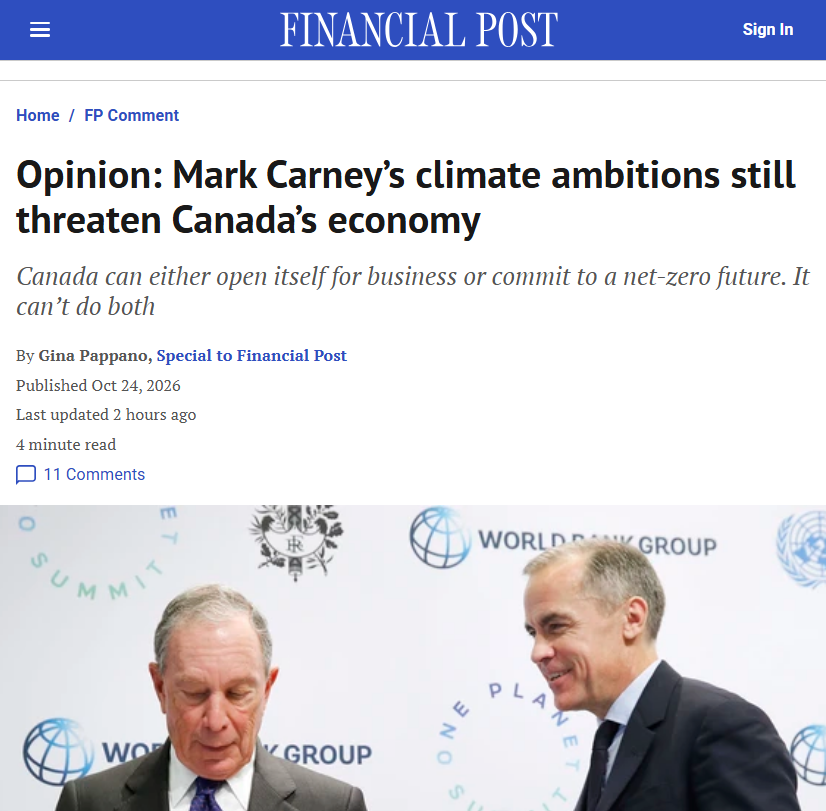
Climate has followed him through many of those roles. In December 2015, Carney and billionaire Michael Bloomberg discussed “Climate Change and Financial Markets” at the UN Climate Change Conference in Le Bourget, France. The two later created the Glasgow Financial Alliance for Net Zero, which Carney chaired while serving in roles at the UN and Brookfield, to convince financial institutions around the world to commit to net-zero emissions. Carney’s 2021 best-selling book "Value(s)" went on to warn of the “existential risks” posed by carbon dioxide emissions.
That view of climate change is laid out in his oft-referenced 2015 Bank of England speech titled “Breaking the Tragedy of the Horizon”, in which Carney called growth in greenhouse gas emissions “a defining issue for financial stability” and presented a “net-zero world” as the only viable path forward.
Critics argue that Carney’s long record on net zero should not be overlooked now that he is in office and should shape how Canadians view his current pro-development agenda.
Should a leader’s past positions weigh on how voters judge them today?
Read the full story: https://t.co/Fmu1ruJX9C
Some of the loudest criticism of Prime Minister Mark Carney now comes from people who once cheered him on.
In his 19 months in office, Carney has pitched himself as a builder of big projects. He scrapped the consumer carbon tax (yet he kept the industrial carbon tax). He also ended the electric vehicle mandate, which would have made it all but impossible to manufacture or market new gasoline- or diesel-powered cars and light trucks after 2035. His government has also extended timelines for or watered down the oil and natural gas emissions cap and the Clean Electricity Regulations, measures that had fallen hardest on Alberta and Saskatchewan.
The Building Canada Strong Act, now being debated in Parliament, is intended to streamline federal approvals for designated infrastructure projects, including oil and gas pipelines.
Conservative voices, including Alberta’s premier, have praised the shift. Climate groups have not. Environmental Defence accused the government of “taking a wrecking ball to Canada’s environmental safeguards and climate progress.”
The sharpest break came from a former federal environment minister, who left the Liberal caucus in May 2026 and resigned as an MP the following September.
The practical impact of these rollbacks remains to be seen, but they will shape how fast pipelines and power plants get built in Canada.
Is this a lasting change of direction, or a pause?
Read the full story: https://t.co/Fmu1ruJX9C
While Prime Minister Mark Carney talks up his efforts to get major resource projects off the ground, his government continues to advance a “green taxonomy” that will have a devastating impact on the entire resource sector.
A green taxonomy ranks potential investments based on their perceived impact on the environment. It is meant to dissuade investors from backing major oil and natural gas projects. The first state-wide green taxonomy was the China Green Bond Endorsed Project Catalogue developed by the People’s Bank of China in 2015.
Despite recent complaints from environmentalists that “New Carney” is ignoring climate change, this is not the case. Throughout his entire career as a Wall Street, executive, central banker, pundit and politician, he has consistently promoted the use of global financial networks to impose a net-zero future on the world. The current green taxonomy is part of that plan.
Carney has recently supported greater ties between Canada and the EU. Europe is a pioneer of aggressive net-zero policies and the use of a green taxonomy to redirect investment away from the traditional energy sector. The result has been cripplingly high energy costs and “accelerating deindustrialization”. Following through on Canada’s net-zero commitments, including a green taxonomy, would replicate Europe’s economic decline here.
If Canada want to have a prosperous future, the prime minister must abandon his net-zero plans and immediately scrap the green taxonomy. Carney should focus on partnerships with nations that prioritize economic growth, not those that seek to stifle it.
Read the full story:
https://t.co/Fmu1ruJX9C
To many Canadians, Mark Carney’s apparent transition from climate-change zealot to build-baby-build capitalist has been a surprising though welcome change. But is it real? Recent evidence suggests the prime minister has not abandoned his longstanding fixation with growth-killing net-zero commitments. Exhibit A is his government’s sustainable investment guidelines. Also known as the “green taxonomy”, this little-known effort seeks to label every development project in the country according to its perceived environmental impact, with the goal of directing where banks and investors are allowed to put their money – and punishing industries deemed unworthy. If not abandoned or watered-down soon, warns industry expert Gina Pappano, the green taxonomy will crush economic growth and cripple the current resurgence in Canada’s vital natural resources sector.
Read the full story:
https://t.co/Fmu1ruJX9C
"A binding green taxonomy is also a prerequisite to better ties to Europe. It is hard to imagine that the deeper economic and financial integration of Canada and the EU that Carney so eagerly promotes is possible without a merging of taxonomies. Unless both economies can agree on the same baseline for investment requirements and restrictions, they will never find common ground.
The green taxonomy can thus be seen as an indicator of the Carney government’s future plans. If the end goal is still net-zero 2050, then a green taxonomy remains a crucial step in that process. The farther it progresses, the closer we get to Euro-style stagnation and decline.
Canada can either open itself for business or commit to a net-zero future. It can’t do both." @InvestNowOrg
Mark Carney claims he wants to build.
Behind the scenes he sneaks in net-zero rules to make sure nothing actually gets built.
Same old Liberal tricks. Higher prices. Fewer jobs.
Only Conservatives will quickly approve pipelines, repeal anti-development laws, and bring home powerful paycheques for your family.