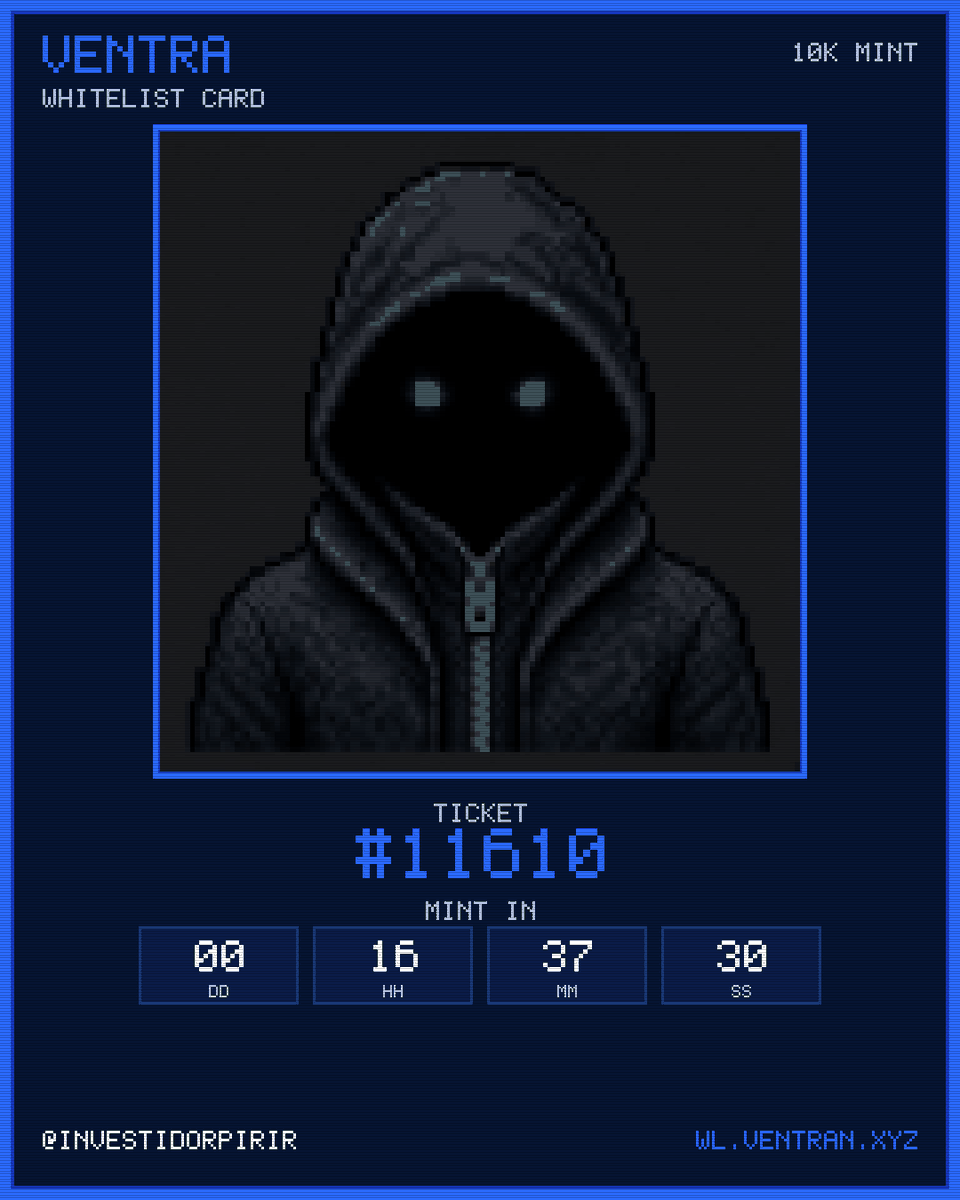
My $VENTRA allocation: 11,160 $VENTRA
Every Arbitrum One transaction I already made counts toward it. Check what you are owed:
https://t.co/IWUBuqtSE4
@ventranxyz
1111 OLIGARCAS LIVRES RELANÇADOS 🥂 📷 https://t.co/fCfyqDB3iz 📷 Mantenha . Os principais detentores no snapshot ganham GTD. > $PONZI CA: 0x62336fcFE2248a7377b534eBa1B2232043a3746A 📷 Queime um Oligarca original 777 via nosso portal para GTD. 📷
1111 FREE OLIGARCHS RELAUNCH 🥂
📜 https://t.co/va7PVRN806
✅ 2 ways to secure a GTD spot.
🪙 Hold $PONZI. Top holders at snapshot get GTD.
> $PONZI CA: 0x62336fcFE2248a7377b534eBa1B2232043a3746A
🔥 Burn an original 777 Oligarch via our portal for GTD.
🌊 777 NFT https://t.co/D2hiiY9Lyl
$ZKSL aims to solve a multi-billion-dollar problem facing the Solana blockchain.
If successful, @zkSLLabs could unlock $SOL's true potential & push it toward decentralisation.
To grasp this massive undertaking, you need to understand the problem it's solving.
————————————————————
➡️ The Problem
Validators are the lifeblood of Solana. They keep the chain alive, secure, and fast.
Usually, validators also keep the blockchain decentralized. But becoming a validator on Solana is extremely expensive.
The estimated ANNUAL cost exceeds $34M+, due to the enterprise-grade hardware required to run a validator. On top of that, this cost rises every year as Solana scales as a network. Some smaller validators operate at a loss.
Solana growing means...
Validator costs rise and...
Centralization risk skyrockets.
Overall, bad for Solana itself.
As a result, Solana's validator count dropped from over 2,500 in 2023 to under 900 in 2025, exacerbating centralization concerns, which would lead to diminished institutional inflows and could slow the adoption of Solana.
The tradeoff rn is speed for decentralisation, and the implications of this aren't good.
This is where $ZKSL comes in.
—————————��——————————
➡️ The Solution
$ZKSL utilizes zkStark proofs and a "Validator Lock" mechanism to enable "light" validation.
They claim this could reduce validator costs by 99.9%. The token model involves staking $ZKSL to validate, earn fees, and vote.
Lowering cost and using zkStarks to do the heavy lifting means everyday Web3 users can be a validator with a laptop and $5-10K.
If successful, this removes the massive $34M+ barrier to entry to become a Solana validator.
This pushes Solana towards decentralization while preserving the speed of the chain.
They recent commits on GitHub to show proof of expertise. I am just a smooth brain degen so I had ChatGPT analyze the GitHub.
Here's what it had to say:
"Yes, the GitHub shows a very reasonable level of competence. The team seems to know what they are doing: they picked appropriate languages, they put in tests, they have a solid design, and they are not just speculating — they have code."
While I am wary of anon teams, they have enough here for me to feel comfortable getting involved.
————————��———————————
➡️ Conclusion
This solution won't go out tomorrow. It will take time to implement, but it aligns with Solana's push for lowering the cost for validators.
This fixes a massive problem for Solana. They are incentivized to get behind this as it has serious positive implications for the network.
✅ GitHub shows expertise
✅ Addresses a huge market
✅ Unique narrative/technology
This has massive potential if you ask me. At only $1M MC, it is a riskier play, but if they execute, the reward massively outweighs it.
What is a project worth if it further drives the adoption of Solana by means of easy validator access and decentralization of the network?
Monitoring closely.
[ P.S. If you were watching MCG earlier, or even yesterday, you knew about this. ]
1/ Life AI Testnet is coming!
We’re opening access to the first OG members who will help shape the future of personalized, proactive healthcare.
OG Role = Exclusive benefits, early access, and special rewards throughout our journey.
Here’s EXACTLY how to secure your spot 👇
@a1lon9 is building the Everything Launchpad, and it starts with accelerating ICM first next
That’s why having Alon as a mentor for our incubator is a game changer.
Welcome officially to the DAO Alon!
Giving away 15 NFTs to those who L/R + Comment "🫵🟩"