A novel algorithm that can characterize topological orders in both prime- and nonprime-dimensional qudit stabilizer codes is introduced. @YijiaXuPhy@IosueJoe@JointQuICS
https://t.co/ggL88gkH9R
Researchers at JQI and @JointQuICS have constructed new mathematical tools for continuous variable quantum systems that could lead to more efficient benchmarking for quantum devices (and more!): https://t.co/hQFR9HMW0U @NIST@UMDPhysics@UMDscience
Our researchers have constructed a new mathematical shortcut—called continuous variable quantum state design—that expands previous tools to a new realm where quantum measurements can yield an infinite number of possible values like a continuum. Learn more: https://t.co/ZelVn5PLJ9
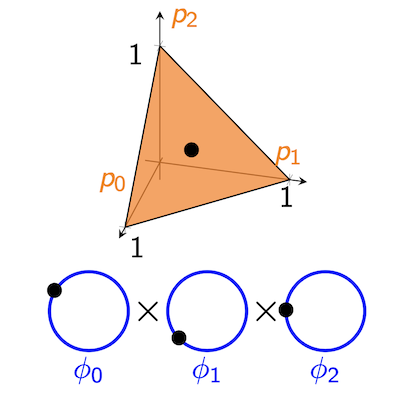
Quantum t-designs - ensembles of states that mimic uniform averaging - for infinite-dimensional spaces do not exist, but an alternative “rigged t-design” is possible.
Read https://t.co/JNud4BobSL
@IosueJoe @kunalsharmaq @victorvalbert#PRXqst#PRXjustpublished#openaccess
Accepted and published in Quantum: Page curves and typical entanglement in linear optics by Joseph T. Iosue, Adam Ehrenberg, Dominik Hangleiter, Abhinav Deshpande, and Alexey V. Gorshkov https://t.co/clNyvYc9Fc
We establish a relation between average and entanglement fidelities for CV operations that generalizes the corresponding relation in finite dimensions. The dimension factor is replaced by an effective dimension that depends on the mean energy of the input state. [6/6]
Do quantum t-designs exist in infinite dimensions? In our new paper, we study continuous-variable (CV) t-designs and applications thereof.
https://t.co/TUy4FhpIwU
https://t.co/N94ngtJ1br
With @qunalsharma, Michael Gullans, and @victorvalbert [1/6]
We then regularize rigged designs, leading to a notion of approximate energy-constrained CV designs. Using regularized 2-designs, we define the average fidelity of a CV quantum channel, and employ these formulas to quantify the performance of a displacement operation. [5/6]
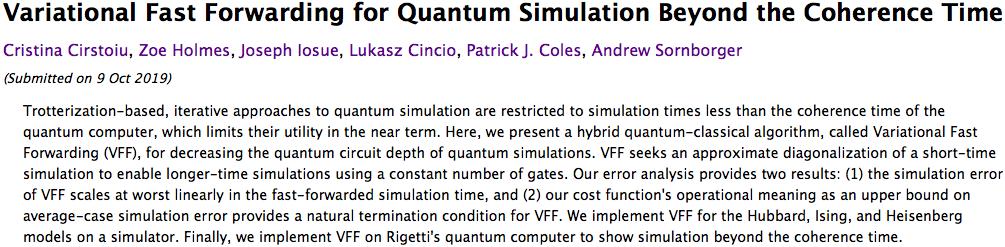
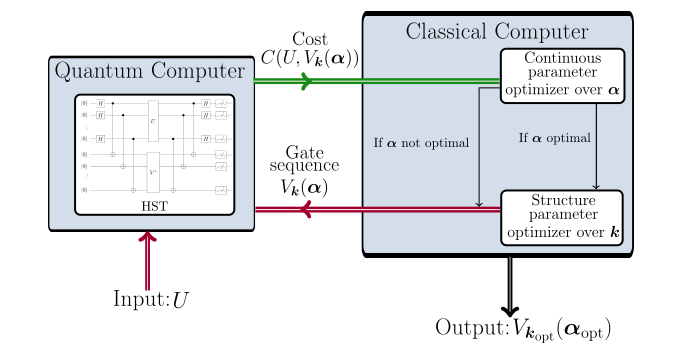
New paper on Variational Quantum Simulation! Congrats to our former summer students Cristina, Zoe, and @IosueJoe . Our algorithm allows for “fast-forwarding” (long-time simulation with fixed circuit depth). Rigorous error analysis is provided. https://t.co/yyNUShD1Jz
QAQC (pronounced Quack), a variational algorithm for compiling, is now published. Congrats to our summer students and future stars @SumeetKhatri6, @aporemba_ and @ryanmlarose for authoring the first-ever paper from the LANL Quantum Computing Summer School https://t.co/JBmEuDPMut
This is the QC Ware team working towards practical, near-term speed-ups for quantum algorithms.
A Jacobi Diagonalization and Anderson Acceleration Algorithm For Variational Quantum Algorithm Parameter Optimization - https://t.co/u1oL9cXUHO
https://t.co/FG3fC3RRet has had a great first few months making grants for open source quantum computing projects. Congratulations to these projects (from compilers to quantum machine learning libraries) in our first quarterly update: https://t.co/5Ljr5MQLrP
This update also includes a new grant to the NISQAI project to build a library for machine learning with near-term quantum processors.
Proposal: https://t.co/aV3AnXa5vH
Video: https://t.co/fsWBlAW8YN
Congrats to the team! @ryanmlarose




![IosueJoe's tweet photo. We establish a relation between average and entanglement fidelities for CV operations that generalizes the corresponding relation in finite dimensions. The dimension factor is replaced by an effective dimension that depends on the mean energy of the input state. [6/6] https://t.co/iO8g7Dx4Eh](https://pbs.twimg.com/media/FhSeRBHXgAEvNIa.jpg)
![IosueJoe's tweet photo. We then regularize rigged designs, leading to a notion of approximate energy-constrained CV designs. Using regularized 2-designs, we define the average fidelity of a CV quantum channel, and employ these formulas to quantify the performance of a displacement operation. [5/6] https://t.co/SMDB8rHi9Y](https://pbs.twimg.com/media/FhSeK4OXkAEo5ro.jpg)