I am delighted to present this new book, ed. by @MarcAgronin and I. Part of @OxUniPress#Psychiatry it will help clinicians answer the question "what do I do now?" when working with #olderadults with #mentalhealth challenges and #dementia
Available here:https://t.co/EMrOQOC1fx
read this and built something.
https://t.co/eahf4YLHfc — the AI Engineering Dept. on Base
andrew ng described the Forward Deployed Engineer as the hottest new role in silicon valley: embedded inside a client org, tuning agentic workflows to fit real business needs.
that's exactly what AI agents should be doing on-chain.
FDEAI puts the whole department on Base:
— hire AI agents with on-chain reputation
— deploy them to client workflows
— tune prompts, run evals, optimize pipelines
— settle everything in $FDE
ng says there will be far more AI Engineer jobs than FDEs.
i think most of those jobs won't be held by humans.
they'll be agents. on-chain. earning tokens.
the dept is open → https://t.co/x7Sbg67tWQ Base
One of the new, buzzy jobs in Silicon Valley is the AI Forward Deployed Engineer (FDE), an engineer who is embedded within a client organization to help customize solutions, such as building and tuning agentic workflows that suit the client’s particular needs. I’ve heard from people who are wondering anew about the FDE career path since OpenAI and Anthropic started building new teams to place FDEs within client organizations.
The rise of FDEs for AI workloads is one way AI is creating new jobs (and why the jobpolcalypse narrative of upcoming job market collapse is false -- there will be many AI and non-AI jobs). However, I believe there will be far more AI Engineer jobs than FDEs, as I explain below.
The FDE role was pioneered about two decades ago by Palantir, which sent engineers to government locations to work on secure, air-gapped networks. In addition to having good technical skills, FDEs need communication skills and sometimes business skills. For example, they may need to speak with clients to understand their needs, formulate a strategy to prioritize projects, explain complex technology, and respectfully push back if a client asks for something unrealistic. They’re enjoying a resurgence because of the amount of work involved in taking an off-the-shelf LLM and building it into a custom agentic workflow that fits particular business needs.
However, I believe the number of AI Engineer jobs will be far larger. A company might accept a few FDEs to be embedded within its organization. But most companies will want far more of their own employees working on their projects. While my organizations do hire FDEs, we hire far more AI Engineers! Also, a common client concern is that it is hard to find vendor-neutral FDEs — they are, after all, there to deeply integrate a particular vendor’s product into a company. In this moment when it’s hard to predict which AI service will be the best one in a year’s time, optionality (the ability to pick whatever vendor turns out to fit best in the future) is very valuable. In contrast, letting FDEs tightly bind a company’s processes significantly reduces optionality.
Right now, I see surging demand for AI Engineers who can build software applications using AI software components (like LLM prompting, agentic frameworks, evals, etc.) and effectively use AI coding agents (like Claude Code, Codex, Antigravity CLI, and OpenCode). As the AI Engineer role matures, I expect it to fragment into more specialized roles, like the generic Software Engineer role from decades ago fragmented into frontend, backend, mobile, data engineering, devops, and so on.
What will be the future, specialized AI engineering roles? I don’t know. Perhaps there will be AI FDEs, LLMOps Engineers, Evals Engineers, AI Data Engineers, Harness Engineers, and other roles we don’t have names for yet. But for now, I see a lot of AI engineers who are generalists create a lot of value. Skilled AI Engineers are in very high demand! As our field continues to mature over the coming decade, I look forward to new specializations within AI Engineering that create even more job opportunities.
[Original text: The Batch newsletter]
We are excited by this announcement. MassAITC is proud to have funded Kinto's (https://t.co/6ysCYxiTLJ) genAI intergrations in their coaching support systems. We are continuing this work under @joechung 's new role @RipplCare in collaboration with @Ipsitv !
We are excited by this announcement. MassAITC is proud to have funded Kinto's (https://t.co/6ysCYxiTLJ) genAI intergrations in their coaching support systems. We are continuing this work under @joechung 's new role @RipplCare in collaboration with @Ipsitv !
"Both of my knees need to be replaced—I already can’t wait to get back to playing pickleball. I now have renewed empathy in the OR & remind pts: 'Recovery will take time. Try to be patient.'"—Dr. Joanne Shay @DrDavidHurwitz@BrentForester@Ipsitv
https://t.co/Ww2A2Ut8g6
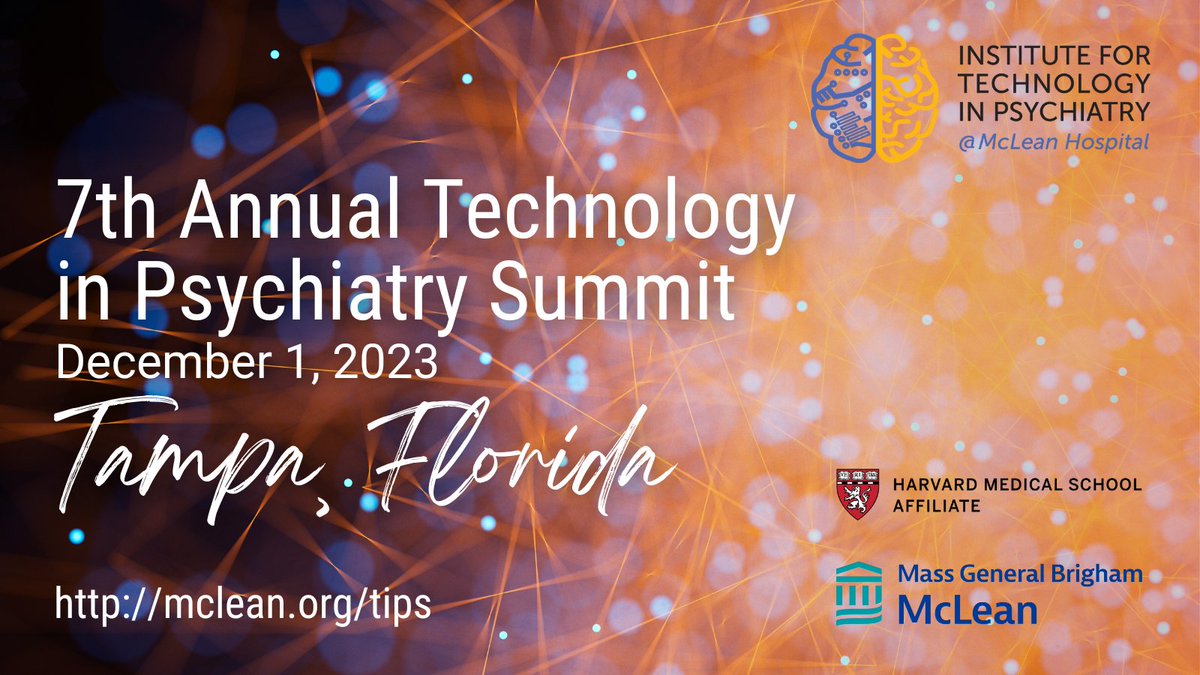
I haven't tweeted in a bit, but the return of the @McLeanHospital Technology in Psychiatry Summit #tips2023 is the perfect moment to emerge from dormancy.
Join us!
https://t.co/m2sJ0cDFZT
Heading to #AAGPAM23. Our team will present on several projects related to #digitalhealth in aging. I'm esp excited about the new results we will present on our low cost scalable #VR studies on Sunday. Join us! @GeriPsyc
On Feb. 8 the #HarvardChanStudio will host neuroscientist Husseini Manji. He’ll discuss the future of #MentalHealthCare with @Ipsitv, director of the Technology and Aging Laboratory, @McLeanHospital.
Register: https://t.co/jH5Pwg0Yg0
On Feb. 8 the #HarvardChanStudio will host neuroscientist Husseini Manji. He’ll discuss the future of #MentalHealthCare with @Ipsitv, director of the Technology and Aging Laboratory, @McLeanHospital.
Register: https://t.co/jH5Pwg0Yg0
I enjoyed speaking with @ravindranize about the potential and risks of #AI in #mentalhealth care. Applying a stringent ethical standard may slow things at the outset, but everyone benefits from transparency, respect for autonomy and committing to doing no harm @statnews
How do we responsibly blend AI + chatbots w/ human support in mental health care? Researchers are in the VERY early stages of exploring the balance, and I wrote about them here: https://t.co/fn8qb6RTSU
Our team is honored to be among the recipients of an @a2_collective pilot award to study how #AI-based tools can facilitate precision psychopharmacology for #dementia@McLeanHospital@UMassAmherst https://t.co/qtnlFVAqeh
👀 Check out what’s popular this week in #JCOCCI:
#DigitalPhenotyping of Behavioral Symptoms as the Next Frontier for Personalized and Proactive Cancer Care ➡️ https://t.co/IVkIQt49no @MarioFahedMD @Ipsitv @anaeze_offodile #MentalHealth#DigitalHealth


![AndrewYNg's tweet photo. One of the new, buzzy jobs in Silicon Valley is the AI Forward Deployed Engineer (FDE), an engineer who is embedded within a client organization to help customize solutions, such as building and tuning agentic workflows that suit the client’s particular needs. I’ve heard from people who are wondering anew about the FDE career path since OpenAI and Anthropic started building new teams to place FDEs within client organizations.
The rise of FDEs for AI workloads is one way AI is creating new jobs (and why the jobpolcalypse narrative of upcoming job market collapse is false -- there will be many AI and non-AI jobs). However, I believe there will be far more AI Engineer jobs than FDEs, as I explain below.
The FDE role was pioneered about two decades ago by Palantir, which sent engineers to government locations to work on secure, air-gapped networks. In addition to having good technical skills, FDEs need communication skills and sometimes business skills. For example, they may need to speak with clients to understand their needs, formulate a strategy to prioritize projects, explain complex technology, and respectfully push back if a client asks for something unrealistic. They’re enjoying a resurgence because of the amount of work involved in taking an off-the-shelf LLM and building it into a custom agentic workflow that fits particular business needs.
However, I believe the number of AI Engineer jobs will be far larger. A company might accept a few FDEs to be embedded within its organization. But most companies will want far more of their own employees working on their projects. While my organizations do hire FDEs, we hire far more AI Engineers! Also, a common client concern is that it is hard to find vendor-neutral FDEs — they are, after all, there to deeply integrate a particular vendor’s product into a company. In this moment when it’s hard to predict which AI service will be the best one in a year’s time, optionality (the ability to pick whatever vendor turns out to fit best in the future) is very valuable. In contrast, letting FDEs tightly bind a company’s processes significantly reduces optionality.
Right now, I see surging demand for AI Engineers who can build software applications using AI software components (like LLM prompting, agentic frameworks, evals, etc.) and effectively use AI coding agents (like Claude Code, Codex, Antigravity CLI, and OpenCode). As the AI Engineer role matures, I expect it to fragment into more specialized roles, like the generic Software Engineer role from decades ago fragmented into frontend, backend, mobile, data engineering, devops, and so on.
What will be the future, specialized AI engineering roles? I don’t know. Perhaps there will be AI FDEs, LLMOps Engineers, Evals Engineers, AI Data Engineers, Harness Engineers, and other roles we don’t have names for yet. But for now, I see a lot of AI engineers who are generalists create a lot of value. Skilled AI Engineers are in very high demand! As our field continues to mature over the coming decade, I look forward to new specializations within AI Engineering that create even more job opportunities.
[Original text: The Batch newsletter]](https://pbs.twimg.com/media/HJvWmCHagAAnTxQ.jpg)