@DefiIgnas I have mixed feelings about BTC right now.
At every bear market we hear arguments that BTC is dead, and it always survived them.
But these concerns might really slow it down one day, and quantum an Ai might create a fear while Btc is supposed to create a sense of security
@fuelkek solana:6GmAFSYs4gk3FDao5FzzySQpPZaWsa4rUJHacpMpUNgx Price being down, they are still burning a decent amount of tokens. The cheaper the Stonk the more tokens can be burned.
@richardnhsu YT and airdrop speculation can really inflate TVL by a lot! That’s why I don’t think we should compare Pendle today’s TVL with its previous top anyway
@DineroDom0 This kind of ve(3,3) tokens tend to be highly inflationary, the real advantage is swapping $up for its locked version (veUp) to earn yield or accumulate voting power.
I have seen more bad takes than I can count over the past 24h
Self custody is not scary. It’s just the usual talking heads don’t use DeFi and freak out because they don’t know what to do to stay safe
- use a multisig
- use a dedicated laptop to sign txs
- use hardware wallets bought from the official manufacturer
- don’t use telegram, signal or open pdfs on your signing machine
- spread funds across different apps and safes
- use some common sense and stay paranoid
@KookCapitalLLC From what I understand, with a smart wallet you don’t necessarily need a private key leak to compromise an account, a single malicious authorization signed by the user can be enough to give an attacker full control over the wallet.
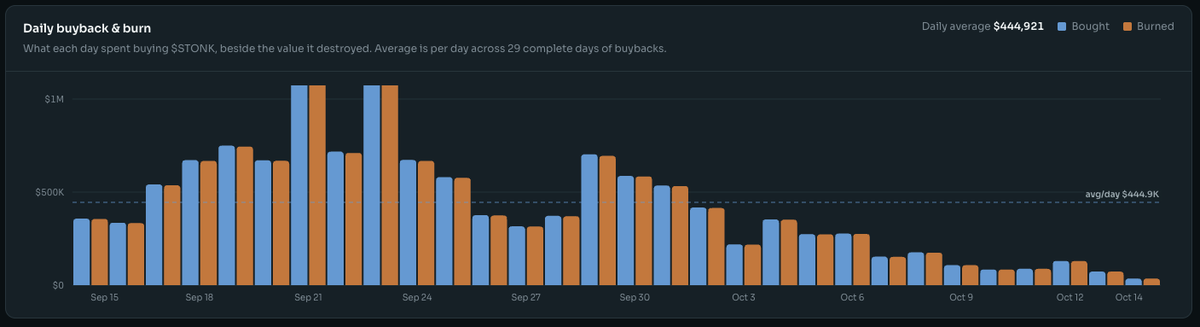
3. Now let's assume the burn rate drops by 50% from here. Even then, half of the total supply would have been burned within 2.7 years.
My point is: $Stonk doesn't need to sustain peak activity to drastically reduce its supply and maintain incredibly compelling tokenomics.
2. Even though the burn rate has slowed down significantly, it remains substantial. The protocol is still burning around 600k tokens a day on average. This is purely hypothetical, but if this rate stayed constant, the remaining supply would be depleted in roughly 3.6 years.
1. $STONK's burns and revenue are down roughly 90% from their highs.
I see people being concerned about it but let's not forget the burn rate was incredibly high and $Stonk has already burned more than 20% of the supply, most of it occurring in only 2 months.
My advice for protecting yourself if you have a large amount of money in crypto:
> Buy hardware wallets only from official websites
> For your long-term holdings, consider setting up a multisig wallet with @safe requiring to sign txs from 2 different hardware wallets (e.g. a Ledger and a Trezor)
> Add a passphrase to your hardware wallets
> Only access crypto websites via links in the projects' official X account bios (avoid Google search results, which are full of scam links)
> Consider keeping some of your funds on a well-trusted CEX too (CEXs come with the risk of freezing your funds, but using them alongside self-custody wallets eliminates single points of failure)
> Keep backups of your seed phrase in multiple locations you consider safe
> If possible, when ordering choose to ship your hardware wallets to a local carrier pickup point to avoid exposing your home address
> Don't tell many people that you're into crypto (just lie, man, and say something else, especially if you live in France, where kidnappings are common)
> Don't deposit more than 10-15% of your portfolio in a single protocol no matter how safe you consider it
All the crypto attacks that have happened over the past few months have genuinely been scary.
Do everything in your power to keep your assets safe.
@BitcoinCouteau Passer sur des stablecoins décentralisés, je serais pas étonné qu’avec ce genre de mesures ils aient un peu plus la côte qu’aujourd’hui.
Ou sinon, pas idéal mais pourquoi pas prendre ses profits en or tokenisé.
@richardnhsu I am wondering if the huge 20x difference between the Mcap and FDV is scaring people away. But from what I can see, around 45% of the supply has been burned or permanently withdrawn from the market, and about 84% of the remaining supply is locked as veUP. Seems pretty good to me
I'm amazed that people are still defending Accountable.
Dozens of millions of dollars have been lost because people trusted Accountable's NAV dashboards, which proved to be totally useless.
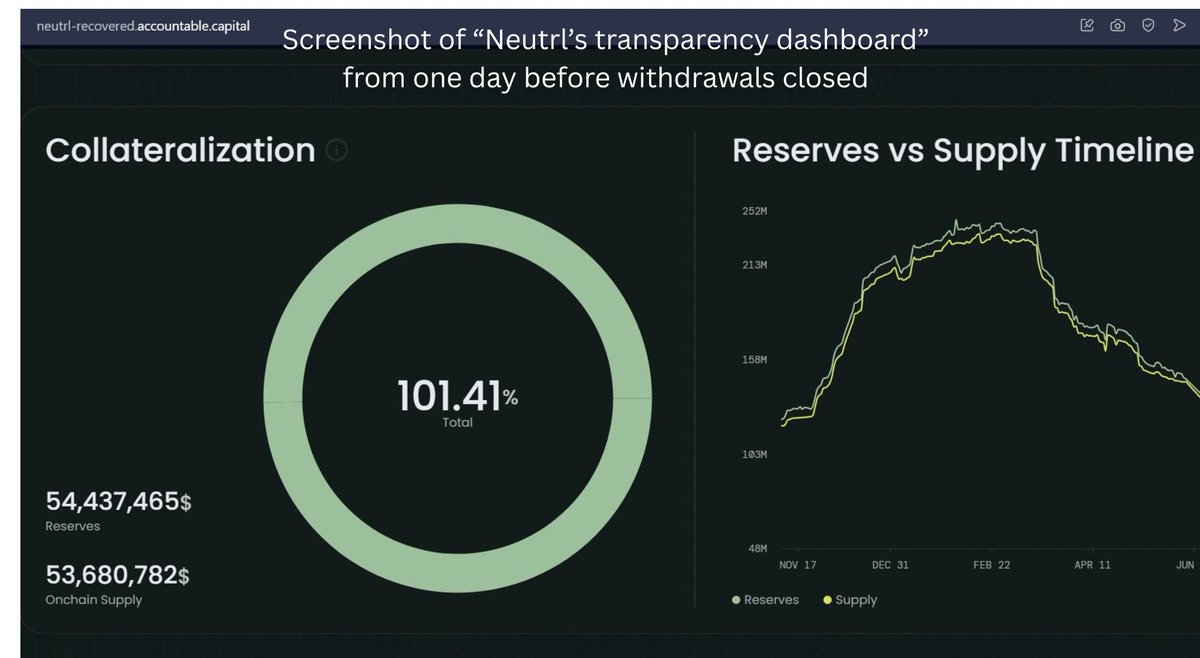
The clearest example of Accountable's incompetence is Neutrl's case.
Just 1 day before Neutrl suspended withdrawals, Accountable's Neutrl dashboard was still showing the protocol as overcollateralized.
Then Neutrl revealed that users were facing a ~49% loss.
Think about how insane that is.
People were relying on a "transparency dashboard" that suggested the protocol was fully backed, only to find out a few days later that nearly half of the funds were gone. 🤡
If this is not a sign of gross incompetence, I don't know what else to say. By the way, Accountable never said sorry to the users who lost money trusting it.
And I keep seeing the argument that "it's not Accountable's fault that protocols aren't willing to be fully transparent with Accountable"
I completely disagree.
If a protocol doesn't give you enough information to independently verify its assets, don't put your name on a verification dashboard that gives users the impression everything is fine.
You can't market yourself as a NAV verification provider and then blame the project's lack of transparency when it blows up.
That's literally the problem you're supposed to solve.
I agree that crypto needs a reliable verification solution.
But Accountable is not it, and it's unfortunate that so many projects (including some good ones) keep working with Accountable.
If you're a DeFi user, my advice is simple:
Don't assume a project is fully collateralized just because it has an Accountable verification dashboard.
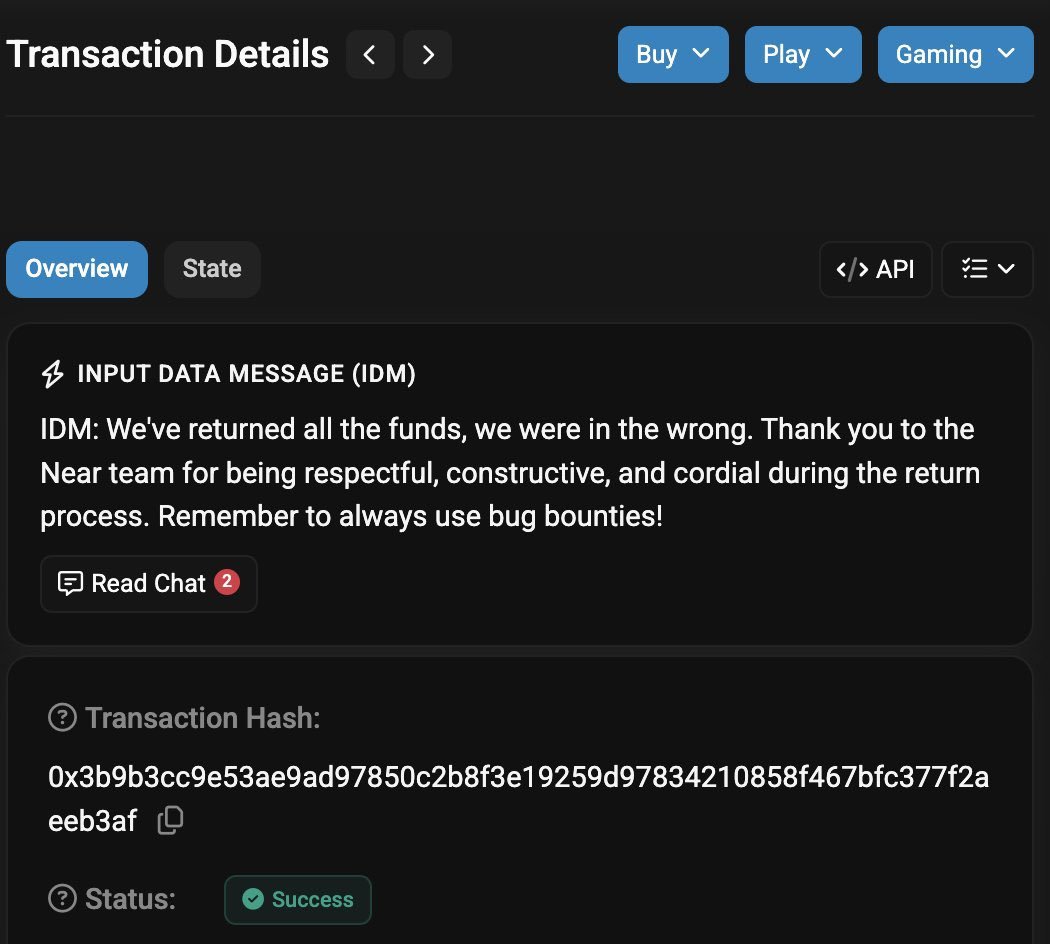
🚨 Le hacker qui avait volé 3,8 millions de dollars à Near Intents a rendu l’intégralité des fonds après avoir été identifié par l’équipe.
Quelques heures plus tôt, Alex Shevchenko, directeur général de Near Intents, lui avait lancé publiquement un ultimatum de 48 heures en affirmant que son identité avait été retrouvée.
L’exploit provenait d’un bug dans l’infrastructure de dépôts et retraits Omni utilisée avec le smart contract Near Intents.
Le hacker a finalement renvoyé 100 % des fonds avant la fin du délai. Dans une transaction on-chain, il a même laissé ce message :
« Nous avons rendu tous les fonds, nous avions tort. »
L’équipe affirme avoir récupéré la totalité des quelque 3,8 millions de dollars et avoir mis fin à son enquête.
@DefiIgnas Compared to the Mcap, the holders revenue of this project is still really high, even compared to other project with high buyback/burn rates. I am really curious to see if this will reflect on the price despite the fud going on.
@AZKCrypto Perso je suis sur Raycat qui permet d’accumuler du Ray en holdant. On doit être autour de 150% APR.
D’ailleurs je me demande si la pool Raycat/Ray redistribue les Ray issus de ce même mécanisme, parce qu’elle est particulièrement rentable!