A stunning 50% of Americans see China as the greatest threat to America. Agree or disagree, like it or not, support it or hate it, this is our reality. Businesses, Investors, regulators, elected officials, everyone needs to understand and discuss this.
https://t.co/iZtHYul7sw
NEW: We got a private SpaceX investor list, from way before the IPO.
It's a rare window into a delicate issue for Musk: which investors in countries like China got stakes in SpaceX, and how.
One investor has ties to Chinese military contractors.
https://t.co/Oja4U8MmaP
“We’re talking about a vast espionage machine by China,” said I-Chung Lai, the president of Taiwan’s Prospect Foundation, a thinktank. Read more, incl. on why some PRC spies seem amateur w/ poor tradecraft but that's not a reason to downplay it: https://t.co/k7hORbMSmS
Two big stories about DeepSeek in the United States. Reuters just reported that the Department of Commerce's influential Bureau of Industry and Security has held off blacklisting DeepSeek -- even though an interagency committee held it to be a national security risk.
Meanwhile, Microsoft is reportedly considering hosting DeepSeek on its platform, as a cheaper alternative. What does this mean? Well, at some point, the U.S. national security establishment will punish a key U.S. defense contractor for their ties to China. Perhaps it will be one of the primes, or perhaps it will be a tech company like Amazon or Microsoft. Companies need to carefully price out the risk of their China exposures, to determine what level of partnership with Chinese entities is worth the risk of inciting the ire of various arms of the U.S. defense and security establishment.
Min Zin went to the PRC because he was invited. He was arrested for engaging in "espionage activities." He was not a spy, and as a US citizen obviously without access to classified PRC info. So, basically, for Beijing, espionage is "analysis we don't like" wherever it is done. Min Zin thought it was important to engage, and this is what it got him: a wrongful detention that @StateDept won't declare.
"Research is Not a Crime" https://t.co/olcw5sCkJN
"Trump's approach is undercutting efforts by traditional allies, led by Europe, to present a united front against China and its flood of cheap exports that are swamping Western markets" via @_AriHawkins@drdesrochers@politico https://t.co/b8d0aPzWJI
The Hidden Front
Spies, screens, and shadow networks in the U.S.-China-Taiwan contest
This edition focuses on the quieter edges of the China-West-Taiwan rivalry, where espionage, technology, and supply chains increasingly overlap in plain sight. From Taiwan’s new tip portal to Beijing’s rebuttal of Five Eyes claims and the Jupiter Systems case, I see a shadow contest moving through websites, vendors, and civilian networks rather than only traditional state channels.
https://t.co/L2X0tC61Zn
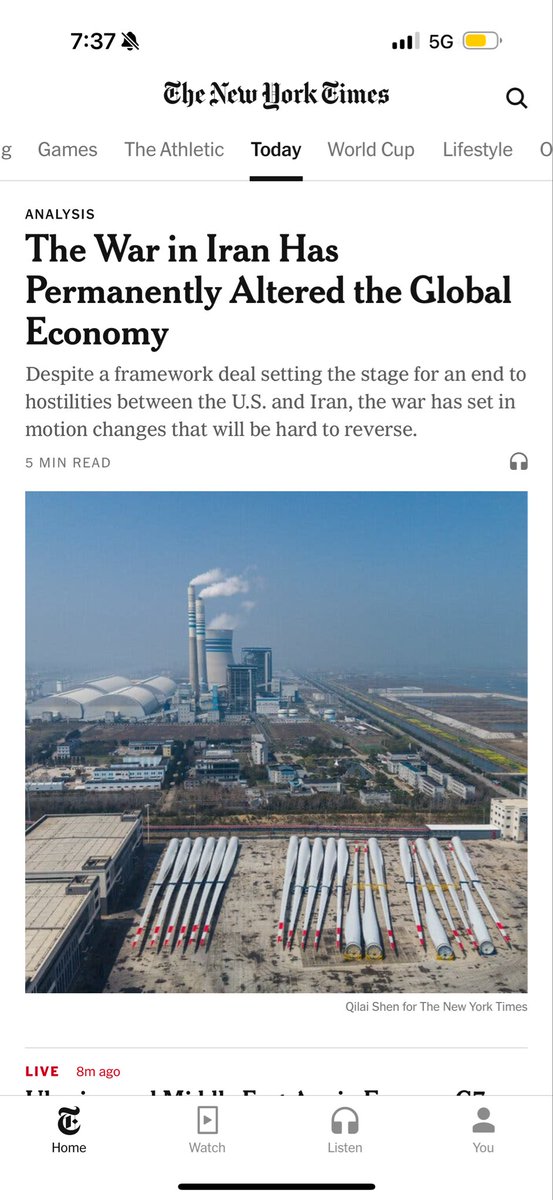
The hubris on this New York Times headline is astounding. How do we know it’s permanent? It just happened.
Not only that, but the next sentence immediately contradicts the headline. If the changes are “hard to reverse,” they’re not necessarily permanent, because they are possible to reverse.
While the world's focused on China's rise, Japan has been quietly boosting its own strategic importance in Asia — and becoming the Indo-Pacific's most trusted power. My talk with @RobertAlanWard of @iiss_org. ⬇️ Clip below and full video in replies.
In 2020, a Beijing-based company called Suirui bought Jupiter Systems, a California manufacturer of TV walls for the U.S. military. How did a Chinese company buy a U.S. defense contractor? We found out. Story with @rachel_cheung1
"Taiwan's government launched a website on Sunday to encourage Chinese nationals to report intelligence tips, saying it was offering a secure channel to what it says is an increasing number of people who are fed up with the system and want change."
https://t.co/Sawi6bWUys
Hi @UCBerkeley,
Your PhD candidate U Min Zin runs what is perhaps the world’s leading Burma-focused think tank.
He is a credit to your school doing cutting-edge, open-source research, but is now wrongfully detained by the PRC.
Is “thoughts” really the best you can do? 👇
Try harder.
Is It Ethical to Cooperate with Chinese State Institutions to Secure Incremental Change?
As democratic governments, universities, and civil society organizations around the world consider how to work with Chinese state institutions, this debate explores a challenging question: can cooperation create meaningful change, or do some compromises carry too great a cost?
Watch our live debate from the @OsloFF 2026, produced in partnership with @HRF.
Arguing Yes: @joannachiu, Managing Partner of @nuoraglobal; Author of "China Unbound"
Arguing No: @isaacstonefish, CEO and Founder of Strategy Risks
Moderated by @JohnDonvan
This is a major story, and one that's not getting the attention it deserves. Per @henrysgao, this is probably the first time that Beijing has sanctioned a sitting minister of another country (outside of Taiwan), and it represents a serious escalation of tensions between China and the U.S. treaty ally the Philippines.
You won't find a bigger critic of Alibaba than me, but it's only fair to note that this was in 2014--and more recently, in March 2026, Jay Clayton brought the massive indictment against the Super Micro cofounder for smuggling AI chips to China.
Trump’s new pick for Director of National Intelligence Jay Clayton was a key lawyer who helped the Chinese tech company Alibaba IPO in the U.S. and raise billions from American investors. This week, the Pentagon designated Alibaba as linked to the Chinese military. Discuss.
My colleagues and I just published a new report on U.S.-China AI competition, taking a holistic view of AI leadership. We argue that the competition is about more than who has the best models and chips. It's a contest of energy, data, talent, capital, industrial capacity, diffusion, and national resilience.
The U.S. remains ahead in frontier model development and advanced compute deployment, but China's deep bench of AI engineers, low-cost models, control over critical nodes in the hardware supply chain, vast energy infrastructure, and aggressive push to diffuse AI make it a formidable competitor.
Beijing has arrested a U.S. scholar "on suspicion of conducting espionage and endangering China’s national security,” in a move that will likely complicate this post-summit thaw. The American, Min Zin, was born in Myanmar -- many if not most of the more than dozens of Americans citizens the Chinese Communist Party is currently detaining were born in other countries or have Chinese heritage. The Party tends to assume (hopefully wrongly) that Americans and the American government won't care as much about Americans with different backgrounds.
By opening the center, Microsoft “appears to be aligning itself with a longstanding CCP priority, which is the globalization of high-tech Chinese companies.” Quoted in this article.