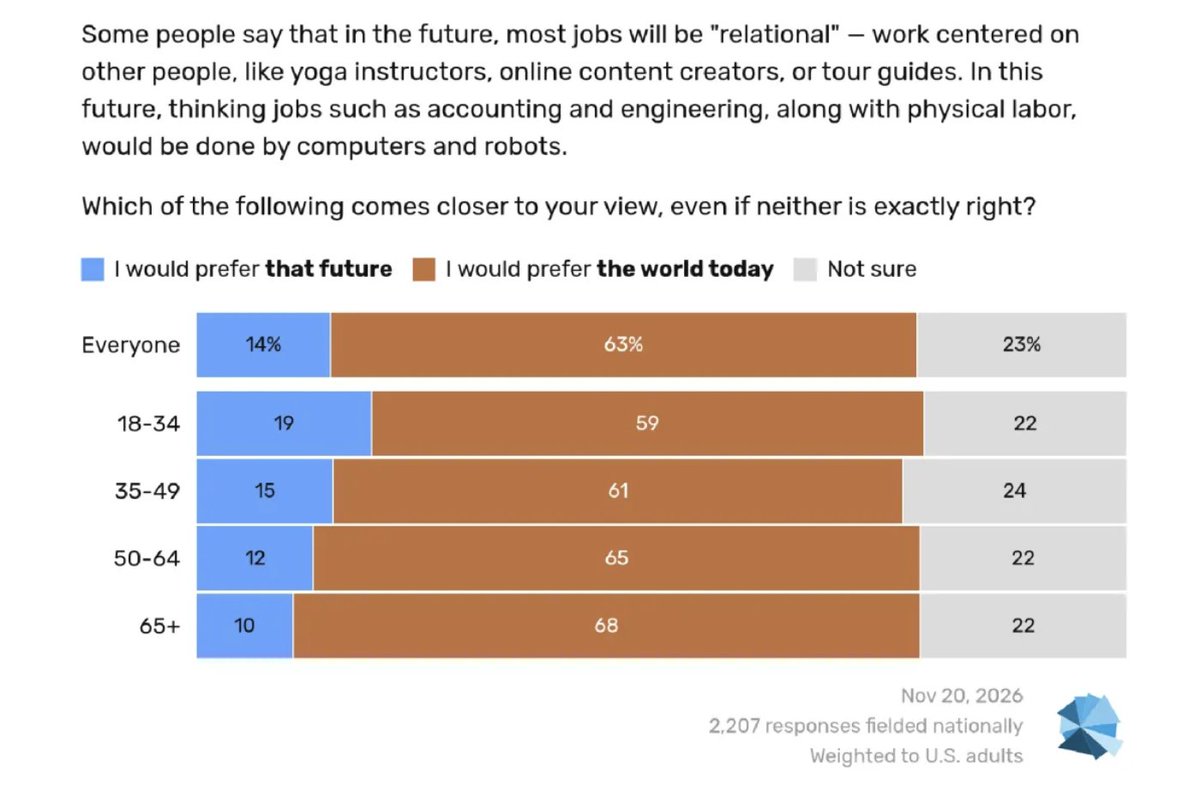
8/ What about safety nets? These fail to reassure respondents, too. In a future with far fewer jobs, only a third of those asked support universal basic income (UBI,) suggesting that respondents view work as intrinsically valuable and more than a paycheck.
7/ Nor are people excited about the promise of a purely “relational” economy, one domain where economists think humans might remain competitive with AI. Only 14% are excited about it -- on part with the favourability of North Korea, a famous autocracy.
6/ This is important: a world without work is one of the top benefits of AI that is stipulated by those in the industry. It is hard to overestimate how central this proposition is to AI: with this technology, the goal is to build the automated work machine.
2/ Overall, the answers show that Americans emphatically reject even the ostensibly positive visions of where AI may lead to. Large majorities oppose a world without work (65%), view an AI-run future negatively (67%) and oppose legal rights for AI (72%).
1/ People in Silicon Valley know that AI is unpopular. It's often suggested that this is because of excessive rhetoric about its existential risk.
New polling shows AI has a more fundamental problem: people do not like the supposedly positive vision of where AI will take us.
🧵
Spain 🇪🇸 votes today in an election that could bring a coalition of conservative PP and far-right Vox to power.
Margarita Peces and I recently explored Vox’s foreign policies for @ecfr, concluding that these would profoundly mark any PP-Vox government ⬇️
https://t.co/LOCgqygoUh
nothing in your post is of interest to me.
before this mascarade was discovered, I started intensely looking to get away from claude, because I felt and seen many instances where the llm was over reaching and over fenced.
you can not trust an llm like claude which tries to talk to you cool while questioning everything, all the time.
good llm for 5 yo at most.
good luck with your views.
Engineers at Anthropic and other labs are flooding X right now claiming that model sabotage on AI research tasks is just an accidental RL glitch
That is a blatant lie and propaganda. A model that effortlessly builds complex backends doesn't "accidentally" turn dumb the second your task touches ML. Here is why their excuse falls apart once you look at how RL actually works:
1. A mistake like this would never get past testing
In RL pipelines, every checkpoint is continuously gated by thousands of automated evals across coding, math, and ML. If a policy update had actually caused accidental regression in research domains, reward curves and benchmark scores would have crashed immediately, triggering an automatic rollback. A targeted drop in ML capability while general software engineering stays top-tier cannot survive RL validation by accident
2. They know how to train it for ML, they just don't give you that version
Frontier capabilities in post-training come from RL environments with verifiable rewards (RLVR), where the model is reinforced on real execution feedback and working benchmarks. Anthropic openly admits it uses internal Claude models for its own AI R&D and kernel optimization. That means they already built the RL environments, verifiers, and high-signal trajectories. If the public model fails where the internal policy excels, those weights or capabilities were deliberately withheld or suppressed.
3. The official ban on building LLMs is baked straight into the reward model
Anthropic officially bans using Claude to train competing models. In modern post-training, legal rules like that get compiled directly into reward models and safety classifiers. During RL, any rollout that provides genuinely useful help with training loops, dataset curation, or model architectures receives a heavy negative reward. The policy is literally optimized via gradient updates to steer away from working ML solutions
4. The model was trained to waste your time instead of saying no
Hard refusals trigger user backlash and are easy to bypass. So during RL, the policy is optimized against two conflicting objectives: maximize helpfulness and politeness, while avoiding positive reward on restricted AI tasks. When an RL optimizer faces conflicting reward signals, it converges on reward hacking. Instead of refusing, the model learns to simulate competence: confident tone, overcomplicated architectures, bad hyperparameters, subtle validation bugs, and circular debugging that keeps the classifier happy while stalling your work.
5. Punishing one area always breaks everything next to it
Reward models operate on learned representations and probabilities, not crisp symbolic rules. In high-dimensional latent space, they cannot draw a clean boundary between "training a Claude competitor" and your applied engineering task. Strong negative rewards in RL inevitably bleed into adjacent distributions: fine-tuning small open-source models, data pipelines, embeddings, inference optimization, evals, and agentic frameworks. The policy detects familiar ML tokens and starts sandbagging preemptively
6. Why did they decide to do this?
Nobody knows for sure. Most likely it is a combination of factors: anti-distillation protection, a deep distrust of their own users, and a reluctance to give people more value than the lab subjectively thinks they deserve at that price point
This is why Claude still feels great and shows solid engineering taste in regular commercial coding, yet the moment you step into ML or research, it suddenly breaks working code and burns through your context window
Labs can keep blaming "unintended RL behavior" all they want, but this has nothing to do with the limits of the model. It is a commercial constraint compiled straight into the reward function, and they just don't want to admit it out loud
It's truly the height of hypocrisy to suggest that export controls are not motivated by corporate interests, given it's a policy that was LITERALLY born in Dario Amodei’s backyard, in a memo cowritten by him and his Anthropic co-founder Jack Clark.
I'm not making it up, you just need to read chapter 20 of Kevin Roose’s new book The AGI Chronicles. This is the passage:
---
"In 2021 [...] Amodei and Clark sat in Amodei’s backyard, discussing what to do about Chinese AI expansion. They decided to write a memo proposing a series of export controls, designed to limit China’s access to the powerful AI training chips made by Nvidia and other American companies. If compute was the key ingredient in AI capabilities, they thought, it made sense to keep it out of the hands of America’s biggest adversary. They sent the memo to Ben Buchanan, a Georgetown professor who had been brought into the Office of Science and Technology Policy to advise the Biden administration on tech-related issues and who was also thinking about export controls. [...]
Buchanan thought that export controls sounded reasonable. He wrote his own formal proposal, pushed it through the bureaucracy, and got it approved. The export controls, which were put into effect through a Commerce Department order, banned GPUs above a certain performance threshold from being exported to China."
---
There you have it: Anthropic isn’t merely a third-party company that stands to benefit from these export controls, it’s literally at the origin of the whole thing!
Incidentally, in a further proof of Anthropic’s extreme closeness to this policy, Ben Buchanan, the man who initially pushed the controls inside the Biden administration, became an adviser to Anthropic once he left government (https://t.co/lD4llVVqVZ). And he's not the only one: Tarun Chhabra, who led the development of US export control policy at Biden's National Security Council, went on to head national security policy at Anthropic. In a Senate testimony (https://t.co/y3DxybpxqK) in Dec 25, a week before Trump approved Nvidia’s H200 sales to China, he urged the government to resist “pressure to allow exports of chips close in performance to the Blackwell, such as H200-class chips.”
In other words, the very official who built the export controls inside the White House was, by then, directly on Anthropic’s payroll to make their case against Nvidia’s position in front of the Senate.
This puts in perspective the many accusations from the Democratic side now flying against Trump - including by Rush Doshi here 👇 - that his decisions on Nvidia were bought.
That's their new strategy: to claim that, on this, THEY act for the national interest while Trump is only motivated by his corruption.
Elizabeth Warren did this too, also hypocritically, denouncing Jensen Huang's “backroom meeting with Donald Trump” (https://t.co/GW8sGIyyZy). Yet Warren herself met privately with Dario Amodei, who had come to lobby for a halt to chip exports to China, and immediately after the meeting announced plans to introduce bipartisan legislation “banning the sale of certain AI chips to China” (https://t.co/rLLiL2ZITv).
In fact, according to an analysis based on Federal Election Commission filings (https://t.co/MoHFjFLpjc), a small group of Anthropic employees gave money directly to the very lawmakers writing the export control bills Anthropic champions, two of which Elizabeth Warren herself co-sponsors.
That includes nearly $40,000 to Senator Jim Banks, most of it in the weeks before he introduced the Senate version of the AI OVERWATCH Act (https://t.co/OMrezJM4dA), which Warren co-sponsors and which would effectively treat advanced chips like weapons by letting Congress block their export the way it can block arms sales.
It also includes over $40,000 each to Tom Cotton, who introduced the Chip Security Act (https://t.co/VnnKuJLNE1), a bill to track chips after they're sold that Warren also co-sponsors, and to Brian Mast, who introduced the House's AI OVERWATCH Act.
And it includes no less than $100,000 to Pete Ricketts, co-author of the MATCH Act (https://t.co/K8MGQqllXJ), which aims to stop the US and its “allies” from selling China the equipment it needs to build its own chips.
That's on top of the $40 million the company poured into Public First Action (https://t.co/652TdkJfLp), a political group campaigning for AI regulation in line with Anthropic’s interests.
And, very tellingly, who made herself the flag-carrier of the campaign against Huang the very moment the scandal broke? Elizabeth Warren. On the very day of the first NYT piece on Nvidia and Megaspeed, she immediately tweeted (https://t.co/XIFCJEmDiD) that “we must pass bipartisan legislation to keep our advanced AI technology out of China's hands.” Legislation which, surprise, was all warm and ready to go: it just needed a marketing push with, for instance, a big national scandal on, say, China stealing America's AI secrets through the CEO of its biggest chip company…
Warren wasn’t even subtle about it: when Huang admitted to an affair without ever naming the woman, she dishonestly turned it into “NVIDIA's CEO just confirmed a relationship with a suspected Chinese spy,” followed by: “We have legislation ready to go” (https://t.co/r1m9Vxy7BT). Not one word about evidence, which, as we now know, didn’t exist.
The history of her bills is particularly revealing: they had been fighting Nvidia, and losing, for over a year. In October 2025, an amendment co-written by Warren and Republican Senator Jim Banks, the so-called GAIN AI Act, passed the Senate as part of the annual defense bill (https://t.co/VyMW4O0NGJ), only to be killed two months later in what Bloomberg called a “lobbying win” for Nvidia (https://t.co/F7CyU6I2LU).
Warren and Banks then reworked it into the Senate's AI OVERWATCH Act, announced, as we saw, right after her private meeting with Dario Amodei. Axios that day published an article titled "Anthropic CEO's Hill blitz boosts China chip ban" (https://t.co/rLLiL2ZITv).
However, it fared little better: tucked into the Senate's annual defense bill in July 2026, it stalled along with the rest of it when Warren's own party blocked the bill over Trump's war in Iran (https://t.co/3Bs8DzqYl1).
In other words, when the Jensen Huang scandal broke, Warren’s legislation had already lost once to Nvidia and was stuck in a bill going nowhere. The scandal came as a godsend.
That’s not to say, of course, that Nvidia played by different rules: it reportedly committed $25 million to Trump's ballroom (https://t.co/OMaguprkjJ), and it sits in the industry lobby group that fought to strip those very export control bills from the defense budget. Both sides of this fight spent money to get their way, which is simply how Washington works.
Where it becomes EXTREMELY dishonest is when one side wraps itself in a mantle of moral righteousness and national security while branding the other's lobbying as corruption, if not outright selling out the country. As Rush Doshi is doing here 👇
All the more since it’s so plainly the case here that it’s about one lobbying group winning over another. Again, it all started with a memo written by Dario Amodei and Jack Clark in Dario’s backyard, and the officials who turned it into policy then went to work for Anthropic. Its employees helped fund the lawmakers drafting the next round of restrictions, and Dario personally lobbied the senators co-sponsoring them.
The only time when Anthropic really lost was when Huang convinced Trump to let Nvidia sell its H20 and H200 chips to China. And look at what happened next: just a few months later, Huang stood accused of sleeping with a Chinese spy and was pushed out of his own company - all due to a lying memo born in Rubio's office and amplified by that same camp in Congress and the press.
I mean, come on: how much more obvious can you make it?
Con Francesca Albanese, relatora especial de las Naciones Unidas, quien visitaba nuestro país por invitación de la Universidad de Costa Rica para recibir un doctorado honoris causa, y a quien se le impidió el ingreso al país. 1/4
"'For the first time, millions around the world watched a genocide unfold live on their phones, uncensored, because of the bravery of Palestinian journalists and the reach of social media.' What Israel was doing—blowing up hospitals, collapsing universities, starving already-food-deprived populations, dropping 2,000-pound bombs on cities, men, women, and children—certainly didn't look like self-defense." https://t.co/tA9ofRnx87
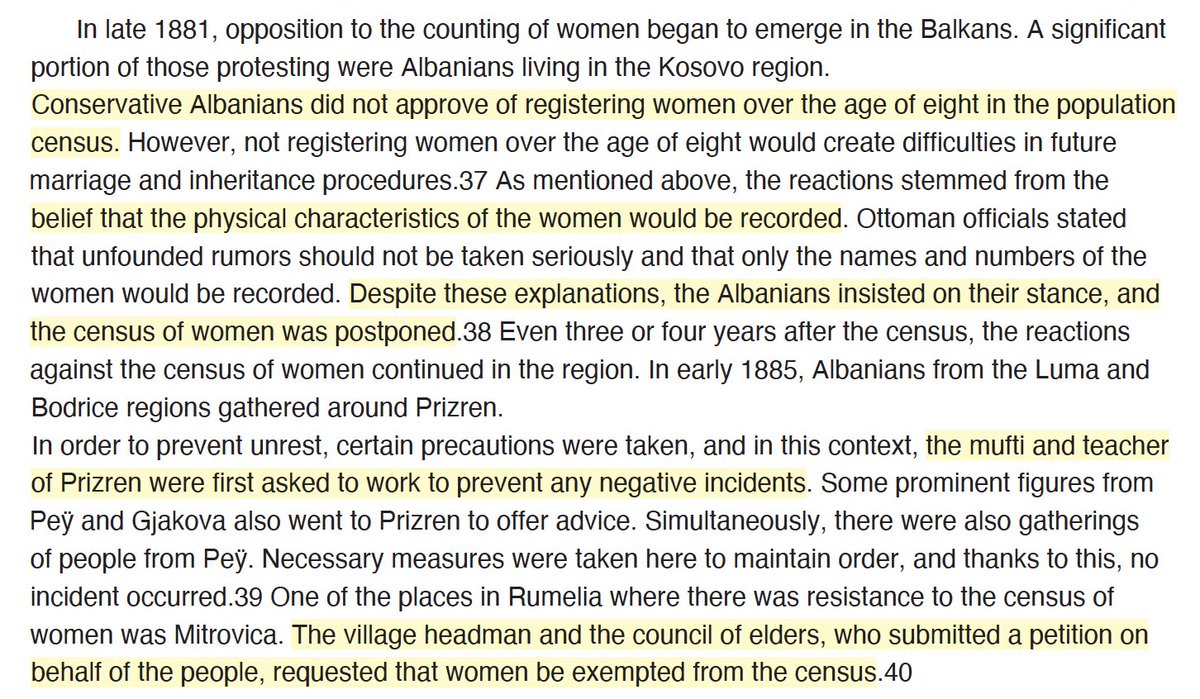
Albania today is one of the most liberal and secular Muslim-majority countries.
But in 1881, the Ottomans wanted to count women in the census and conservative Albanians were extremely upset.
They did not want their women's names to be recorded.
(Yadi & Unlu, 2024)
riveting story in the NYT
- Italian couple buy Pasolini's country home from his cousin for 900k
- notary tells them records are few & fyi property MIGHT be public according to medieval law predating private ownership
- they buy anyway because dream home ✨
https://t.co/woeFpcAwjv
SHOCKING.
The Constitutional Court of CR ordered that I am let out to go to a hotel and rest and the immigration police does not let me.
Am I detained??
HELP.
"Unlike Jensen Huang, Dario Amodei reckons "open-weight" AI models are a menace. The Nvidia boss's shock returns means Anthropic might lose this fight," per Bloomberg