Crypto payments funding grew from $105M in Q2 2024 to $685M in Q3 2026
It’s literally 6x growth, but where it is happening in the cycle is even more interesting.
Overall investor activity has cooled since 2025, yet payments still ranked:
→ #1 by deal count with 30 rounds.
→ #2 by capital raised with $685M.
The largest rounds were:
→ @augustus_bank: $180M
→ @Felixpago: $87M
→ @fasset: $68M
→ @yellowcard_app: $40M
→ @VelocityDEX: $38M
→ @hifiHQ: $37M
→ @rtp: $35M
Several of the biggest deals were Series B or C rounds.
That suggests capital is moving beyond early payment experiments and into companies that already have products, users and distribution.
My best guess for the strongest part of this trend:
Stablecoin-based cross-border payments, especially B2B settlement, remittances and treasury flows in emerging markets.
These markets already have clear demand: expensive transfers, slow banking rails and limited access to dollars.
But I do not think every "crypto payment" token will benefit.
The real winners will likely control at least one difficult layer:
→ Local licenses and banking access
→ Fiat on/offramps
→ FX and stablecoin liquidity
→ Merchant or business distribution
→ Compliance infrastructure
if i were positioning around this theme, i would focus less on generic payment tokens and more on projects with measurable volume, revenue and strong regional distribution.
Felix Pago, Yellow Card and Fasset are names i would keep tracking from this funding list.
My highest-conviction sector bet remains the infrastructure connecting stablecoins to real businesses and local financial systems.
That is where i expect the most durable value to accrue this cycle.
SINGAPORE WAS LOUD
#Token2049 had the usual flood of announcements but @Bitroot_ took a different route: a keynote on the machine economy, a booth at Marina Bay Sands, and two side events in two days.
I wanted to know what all that visibility was actually building toward. 🧵
DTCC’s $114T custody base makes @CantonNetwork impossible to fade
to be clear, that figure is DTC’s total custody base. It is not capital already deployed on #Canton, and DTCC is pursuing multiple networks.
What caught my attention was the actual activity: DTCC’s July production trades included collateral pledges, securities lending, Treasury repo and margin workflows.
Those are services institutions already use and pay for.
From a macro perspective, i care about funding costs and liquidity.
If a firm can finance securities faster or deliver collateral when it needs to meet margin, tokenization has a measurable financial use.
There’re evidences that make Canton too big to ignore:
– @Broadridge DLR: $351B average daily repo volume; $7.4T monthly volume.
– @The_DTCC: production transactions with 30+ participating firms.
– @Rho_Labs: reported trading history, its website reports $60B+ cumulative trading volume.
– Network activity: growth still needs proof, CCView reports 35M transactions, −0.7% MoM, and 456,173 active parties, −1.7% MoM.
Three Canton projects I’m looking at:
→ Broadridge DLR - repo financing
DLR runs on Canton and processed $351B in average daily repo transactions in August.
I find this compelling because the usage is already there. That number is transaction volume, though, so i wouldn’t treat it as TVL or app revenue.
→ @AlpendHQ - native lending
Its live markets support CC, USDCx and CBTC.
I’m curious whether it can build sustained borrowing demand and eventually support more institutional collateral. Its current asset list gives me a concrete starting point; access to DTC securities still needs to be demonstrated.
→ Rho - funding-rate markets
Rho offers funding-rate futures and uses Canton for private settlement records.
I like the financing angle: traders can hedge variable funding costs. I want to see repeat demand for that service as onchain trading grows.
I’m interested in #Canton because these products address specific financial needs.
My next checks are collateral eligibility, repeat counterparties, outstanding loans and fees earned.
and if i’m evaluating a token, i need to see how those fees reach holders.
The custody headline gets my attention. Actual financing activity is what would build my conviction.
DYOR.
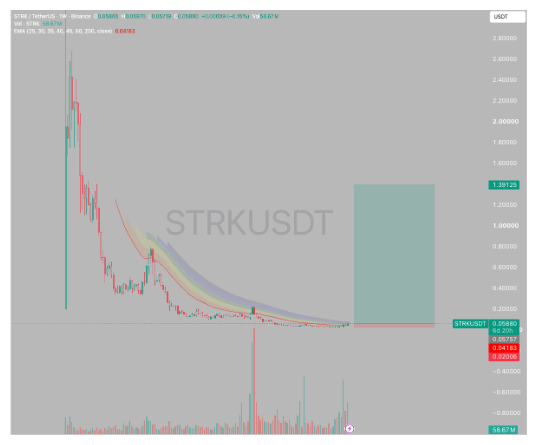
$STRK - the most hated token might be the most shilled token in the coming days.
I've read a few $STRK theses and wrapped them up so you don't have to 👇🏻
1/ Bottom chart
– $STRK is down about 99% from the launch highs, and is now at a $430M mcap after raising ~$310M
– ~74% of supply is already out and well absorbed
– Basically, the chain has only a tiny number of users and little revenue, but ppl are trading the narrative over the fundamentals
2/ Privacy
– Eli Ben-Sasson cofounded both Zcash and StarkWare, so $ZEC, then $STRK
– Native privacy shipped in June, shield any token on the chain
– Ekubo already has private swaps on the same public liquidity
– Private actions settle in $STRK (4 STRK each)
– Private Bitcoin via strkBTC
3/ BTCFi + dual staking
Starknet is the first rollup with dual-token consensus: STRK 75% / BTC 25% staking power (SNIP-31).
– Stake a BTC wrapper and receive rewards in STRK, not BTC
– BTC receives a fixed 25% of the mint, so the BTC APR depends on the amount of BTC staked and the STRK price
Flywheel: more STRK staked → mint increases → BTC APR becomes more attractive → more BTC is pulled into consensus and DeFi.
4/ Quantum resistance
STARKs are post-quantum by design.
The roadmap adds BLAKE hashing (v0.14.3), client-side proving, and a challenge to reduce the cost of proving a post-quantum Bitcoin tx (from ~$320 down to ~$67 in GPU compute in a one-week contest).
I already bought a bag here and will add more if it back to $0.42 (EMA25 zone). NFA and Dyor!
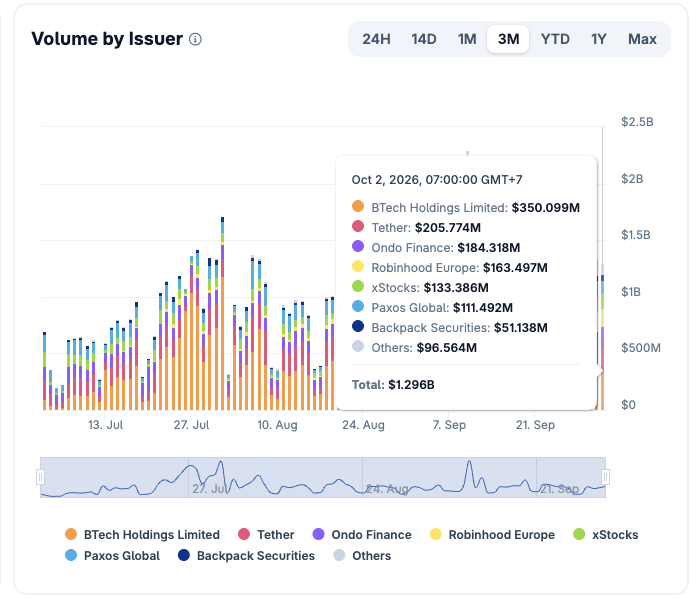
Been staring at the issuer tab on @coingecko RWA Charts, and xStocks is the one that doesn’t fit the usual tokenized-stock story.
– $910.3M mcap, basically next to Ondo at $983.8M
– $133.4M on the tape that day, out of $1.30B total volume
– 149 tokens issued (Reality has 610, Ondo 448, Dinari 250)
So, even if xStocks is not winning the catalogue, it’s winning the capital.
That’s the split we should look at:
– Reality and Dinari are wide w/ lots of listings but thin stack
– xStocks has fewer tokens but the volume share roughly matches the cap
If RWAx are on your list, don’t watch the sector number. Watch who is listing, and who is getting the tape.
Some issuers are printing tickers, some are cooking huge volume.
Can check deeper on that space here: https://t.co/rw49gOuUrs
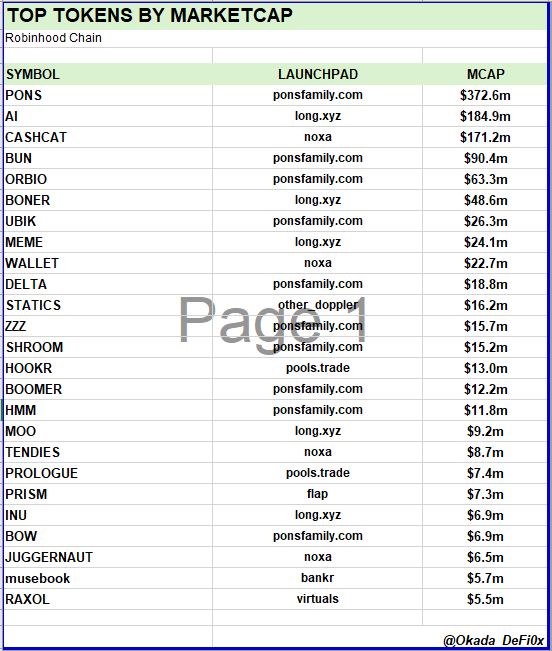
If you’re hunting gems on @RobinhoodCrypto Chain, this is the map you need rn.
Instead of chasing every new launch, research the ecosystem, pick 2-3 names with good liquidity + mindshare, then hold and wait for the next rotation.
Current MC leaderboard:
– $PONS | @ponsdotfamily | $372.6M
– $AI | @longdotxyz | $184.9M
– $CASHCAT | @cashcat_token | $171.2M
– $BUN | @BundleCatAI | $90.4M
– $ORBIO | @orbiodotso | $63.3M
– $BONER | @bonercoinlong | $48.6M
– $UBIK | $26.3M
– $MEME | @amemecoinrh | $24.1M
– $WALLET | $22.7M
– robinhood:0xe8ffd7e24187f72afb08d75b1bb13088a989a791 | @deltaliquidity | $18.8M
Personally, my 3 picks are:
– $PONS – #1 by MC on Robinhood Chain
– $BUN – already at $90M+ MC and still one of the names I’m watching closely.
– robinhood:0xe8ffd7e24187f72afb08d75b1bb13088a989a791 – only ~$19M MC, higher risk but much higher beta if the ecosystem gets another wave.
Pons currently has multiple tokens across the top MC leaderboard, so this is the launchpad ecosystem I’m watching the closest.
I still believe another wave will come back to Robinhood Chain.
Pick 2-3 names, manage your entries and wait for the rotation.
Most people see 200–300% on a stock LP and do one of two things: ape it naked, or scroll past.
I think both miss the actual trade.
Robinhood is a stock chain. Protocols, launchpads, even memes keep routing through stock tokens.
So demand is real but LP sitting against that flow is still small.
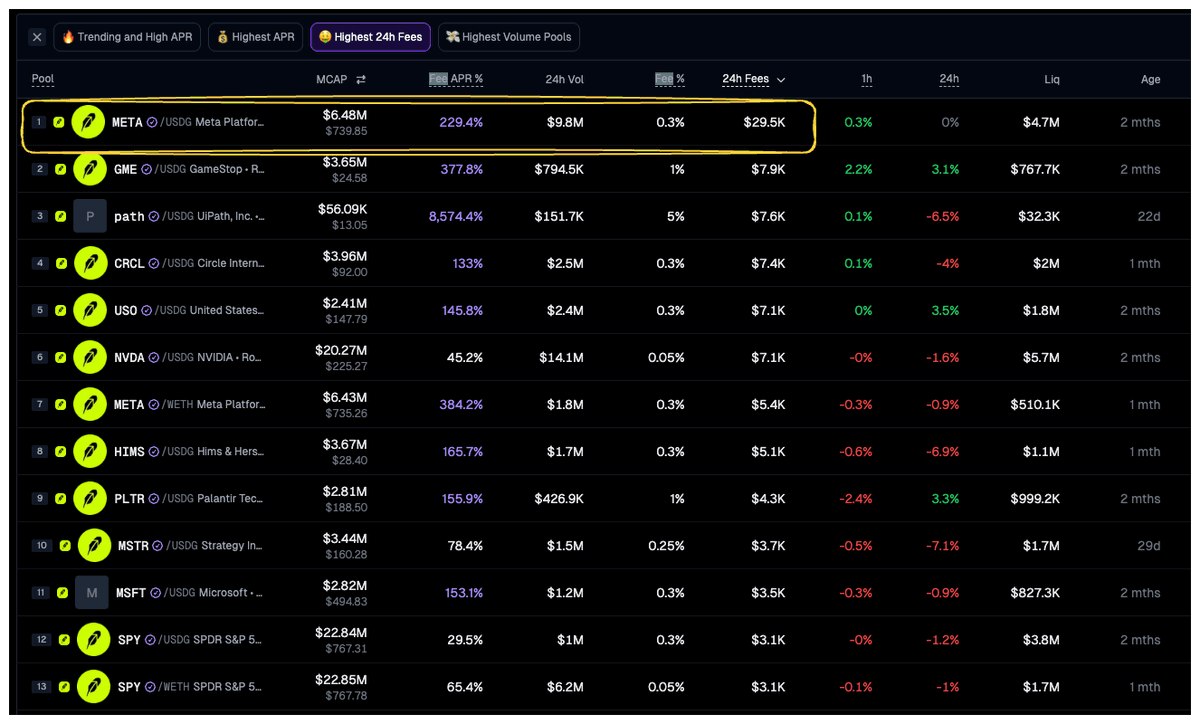
That’s why a pair like META/USDG can print ~300% fee APR. Because too many ppl want to trade the stock and not enough ppl are willing to be the other side.
Here’s how I’m farming Stock LP pools on RH:
I use @GeckoTerminal to find the right pool with most attractive.
Stock Pairs tab → sort by 24h fees / vol / trending first, APR second. I want a ticker that already pays good yield to LPs, with enough age, liq and stable to avoid the IL
That’s why I’m running META/USDG:
1/ Liquid enough, less volatility, APR still high (~300% atm)
2/ Buy META on Robinhood + USDG, 50/50.
3/ Short the same notional of META on Variational (or other perps you can find). Spot long in the pool, perp short on the side.
4/ Add LP on Uniswap v3 with a tight range, around ±5%. Concentrated so the APR is actually usable. Out of range = you stop earning and sit single-sided, so this only works if you watch it.
5/ Hold as long as the fee still covers the drag. Break even = fee earned − IL − spot fees − perp fees/funding
I think tokenized stock LP is still early. But NFA, size small, watch the range, and don’t treat 300% as a year-long rate.
Shoutout GT for for making this play a lot easier.