A quick real world test of mobility & flexibility that, were you to do it every day, would offset substantial age related decline in your mobility, balance and flexibility. Can you do the Put On (& Tie) Your Socks and Shoes While Standing Test? @trainer2thepros on Huberman Lab
Throwing this out there for future reference regarding ~$106k.
If $60k low holds for Bitcoin, then the .702 retrace is also the weekly resistance of late 2024 / early 2025 when the technical strength of the bull run ended.
Be alert of social media euphoria/confidence there.
🚨BREAKING: Claude has a feature called Learning Mode.
You can use it to learn literally anything, step by step, like a personal tutor.
Here’s how to access it.
Today is a monumentous day for quantum computing and cryptography. Two breakthrough papers just landed (links in next tweet). Both papers improve Shor's algorithm, infamous for cracking RSA and elliptic curve cryptography. The two results compound, optimising separate layers of the quantum stack. The results are shocking. I expect a narrative shift and a further R&D boost toward post-quantum cryptography.
The first paper is by Google Quantum AI. They tackle the (logical) Shor algorithm, tailoring it to crack Bitcoin and Ethereum signatures. The algorithm runs on ~1K logical qubits for the 256-bit elliptic curve secp256k1. Due to the low circuit depth, a fast superconducting computer would recover private keys in minutes. I'm grateful to have joined as a late paper co-author, in large part for the chance to interact with experts and the alpha gleaned from internal discussions.
The second paper is by a stealthy startup called Oratomic, with ex-Google and prominent Caltech faculty. Their starting point is Google's improvements to the logical quantum circuit. They then apply improvements at the physical layer, with tricks specific to neutral atom quantum computers. The result estimates that 26,000 atomic qubits are sufficient to break 256-bit elliptic curve signatures. This would be roughly a 40x improvement in physical qubit count over previous state-of-the-art. On the flip side, a single Shor run would take ~10 days due to the relatively slow speed of neutral atoms.
Below are my key takeaways. As a disclaimer, I am not a quantum expert. Time is needed for the results to be properly vetted. Based on my interactions with the team, I have faith the Google Quantum AI results are conservative. The Oratomic paper is much harder for me to assess, especially because of the use of more exotic qLDPC codes. I will take it with a grain of salt until the dust settles.
→ q-day: My confidence in q-day by 2032 has shot up significantly. IMO there's at least a 10% chance that by 2032 a quantum computer recovers a secp256k1 ECDSA private key from an exposed public key. While a cryptographically-relevant quantum computer (CRQC) before 2030 still feels unlikely, now is undoubtedly the time to start preparing.
→ censorship: The Google paper uses a zero-knowledge (ZK) proof to demonstrate the algorithm's existence without leaking actual optimisations. From now on, assume state-of-the-art algorithms will be censored. There may be self-censorship for moral or commercial reasons, or because of government pressure. A blackout in academic publications would be a tell-tale sign.
→ cracking time: A superconducting quantum computer, the type Google is building, could crack keys in minutes. This is because the optimised quantum circuit is just 100M Toffoli gates, which is surprisingly shallow. (Toffoli gates are hard because they require production of so-called "magic states".) Toffoli gates would consume ~10 microseconds on a superconducting platform, totalling ~1,000 sec of Shor runtime.
→ latency optimisations: Two latency optimisations bring key cracking time to single-digit minutes. The first parallelises computation across quantum devices. The second involves feeding the pubkey to the quantum computer mid-flight, after a generic setup phase.
→ fast- and slow-clock: At first approximation there are two families of quantum computers. The fast-clock flavour, which includes superconducting and photonic architectures, runs at roughly 100 kHz. The slow-clock flavour, which includes trapped ion and neutral atom architectures, runs roughly 1,000x slower (~100 Hz, or ~1 week to crack a single key).
→ qubit count: The size-optimised variant of the algorithm runs on 1,200 logical qubits. On a superconducting computer with surface code error correction that's roughly 500K physical qubits, a 400:1 physical-to-logical ratio. The surface code is conservative, assuming only four-way nearest-neighbour grid connectivity. It was demonstrated last year by Google on a real quantum computer.
→ future gains: Low-hanging fruit is still being picked, with at least one of the Google optimisations resulting from a surprisingly simple observation. Interestingly, AI was not (yet!) tasked to find optimisations. This was also the first time authors such as Craig Gidney attacked elliptic curves (as opposed to RSA). Shor logical qubit count could plausibly go under 1K soonish.
→ error correction: The physical-to-logical ratio for superconducting computers could go under 100:1. For superconducting computers that would be mean ~100K physical qubits for a CRQC, two orders of magnitude away from state of the art. Neutral atoms quantum computers are amenable to error correcting codes other than the surface code. While much slower to run, they can bring down the physical to logical qubit ratio closer to 10:1.
→ Bitcoin PoW: Commercially-viable Bitcoin PoW via Grover's algorithm is not happening any time soon. We're talking decades, possibly centuries away. This observation should help focus the discussion on ECDSA and Schnorr. (Side note: as unofficial Bitcoin security researcher, I still believe Bitcoin PoW is cooked due to the dwindling security budget.)
→ team quality: The folks at Google Quantum AI are the real deal. Craig Gidney (@CraigGidney) is arguably the world's top quantum circuit optimisooor. Just last year he squeezed 10x out of Shor for RSA, bringing the physical qubit count down from 10M to 1M. Special thanks to the Google team for patiently answering all my newb questions with detailed, fact-based answers. I was expecting some hype, but found none.
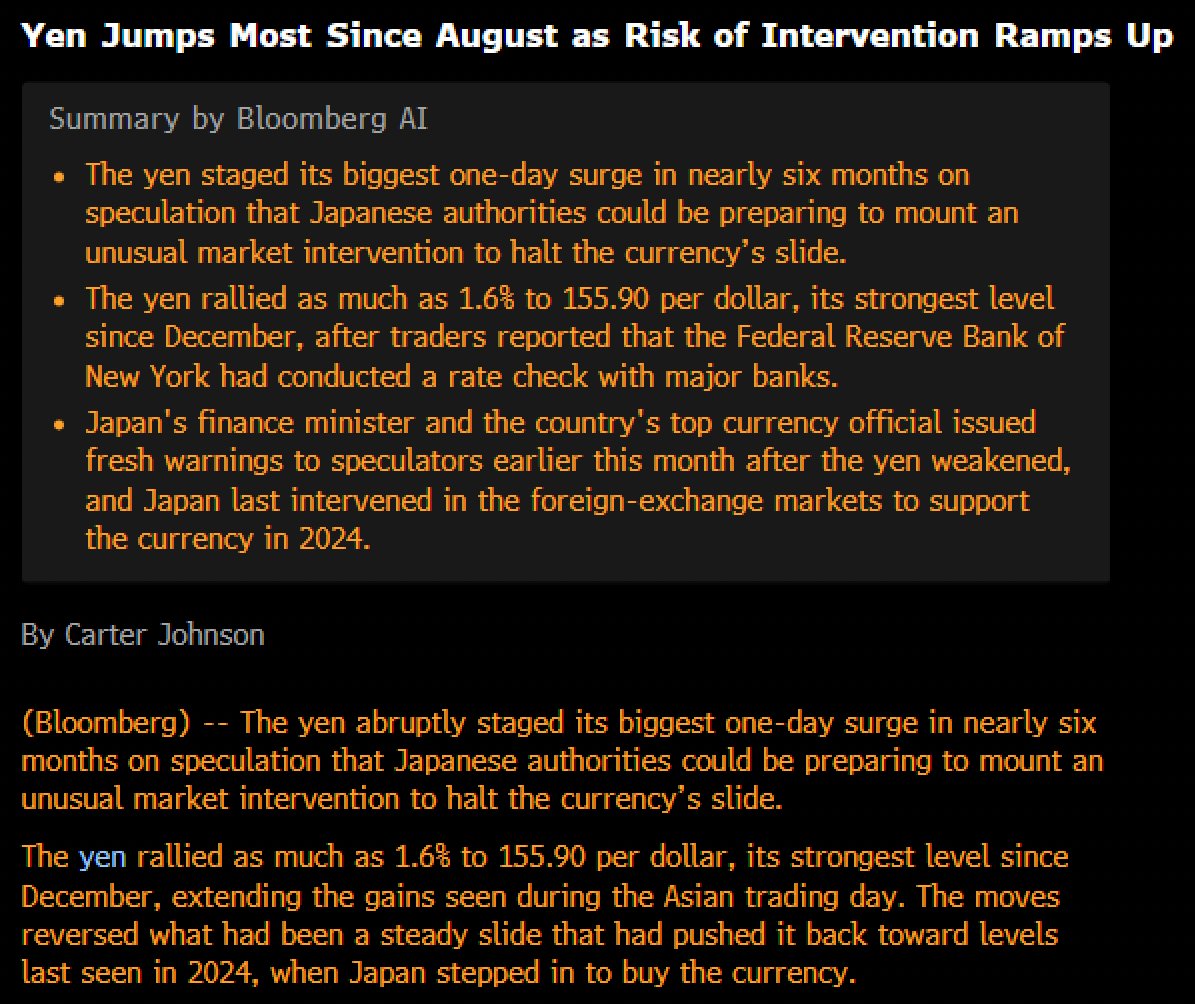
Very boolish if true for $BTC. This assumes Fed prints $, creates banking reserves. $'s are then sold to buy yen. If the Fed is manipulating the yen, we will see its b/s grow via the Foreign currency denominated assets line item which comes out weekly in the H.4.1 release.
You’re Watching the Wrong Number…The Stress Is Hidden in the Plumbing
This week’s H.4.1 doesn’t deliver a dramatic headline. The Fed’s balance sheet barely moved, down about $16B, still sitting near $6.5T. But the details beneath that surface are far more revealing. The Fed isn’t tightening anymore, but it also isn’t easing in the way markets often imagine. It’s managing a system that’s getting more delicate to steer.
And now that QT is officially over and another rate cut is expected in a few days, the story becomes less about size and more about how liquidity is shifting inside the system.
What Actually Changed This Week
Securities Are Slowly Eroding
Outright holdings fell about $2.5B, mostly Treasuries. Weekly averages show a larger decline for both Treasuries and MBS. This isn’t a new policy move, it’s just runoff and amortization. But it underscores one thing: the Fed is done adding duration, and the portfolio’s income power will only recover slowly.
Reserves Dropped Again
Bank reserves fell almost $20B on the Wednesday reading and more than $38B on the weekly average. That’s a meaningful drain especially considering QT just ended. It’s a reminder that flows, not policy settings, drive liquidity now.
The TGA Jumped
Treasury’s account at the Fed climbed more than $33B on the weekly average. Every dollar that moves into the TGA drains reserves. That’s one of the cleanest ways liquidity evaporates, and it explains much of the reserve decline.
RRP Is Still Sticky
Reverse repo balances are holding around $330B. Money funds still prefer parking cash with the Fed rather than lending in the private market. When RRP refuses to fall, it’s a sign of lingering caution.
Repo Usage Flared And Then Disappeared
On the Wednesday snapshot, repo looks like zero. But the weekly average shows meaningful activity earlier in the week. That’s the Fed smoothing funding conditions and quietly stepping in when things tighten, stepping back when they stabilize. The tape notices even if the headlines don’t.
How the Fed’s Policy Pivot Fits In
QT ended on December 1, maturing securities are now reinvested, and another rate cut is widely expected. The Fed has clearly shifted from draining liquidity to trying to stabilize it. But ending QT doesn’t automatically ease conditions. With TGA rising and RRP still attracting cash, reserves can still fall even in an easing environment.
This is the new regime with a balance sheet that’s held steady, while liquidity inside it keeps shifting.
What Actually Worries Me
A Massive Deferred Loss Still Hangs Over Everything
The Fed is carrying roughly -$243B in deferred remittances. It doesn’t affect operations, but it matters politically and optically and it quietly creates an incentive structure where lower short term rates help repair the hole faster.
The Duration Trap
The Fed holds a huge amount of long dated securities. Most of the MBS book and $1.6T in Treasuries mature in more than 10 years. That means asset yields adjust painfully slowly. Even with cuts, the Fed’s income recovery is glacial.
Liquidity Is Becoming Uneven
This week shows a pattern of…
• reserves falling
• TGA rising
• RRP refusing to drain
• repo flickering in the background
Not signs of crisis, signs of a system that’s operating with less slack.
My Read
The balance sheet isn’t giving a big, dramatic warning. It’s giving a quiet, structural one.
We’re entering a period where…
• the size of the balance sheet matters less
• the distribution of liquidity matters more
• reserves will be the pressure point
• and the Fed will use tactical tools (repos, lending, reinvestments) to prevent small cracks from turning into bigger ones
Rate cuts won’t automatically fix these pressures if TGA and RRP keep absorbing cash that banks need.
The message underneath the numbers is simple…
Watch the plumbing. That’s where the next shift will show up first.
🚨NEW: @elonmusk reflects on what DOGE taught him🤣🐼
"It was like a very interesting side quest."
"Fraudsters necessarily will come up with a very sympathetic argument. They're not going to say, 'Give us the money for fraud.'"
"It's going to be like the 'Save the Baby Pandas' NGO, which is like, who doesn't want to save the baby pandas? They're adorable."
"But then it turns out no pandas are being saved in this thing. It's just corruption, essentially."
"And you're like, 'Well, can you send us a picture of the panda?' They're like, 'No.' 'Okay. Well, how do we know it's going to the pandas then?'"
@DailyCaller
The U.S. isn’t rebuilding China’s rare-earth empire — it’s leapfrogging it.
Science, finance & alliances are converging into a multi-pronged strategy that could compress decades into years
The membrane story was just the start..🧵
🚨GIVEAWAY
5 winners, $1000 each
Steps:
1. Join our waitlist (link below)
2. Drop a screenshot of the email confirmation
3. Like & RT this post
If we double the waitlist total by Sunday, .@RaoulGMI will add $5k more to one extra winner!
Winners announced on Monday, Oct 27
The HyperLiquid whale shorting BTC/ETH yesterday was placing shorts up till exactly 1 minute before Trump threatened tariffs against China.
The last short was placed at 20:49 GMT. Trump tweeted at 20:50 GMT.
What incredible "luck"